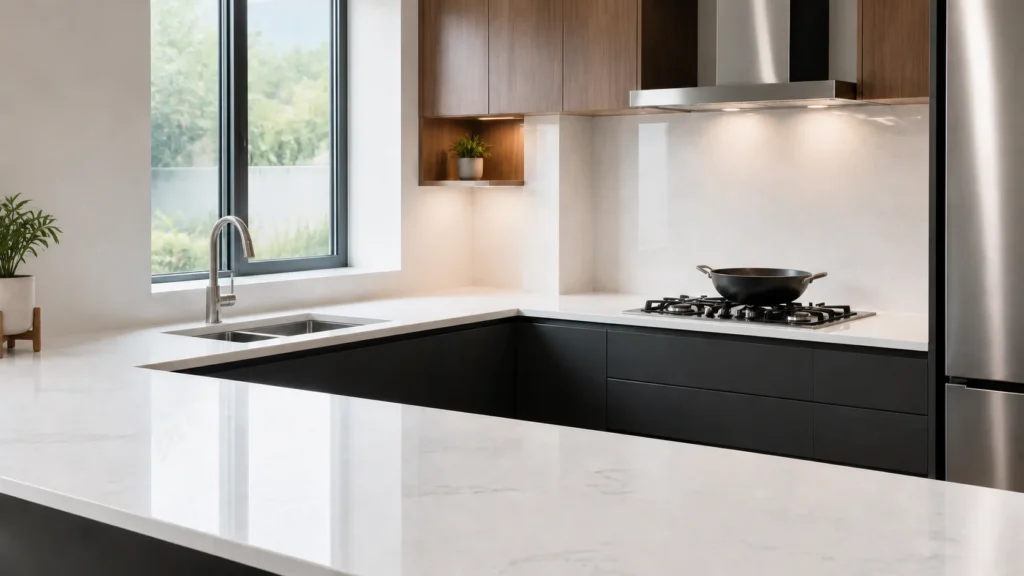
The stone that stains is not the stone you paid for. Here is how to catch the swap before you sign.
Compressed marble sold as quartz is a material substitution: the supplier quotes you a “quartz top”, installs a resin-bound marble slab that looks almost identical in the showroom, and pockets the difference. You usually find out months later, when a splash of limau nipis leaves a dull white patch that no amount of scrubbing removes. Real quartz does not do that, and one test on a sample will tell you which one you are holding.
Key Takeaways
- Compressed marble is crushed marble dust bound in resin. Its main ingredient is calcium carbonate, which reacts with acid; quartz crystal does not.
- The acid test settles it. A drop of lime juice or vinegar left on compressed marble leaves a permanent dull etch mark within minutes. Genuine quartz wipes clean.
- Price is the earliest warning. The cheapest genuine quartz on our 2026 list is RM110 per square foot supplied and installed, so a “quartz” quote well below that deserves a direct question.
- A quotation that says only “quartz top” protects nobody. Insist on brand, collection name, colour code and thickness in writing before you pay a deposit.
- Cabinet packages that throw in 10 or 15 foot run of “free” quartz top are where this happens most often, because nothing free ever gets specified on paper.
- If it is already installed, your invoice wording is your strongest evidence, and claims up to RM50,000 can go to the Tribunal for Consumer Claims Malaysia.
What Exactly Is Being Swapped?
Two materials that look alike under showroom lighting behave nothing alike in a Malaysian kitchen, because they are built from different minerals.
Genuine quartz is roughly 90 to 95% crushed natural quartz crystal, bound with polymer resin under heat and pressure. Quartz crystal sits at about 7 on the Mohs hardness scale, and it is chemically inert. Acid does not touch it.
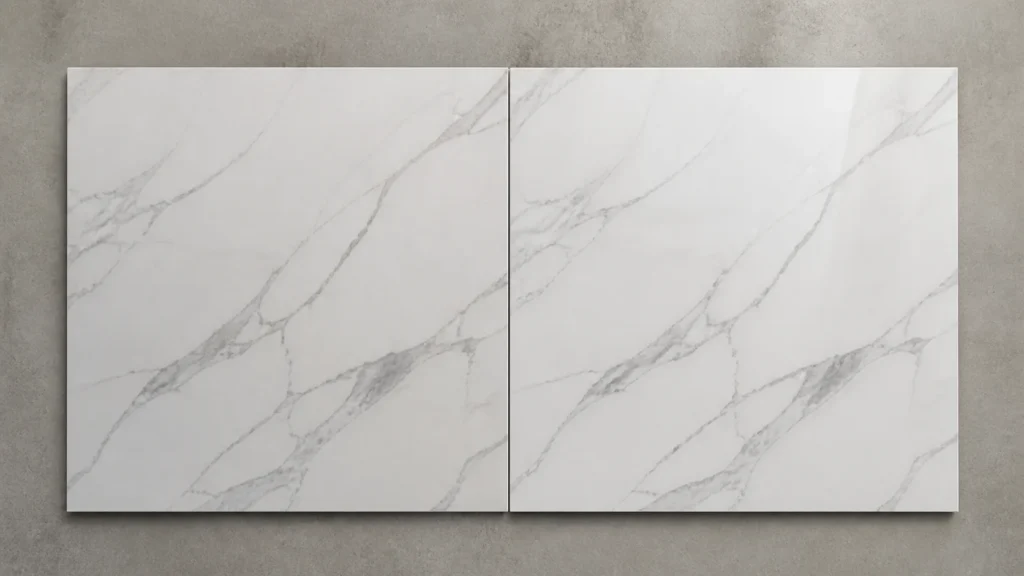
Compressed marble (also sold as engineered marble, reconstituted marble or agglomerate marble) is crushed marble dust bound with resin in much the same way. But marble is calcium carbonate, which sits around 3 on the Mohs scale and reacts on contact with acid. The resin holds the slab together; it does not change what the stone is made of.
| Genuine quartz | Compressed marble | |
|---|---|---|
| Main mineral | Quartz crystal | Calcium carbonate (marble) |
| Mohs hardness | ~7 | ~3 |
| Reaction to acid | None | Etches permanently |
| Porosity | Non-porous | Porous, absorbs oil and sauces |
| Scratched by a steel knife | No | Yes |
| Sealing needed | No | Yes, repeatedly |
Note what this table is not saying. Compressed marble is not a bad material, and Sinno fabricates it for the jobs it suits, including bathroom vanities, feature walls and flooring. The problem is narrower than that: it is being sold under the wrong name, at the wrong price, for the wrong room.
Why Does This Substitution Happen So Often in Malaysia?
It happens because the two slabs look similar, the price gap is wide, and the failure shows up long after the final payment has cleared.
The Price Gap Is Worth Chasing
Genuine quartz supplied and installed sits in a well-documented range. These are Sinno’s 2026 supply-and-install prices per square foot:
| Brand | Supply & install (per sqft) |
|---|---|
| Zenstone | RM110 to RM160 |
| Moonstone | RM182 to RM226 |
| Silestone | RM282 to RM634 |
| Caesarstone | RM332 to RM689 |
A dishonest supplier who quotes at the quartz end and installs something cheaper keeps the gap on every square foot. On a 45 square foot kitchen, even a small per-foot gap turns into thousands of ringgit. For the full brand-by-brand breakdown, see our guide to quartz stone prices in Malaysia.
The “Free” Countertop in a Cabinet Package
This is where most cases start. A kitchen cabinet package advertises 10 foot run, sometimes 15 foot run, of quartz top free of charge, and the homeowner signs on the strength of the cabinet price. The stone was never priced, never chosen and never written down, so there is nothing on paper to substitute against.
Think about what free has to mean here. Even the cheapest genuine quartz costs the carpenter real money per square foot, and no cabinet margin absorbs 15 foot run of it indefinitely. Sometimes a carpenter genuinely does subsidise the stone from the cabinet job to win the package, which is fair enough. Often the giveaway is funded the other way, by installing a cheaper slab and letting the word “quartz” do the work. Compressed marble is the natural candidate: same marble-look veining, a fraction of the cost, and a failure that only surfaces long after the keys are handed over.
You do not have to refuse the offer. You just have to make it specific. Ask which brand, which collection, and what happens to the price if you want a different one, then get the answers written into the package quotation. A carpenter supplying genuine quartz will name it without hesitating. Our guide on choosing between a carpenter’s stone bundle and your own supplier goes through the trade-off in full.
“Quartz Top” Is a Line Item, Not a Specification
Most renovation quotations describe the countertop in two or three words. “Quartz top, 20mm.” No brand, no collection, no colour code. That single vague line is what makes the swap possible, because nothing in writing says which quartz, or that it is quartz at all. Our walkthrough on how to read a countertop quotation covers what each line should actually contain.
The Damage Arrives Late
A car that fails, fails on the road. A countertop substitution stays invisible until the first asam splash, the first cut lime left on the counter overnight, the first pot of curry set down without a trivet. By then the renovation is closed, the retention released, and the contractor has moved on to the next unit.
What Are the Warning Signs Before You Sign?
Four signals, in the order you will meet them: the price, the paperwork, the answers, and the slab.
A “Quartz” Price That Undercuts the Entry Point
The lowest genuine quartz on our 2026 price list is RM110 per square foot, supplied and installed, and that already assumes an efficient fabricator working at volume. If a quote for “quartz” comes in noticeably under that, ask what brand and collection it is, then ask why it costs less. A supplier with a real answer will give you one. The same three questions apply to a bundled cabinet package, where the stone often carries no price at all.
No Brand, No Collection, No Code
Genuine quartz arrives with an identity. Zenstone Calacatta Gold has a code. Caesarstone Piatra Grey has a code. Silestone lists a colour group. If your supplier will not put a brand name, a collection name and a colour code on the quotation, that is not a paperwork oversight. It is the substitution’s only hiding place.
Vague or Shifting Answers
Watch how the answers move when you press. Warning signs sound like this:
- “Imported stone, very good quality one.” (From where? Which factory?)
- “Same as Caesarstone, just no brand.” (There is no such thing as an unbranded Caesarstone.)
- “Cannot see the slab, still in the container.” (Then the quote is not ready to sign.)
- “Warranty? Ten years, don’t worry.” (In writing, from whom?)
A fabricator who handles genuine material talks about it happily, because the specification is the selling point.
No Access to the Full Slab
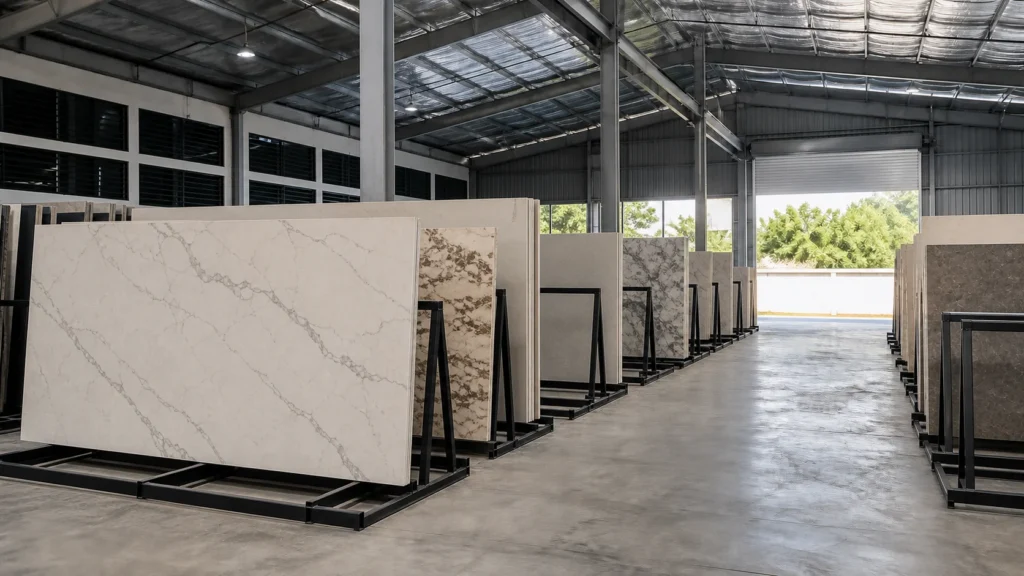
A sample chip is chosen to flatter. Ask to see the actual slab before it is cut, which you should be doing anyway for reasons that have nothing to do with fraud, as our post on why you should never choose a countertop from a sample alone explains. On a full slab you can look for the manufacturer’s label or backstamp on the reverse face, which compressed marble slabs passed off as quartz will not carry.
How Do You Test the Stone Yourself?
The acid test is the one that separates compressed marble from quartz, because it targets the chemistry rather than the finish.
Ask your supplier for a sample offcut and permission to test it. A supplier who refuses both has told you something already.
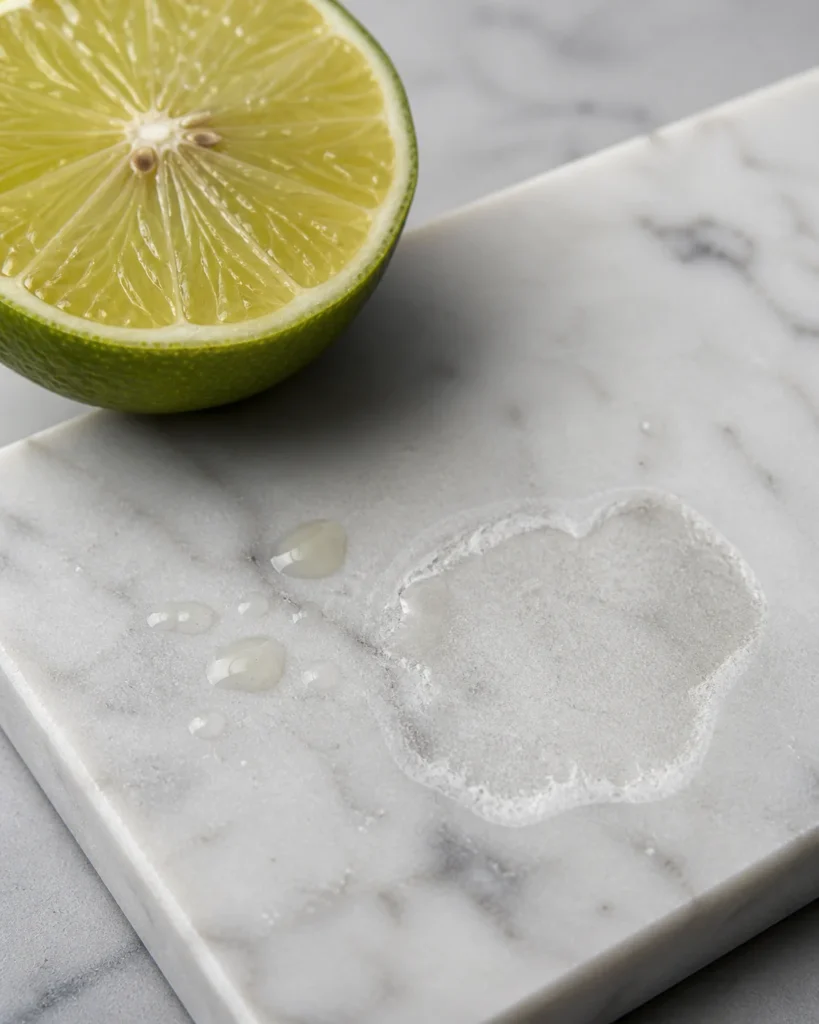
The acid test (the definitive one). Squeeze a few drops of limau nipis juice or white vinegar onto the sample. Leave it for 10 to 15 minutes, then wipe and dry the surface. Compressed marble will show a dull, whitish, slightly rough patch where the acid ate into the calcium carbonate. That is etching, not staining, and it does not come off. Genuine quartz will look exactly as it did before.
The knife test. A steel knife blade sits around 5.5 on the Mohs scale. Drag it firmly across an inconspicuous corner. Compressed marble at Mohs 3 marks easily. Quartz at Mohs 7 does not.
The water and oil test. Put a small puddle of water and a drop of cooking oil on the sample and leave them for 20 minutes. Quartz is non-porous, so both wipe away clean. Compressed marble will often darken where the oil sat, and the mark may take days to fade or may not fade at all.
Run these on the sample before the deposit, not after the install. If you want the wider battery of checks that covers resin-heavy imitations too, our guide on how to spot fake quartz adds the glass scratch, Harpic and turmeric tests.
How Do You Write a Quotation That Blocks the Swap?
You block it by making the material specific enough that substituting it becomes a documented breach rather than a misunderstanding.
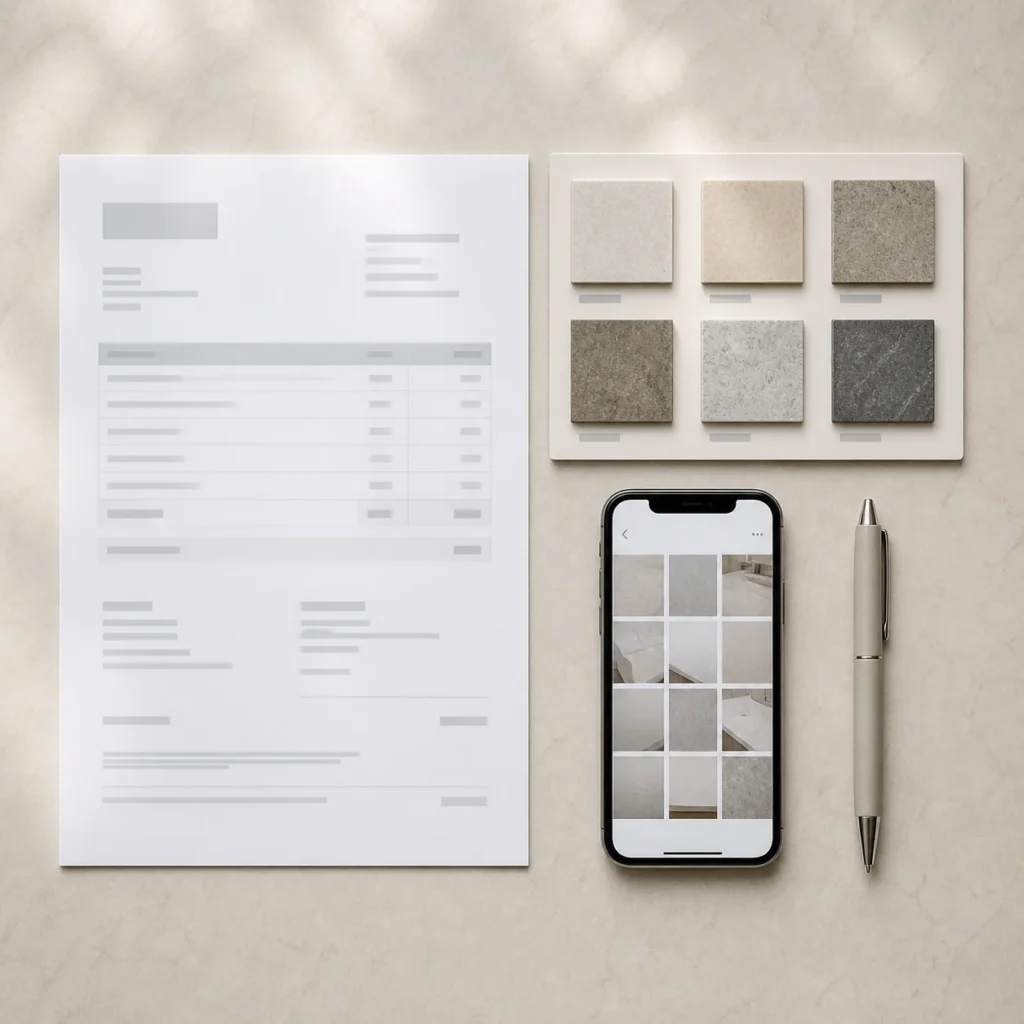
Before you pay any deposit, get these five lines on the quotation:
- Brand (Zenstone, Moonstone, Silestone, Caesarstone, and so on)
- Collection or colour name, plus the code (for example, Zenstone Calacatta Gold, QS15P-1302)
- Thickness (15mm or 20mm)
- Price per square foot, and what it includes: cutouts, edge profile, transport, installation
- Warranty terms, naming who honours them, the fabricator or the brand
Then add one sentence in your own words: material to be supplied as specified above; any substitution requires written approval before fabrication. It costs nothing to add, and it changes the conversation entirely if the slab that arrives is not the slab you chose.
What If It Is Already Installed?
Start by confirming what you actually have, then work from the paperwork.
Confirm the material. Run the acid test on an offcut if your fabricator left one, or on a hidden underside area such as beneath the sink cutout or behind the hob. Photograph the result with the date visible.
Gather the paper trail. Your quotation, invoice, receipts, WhatsApp messages and any brochure or colour card you were shown. If the invoice says a brand and collection and the installed stone fails the acid test, the discrepancy is documented rather than argued.
Raise it with the supplier first, in writing. Ask them to produce the brand documentation and warranty certificate for the collection named on your invoice. Many disputes end here, because there is nothing to produce.
Escalate if needed. Consumer claims up to RM50,000 can be filed with the Tribunal for Consumer Claims Malaysia (Tribunal Tuntutan Pengguna Malaysia) under the Ministry of Domestic Trade and Cost of Living, without needing a lawyer. Your invoice wording and your photographs are the case.
FAQ
How can I tell compressed marble from quartz at home? Leave a few drops of lime juice or white vinegar on the surface for 10 to 15 minutes. Compressed marble etches into a permanent dull patch because it is calcium carbonate; quartz is chemically inert and wipes clean with no mark.
Is compressed marble always a scam? No. It is a legitimate material that works well on bathroom vanities, feature walls and flooring, and reputable suppliers sell it openly at compressed marble prices. It only becomes fraud when it is sold under the quartz name at quartz prices.
What is the cheapest genuine quartz countertop in Malaysia? On Sinno’s 2026 price list, Zenstone starts at RM110 per square foot supplied and installed. A “quartz” quote that sits well below that entry point is worth questioning before you pay a deposit.
Can an etched compressed marble countertop be repaired? Not fully. Etching is corrosion of the stone itself rather than a surface stain, so cleaning will not lift it. Professional polishing can soften how visible it is, but the original finish does not come back.
Is the free quartz top in a cabinet package real quartz? Sometimes, but it is the single most common setting for a compressed marble swap, because free stone is rarely specified on paper. Ask the carpenter to name the brand and collection in the package quotation before you sign, and treat a refusal as your answer.
What should my quotation say so this cannot happen? It should name the brand, the collection and colour code, the thickness, the price per square foot with inclusions, and the warranty terms. Add a line requiring written approval for any material substitution before fabrication.
Conclusion
The difference between quartz and compressed marble is not a matter of grade or opinion. It is a different mineral, with a different hardness, a different reaction to acid, and a different price. Once you know that, the whole scam reduces to two habits: get the brand and collection written on the quotation, and put a drop of lime juice on the sample before you pay.
Not sure what is sitting in your kitchen, or what the quote in front of you actually covers? Bring it to our Sungai Buloh showroom and we will go through it with you, slab by slab and line by line.