

The Mohs hardness scale ranks minerals from 1 to 10 by whether one can scratch another, and for countertops it tells you one thing only: how well a surface resists scratching. Marble sits at 3 to 4, granite at 6 to 7, engineered quartz at 7, and sintered stone at 8 — but a higher number does not automatically mean a better countertop for your kitchen.
A sales consultant tells you quartz scores a 7, sintered stone scores an 8, marble is a soft 3, and you nod along. So what does any of it actually mean when you’re standing in your own kitchen, with a wok on the hob and a bag of limes on the counter?
This guide explains the Mohs scale in plain English: what it measures, what it quietly leaves out, where every common Malaysian countertop material sits, and how fabricators use those numbers every day when they cut and polish your slab.

Key Takeaways
- The Mohs scale measures scratch resistance only. It says nothing about heat, stains, porosity, or how easily a material chips
- Marble sits at Mohs 3–4, granite at 6–7, engineered quartz at 7, porcelain slab at 7–8, and sintered stone at 8
- Anything above Mohs 6 already resists your kitchen knives, cutlery, and pots, so the gap between a 7 and an 8 rarely shows up in daily cooking
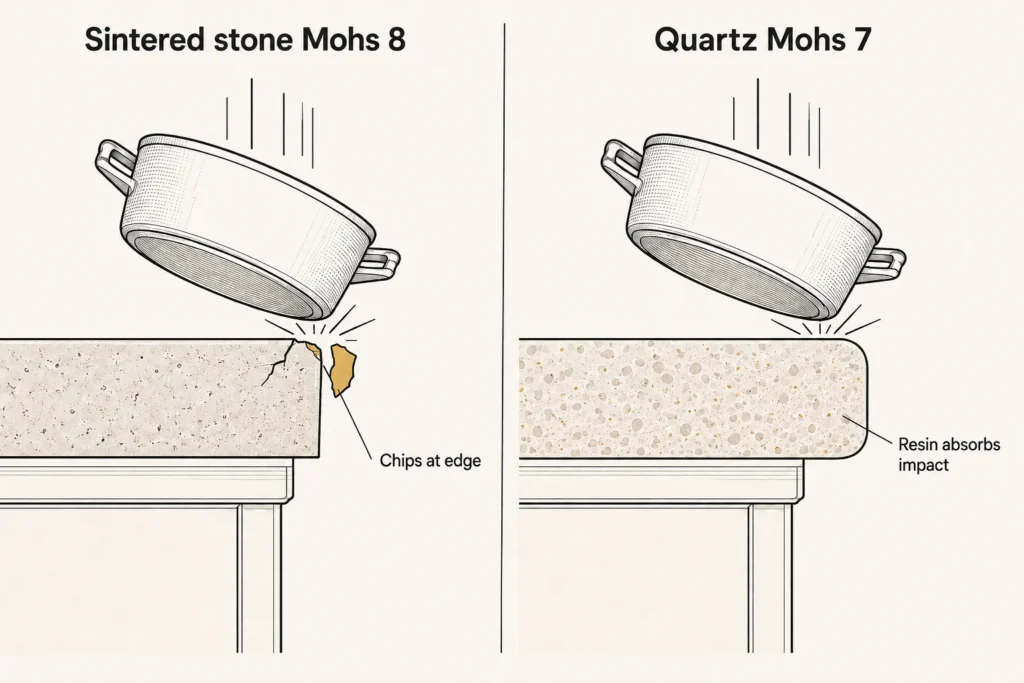
- Harder is not stronger: sintered stone scores higher than quartz but chips more readily at edges, because quartz’s resin binder absorbs impact
- The one place the number genuinely helps you is the glass scratch test — real quartz at Mohs 7 scratches glass at Mohs 5.5, and fake quartz usually can’t
- What actually damages Malaysian countertops is impact, heat, harsh chemicals, and pigment stains, none of which Mohs measures
What Is the Mohs Hardness Scale?
The Mohs hardness scale is a 1-to-10 ranking of minerals based on which one scratches which, developed in 1812 by German mineralogist Friedrich Mohs. Rather than measuring hardness in abstract units, he simply lined minerals up and let them scratch each other.
Here is the full scale, with the reference points that matter for countertops:
| Mohs | Mineral | What it means in practice |
|---|---|---|
| 1 | Talc | Scratches with a fingernail |
| 2 | Gypsum | Scratches with a fingernail under pressure |
| 3 | Calcite | Scratches with a copper coin |
| 4 | Fluorite | Scratches easily with a steel knife |
| 5 | Apatite | Just barely scratched by a steel knife |
| 5.5 | Glass | Harder than a knife blade, but not by much |
| 6 | Orthoclase feldspar | Scratches glass, resists a steel knife |
| 7 | Quartz | Scratches glass easily |
| 8 | Topaz | Harder than quartz |
| 9 | Corundum (sapphire, ruby) | Extremely hard |
| 10 | Diamond | The hardest natural material known |
The rule is one-directional. A material with a higher score scratches anything below it. A material with a lower score cannot scratch anything above it. That is the whole science, and it is genuinely useful once you know where your countertop sits.
What Does the Mohs Scale Not Measure?
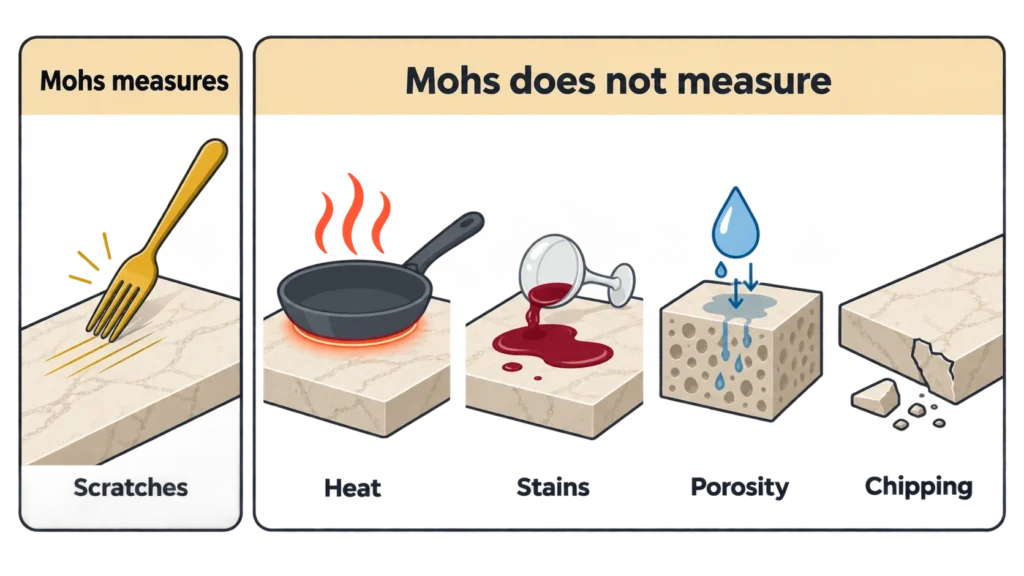
Mohs measures scratch resistance and nothing else. This surprises most homeowners, because “hardness” sounds like it should cover everything. It doesn’t cover:
- Brittleness. A material can be very hard and still shatter under a sharp knock. Diamond scores a 10 and still cracks if you hit it the wrong way.
- Porosity. How much liquid a stone absorbs has nothing to do with how hard it is.
- Stain resistance. Soft marble can be sealed against stains. Hard granite still soaks up cooking oil if you leave it unsealed.
- Heat resistance. Whether a surface survives a hot wok comes down to its thermal properties, not its Mohs number.
- Toughness. Resisting a crack under force is a completely separate property from resisting a scratch.
Keep that list in mind, because four of those five are what actually go wrong in a Malaysian kitchen.
Where Do Common Countertop Materials Sit on the Scale?
Malaysian countertop materials span Mohs 3 to 8, with marble at the soft end and sintered stone at the hard end. Here is the full spread:
| Material | Mohs hardness | Notes |
|---|---|---|
| Marble | 3–4 | Calcite-based; scratches and etches relatively easily |
| Compressed marble | 3–4 | Same soft base material as natural marble |
| Granite | 6–7 | Varies with the mineral mix in each slab |
| Engineered quartz | 7 | Consistent, because it is manufactured |
| Quartzite (natural) | 7–8 | Often harder than granite |
| Porcelain slab | 7–8 | Dense fired ceramic; very hard surface |
| Sintered stone (e.g. Dekton) | 8 | Among the hardest countertop materials sold |
| Diamond (reference) | 10 | Hardest natural material |
Why Does Marble Scratch So Easily?
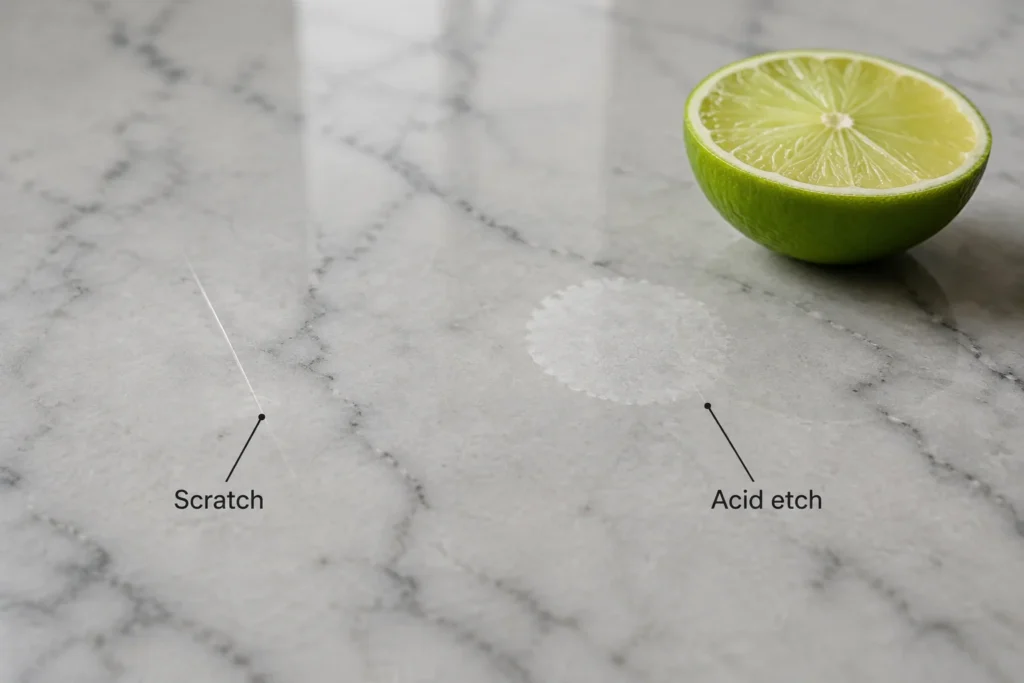
Marble scratches easily because it sits at just Mohs 3 to 4, softer than the steel utensils you use every day. Drag a metal spoon across it and you leave a fine line. Worse, acidic liquids — lemon, vinegar, tamarind water, all staples of Malaysian cooking — etch marble chemically, leaving dull patches even where nothing has scratched it.
That doesn’t make marble a bad choice. Its veining and depth are still unmatched, and in a dry kitchen or a bathroom vanity it holds up perfectly well. It just means you should choose it with your eyes open rather than discover the limitation three months after installation.
If you’re weighing the two, our guide on how marble compares to quartz in Malaysian kitchens covers how each handles our cooking habits and our climate.
Is Granite Hard Enough for a Kitchen?
Yes. Granite sits at Mohs 6 to 7, comfortably above the 5.5 to 6 of a kitchen knife, so normal cooking won’t scratch it. The range exists because granite isn’t one mineral but a mix of quartz, feldspar, and mica, and the proportions differ from slab to slab.
Granite’s real weakness is porosity, not hardness. It absorbs oil and pigment unless it is sealed and re-sealed over the years, which is a different problem entirely from the one Mohs describes. Our honest look at whether granite is still the right countertop choice for Malaysian kitchens goes through the trade-offs in full.
Why Is Engineered Quartz Always Exactly 7?
Engineered quartz sits at a consistent Mohs 7 because it is manufactured, not quarried. Brands like Caesarstone, Silestone, and Zenstone bind crushed natural quartz crystals with resin, so hardness is uniform across the whole slab rather than varying with what came out of the ground.
At Mohs 7, no kitchen utensil, steel cutlery, or ceramic dish will scratch it. It also sits well above glass at 5.5, which is what makes the glass scratch test work as a quick authenticity check.
The resin does something the Mohs number can’t show you: it adds toughness. That slight flexibility lets quartz absorb a knock instead of transmitting it straight through the slab, which is why quartz resists chipping better than harder materials. For the manufacturing detail behind that, see what quartz stone is and how it is made.
Why Does Sintered Stone Score Higher Yet Chip More?
Sintered stone chips more readily than quartz because the same extreme density that earns it Mohs 8 also makes it brittle. It contains no resin at all — it is pure mineral, fused under heat and pressure — so it has nothing to absorb an impact.
In practice: sintered stone shrugs off scratches better than anything else on a Malaysian countertop, but a heavy cast iron pan dropped near an edge or corner is a bigger risk than the same pan dropped on quartz. Our guide to the disadvantages of sintered stone treats this trade-off in detail, because it is the single most misunderstood thing about the material.
Where Does Porcelain Slab Fit?
Porcelain slab sits at Mohs 7 to 8, close to sintered stone, because high-temperature firing densifies the ceramic body in a similar way. It shares the same caveat too: hardness doesn’t protect it from breakage, and porcelain’s thinner profile makes it vulnerable to something falling on it from above.
In a wet kitchen where heavy pots come out of overhead cabinets several times a day, that matters more than the extra point on the scale.
How Do Stone Fabricators Use the Mohs Scale?
Fabricators use Mohs hardness to choose blades, set cutting speeds, and plan polishing steps, because the harder the stone, the harder the tooling and the slower the work.
Choosing the Right Cutting Tools
The rule is simple: the tool must be harder than the material. Diamond blades work on every countertop material because diamond at Mohs 10 outranks all of them, including sintered stone at 8. The diamond grit abrades through the stone as the cut progresses.
But not every diamond blade is the same. A blade specified for quartz at Mohs 7 wears out far faster on sintered stone at Mohs 8, and a worn blade builds heat, which is how micro-cracks and ragged cut edges start. So fabricators match the blade to the material:
- Quartz: standard diamond blades cut well; continuous rim blades give the cleanest edge
- Sintered stone: needs higher diamond concentration and a softer bond matrix, so worn particles shed and expose fresh cutting edges
- Porcelain slab: similar blade requirements to sintered stone, with cutting speed managed carefully to stop the edge chipping
- Marble and granite: vary by slab, so fabricators tune cutting speed and water flow to each one
Get this wrong and the result isn’t subtle. The wrong blade on sintered stone gives you chipped cut edges, or stress cracks that travel inward from the cut line.
CNC Milling for Sink Cutouts
Sink and hob cutouts are milled on a CNC machine rather than the bridge saw, and hardness drives bit choice and feed speed there too. Quartz and softer stones cut efficiently with standard diamond router bits. Sintered stone and porcelain need slower feed speeds, more frequent bit checks, and heavier coolant flow to keep heat down.
A rushed cutout on sintered stone is one of the most common causes of a cracked slab, which is a good reason not to hand harder materials to a fabricator who mostly works in quartz. Our walkthrough of how a countertop goes from raw slab to finished surface covers each stage of that process.
Edge Polishing Takes Longer on Harder Stone
Harder stone needs more abrasive steps and more time to reach the same finish. Marble at Mohs 3 to 4 polishes quickly, because abrasive pads cut through surface irregularities with little effort. Quartz at Mohs 7 needs a full progression of diamond pads from coarse to ultra-fine. Sintered stone at Mohs 8 needs more steps again, with more aggressive pads, which is a real part of why sintered stone fabrication costs more than quartz.
At Sinno Stone, our mitre edges get a 3mm chamfered polish on every joint, an upgrade we made in 2022 after consulting Spanish fabrication technicians. It adds time to every job, and it removed the edge chipping complaints that a sharper 1mm chamfer can produce on harder materials.
Protecting the Surface During Installation
Installation tools and brackets are mostly steel, sitting around Mohs 5.5 to 6, so the scratch risk depends entirely on what you’re installing:
- Marble (3–4): steel scratches it easily, so protective padding is not optional
- Quartz (7): steel can’t touch it; if anything, the quartz scratches the tools
- Sintered stone (8): even less scratch risk, but the brittleness means the attention shifts to impact protection instead
What Does Mohs Hardness Mean for a Malaysian Kitchen?
For most Malaysian kitchens, Mohs hardness matters less than you’d expect, because anything above Mohs 6 already resists everything you use daily. Scratching is rarely what ruins a countertop here.
The Wet Kitchen Reality
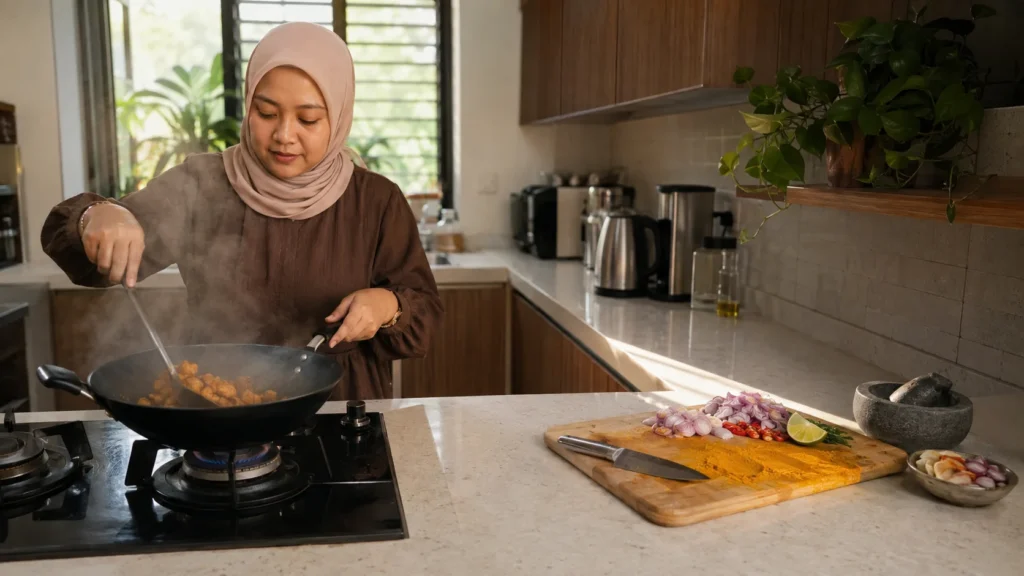
Malaysian cooking is hard on surfaces. Wok cooking runs hot, pots move constantly, oil splashes, and the ingredients themselves are aggressive — tamarind and lime on the acidic side, turmeric, belacan, and sambal on the staining side.
In that environment, two things are true. First, every material above Mohs 6 already resists your knives, cutlery, and cookware, so the difference between a 7 and an 8 is not something you will ever feel during a normal week of cooking. Second, what actually damages countertops in Malaysian homes is impact from something dropped out of an overhead cabinet, heat from a pan set down without a trivet, chemical exposure from harsh drain cleaners, and pigment staining from cooking. Mohs measures none of those.
What Should Actually Drive Your Decision?
Match the material to how your kitchen is used, not to the highest number available:
Heavy daily wet kitchen cooking: prioritise toughness over raw hardness. Quartz at Mohs 7, with resin to absorb impact, handles dropped pots better than the harder but more brittle sintered stone at Mohs 8.
You want the most scratch-proof surface possible: sintered stone and porcelain slab at Mohs 8 lead the field, and sintered stone’s UV stability makes it the sensible pick for outdoor kitchens and sun-exposed surfaces.
You love marble but worry about scratching: marble’s Mohs 3 to 4 is a genuine limitation in a wet kitchen. Put it in a dry kitchen or a bathroom vanity where traffic is lower, or choose a marble-look quartz that gives you the veining at Mohs 7 durability.
You’re comparing natural stones: granite at 6 to 7 and quartzite at 7 to 8 are both solid choices, and the deciding factor between them isn’t hardness — it’s porosity, since both need sealing to resist stains.
Where the Mohs Number Genuinely Helps You
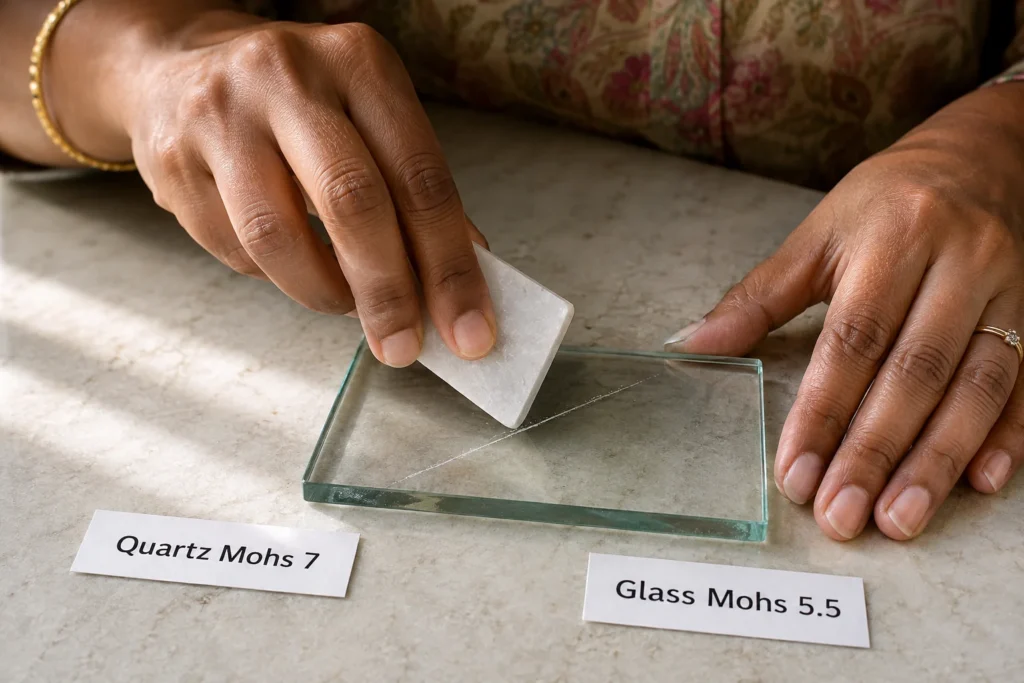
The one place the scale earns its keep for homeowners is spotting fake quartz. Genuine engineered quartz at Mohs 7 scratches glass at Mohs 5.5. If a “quartz” sample can’t mark a glass tile, its quartz content is nowhere near what the seller claims, and you’re likely looking at compressed marble or a resin-heavy imitation dressed up as quartz.
That is a hands-on test you can run in a showroom in ten seconds, before you commit to a slab. Our guide on how to spot fake quartz and protect your renovation investment covers the other checks worth doing alongside it.
Is Harder Always Stronger?
No. Hardness and strength are separate properties, and confusing them is the most common mistake homeowners make with the Mohs scale. Hardness resists scratching. Strength, or toughness, resists cracking and breaking under force.
A diamond scores 10 and still shatters under a hammer. It is the hardest natural material on earth and nowhere near the toughest.
The same logic applies one rung down. Sintered stone at Mohs 8 is harder than quartz at Mohs 7, but quartz is tougher, because the resin gives it flex that pure mineral surfaces don’t have. In a real kitchen, that is why quartz edges survive knocks that chip sintered stone, even though sintered stone wins the hardness contest on paper.
So for a Malaysian homeowner: a higher Mohs number isn’t automatically better, the right level depends on how you cook, and toughness, heat tolerance, chemical resistance, and stain resistance all need weighing separately.
FAQ
What is the Mohs hardness of quartz countertops? Engineered quartz countertops sit at Mohs 7, consistently across the whole slab, because the material is manufactured from crushed quartz crystals bound with resin rather than quarried. That places it above kitchen knives, cutlery, and glass, so normal cooking won’t scratch it.
Is sintered stone harder than quartz? Yes, sintered stone sits at around Mohs 8 against quartz at Mohs 7, making it more scratch resistant. It is also more brittle, since it contains no resin to absorb impact, so it chips at edges more readily than quartz does.
Can you scratch a quartz countertop with a knife? No. Kitchen knives sit at roughly Mohs 5.5 to 6 and quartz sits at 7, so a blade cannot mark the surface. What looks like a scratch on quartz is usually a metal transfer mark from a pan or utensil, which wipes off with a cream cleaner.
Does a higher Mohs number mean a better countertop? Not necessarily. Above Mohs 6 you already have more scratch resistance than daily cooking demands, and the extra hardness of a Mohs 8 surface comes with more brittleness at edges and higher fabrication costs. Heat tolerance, stain resistance, and toughness matter more in most Malaysian kitchens.
How do I use the Mohs scale to check if quartz is real? Press the sample firmly against a glass tile and drag it across. Real quartz at Mohs 7 scratches glass at Mohs 5.5, so if the sample leaves no mark on the glass, its quartz content is far lower than advertised.
Conclusion
The Mohs hardness scale is a useful tool, but it answers one question out of the six or seven that matter when you’re choosing a countertop. Marble at 3 to 4 needs care, granite at 6 to 7 needs sealing, quartz at 7 balances hardness with toughness, and sintered stone and porcelain at 8 buy you maximum scratch resistance at the cost of brittle edges and a higher fabrication bill.
Whichever way you lean, pick a fabricator who understands the material rather than just quoting its number — someone who knows what that hardness means for how your slab gets cut, polished, handled, and fitted. If you’d like to talk through which material suits how you actually cook, we’re happy to walk you through the options before you commit to anything. Our comparison of sintered stone and quartz for Malaysian kitchens is a good place to start.