

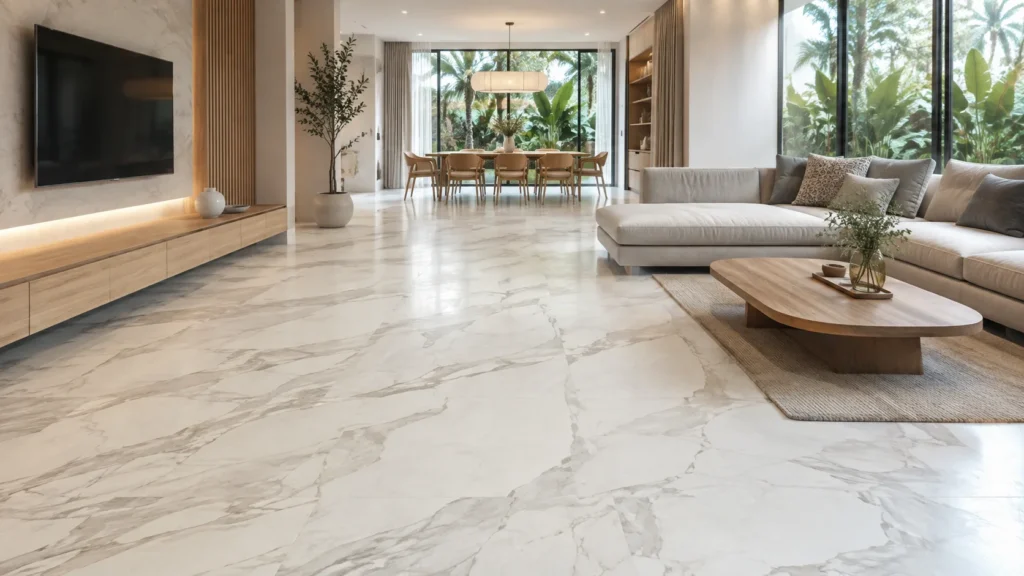
Linear match porcelain slab flooring is a large-format floor where the printed veining continues from one slab into the next, so the pattern flows in a single direction across the whole room instead of stopping at every joint. It is the reason the marble-look floors in KL hotel lobbies look like one enormous piece of stone rather than a grid of tiles.
Most Malaysian homes still get the grid. Standard tiles are printed independently, so each piece carries its own self-contained pattern and the floor ends up looking busy, no matter how good the individual tile is. Linear matching solves that, and in open-plan homes where the living, dining, and kitchen zones share one floor, the difference is hard to unsee once you’ve noticed it.
Key Takeaways
- Linear match means slabs from the same batch are printed, numbered, and laid in sequence so veining runs continuously in one direction across the floor
- It is not the same as book match, which mirrors two slabs to create a symmetrical butterfly effect and works better on a feature wall than underfoot
- Large-format slabs cut the number of grout lines dramatically, which matters in Malaysia’s humidity where grout discolours over time
- Moca Compact large-format slabs are listed from RM1,600 per 3200mm x 1600mm slab (about 55 sq ft of material) for the Regular series, with flooring installation quoted separately by your installer
- The effect only survives careful planning: same batch, correct slab sequence, a properly levelled subfloor, and 10–15% extra material ordered up front
What Is Linear Match Porcelain Slab?
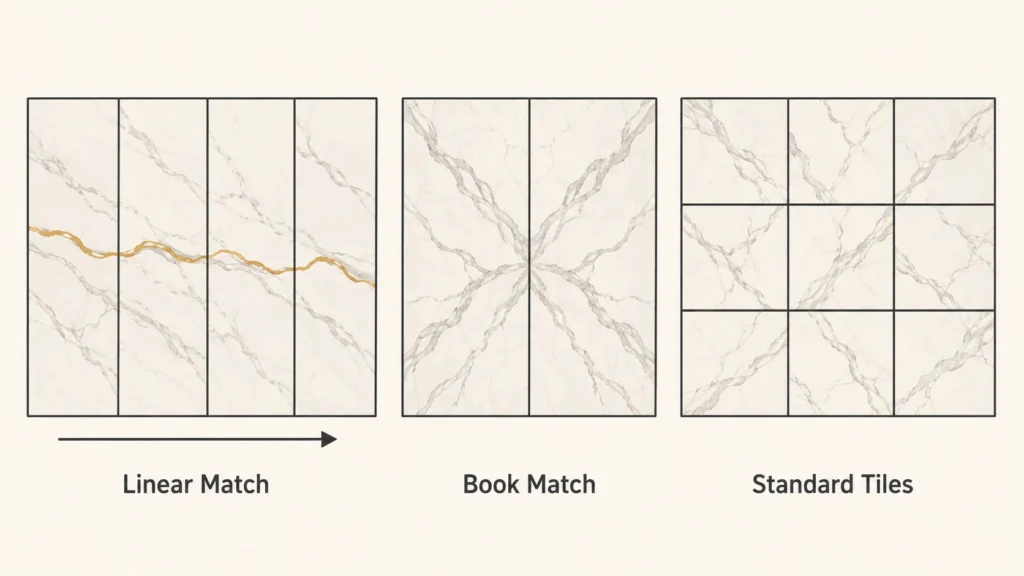
Linear match is a technique where slabs are manufactured, numbered, and installed in a set sequence so the veining pattern carries on from one slab to the next. Think of a photograph cut into strips: put the strips back in the right order and you get the full picture again.
It starts at the factory. Large-format slab production prints in a sequential pattern across a run of slabs, so the design on slab two picks up where slab one ended. Those slabs are numbered before they leave the plant, and the installer lays them in that order.
Standard tiles can’t do this. Each tile is printed as a self-contained piece, so you might find three tiles in a row whose veins look similar, but they will never actually connect. Your eye picks up that disconnection even when you’re not consciously looking for it, which is why a tiled floor often feels visually restless while a slab floor feels calm. Our guide on porcelain slabs versus porcelain tiles covers the wider differences between the two formats.
How Is Linear Match Different from Book Match?
Book match mirrors, linear match continues. Book matching takes two slabs and flips one along a shared edge so the veining meets in a symmetrical butterfly pattern. Linear matching keeps every slab in the same orientation so the pattern travels in one direction.
For floors, linear match is usually the better choice. A book-matched pattern creates a strong centrepiece that demands to be seen as a whole, which is why it belongs on a feature wall where you view it head-on. The same principles applied vertically are covered in our comparison of porcelain slab versus tiles for wall cladding. On a floor you walk through the pattern rather than look at it, so a flowing direction serves the space better than a mirrored centre.
Why Do Porcelain Slabs Beat Standard Tiles on a Floor?
Slabs win on three counts: fewer joints, a denser surface, and a more convincing stone appearance. All three matter more in a Malaysian home than most homeowners expect.
Fewer grout lines. A 600mm x 600mm tile puts a grout line every two feet in both directions. A 3200mm x 1600mm slab covers the same area with a fraction of the joints. In our humidity, grout is the part of a floor that ages first: it discolours, it holds dirt, and it needs periodic attention. Less grout means less of that.
A denser, harder surface. Large-format porcelain slabs are pressed and fired at temperatures above 1200°C, which produces a surface that resists scratching and abrasion well under constant foot traffic. Water absorption sits below 0.5%, so humidity doesn’t get into the body of the material.
A more believable stone look. Digital printing has reached the point where a slab convincingly reads as marble, limestone, or travertine from standing height. The real advantage over natural stone is control: quarried marble varies block to block, so true vein matching is close to impossible, while a printed slab range can be produced to continue logically from slab to slab. You get the Calacatta look with veins that actually line up.
What Does Linear Match Flooring Do for a Malaysian Home?
It makes rooms feel longer, ties open-plan zones together, and ages well, which are the three things that matter most in a typical Malaysian layout.
Does It Really Make a Room Look Bigger?
It genuinely does, because continuous directional veining creates long visual lines that draw the eye forward and stretch the space. Run the pattern parallel to the longest wall and a compact living-dining area reads as more generous than its floor plan suggests. It works the same way vertical stripes do on a shirt.
For a Klang Valley condominium of 800 to 1,200 square feet, that optical effect is worth more than in a bungalow, where the space is already there.
Does It Suit Open-Plan Layouts?
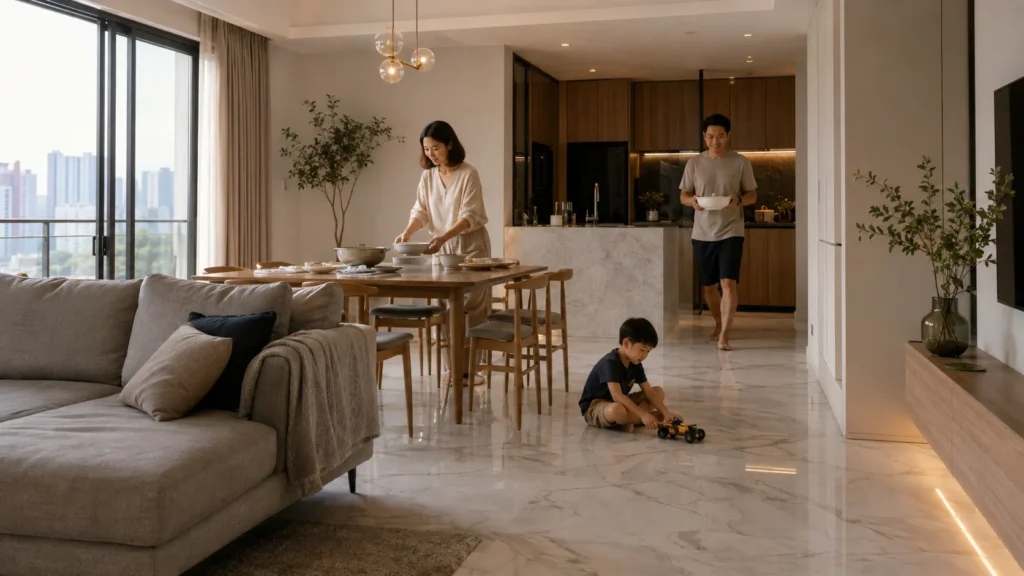
Open plan is exactly where linear match earns its keep. When the living room, dining area, and kitchen share one floor with no walls between them, a tiled grid chops the space into segments while a continuous pattern reads as one room.
Picture a Hari Raya or Chinese New Year open house with guests moving between the living and dining areas all afternoon. A flowing floor pattern quietly guides that movement instead of interrupting it every 600mm.
Does It Date?
Less than most alternatives. Bold geometric tiles and heavily textured surfaces tend to carry a decade stamped on them. Flowing stone veining doesn’t, because it borrows from a material people have used for centuries.
That matters when you consider how rarely floors get replaced. Nobody redoes a floor every few years, so the sensible question is whether the choice still looks right in year 15.
How Does It Handle Our Climate?
Well, and better than most flooring materials sold here. High humidity, air-conditioned rooms cycling against 32°C outdoors, and heavy rain tracked in from outside all put stress on a floor. Porcelain slab absorbs almost no water, barely moves with temperature change, and has fewer joints where that movement would otherwise show up.
How Much Does Linear Match Porcelain Slab Flooring Cost in Malaysia?
Material is priced by the slab, not by the square foot, and Sinno’s Moca Compact large-format range starts at RM1,600 per slab. Here is the current list pricing:
| Series | Slab size | Area per slab | Price per slab | Material cost per sq ft |
|---|---|---|---|---|
| Regular | 3200mm x 1600mm | 55 sq ft | RM1,600 | ~RM29 |
| Leathered | 3200mm x 1600mm | 55 sq ft | RM2,000 | ~RM36 |
| Jumbo | 3200mm x 1800mm | 62 sq ft | RM1,800 | ~RM29 |
| Homogeneous | 3200mm x 1600mm | 55 sq ft | RM2,800 | ~RM51 |
To put that into a real project: a 1,000 square foot ground floor, with 10–15% added for cuts and offcuts, needs roughly 20 to 21 Regular slabs. That works out to about RM32,000 to RM33,600 in material.
On installation cost: the figures above are slab supply prices. Flooring installation is quoted separately and depends on your installer, the substrate condition, adhesive quantity, cutting, and grouting. Sinno’s published supply-and-install rates of RM110 to RM150 per square foot are countertop rates, which cover a different scope of fabrication work entirely, so don’t use them to budget a floor. Ask your flooring installer for an itemised quote.
Standard 600mm x 600mm porcelain tiles cost a fraction of this at the material level, and there is nothing wrong with a well-laid tile floor. What you’re paying the difference for is pattern continuity and the near-absence of grout lines, and it’s worth being clear-eyed that this is an aesthetic premium rather than a performance one.
Which Linear Match Pattern Suits Your Home?
Match the strength of the veining to the size of the room and the amount of light it gets. A pattern that looks stunning in a showroom can overwhelm a compact condominium unit.
Bold veining for large, bright spaces. Calacatta-style patterns with thick grey or gold striations suit semi-detached and bungalow living areas with high ceilings. If you go bold, commit to it: keep wall colours and furnishings restrained and let the floor lead.
Subtle veining for compact spaces. Carrara-style patterns with fine grey veining on white give you the continuity without the drama. The flow is still there, it just doesn’t compete with your furniture.
Warm tones for traditional interiors. Travertine-look slabs in beige and cream suit homes with a warmer or more tropical palette, and they hide dust and footprints better than a bright white floor. That’s a practical point in a house with children or pets.
Grey and concrete looks for contemporary homes. Concrete-effect slabs give you the same continuity in a quieter, more industrial register that sits well with minimalist interiors.
What Should You Know Before Installation Day?
Linear match is an installation technique as much as a product. The slabs can be perfect and the floor can still fail if the sequence, the subfloor, or the layout planning is wrong.
Can a Regular Tiler Install It?
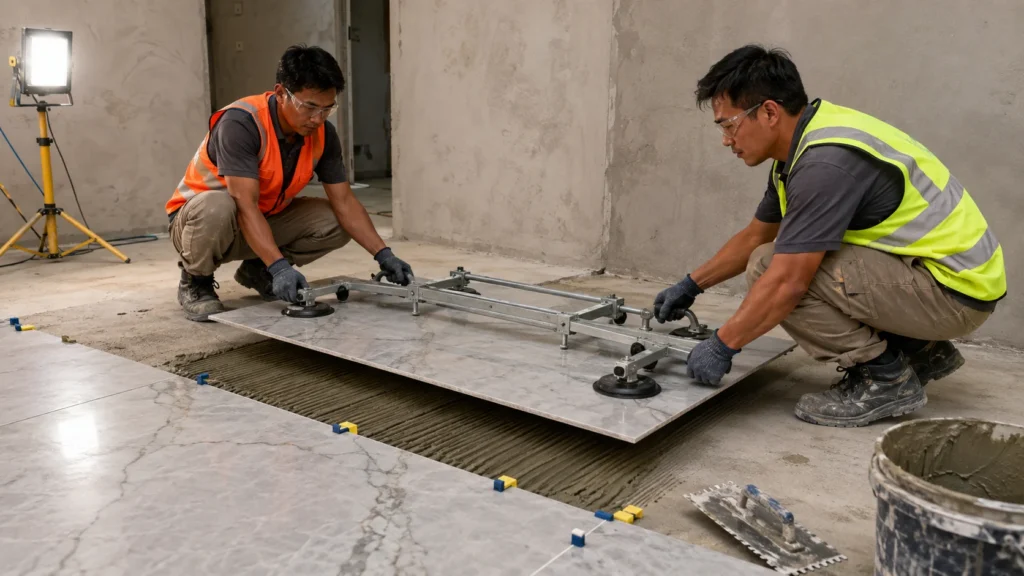
Not usually. Large-format slabs are heavy, awkward, and unforgiving: a single slab laid out of sequence or rotated breaks the flow for the whole room, and a mishandled slab cracks. Installers who work with this format use vacuum lifters, large suction frames, and levelling systems, and they know how to keep the pattern running through doorways and around obstacles.
This is the same constraint that applies to sintered stone flooring in Malaysia, where using a general tiler is one of the most common and most expensive mistakes homeowners make.
How Is the Layout Planned?
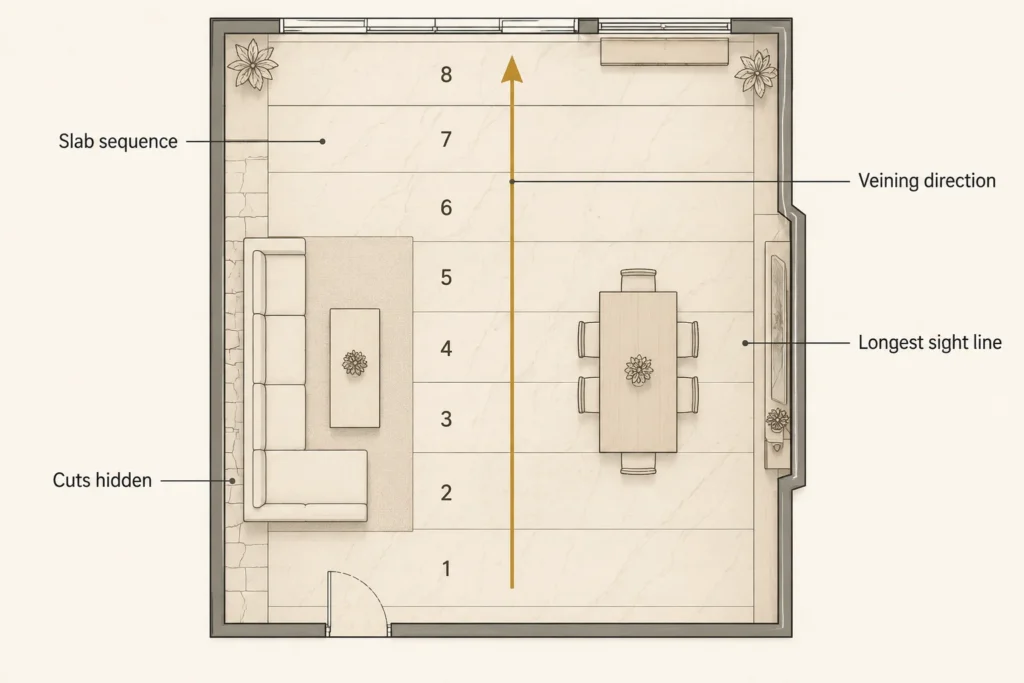
Before anything is laid, the installer plans the sequence: which numbered slab goes where, and which direction the veining runs. The four decisions that shape the result are:
- Veining direction: it should follow the longest sight line in the space
- Focal points: the most visible areas get the cleanest, uncut slabs
- Transitions: how the pattern carries through doorways or meets a different material
- Cut placement: cuts are unavoidable, so they get planned into the least visible zones
Why Does the Subfloor Matter So Much?
Because any dip or hump in the subfloor telegraphs straight through to the surface as lippage, where one slab edge sits higher than its neighbour. On a large-format floor that catches both light and toes, and it ruins the seamless effect you paid for.
Expect the installer to assess the substrate and, where needed, apply a self-levelling compound before laying anything. It adds time and cost, and skipping it guarantees a disappointing floor.
What About Adhesive and Grout?
Large slabs need adhesive rated for the format, applied with full coverage and enough open time for the installer to position each piece precisely. Standard tile adhesive doesn’t give either. Grout is colour-matched to make the remaining joints disappear, and epoxy grout is worth considering in kitchens and wet zones since it resists staining and holds its colour.
How Does It Compare to Other Premium Floors?
Against natural marble, engineered wood, and sintered stone, linear match porcelain trades a little prestige for a lot less maintenance.
| Linear match porcelain slab | Natural marble | Engineered wood | Sintered stone | |
|---|---|---|---|---|
| Pattern continuity | Continuous by design | Not achievable, every block differs | Grain variation only | Continuous by design |
| Porosity | Very low | Absorbs spills, stains | Vulnerable to water | Very low |
| Scratch resistance | High | Moderate, marks easily | Low | Highest |
| Maintenance | Sweep and mop | Sealing plus periodic polishing | Periodic refinishing | Sweep and mop |
| Humidity behaviour | Stable | Stable | Can cup or gap | Stable |
Marble remains the reference point for luxury, but in a Malaysian home it asks for regular sealing, stains from ordinary spills, and scuffs from furniture and heels. Engineered wood brings warmth that stone can’t, at the cost of real vulnerability to humidity and standing water.
Sintered stone and porcelain slab are close cousins and often confused, though they are distinct materials with different manufacturing processes. For a floor, both perform well. Sintered stone edges ahead on hardness, which matters more on a countertop than underfoot, so the decision usually comes down to the specific design you want and what it costs.
One caution that applies to both: not every slab in a range is rated for every location. A gloss finish that looks superb in a dry dining room becomes a slip risk on a wet balcony, which is why indoor and outdoor stone flooring are not interchangeable. Confirm the rating and finish with your supplier before the slab goes anywhere near an exposed area.
What Mistakes Do Homeowners Make with Linear Match Floors?
The five below account for most of the disappointing results, and every one of them is avoidable before the first slab is laid.
1. Deciding from a small sample. A 100mm chip tells you the colour and nothing about how the veining behaves across a room. View full slabs, ideally laid next to each other in sequence. This is the same trap covered in our guide on why you shouldn’t choose a countertop from a sample alone.
2. Ignoring the direction. Running the veining along a narrow corridor makes it feel longer, running it across makes it feel shorter and busier. Settle the direction with your installer before work starts, based on how you enter the room and where the furniture lands.
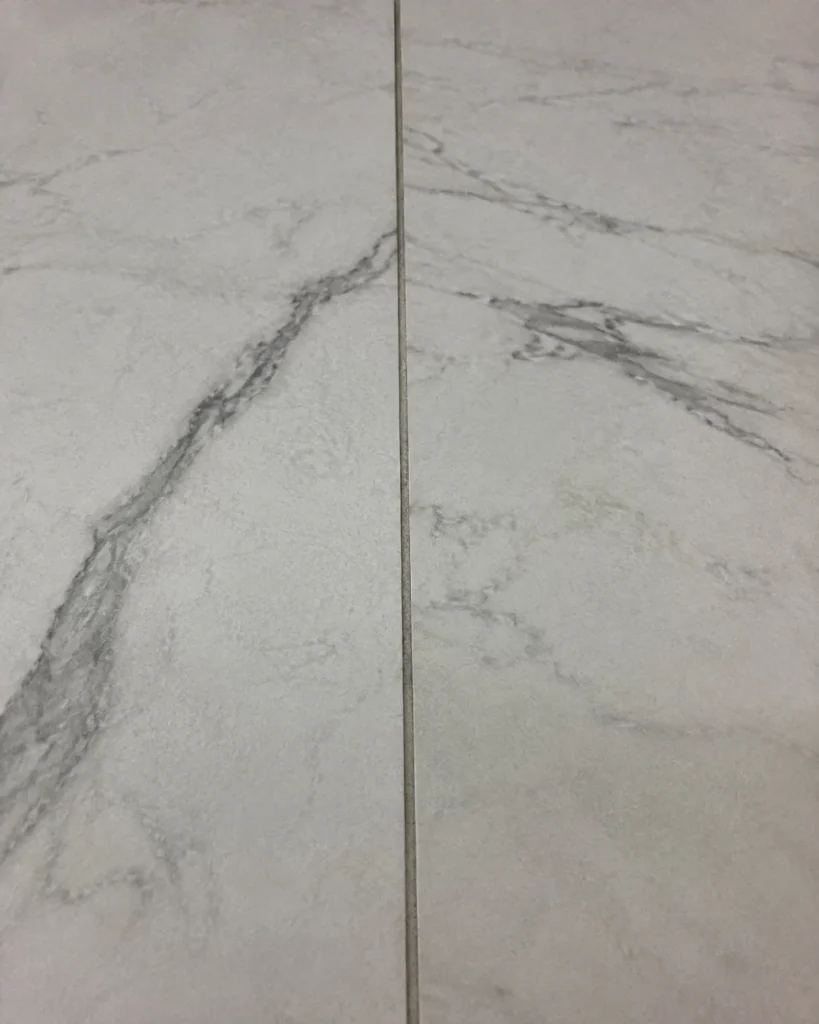
3. Mixing batches. Linear match only holds within one production batch. Order everything at once with 10–15% extra for cuts and future repairs. Running short and topping up later risks a colour or pattern shift that undoes the whole effect.
4. Skipping subfloor preparation. Rushing the levelling to save a few days is the most expensive shortcut on the list, because the fix after the fact is a full relay.
5. Buying on price alone. Cheaper slabs may claim linear match capability and still fall short on pattern consistency. Look at several slabs from any range you’re considering and check whether the veins actually continue between pieces.
How Do You Maintain a Linear Match Floor?
Sweep or vacuum regularly, mop with a pH-neutral cleaner, and leave the harsh chemicals alone. That’s genuinely the whole routine, since porcelain needs no sealing.
Daily sweeping or vacuuming of high-traffic areas removes the grit that would otherwise dull the surface over time. Weekly mopping with clean water and a pH-neutral cleaner handles the rest. Avoid bleach and acidic cleaners: porcelain resists them, but repeated use can flatten the sheen. On gloss finishes, a microfibre mop leaves fewer streaks than a string mop.
The grout still needs occasional attention. There is far less of it than on a tiled floor, but it can fade or darken over the years, particularly where sunlight lands on it daily. Periodic cleaning keeps it even, and re-grouting is straightforward if it ever gets beyond that.
A porcelain slab floor should hold its appearance for decades with this level of care. The one long-term risk is impact damage: a heavy dropped object can crack a slab, and replacement means finding a matching piece. That’s exactly why the extra material you ordered at the start should be stored, not sold off.

FAQ
Is linear match the same as book match?
No. Linear match runs the veining continuously in one direction across all slabs, while book match mirrors two slabs so the pattern meets symmetrically like an open book. Linear match suits floors, book match suits feature walls where you view the pattern head-on.
Can I use linear match porcelain slab in a bathroom or wet area?
Yes, provided you choose the right finish. Porcelain absorbs almost no water, so moisture isn’t the issue, but a gloss finish gets slippery when wet. Specify a matte or textured finish for bathrooms, wet kitchens, and any area exposed to rain, and confirm the slip rating with your supplier.
How many extra slabs should I order?
Add 10–15% to your floor area to cover cuts, offcuts, and future repairs. All of it must come from the same production batch, because a replacement slab ordered later may not match, and at that point the linear match effect is gone.
Can my usual tiler lay porcelain slab flooring?
Most cannot. Large-format slabs need vacuum lifters, large-format cutting equipment, levelling systems, and experience in sequencing the slabs correctly. A tiler set up for 600mm x 600mm work risks cracked slabs and a broken pattern, and neither is cheap to fix.
Does linear match work in a small condominium unit?
It works particularly well there, as long as you pick a subtler pattern. Continuous veining running along the longest sight line stretches a compact living-dining area visually, while a bold Calacatta pattern in the same room tends to feel crowded.
Conclusion
Linear match porcelain slab flooring buys you one thing that no tile can deliver: a floor that reads as a single surface instead of a grid. In open-plan Malaysian homes, where the living, dining, and kitchen zones share one continuous floor, that continuity does more for the sense of space than almost any other finish decision.
It costs more than tiles, it demands an installer who works with large-format slabs, and it needs planning before the first piece is laid. If those three conditions are met, the result holds up for decades with a mop and a bit of care, which is more than most premium floors can claim.
Worth seeing before you decide. Look at full slabs laid in sequence rather than samples, browse our porcelain slab range, and if you’d like help matching a pattern to your floor plan and working out a realistic slab count, talk to us about your project.