

Malaysian installers refuse customer-supplied sintered stone and porcelain slabs from China because the slab arrives without a sink hole, and cutting that hole on-site with handheld tools is the single most likely way to crack it. If it cracks, nobody can say whose fault it was: the supplier is in another country, the material has no warranty, and the installer carries all the blame with none of the margin.
So your slab is leaning against the garage wall, you have called a dozen fabricators, and every one of them said no.
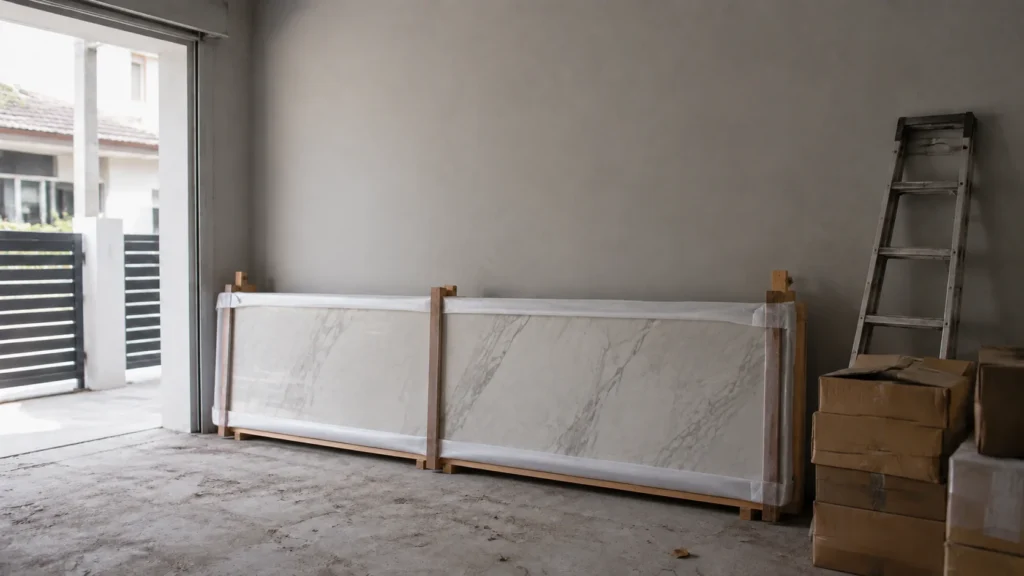
Key Takeaways
- Your slab arrived without a sink hole on purpose. A slab with a cutout is far more likely to crack during shipping, so China suppliers leave it solid and pass the riskiest cut to you.
- Porcelain and sintered stone have no resin binder, so they do not flex under stress the way quartz does. Under a handheld grinder, they crack rather than give.
- The slab also arrives oversized on purpose, so it has to be trimmed down to your cabinet run on-site. Every extra cut is another chance to chip or crack it.
- Hidden cracks are what installers fear most. A knock during shipping can leave a hairline crack you cannot see, and it only shows when the sink hole is cut and the slab splits in half, with no way to prove whose fault it was.
- Malaysian installation teams are set up around quartz. Most do not own the blades, water feed, or support systems that porcelain cutting needs, because their supplier partners handle that in a factory.
- The liability is the real deal-breaker. One cracked customer-supplied slab wipes out the profit from ten normal jobs, and no warranty exists to absorb it.
- The savings mostly evaporate. Moca Compact sintered stone runs RM110 to RM150 per square foot fully installed, which lands close to a China slab once you add shipping and premium on-site labour, with factory fabrication and warranty included.
- If you have already bought the slab, your best outcome is a fabricator who takes it back to their factory to cut the sink hole on CNC, not anyone willing to attempt it in your kitchen.
Why Was the Price So Attractive in the First Place?
The price was attractive because you were only ever quoted for the material, not for the work that turns material into a working kitchen top.
A pre-fabricated porcelain countertop advertised out of China typically lands somewhere around RM1,500 to RM2,500, cut to your dimensions with the visible edges polished. Set that against a locally supplied and installed sintered stone top and the gap looks impossible to ignore. When you are budgeting a renovation in Kuala Lumpur or Selangor and every ringgit is already spoken for, of course you noticed.
You were not being careless. You were being a sensible shopper who found what looked like real value. The problem is that the product at that price is incomplete, and finishing it here is far harder than the listing suggests.
What Does “Pre-Fabricated” Actually Leave Out?
Pre-fabricated means the slab has been cut to your outline and its edges polished. It does not mean the sink hole, the tap holes, or the wall scribing have been done, and those are the parts that need doing here.
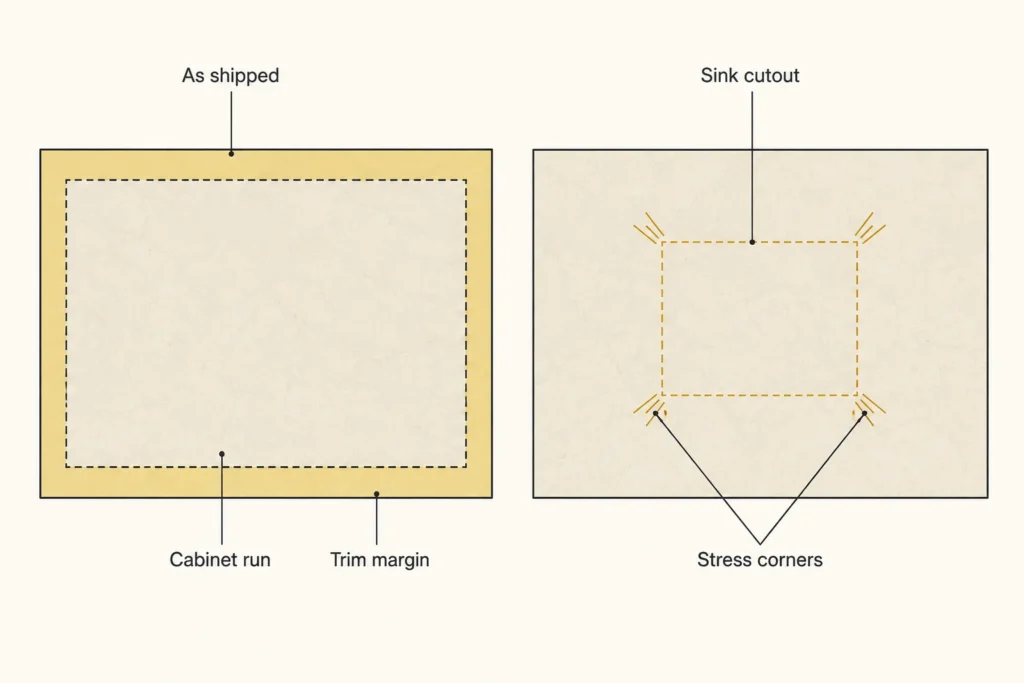
Here is the detail most buyers only discover after delivery: your countertop arrived without a sink hole cut. That is not an oversight. A large rectangular opening creates stress points that make the slab fragile, and a fragile slab does not survive weeks at sea and a lorry journey up the North-South Expressway. Leaving it solid is the only reliable way to land it in Malaysia in one piece.
Which means the most dangerous cut of the entire job has been handed to you.
There is a second surprise waiting alongside it: the slab is almost certainly bigger than your cabinet run. Suppliers cut generously on purpose, because a slab that arrives slightly oversized can still be trimmed down, whilst one cut a few millimetres short is scrap they would have to replace across an ocean. Sizing it large is how they protect themselves against your measurements being off, and it works fine for them. It just means the trimming lands on your side.
That trimming is not a light shave. Getting an oversized slab down to a cabinet run means running long cuts down the full length of the piece, sometimes on two or three sides, then polishing every one of those cut edges back to match the factory finish. Each pass is another opportunity for the blade to snatch, for the unsupported overhang to drop, or for a corner to chip. With quartz you would get away with most of that. With sintered stone and porcelain, the odds stack up quickly: the more cutting that happens on-site, the higher the chance you end up with a chipped edge or a crack running through the piece.
Beyond the sink and the sizing, every real kitchen needs adjustments the factory could never have anticipated. Your walls are not perfectly straight. Your cabinet run has small variations. Your plumbing may sit a few centimetres off the drawing you sent.
Standard on-site work for any countertop includes:
Sink hole cutting. Your slab came solid. The opening has to be cut here, to match your actual sink and its actual position. Without it, you have a very expensive shelf.
Trimming to size. The oversized slab has to be cut down to the actual cabinet run, then every fresh edge polished back to match the factory finish.
Tap hole drilling. Mixer taps, filtered water taps, and soap dispensers are almost always drilled on-site to suit the fittings you bought.
Scribing to walls. Where the top meets a wall, the installer trims the edge to follow the wall’s real contour.
Joint fitting and polishing. L-shaped and U-shaped kitchens need multiple pieces joined on-site, with seams cut, closed, and polished.
Edge adjustments. Minor trimming where the top meets a hob cutout, a fridge gap, or a wall return.
None of these are optional extras. Every one of them means cutting, grinding, or polishing your imported slab in your house.
Why Is On-Site Work on Porcelain Such a Problem?
On-site work is a problem because the material you bought, whether the listing called it sintered stone or porcelain slab, has almost no tolerance for uneven stress, and a kitchen floor is nothing like a factory bench.
Quartz contains resin binders that give it a little flex. That flex absorbs the vibration and pressure of cutting. Porcelain and sintered stone are fired ceramic with very little give. When stress concentrates at a point, the material does not bend. It breaks.
In a factory, porcelain fabrication happens on a flat bed with the slab supported across its whole surface, on CNC equipment running at a set speed with a calibrated water feed, operated by someone trained on that material specifically. On-site, none of those conditions exist. The slab may be sitting across two trestles. The operator is leaning over it at an awkward angle. The blade is whatever was in the van.
The Sink Hole: The Cut You Cannot Avoid
This is the heart of it. Your slab has no sink hole, and it needs one.
Cutting a large rectangle out of the middle of a porcelain slab creates exactly the stress points the supplier avoided during shipping. In a factory, the corners get radiused so stress spreads instead of concentrating, the slab stays fully supported throughout, and the whole operation is done and checked in about half an hour.
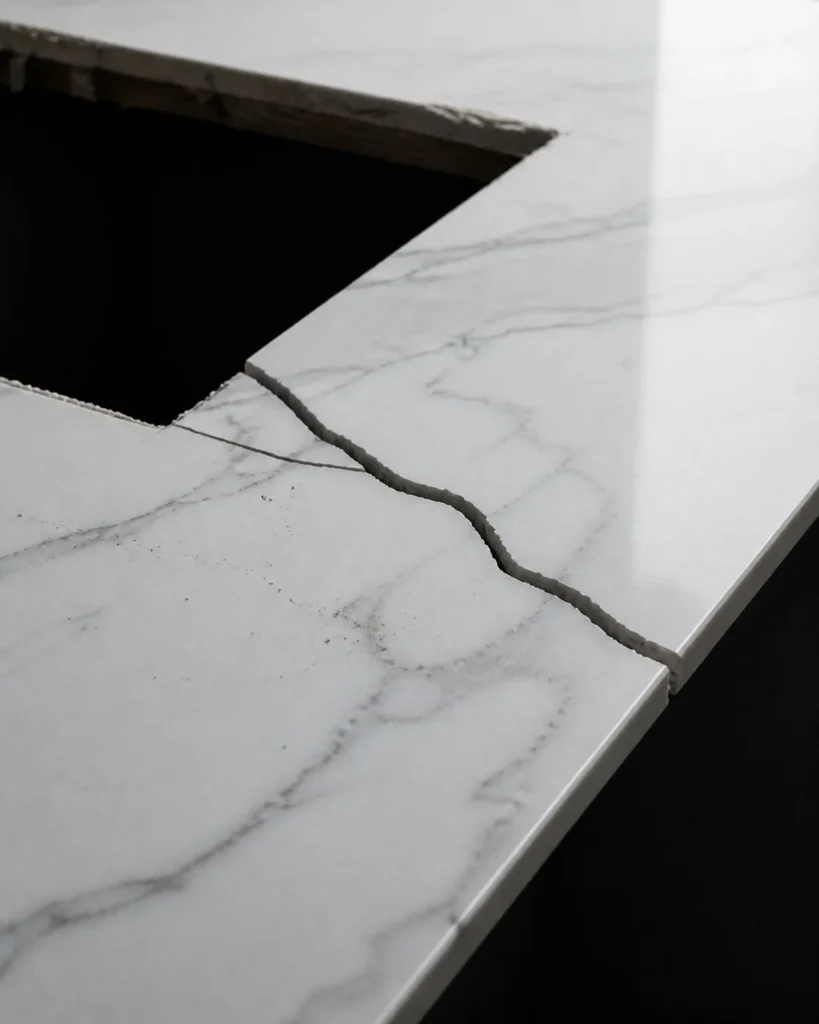
On-site, one moment of extra pressure, one bounce in the support, or one internal stress point nobody could see, and the crack runs from the cutout corner straight out to the edge. We hear from homeowners after this has already happened: the slab is in two pieces, the person who cut it has gone quiet, and there is nothing to claim against.
Edge Polishing That Never Quite Matches
Any edge cut on-site has to be polished back to match the factory finish, and it rarely does.
Porcelain edge polishing runs through a sequence of progressively finer diamond pads with constant water and even pressure along the full length. A factory line does that automatically and identically every time. A handheld grinder relies entirely on the operator’s wrist. The usual result is a visible difference between the original edges and the reworked ones: slight waviness, patchy sheen, or fine scratch patterns catching the light. On a material you chose for how it looks, that stings.
Silica Dust in Your Kitchen
Cutting and grinding porcelain throws off a large volume of fine silica dust, which is a genuine respiratory hazard rather than just a mess.
Factories manage it with industrial extraction and proper protective equipment. In your kitchen, with plastic sheeting and a portable vacuum, the dust still finds its way into cabinet carcasses, appliance vents, and your air-conditioning. Plenty of installers decline on this basis alone. They do not have the extraction for on-site porcelain work, and they are not willing to breathe it for the sake of one job.
Why Can’t Installers Simply Do What the Factory Does?
They cannot because the equipment gap is real, and it exists for a good commercial reason: professional countertop work in Malaysia grew up around quartz, which forgives a lot more than porcelain does.
Quartz cuts cleanly with a standard angle grinder and a diamond blade, tolerates handling stress, and can be trimmed on-site with reasonable confidence. That same kit on porcelain is a coin flip. Porcelain needs blades made for ultra-hard material, noticeably slower feed rates, more water, and full-length support beneath the cut line. Most installation teams do not own that setup because they almost never need it. Their fabrication partners handle porcelain in the factory, where the right machines already exist.
Asking a quartz installer to cut a sink hole in your China slab is a bit like asking your regular car workshop to service an aeroplane. Both work on engines. The consequences of getting it wrong are not remotely comparable.
What Is a Hidden Crack, and Why Do Installers Fear It Most?
A hidden crack is a hairline fracture inside the slab that you cannot see with the naked eye, and it is the thing installers fear most about a customer-supplied slab. It survives delivery and every visual check, then opens up the moment someone cuts the sink hole.
Think about the journey your slab took. It was crated in Foshan, lifted by forklift, packed into a container, shipped across the South China Sea, unloaded at Port Klang, driven up by lorry, and carried into your house by hand. Any one of those steps could have knocked the crate hard. Nobody was watching, nobody recorded it, and the slab came out of the crate looking perfect.
That is the trouble with sintered stone and porcelain. A knock that would leave an obvious chip on quartz can instead leave a fine fracture running inside a ceramic slab, below the surface. The face still looks flawless. You cannot see it, the installer cannot see it, and the slab can sit in your garage for months without showing a thing.
Then the sink hole gets cut. Opening a cutout pulls stress towards its corners, which is exactly where a hidden crack is waiting to travel. The blade reaches the weak line, and the whole piece splits in half.
So Is It the Installer’s Fault?
Often not, but nobody can prove it either way, and that is the real problem.
The crack most likely started in transit, but it only showed itself under the installer’s blade. From where you stand, they broke your slab. From where they stand, it was already broken when it arrived. There is no evidence to settle it: no inspection record from the port, no photos of the crate, and no way to see inside the stone.
Every party has a reasonable answer that clears them. The supplier says the slab left their factory intact. The shipping company says the crate arrived undamaged. The installer says they only cut what you handed them. You are left with two pieces of stone and nobody to claim from.
When a local fabricator supplies the slab, this never becomes your problem. They bought it, they inspect it in their own factory, and if it breaks during cutting they absorb the loss and cut another. That is why so many installers turn down a China slab before they have even looked at it. They are not doubting their own skill. They are refusing to stake their name on damage that may have happened weeks before the slab reached them.
Can You Check for a Hidden Crack Before Cutting?
You can lower the odds, but you cannot rule it out. These checks are worth doing before anyone picks up a grinder:
- Photograph the crate on delivery. Shoot every side before it is opened, and note broken battens, crushed corners, or impact marks. A damaged crate is your strongest clue.
- Wet the surface. Wipe the slab down with water and watch it dry. A hairline crack can hold moisture a little longer and show up as a thin dark line.
- Use a raking light. In a dim room, shine a torch low across the surface, almost flat to it. Fine cracks can catch light that overhead lighting hides.
- Tap along the slab. Tap gently with a knuckle or a rubber mallet. A dull or dead-sounding patch is worth a closer look.
None of these see inside the stone, so a slab that passes every check can still split under the blade. If you do find something, document it straight away, because weeks after delivery a China supplier is unlikely to accept a transit damage claim.
Who Pays If It Cracks?
Nobody, and that unanswerable question is why the phone keeps getting put down on you.
When you buy through a proper supply-and-install arrangement, the fabricator owns the whole chain. If the slab breaks during fabrication or fitting, they replace it at their cost, because their warranty covers material and workmanship together. That chain is what you are actually paying for.
With a customer-supplied China slab, the chain is broken at the first link. If your slab cracks under an installer’s grinder, they will say it already had a hidden crack from shipping. You will say their technique was wrong. Neither of you can prove it, and the original supplier is unreachable in Foshan.
No sensible business signs up for that. The installer risks their reputation, their labour cost, and a dispute they cannot win, in exchange for one job’s margin. Charging a premium does not fix the maths, because a single cracked slab erases the profit from ten clean jobs. This is the same accountability problem behind buying quartz supply-only and asking your tiler to fit it, just with a far less forgiving material.
But the Supplier Said Installation Would Be Easy?
They said that because at RM1,500 to RM2,500 for a complete countertop, they are selling volume, not advice, and their responsibility ends when the crate leaves the port.
From their side, “ready to install” is true enough. They cut it to your dimensions and polished the visible edges. What the listing does not mention:
They left the sink hole uncut deliberately. It protects their product in transit and transfers the riskiest cut to you.
They have never seen your kitchen. They worked from measurements you supplied, which may or may not match what is actually built.
They are not responsible for installation. Once it ships, their obligation is finished. The sink cutout that must happen is now your problem.
They do not know the Malaysian installation market. They have no reason to know that local teams lack on-site porcelain equipment, or that finding someone to cut your sink hole here will be close to impossible.
The supplier got paid. You got a solid slab with no hole in it. The gap between those two facts is where you are standing now.
Does the Cheaper Slab Actually End Up Cheaper?
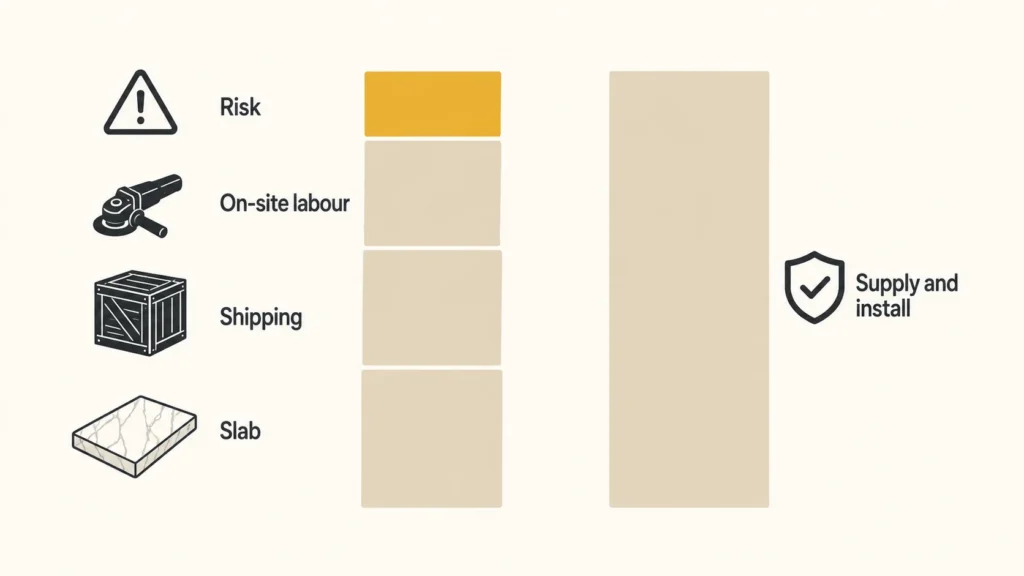
Usually not, because the number you compared was a material price against a finished-kitchen price, and the two are not the same thing.
What You Paid
A pre-fabricated China porcelain top for a standard L-shaped kitchen is commonly advertised at RM1,500 to RM2,500, plus shipping and handling to your door. On paper, against a local supply-and-install quotation, that reads as a straightforward win.
Why You Cannot Use It Yet
Your slab still needs its sink hole cut, its tap holes drilled, scribing to your actual walls, and the installation itself. The catch is not the cost of that work. The catch is finding anyone who will do it. And the few who agree quote at a premium precisely because they are absorbing risk that would normally sit with a supplier, so expect two to three times normal rates with no warranty attached at the end of it.
What Happens When Nobody Will Touch It
After fifteen calls and fifteen refusals, homeowners generally land in one of three places.
Pay the premium. Someone agrees at a steep rate. Your total creeps toward what a proper supply-and-install job would have cost, except you still have no warranty and no recourse.
Take the risk. You find a tiler who will “try”. The sink hole cracks. Your slab is now worth nothing, and you still need a countertop.
Let it sit. Months pass. The renovation stalls around the missing top. Eventually you buy locally anyway, and the China slab becomes the most expensive thing in your garage.
What the Same Money Buys Locally
Here is what supply-and-install actually costs in Malaysia for the same category of material, from our 2026 price list:
Moca Compact sintered stone: RM110 to RM150 per square foot, fully installed
Dekton sintered stone (Cosentino): RM248 to RM469 per square foot, fully installed
For a 45 square foot L-shaped kitchen:
| Option | Material Cost | Fabrication & Installation | Risk of Total Loss | Warranty |
|---|---|---|---|---|
| China pre-fabricated slab | RM1,500 to RM2,500 plus shipping | Premium rates, if anyone agrees | High | None |
| Moca Compact supply & install | RM4,950 to RM6,750 | Included | Low | Yes |
| Dekton supply & install | RM11,160 to RM21,105 | Included | Low | Yes |
Look at the Moca Compact row properly, because it is the honest like-for-like comparison. It is sintered stone, the same category you tried to buy. Once you add shipping and premium on-site labour to the China slab, the gap between the two narrows considerably, and one of them arrives with factory-cut sink hole, machine-polished edges, a professional install, and a warranty you can actually claim on.
For the full picture across every brand we carry, see our 2026 stone countertop price guide.
You Have Already Bought the Slab. What Now?
Your best realistic option is to find a fabricator who will take the slab into their factory, cut the sink hole on CNC, and come back to install it. Everything else is either a compromise or a write-off.
Option 1: Factory Sink Cutting, Then Site Installation
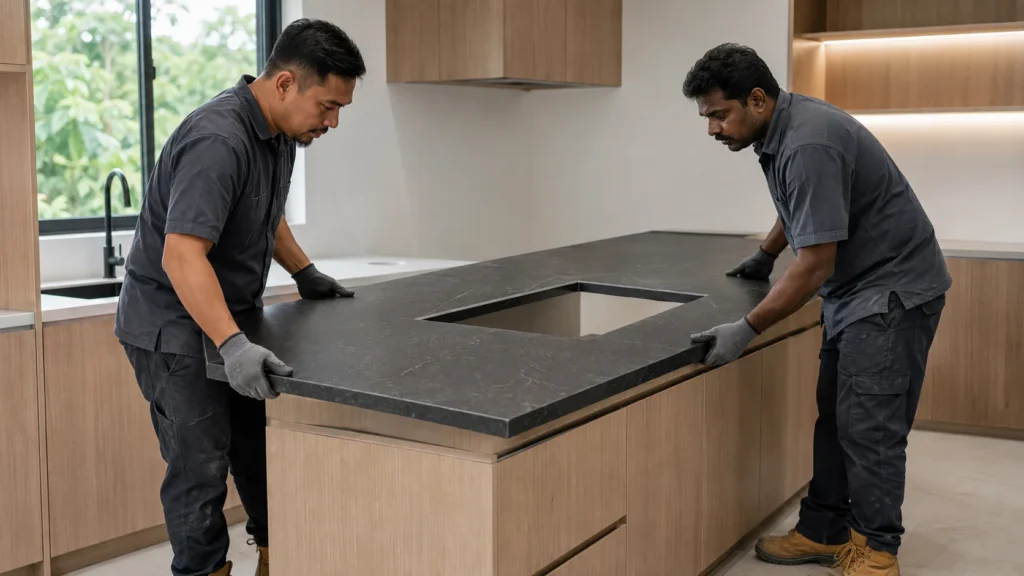
Ask fabricators specifically whether they will collect the slab, cut the sink opening in their workshop with proper support and equipment, then return to fit it.
This is the option worth chasing, because it moves the high-risk cut off your kitchen floor and into controlled conditions. On-site, the installer then only handles placement and light adjustment. Expect to pay for the extra transport and the second trip, and expect to sign a waiver accepting liability for material defects. They did not supply the slab, so they cannot warrant it.
Option 2: A Porcelain Specialist Who Takes Customer Material
Some fabricators do own the right equipment and will occasionally take on customer-supplied porcelain. Fewer than you would hope, and at rates well above standard, but they exist. The same waiver applies.
Option 3: Repurpose It as Cladding or Flooring
Porcelain and sintered stone slabs work beautifully in applications with no sink cutout: feature walls, TV consoles, fireplace surrounds, outdoor cladding. The cuts are simpler and the failure risk drops sharply.
A tiler experienced with large-format porcelain may well install your slab as a sintered stone feature wall. You do not get your kitchen top, but you recover real value from what you bought.
Option 4: Sell It On
List it. Contractors and homeowners with simpler requirements do go looking for slabs at the right price. You will take a loss, but a partial recovery beats a total one.
Option 5: Set It Aside and Buy Properly
Sometimes the cheapest remaining move is to stop spending on a bad position. If none of the options above work, buy the countertop properly and get your kitchen finished. That feels like waste, and it is, but chasing the slab further usually costs more than the slab did.

Why Does the Malaysian Trade Work This Way?
Installers are not being awkward. They have learnt through experience that customer-supplied porcelain generates problems worth more than the job pays.
Stone fabrication runs on thin margins with heavy liability. A slab that cracks during on-site work means lost labour, a dispute the fabricator cannot win, and a damaged reputation in a trade that runs largely on word of mouth. When a fabricator controls supply, factory fabrication, and installation, they can manage quality end to end and stand behind the result. Insert an unknown slab from an unreachable supplier, then ask them to perform the highest-risk cut with the wrong tools, and you are asking them to gamble their name on a purchase they had no part in.
They can fill the diary with normal supply-and-install work at manageable risk instead. From where they sit, that is not a close call. This is one of the reasons buying stone direct from China is the sourcing route we tell homeowners to avoid.
FAQ
Can any installer in Malaysia cut a sink hole in my China porcelain slab on-site? Almost none will, and the ones who agree are usually not equipped for it. On-site sink cutting in porcelain needs full slab support and specialised blades that most installation teams do not carry, which is why the answer is nearly always no.
Why did my sintered stone slab arrive without a sink hole? Because a slab with a large cutout is far more likely to crack in transit. Suppliers ship it solid to protect the product during the journey, which moves the riskiest cut from their factory to your kitchen.
Why is my pre-fabricated slab bigger than my kitchen cabinets? Suppliers cut oversized deliberately, because a slab that comes up short cannot be fixed from another country whilst an oversized one can still be trimmed. The catch is that the trimming has to happen in your kitchen, and every extra cut in sintered stone is another chance to chip an edge or crack the piece.
My slab cracked in half when the installer cut the sink hole. Is it the installer’s fault? Not necessarily, and usually nobody can prove it either way. A knock during shipping can leave a hidden crack inside the slab that only opens when the cutout is made, and with no inspection record, no warranty and an overseas supplier, there is no one to claim from.
How do I check a sintered stone slab for hidden cracks? Photograph the crate before opening it, wipe the slab with water and watch for a thin dark line as it dries, shine a torch low across the surface, and tap along it for dull-sounding patches. These catch the obvious cases, but no visual check can see inside the stone.
Is sintered stone from China the same as Dekton or Moca Compact? Not necessarily. Many China imports sold as sintered stone are porcelain slab, a related but different material, and quality varies widely between factories. Established brands run consistent, documented production, which is part of what makes them predictable to fabricate.
Can a tiler install my imported porcelain countertop? A tiler can handle large-format porcelain on a wall or floor, but a countertop is a different job. Sink cutouts, undermount support, and joint polishing sit outside normal tiling work, and attempting them without stone fabrication equipment is how slabs crack.
What if I just accept the risk and sign a waiver? A waiver protects the installer, not your slab. You keep the full cost of a crack, and since the material carries no warranty and the supplier is unreachable, there is nothing to fall back on.
Is it cheaper to buy the slab from China and pay for installation separately? Rarely, once you add shipping, premium on-site labour, and the risk of losing the slab entirely. Moca Compact sintered stone at RM110 to RM150 per square foot installed lands close enough that the savings largely disappear, and it comes with fabrication and warranty included.
Conclusion
The appeal is completely understandable. When one number says RM2,000 and the other says RM6,000, the decision looks like it makes itself. But the real cost of a countertop is not the purchase price. It is the cost of having a finished, working surface in your kitchen. A RM2,000 slab that nobody will install costs you RM2,000 plus whatever you eventually spend replacing it. A RM6,000 top that was fabricated and fitted properly costs you RM6,000, once.
Before you click buy on that pre-fabricated slab, answer three questions with actual names: who cuts the sink hole, who drills the tap holes, and who scribes it to my walls. If you cannot, you are not ready to order. And if the slab is already in your garage, ask around for a fabricator willing to cut it in their factory rather than yours. We are happy to tell you honestly whether your slab is worth saving.