

Sintered stone flooring is an ultra-compact stone surface laid in large slabs instead of small tiles, and in Malaysia it delivers a near-seamless floor that resists stains, scratches and tropical humidity without ever needing sealing. The catch is cost and installation: it needs a specialist, and a general tiler will get it wrong.
Walk into Cosentino’s showroom at Kota Damansara and the case makes itself. The showroom floor is sintered stone. So is the staircase. So is the lift floor. Every surface you step on was chosen deliberately, not just to display the product but to show that this is a material confident enough to be used underfoot in one of the highest-traffic commercial spaces you could pick.
Beneath the aesthetics sits a material with real technical merit and real limitations. This guide gives you both: the honest pros, the actual cons, current Malaysian pricing from the brands available here, and a frank account of what happens on site during installation.
Key Takeaways
- Sintered stone flooring is non-porous, UV-stable and scratch-resistant, which suits Malaysia’s humidity, glare and heavy cooking better than most flooring materials.
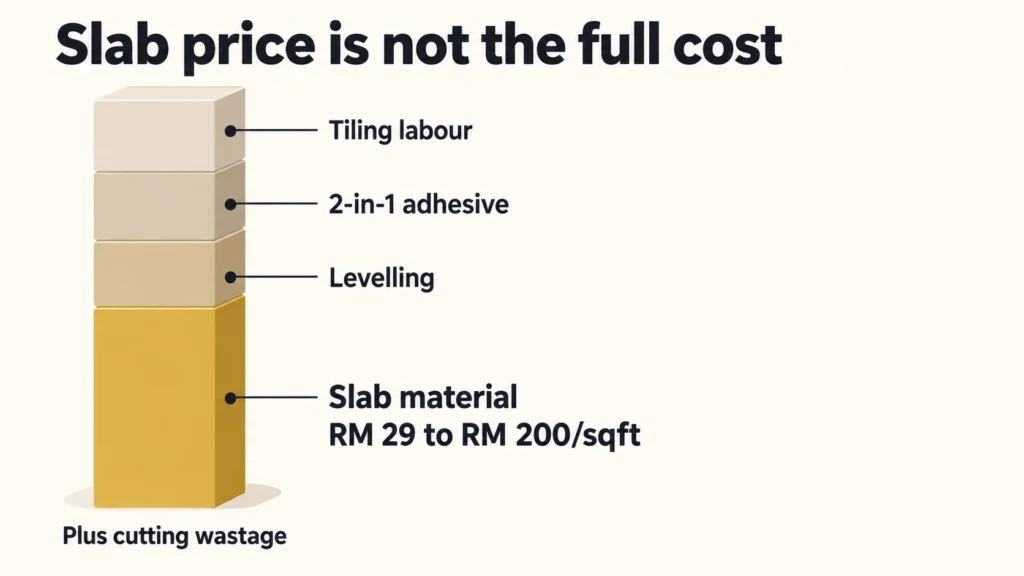
- Slab prices in Malaysia run from about RM 29 per sqft (Moca Compact Regular) to about RM 200 per sqft (Dekton Group 5) for material alone, before tiling labour.
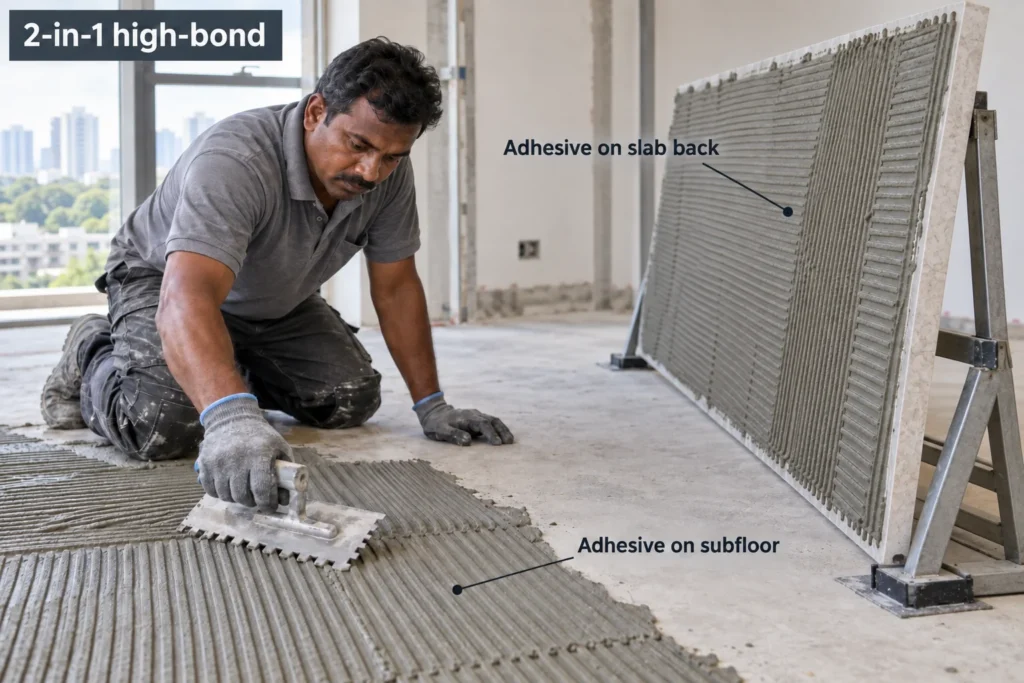
- It must be laid with a 2-in-1 high-bond cement adhesive applied to both the subfloor and the back of the slab. Standard tile cement will hollow and debond.
- The subfloor has to be dead level. Slabs crack when they bridge high and low points.
- It is hard to repair. A chipped slab usually means replacing the whole piece, and matching a discontinued batch is difficult.
What is sintered stone, and why is it being used for floors?
Sintered stone is an ultra-compact surface made by pressing a blend of natural minerals, feldspar, silica, glass and metal oxides, then firing them above 1,200°C. The process compresses in hours what geology takes millions of years to do, and the result is a slab that is dense, fully vitrified and non-porous.
If you want the full manufacturing story, the science behind sintered stone breaks down the process properly.
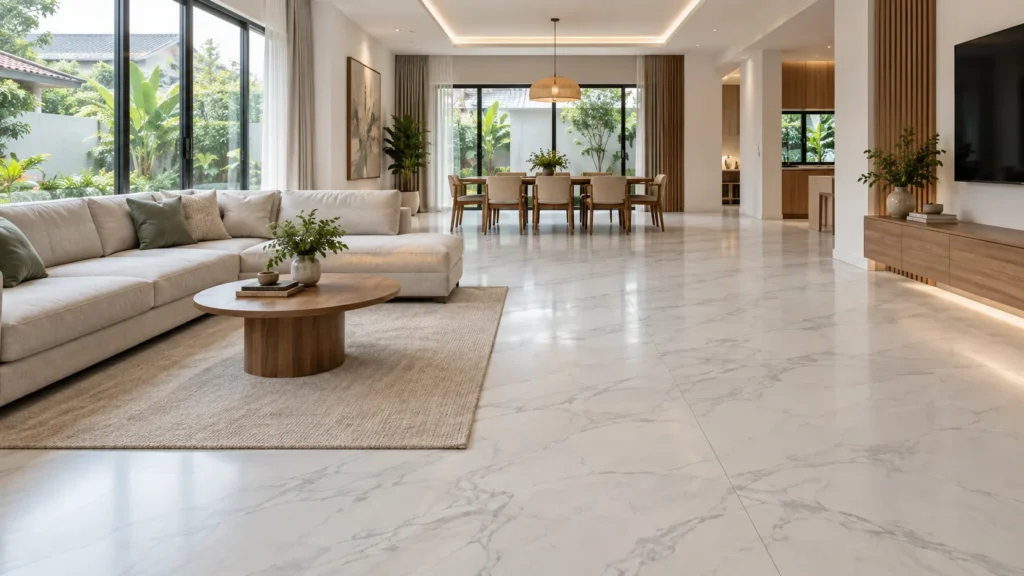
Sintered stone first caught on here as a countertop material. Designers and homeowners then started specifying it for floors, for three reasons: slabs come in large formats, the surface takes daily abuse without marking, and a floor laid in 3.2-metre slabs runs almost seam-free through an open-plan ground floor.
Why does sintered stone work well in Malaysian conditions?
Because the three things that wreck floors here, humidity, UV through glass, and pigmented cooking spills, are the three things a non-porous vitrified surface shrugs off.
Malaysia’s climate puts flooring through cycles that cooler countries never see. Constant high humidity, hard afternoon sun through full-height glazing, and the daily swing between air-conditioned rooms and un-air-conditioned corridors. Add barefoot living, open-plan traffic and a wet kitchen that sees wok work several nights a week, and it becomes clear why homeowners look past standard ceramic tile.
Sintered stone answers those conditions directly:
- Non-porous surface. Moisture cannot soak in, so mould and mildew have nothing to feed on at the surface.
- UV colour stability. It holds its colour under sustained tropical sun, where some engineered materials yellow or fade permanently.
- Chemical resistance. It takes the strong cleaners common in Malaysian households without dulling or etching.
- Slip-resistant finishes. Textured and matte finishes give usable grip near bathrooms, wet kitchens and laundry areas.
Not every slab is suited to every location, though. Outdoor terraces, porches and pool surrounds need a different surface rating from an indoor living room, and indoor vs outdoor stone flooring explains where that line sits.

What are the pros of sintered stone flooring?
Durability, stain resistance and large-format seamlessness are the three that homeowners actually notice. Here is the full list.
1. It resists scratches at a level most floors cannot
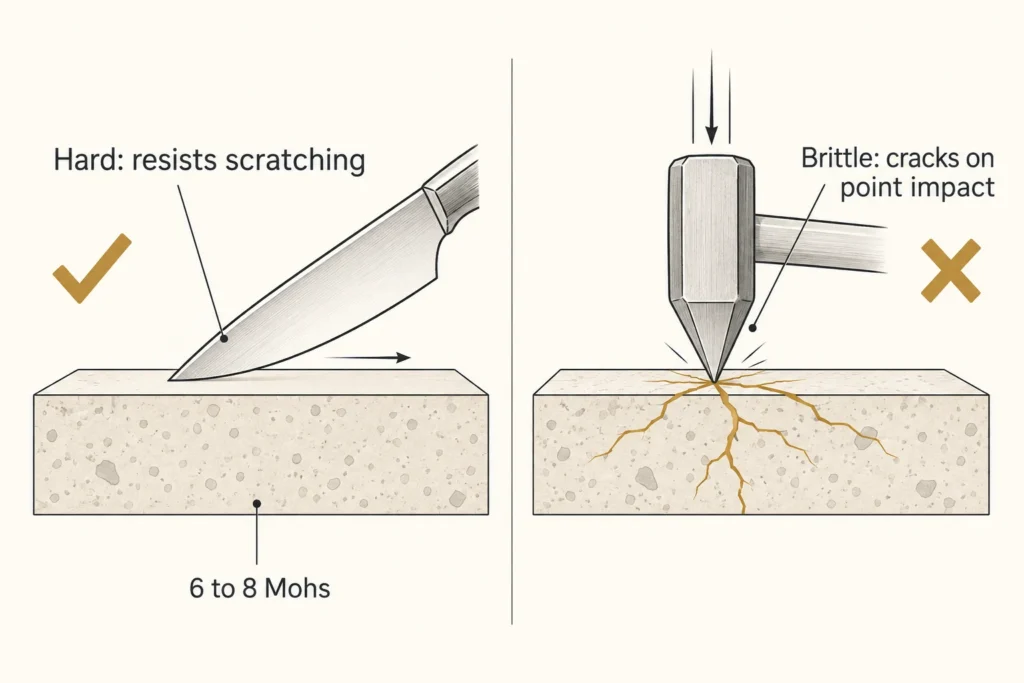
Sintered stone sits between 6 and 8 on the Mohs hardness scale, depending on brand and formulation. Dragged furniture, pet claws, grit tracked in from the porch and constant foot traffic do not leave visible marks. For a busy household with children, frequent guests or a helper, that means a floor that still looks right in year ten. If you want to understand what those numbers actually mean, the Mohs hardness scale explained is worth ten minutes.
2. Malaysian cooking stains do not stand a chance
Turmeric curry, belacan sambal, char kway teow dark with kicap. These are the spills that terrify anyone with a light marble or porous stone floor.
A fully vitrified, non-porous surface gives those pigments nowhere to go. Oil and sauce sit on top instead of soaking in, and a wipe restores the surface. There is no sealing schedule to remember, which is a real maintenance saving over natural stone and compressed marble floors.
3. It holds its colour under Malaysian sun
Full-height glazing and seamless indoor-outdoor connections are standard in new Malaysian builds and condominiums. Sintered stone keeps its colour under that exposure, which matters when one half of a living room gets direct afternoon sun and the other half does not.
4. It is hygienic in a way that suits families
Because the surface is vitrified and non-porous, bacteria, fungi and allergens have no pore structure to settle into. For households with a crawling toddler or someone with respiratory sensitivity, that is a genuine benefit rather than a marketing line. Upkeep is a damp mop and a pH-neutral cleaner. Nothing specialist.

5. Large format means far fewer grout lines
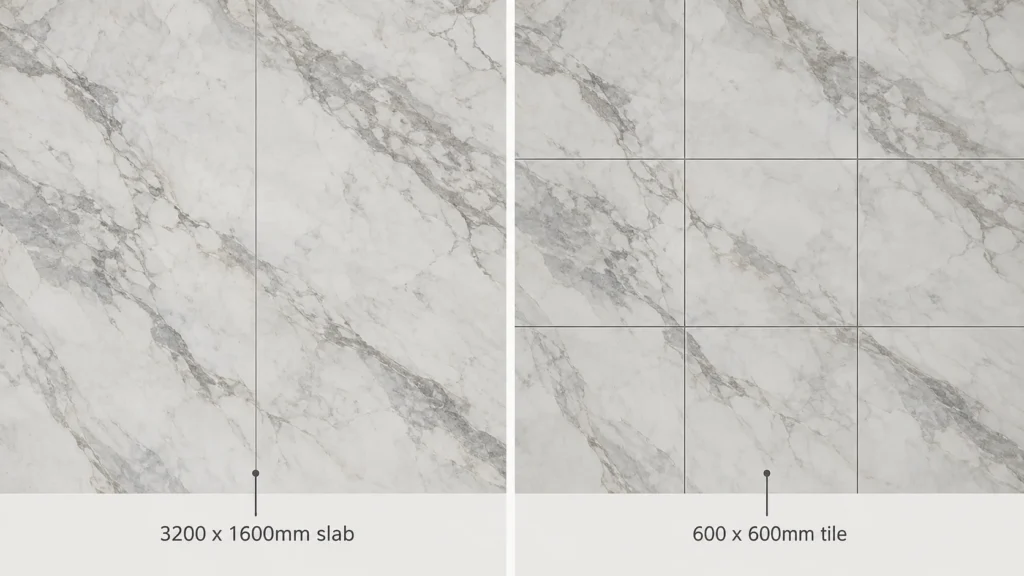
Sintered stone comes in slabs of roughly 3200mm x 1600mm, and Dekton runs around 3270mm x 1470mm. Laid whole, a floor has a handful of joints instead of dozens of grout lines. Rooms read larger and calmer, and there is less grout to discolour over time.
This is why it works so well in Malaysian open-plan layouts, where the living room, dining area and dry kitchen share one continuous floor. You cannot get the same effect with 600mm x 600mm or 800mm x 800mm tiles.
6. Heat and finish flexibility
Sintered stone resists thermal shock and does not hold surface heat the way some dark natural stones do. It also comes in polished, matte, textured and leather finishes, so you can specify grip where you need it without giving up the look. The full stone finish guide covers how each finish behaves underfoot and under cleaning.
7. The design range covers most Malaysian interiors
Current ranges include marble veining, concrete textures, terrazzo patterns and limestone looks. Whether the house leans contemporary minimalist, warm tropical, or resort-inspired, there is usually a slab that fits without compromise.
What are the cons of sintered stone flooring?
Cost, installer scarcity and poor repairability. None of them are reasons to rule it out, but all three should shape your budget and your contractor choice.
1. Specialist installation is not optional
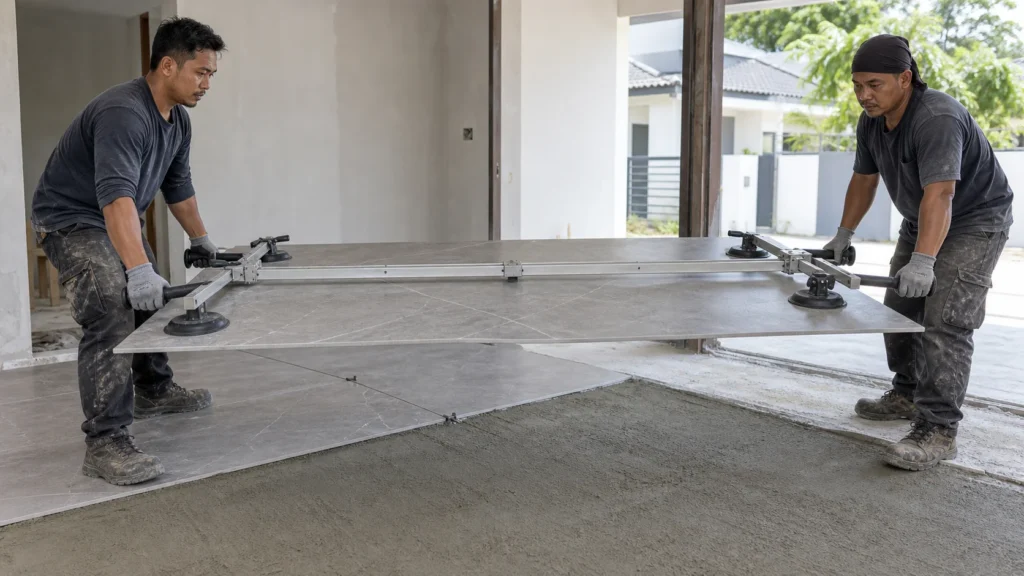
A general tiler cannot lay sintered stone. The material needs diamond-tipped cutting, trained handling to avoid cracking during transport and laying, and a properly prepared level subfloor. Mistakes on site, especially a slab cracked during handling, are expensive and awkward to fix.
This is the complaint we hear most from Malaysian homeowners: they discover mid-renovation that their contractor does not have the tools or the experience, and by then the material is already on site.
2. Hard against scratches, brittle under point impact
Sintered stone is extremely hard, but hardness is not toughness. A large slab will crack if it is dropped, poorly supported during transport, or cut with unsuitable equipment. That brittleness is exactly why experienced Malaysian fabricators refuse to work with off-brand or China-direct sintered stone, where slab density varies batch to batch and cutting behaviour becomes unpredictable. Here is what happens when installers are asked to touch it.
For a wider look at the material’s limitations, the disadvantages of sintered stone covers them in depth.
3. Cold and hard underfoot
Sintered stone stays cool, which most Malaysians count as a plus rather than a drawback. The hardness is the real issue. Standing on it for long stretches, particularly while cooking, is more tiring than standing on vinyl or timber. In bedrooms, some homeowners find it less comfortable than engineered timber or carpet.
4. Upper floors need a structural check
Sintered stone slabs are dense and heavy. If you are specifying it for a first-floor master bedroom in a terrace house, confirm the floor structure can carry the extra dead load. This matters more in older Malaysian properties designed around lighter screed-and-tile systems.
5. Damage means replacement, not repair
If a slab chips or cracks after a heavy impact, matching the exact colour and batch for a replacement is difficult, and often impossible for a discontinued colourway. Softer floors can be patched or refinished in place. Sintered stone cannot. Careful installation and a spare slab kept aside are the practical answers.
How much does sintered stone flooring cost in Malaysia?
Material alone runs from about RM 29 per sqft for Moca Compact Regular to about RM 200 per sqft for Dekton’s top group, before any tiling labour, adhesive or substrate work.
Flooring is quoted from slabs, so slab pricing is the number that matters. Here is the 2026 retail slab pricing for the two sintered stone brands most commonly specified in Malaysia:
| Brand and series | Slab size | Slab area | Slab price | Works out to |
|---|---|---|---|---|
| Moca Compact Regular | 3200 x 1600mm | 55 sqft | RM 1,600 | about RM 29/sqft |
| Moca Compact Jumbo | 3200 x 1800mm | 62 sqft | RM 1,800 | about RM 29/sqft |
| Moca Compact Leathered | 3200 x 1600mm | 55 sqft | RM 2,000 | about RM 36/sqft |
| Moca Compact Homogeneous | 3200 x 1600mm | 55 sqft | RM 2,800 | about RM 51/sqft |
| Dekton Group 0 | 3270 x 1470mm | 51 sqft | RM 3,700 | about RM 73/sqft |
| Dekton Group 1 | 3270 x 1470mm | 51 sqft | RM 5,300 | about RM 104/sqft |
| Dekton Group 2 | 3270 x 1470mm | 51 sqft | RM 6,200 | about RM 122/sqft |
| Dekton Group 3 | 3270 x 1470mm | 51 sqft | RM 7,100 | about RM 139/sqft |
| Dekton Group 4 | 3270 x 1470mm | 51 sqft | RM 8,500 | about RM 167/sqft |
| Dekton Group 5 | 3270 x 1470mm | 51 sqft | RM 10,200 | about RM 200/sqft |
Two things to hold in mind when you read those figures.
First, the per-sqft column is material only. It does not include tiling labour, 2-in-1 adhesive, screed levelling, cutting wastage or delivery. Flooring labour is a separate trade from countertop fabrication and is quoted separately.
Second, you never use 100% of a slab. Cuts, room shapes and pattern alignment mean real wastage, so budget slab count on the area you need plus a margin, not on a straight division.
For comparison, this is what the same materials cost as a supplied and installed countertop, which is a different process with different labour:
| Brand and group | Supply and install, per sqft (countertop) |
|---|---|
| Moca Compact Regular | RM 110 |
| Moca Compact Jumbo | RM 120 |
| Moca Compact Leathered | RM 130 |
| Moca Compact Homogeneous | RM 150 |
| Dekton Group 0 | RM 248 |
| Dekton Group 1 | RM 320 |
| Dekton Group 2 | RM 351 |
| Dekton Group 3 | RM 400 |
| Dekton Group 4 and 5 | RM 469 |
Do not use the countertop column to budget a floor. It is included here so you can see where the same material sits when fabrication, edge profiling and countertop installation are bundled in. For a floor, get an itemised quote from a flooring specialist that separates material, adhesive, levelling and labour. If you are pricing a countertop at the same time as the floor, the 2026 stone countertop price guide sets out what every brand costs supplied and installed.
For context on the alternative: standard porcelain tile material sits around RM 5 to RM 25 per sqft. On a 600 to 900 sqft open-plan ground floor, the gap is significant.
Sintered stone flooring vs porcelain tile: which should you choose?
Choose sintered stone if you want the large-format seamless look and a surface that stays unmarked for a decade. Choose porcelain tile if budget and installer availability matter more than joint count.
| Feature | Sintered stone | Standard porcelain tile |
|---|---|---|
| Surface hardness | Higher (6 to 8 Mohs) | Moderate (5 to 7 Mohs) |
| Stain resistance | Excellent | Good |
| UV colour stability | Excellent | Good |
| Format | Large slab, few joints | Standard tile, many grout lines |
| Installer availability | Specialist required | Widely available |
| Material price | RM 29 to RM 200/sqft | RM 5 to RM 25/sqft |
| Repairability | Difficult | Easier |
| Maintenance | Minimal, no sealing | Minimal |
If you like the large-format look but the budget will not stretch, linear match porcelain slab flooring is the middle option worth reading about before you commit. The porcelain slabs vs porcelain tiles comparison covers how much of the seamless effect you keep at that price.
Is sintered stone the same as porcelain slab?
No. They are two different products, even though suppliers often use the names interchangeably. The manufacturing processes differ, the raw material blends differ, and the performance profiles differ.
The distinction matters when you are reading specifications and comparing quotes, because a quote for “porcelain slab” and a quote for “sintered stone” are not automatically comparing like with like. The difference between sintered stone and porcelain slab sets out exactly what separates them.
For flooring specifically, ask the supplier for the slab’s brand, series and thickness rather than accepting the category name on the quote. Two slabs both sold as “sintered stone” can differ by RM 70 per sqft and behave differently under the cutting blade, and the label alone will not tell you which one is on the lorry.
What should you expect during installation in Malaysia?
Expect subfloor levelling first, specialist cutting equipment, full-bed 2-in-1 adhesive on both surfaces, proper expansion joints, and three to five working days for a typical open-plan ground floor.
Subfloor assessment and levelling
A dead-level subfloor is not a nice-to-have. Any unevenness, even minor variation in the screed, leaves a slab bridging a high point and a void, and that is where cracks start. Expect your installer to spend real time assessing and correcting the substrate before a single slab goes down. If a contractor wants to start laying on day one, that is a warning sign.
Specialist cutting equipment
The standard wet-saw tile cutters most Malaysian tilers carry are not suitable. Look for installers running CNC-guided diamond blade bridge saws or equivalent. If a contractor proposes laying sintered stone with ordinary tile tools, walk away.
Full-bed 2-in-1 cement adhesive
This is the detail that separates a floor that lasts from one that hollows out in two years.
Large-format sintered stone needs full-bed adhesive application, meaning the entire underside of each slab is coated. The spot-gluing or dot-and-dab method used for ordinary porcelain tile is unsuitable at this size.
The adhesive type matters just as much. Standard cement grout or ordinary tile adhesive does not have the bond strength to hold a large sintered stone slab over the long term. What you need is a 2-in-1 cement adhesive, a high-performance tile adhesive applied to the subfloor and to the underside of the slab at the same time. That double-sided application, sometimes called back-buttering, creates a far stronger mechanical bond that carries the weight and rigidity of the slab without debonding, hollowing or cracking later.
Less experienced contractors get this wrong regularly. If a tiler quotes you for sintered stone flooring using standard tile cement, they have not laid it before. Verify that the quote specifies a 2-in-1 high-bond cement adhesive rated for large-format stone slabs before work starts.
Expansion joints
Like all large-format surfaces, sintered stone floors need adequate expansion joints for thermal movement. In Malaysian homes, where an air-conditioned living room sits directly beside an un-air-conditioned corridor or a sun-exposed patio, the temperature differential across a continuous floor is real. Correctly placed expansion gaps prevent that stress from turning into cracks.
Installation timeline
Sintered stone takes longer to lay than ordinary tile. For an open-plan area of 600 to 800 sqft, expect three to five working days on site, then 24 to 48 hours of curing before the space is used. Add lead time for material if the colour is not in local stock.
Which sintered stone brands are available in Malaysia?
Dekton and Moca Compact cover most of the market here, at opposite ends of the price range.
Dekton by Cosentino (Spain)
Dekton is the global benchmark for sintered stone. Cosentino’s Sinterized Particle Technology produces an ultra-compact surface that performs at the top of every metric that matters: scratch resistance, stain resistance, UV stability, chemical resistance. It is available in Malaysia through specialist stone suppliers and comes with full technical documentation, which is why interior designers specify it on projects that need certainty.
The most convincing endorsement of its flooring capability comes from Cosentino themselves. At their Kota Damansara showroom, every floor surface is Dekton, including the staircase treads and the lift floor. A lift cab is about as demanding as flooring gets: concentrated point loads, constant traffic, no rest. Installing your own product there says more than a specification sheet does. If you want the full picture on the brand, what is Dekton covers its range and properties.
Moca Compact (Malaysia)
For homeowners who want the functional benefits at a workable price, Moca Compact is a locally supplied brand with a wide range of colours and finishes, from natural stone looks to homogeneous solid tones. Local distribution also means shorter lead times and simpler logistics than a fully imported range, which matters when a renovation schedule is already tight.
China-imported sintered stone
China-imported slabs are available at much lower prices through some suppliers and online platforms. Experienced Malaysian fabricators and installers largely refuse to work with them. Quality control is inconsistent, cutting behaviour is unpredictable, and there is no local warranty or technical support to fall back on. For flooring, where you are laying large unbroken areas and one cracked slab holds up the whole job, that risk is not worth the saving.
Is sintered stone flooring worth it for your Malaysian home?
It is worth it if you are staying in the house long-term and you value a floor that needs no sealing, tolerates heavy daily use and still looks right in year fifteen. It is not worth stretching for if the budget is already tight or the property is a short-term hold.
The ideal candidate is the homeowner renovating or building a home they intend to live in, who would rather pay once for a floor that outlasts the renovation than pay less now and redo it in eight years.
One practical note if you are already committed to the material: the same slab runs vertically as well. Carrying a floor colour up a TV feature wall or a staircase spine costs less per sqft than most people assume once the slabs are already being ordered and cut, and sintered stone feature walls breaks down what that adds to a job.
If you are still weighing sintered stone against other premium surfaces, the honest comparison between sintered stone and quartz covers the trade-offs between the two most popular engineered stone categories in Malaysia.
FAQ
How much does sintered stone flooring cost in Malaysia? Material runs from about RM 29 per sqft (Moca Compact Regular, RM 1,600 for a 55 sqft slab) to about RM 200 per sqft (Dekton Group 5, RM 10,200 for a 51 sqft slab), before tiling labour, adhesive and levelling. Get an itemised flooring quote rather than working from countertop rates, which cover a different process.
Can a normal tiler install sintered stone flooring? No. Sintered stone needs diamond-blade cutting equipment, trained slab handling and a 2-in-1 high-bond cement adhesive applied to both the subfloor and the back of the slab. A tiler quoting standard tile cement and a wet saw has not laid it before, and cracked or hollow slabs are the usual result.
Is sintered stone flooring slippery when wet? Not if you specify the right finish. Polished slabs get slippery when wet and belong in dry areas. For bathrooms, wet kitchens, laundry areas and anywhere near an outdoor transition, choose a matte, textured or leather finish that gives grip.
Can sintered stone flooring be laid outdoors in Malaysia? Some ranges can, but not all of them. Outdoor use needs a slab rated for it and a finish with proper wet grip, plus correct falls and drainage for heavy rain. Confirm the specific slab is approved for external use before you buy.
What happens if a sintered stone floor slab cracks? The damaged slab is cut out and replaced, because sintered stone cannot be patched, filled or refinished in place like softer materials. Colour and batch matching is the hard part, so keep one spare slab from the original batch when the floor is laid.
Conclusion
Sintered stone flooring sits at the premium end of the Malaysian market, and the reputation is earned. UV stability, stain and scratch resistance, a hygienic non-porous surface, and the visual impact of a floor that runs almost seamlessly through an open-plan ground floor. Few materials do all four in a tropical climate.
The trade-offs are real. Higher material cost, a shorter list of contractors who can actually lay it, and a material that is unforgiving when handled badly. None of those are reasons to avoid it. They are reasons to go in with a realistic budget, a level subfloor, and an installer who can tell you what adhesive they are using without checking first.
If you are considering sintered stone for your living area, kitchen or bathroom, visit a showroom, look at full-size slabs under natural light rather than a small sample, and get itemised quotes that separate material from labour. We are happy to walk you through slab options and pricing before you commit to anything.