

Yes, a seamless L-shaped kitchen top measuring 9ft by 4ft can be cut from a single 3000 x 1400mm quartz slab, but only if the 4ft is measured the right way, and only if the piece can physically reach your kitchen. Fitting on the slab is the easy part. Getting a 2.7-metre L-shaped stone through the door, up the building and onto the cabinets is where the real decision sits.
We get this question often, usually from homeowners who have just measured their kitchen and spotted that the numbers look close to the slab size. They are right to ask. A top with no joint looks cleaner, especially on a veined design. But a one-piece L costs more to fabricate and install, and in most high-rise homes it simply cannot be delivered.
Key Takeaways
- A 9ft x 4ft L-shaped top fits on a 3000 x 1400mm slab only when the 4ft is measured from the back wall and includes the corner.
- If the 4ft is the length of the return leg on its own, a 600mm-deep L needs about 1819mm of width. That is too wide for both 3000 x 1400mm and 3200 x 1600mm slabs, so you need a joint.
- A one-piece L costs more, because cutting, moving and installing it takes a few more workers than a jointed top.
- Most condo and apartment lifts are not big or tall enough for a one-piece L, so seamless tops are mainly an option for landed homes and high-rises with very large lifts.
- A well-made joint on quartz is neat and hard to spot, which makes it the practical choice for most Malaysian kitchens.
Can a 9ft x 4ft L-shaped kitchen top be cut from one slab?
It can, as long as the whole L fits inside the slab’s rectangle. Picture the L sitting on the slab like a shape drawn on paper: its longest side has to fit the slab’s length, and its widest side has to fit the slab’s width.
Here is the conversion for a typical layout, assuming a standard 600mm countertop depth:
| Measurement | In feet | In millimetres |
|---|---|---|
| Long leg | 9ft | about 2743mm |
| Short leg | 4ft | about 1219mm |
| Countertop depth | about 2ft | 600mm |
Many of our popular 15mm quartz colours come in a 3000 x 1400mm slab. Against that slab, a 2743mm leg leaves about 257mm to spare on the length, and a 1219mm leg leaves about 181mm on the width. On paper, the L fits.
The catch is in one word: the 4ft. Which 4ft did you measure?
Why does it matter how you measure the 4ft?
It matters because one way of measuring adds 600mm to the short side, and that 600mm is the difference between “fits” and “does not fit”.
Option A: 4ft measured from the back wall
If you ran your tape along the second wall starting from the corner, the 4ft already includes the 600mm that the long leg covers. The L’s outer size is about 2743 x 1219mm, which fits inside a 3000 x 1400mm slab. A one-piece top is possible.
Option B: 4ft measured from the front edge of the long leg
If the 4ft is the part of the return leg that sticks out beyond the long counter, the short side becomes 1219mm plus 600mm, so about 1819mm. That is wider than a 3000 x 1400mm slab, and wider than the larger 3200 x 1600mm slabs used for some colours too. At a 600mm countertop depth, neither slab size can take this L in one piece, so you need a joint.

Homeowners mix these two up all the time, and so do some contractors. Before you get excited about a seamless top, check which way your 4ft was measured. Better still, let the fabricator take the measurements during templating, after your cabinets are in. That is also why we advise homeowners to install your cabinets before ordering the stone: the template follows what is actually built, not what the drawing says.
Why does a one-piece L-shaped kitchen top cost more?
A one-piece L costs more because it takes more people and more care at every stage, from the cutting table to your cabinets.
Fabrication. An L-shaped piece is awkward to handle in the workshop. The inside corner, where the two legs meet, is the weakest point of the whole top. It has to be cut with a slightly rounded corner rather than a sharp 90 degrees, because a sharp inside corner concentrates stress and is where cracks like to start. Every time the piece is lifted or turned, that corner is at risk, so the team handles it slowly and with extra hands.

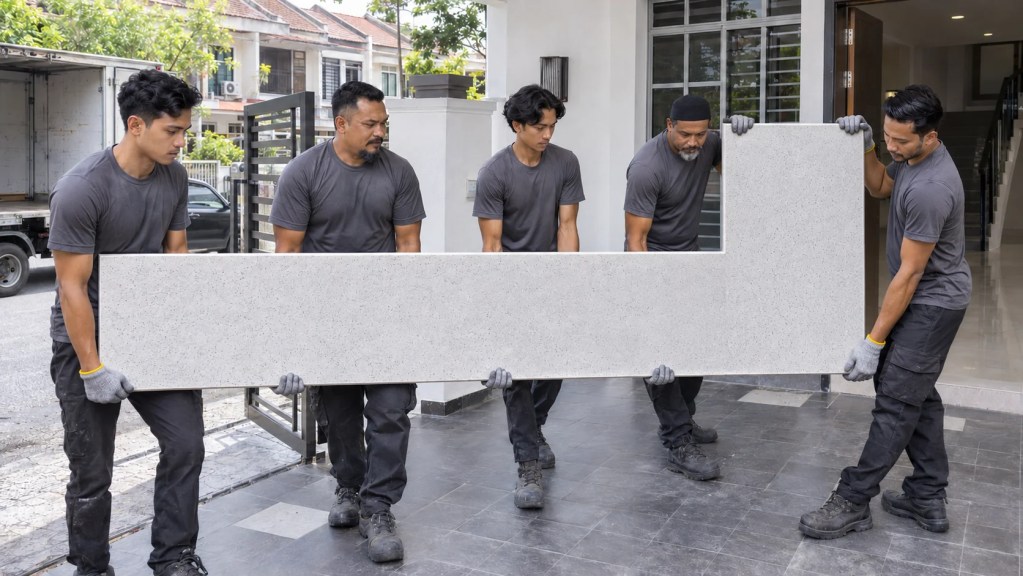
Delivery and installation. A standard jointed L arrives as two straight pieces that a normal crew can carry. A one-piece L arrives as a single large, heavy and oddly shaped stone. Moving it from the lorry to your kitchen takes a few more workers than usual, all lifting together so the corner does not flex. More workers on site means a higher labour cost on your quote.
There is no rule of thumb for how much more it adds, because it depends on your access route and floor level. If you are weighing the two options, ask your fabricator to quote both and list the handling separately. Our guide to the line items on a stone countertop quote shows what to look for.
For a sense of the material cost itself, 15mm Zenstone quartz in a 3000 x 1400mm slab is priced at RM 110 to RM 160 per sqft, supply and install. The seamless option sits on top of that as extra labour, not a different material price. You can compare the full range in our current quartz stone prices in Malaysia.
Can a one-piece L-shaped top go up a condo lift?
In most cases, no. This is the biggest reason seamless L-shaped tops are rare in Malaysian high-rise homes.
A 2.7-metre L-shaped piece cannot lie flat inside a lift car, and it cannot be tilted easily either, because the short leg sticks out sideways by more than a metre. Most residential lifts in condos and apartments are neither big enough nor tall enough to take it. Carrying it up the stairwell is not a realistic option above the first few floors, and the tight landings put the inside corner at serious risk.

There are exceptions. Some high-rise buildings, often newer developments, have very large lifts or service lifts meant for moving furniture. If your building has one, a one-piece L may be possible, but the lift is only part of the route. Before you commit, ask your management office for the lift’s internal width, depth and height, plus the size of its door opening. Then measure the building entrance, corridors, unit door and kitchen doorway, and note any tight turns along the way. Share all of this with your fabricator, who can assess whether the piece can make the whole trip. We would rather check this before cutting than discover it at the lift lobby with a 2.7-metre stone and five workers.
Who is a seamless L-shaped top best for?
- Landed homes with a ground-floor kitchen and a clear route from the gate to the kitchen
- High-rise units with a very large lift and a clear route to the kitchen, confirmed by measurement, not by guesswork
- Heavily veined designs, where a joint would cut through a vein and the continuous flow is worth the extra cost
Is a kitchen top seam something to worry about?
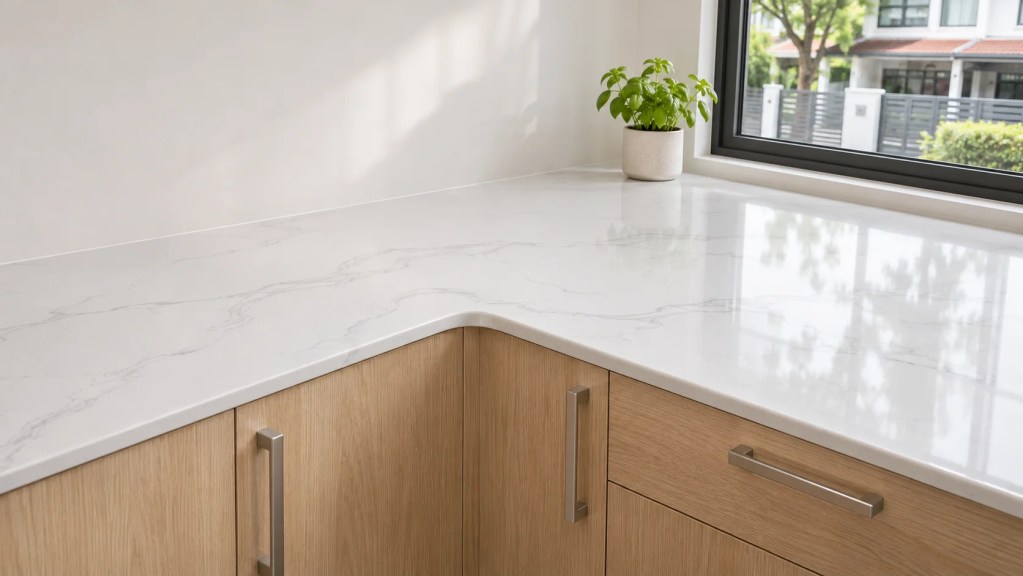
Not if it is done properly. A good L-shaped kitchen top joint on quartz is tight, flat and filled with colour-matched adhesive, so on a plain or lightly speckled colour most people never notice it.
Where the joint goes matters as much as how it is made. On an L-shape, the natural place is at the corner, where the counter changes direction. That is also where the cabinets give the stone solid support from below. A good fabricator keeps the joint well away from the sink and hob cutouts, because a cutout already weakens the stone and a joint next to it adds to the strain.

A joint also makes the job easier in ways that matter. Two straight pieces are easier to manoeuvre than an L, need a normal-sized crew, and are less likely to crack during handling. They still need an access check, though. In our 9ft example, the longer piece can be about 2.7 metres, or about 2.1 metres if the short leg takes the corner, so ask your fabricator to confirm it can clear the lift and the rest of the route. If you want to see how seams, cutting and polishing come together, our step-by-step look at countertop fabrication in Malaysia walks through it.
On a veined slab, the fabricator can also line up the pattern across the joint so the veins flow from one piece to the next. It will never be as perfect as a single piece, but on a well-matched joint you have to look closely to find it.
Does slab thickness change the answer?
Not much. Quartz comes in both 15mm and 20mm, and the slab size depends on the colour and thickness you choose rather than on thickness alone. Some colours come in a larger 3200 x 1600mm slab, which gives more room for one-piece layouts. The access problem stays the same either way, and a thicker top is heavier to carry. If you are torn between the two thicknesses, our take on how much stone thickness matters in Malaysian kitchens is worth a read.
FAQ
Can an L-shaped quartz countertop be one piece? Yes, an L-shaped quartz countertop can be one piece if its outer size fits within a single slab and the piece can be carried into your kitchen. For a 3000 x 1400mm slab, that means both legs must fit within those two measurements, with the short leg measured from the back wall.
Where should the joint go on an L-shaped kitchen top? The joint on an L-shaped kitchen top usually goes at the corner, where the counter changes direction. It sits on solid cabinet support there and stays away from the sink and hob cutouts.
Will I see the seam on a quartz kitchen top? On a plain or lightly speckled quartz kitchen top, a well-made seam is hard to spot because it is tight and filled with colour-matched adhesive. On a heavily veined design, the fabricator matches the veins across the joint, though you will still find it if you look closely.
Why can’t my condo take a one-piece L-shaped top? Most condo lifts are not big or tall enough for a 2.7-metre L-shaped piece, and carrying it up the stairs is impractical above the lower floors. Buildings with very large lifts can be the exception, so get the lift and door measurements from management, and ask your fabricator to assess the full route to your kitchen.
How many workers does it take to install a one-piece L-shaped top? A one-piece L-shaped top needs a few more workers than a standard two-piece top, because the whole piece has to be lifted together to protect the inside corner. That extra labour is why the installation cost is higher.
Conclusion
A seamless L-shaped kitchen top is possible for a 9ft x 4ft layout on a 3000 x 1400mm slab, but only when the 4ft is measured from the back wall, and only when the piece can get to your kitchen. For landed homes and high-rises with very large lifts, it is a real option if you are happy to pay for the extra workers. For most condo kitchens, a neat joint at the corner is the safer and more sensible choice. If you are still deciding on the material itself, start by comparing kitchen countertop materials in Malaysia.
Not sure whether your layout and building can take a one-piece top? Send us your kitchen measurements and tell us whether you live in a landed home or a high-rise. We will check the slab fit and the access route, and quote both options so you can see the difference before you decide.