

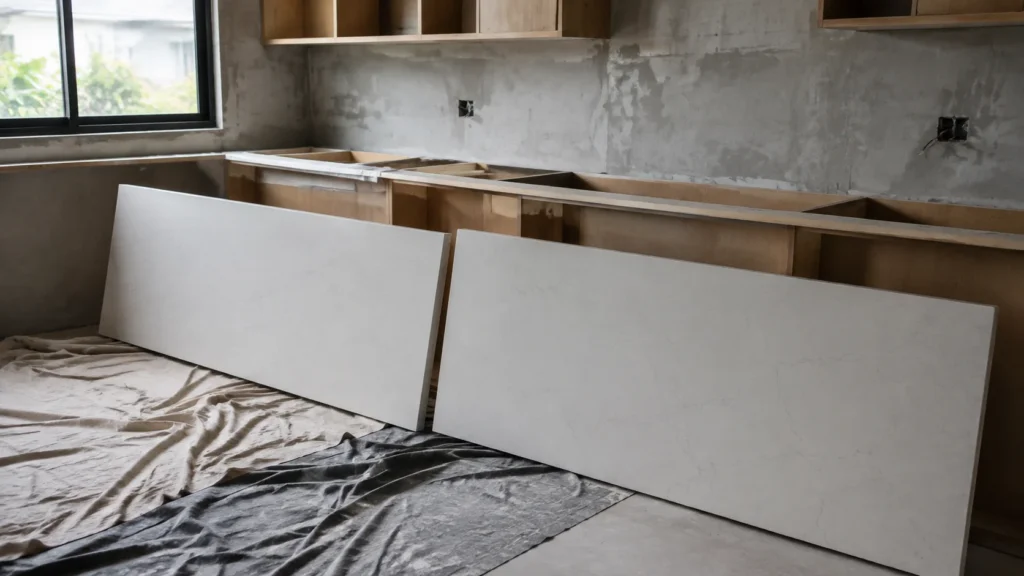
You can buy a quartz slab supply-only in Malaysia, but handing it to your tiler or wet worker to cut and install almost never works out. Quartz is fabricated on a bridge saw or CNC in a workshop, not shaped on-site with a wet saw, and most tilers will either decline the job or accept it and leave you with edges you can’t fix.
Key Takeaways
- Quartz sits at 7 on the Mohs hardness scale and is cut and polished to finished size in a workshop, not shaped on-site with a tiler’s wet saw or angle grinder
- Splitting the job (factory cuts, tiler installs) usually fails at the template rather than the install — the mitre edge overhang, which run gets an edge profile versus a backsplash, and the exact sink position all have to be on the drawing or the fabricator cuts to the wrong assumptions
- The most common visible failure is edge polishing done with a handheld grinder, which leaves circular marks and a two-tone finish that can only be fixed by re-fabricating the piece
- Manufacturer warranties are generally conditional on installation by an authorised fabricator, and cutting quartz on-site releases crystalline silica, classified by the IARC as a Group 1 carcinogen
- The honest way to lower your bill is to choose a cheaper collection, not a cheaper installer: Zenstone starts at RM110 per square foot supply and install, against RM689 for Caesarstone’s top collections
Can You Actually Buy Quartz Supply-Only in Malaysia?
Yes, some suppliers will sell you a slab without installation — but almost every reputable fabricator will ask who is installing it, and many will decline the sale once they hear the answer is your tiler.
That reluctance isn’t a sales tactic. A fabricator’s name travels with the slab. When a homeowner posts a photo of a badly finished countertop in a renovation group, nobody asks who installed it — they ask what brand it is. Fabricators who sell supply-only to unqualified installers end up defending work they never did.
If you do find a supplier happy to sell you a slab with no questions asked about installation, treat that as information rather than good luck. It usually means either the material isn’t what it’s being called, or the supplier has no reputation to protect.
Why Isn’t Quartz Just Another Building Material?
Because quartz is fabricated to a finished dimension before it reaches your kitchen, and once it’s cut, it can’t be adjusted.
Your tiler works with materials that forgive on-site correction. A tile that sits 2mm out gets nudged, and the grout line hides the rest. Cement render gets floated flat. Quartz offers none of that. The slab arrives as a single finished piece, and every millimetre was decided in the workshop.
Three properties make it a workshop material rather than a site material:
It’s hard. Quartz sits at 7 on the Mohs hardness scale — harder than most steel. Cutting it needs diamond tooling with water cooling, not a tile blade.
It’s heavy. A typical kitchen run weighs 80kg to 150kg once fabricated. Moving it into position takes suction lifters and three or four people who have done it before.
It’s unforgiving on edges. The exposed front edge is what you look at and touch every day. Getting it to match the polish on the slab’s face takes progressive diamond pads through several grits on a proper edge polisher. There is no shortcut that looks acceptable.
Asking a tiler to fabricate quartz isn’t a question of whether they’re skilled. It’s a different trade with different machinery — the same way a good carpenter isn’t a plumber.
What Does Proper Quartz Fabrication Actually Involve?
Four stages, all of which happen before the slab ever reaches your house.
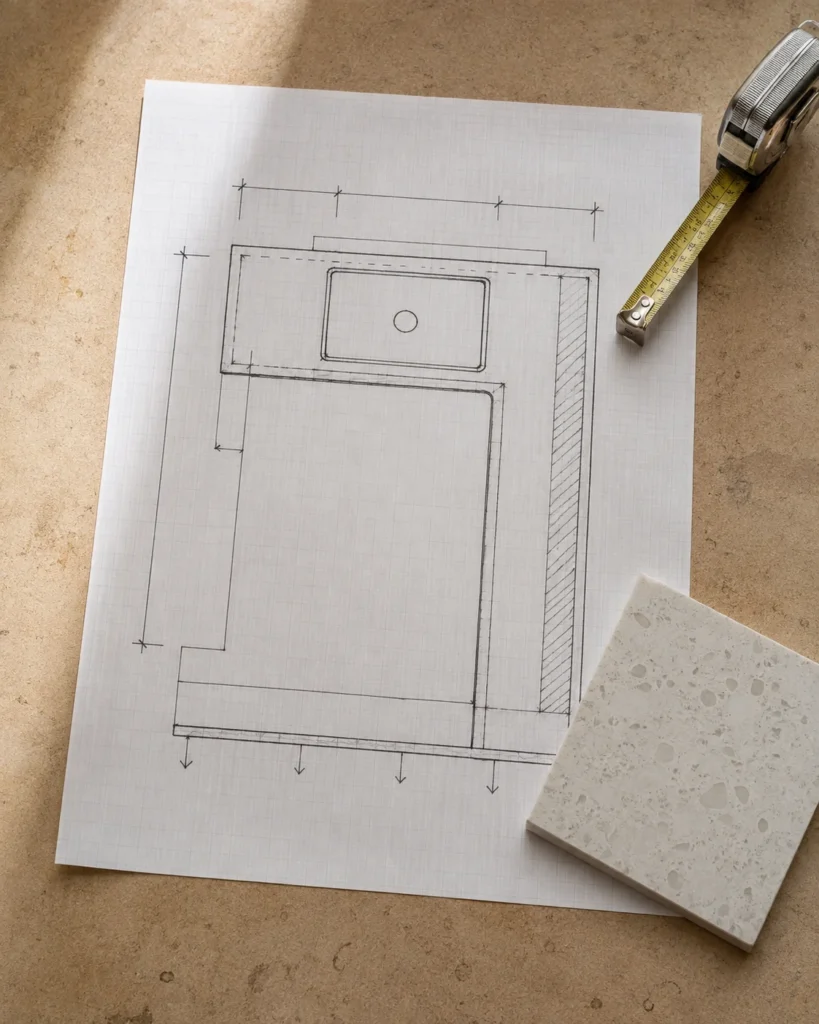
Templating. A fabricator measures the installed cabinets, not the drawings. Malaysian walls are rarely straight and corners are rarely 90 degrees, especially in older terrace houses. Templating captures those deviations so the slab is cut to your actual kitchen rather than an idealised one. Measurements passed to a tiler on WhatsApp capture none of it.
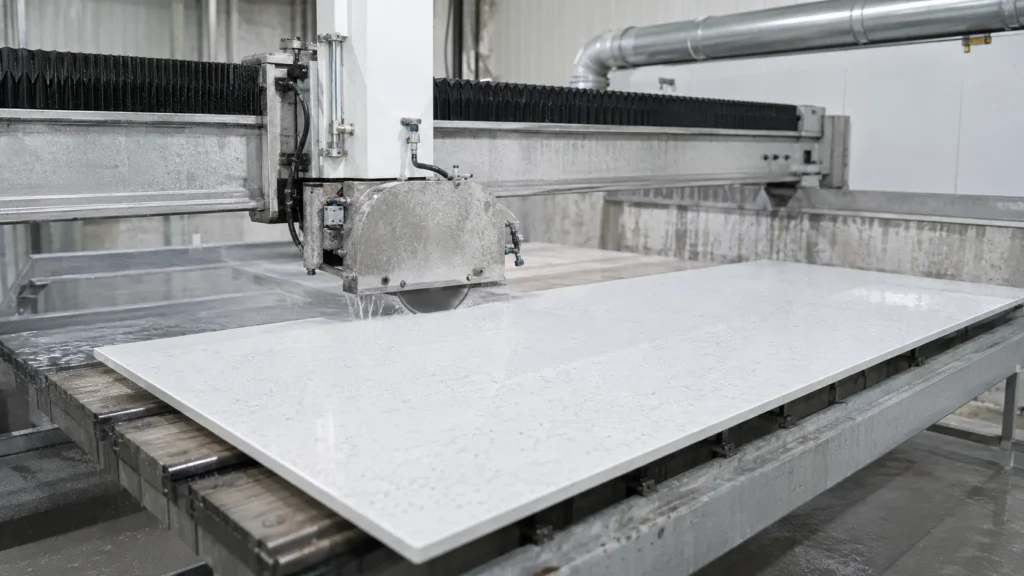
Cutting. Bridge saw or CNC, water-cooled, following the approved template. This is where sink and hob openings are made, with the slab properly supported underneath so the cutout corners don’t chip.
Edge profiling and polishing. The cut edge is shaped and then polished back to match the face of the slab. This is the stage that separates a countertop that looks finished from one that looks cut.
Seam preparation. L-shaped and island runs almost always need more than one piece. The joining faces are prepared in the workshop so the seam closes tightly on site with colour-matched epoxy.
If you want the full picture of what happens between slab and installed surface, we’ve documented it in From Slab to Surface: How Your Kitchen Countertop Is Made in Malaysia.
What Actually Goes Wrong When a Tiler Installs Quartz?
The failures are consistent, and the edge finish is the one that comes up most.
A homeowner in Petaling Jaya bought a Silestone slab and asked their renovation contractor to install it. The trouble started at delivery — six workers were needed to unload the slab from the lorry, and the driver declined to help carry it, so the homeowner ended up shouldering part of it himself. Installation went ahead anyway. The real damage only became visible once the countertop was in place: the contractor’s worker had polished the exposed front edge with a handheld angle grinder. The result was circular grinding marks running the length of the edge and a clear two-tone effect, where the ground areas looked nothing like the rest of the slab. The countertop had to come out and be professionally re-fabricated. The material cost was paid twice.
That specific failure — angle grinder on the front edge — is the single most common one, and it can’t be repaired in place. The other four:
Chipping during handling. A corner catching a cabinet edge takes 20cm or 30cm of polished edge with it. Suction lifters and enough hands exist for exactly this reason.
Wrong adhesive. Quartz needs stone bonding adhesive applied in a specific pattern. Tile adhesive or general silicone eventually lets go, and the separation usually shows up near the sink where the surface gets the most water and movement.
Poor levelling. Cabinets that aren’t shimmed level leave a countertop that holds standing water. In Malaysian humidity, that turns into a mould problem in the cabinet below rather than just a cosmetic one.
Visible seams. A properly joined seam is barely findable. One done without colour-matched epoxy and proper clamping pressure is the first thing every visitor notices.
What If the Factory Fabricates and My Tiler Only Installs It?
This sounds like the sensible middle ground, and it’s the version we hear most often — but it breaks the job at the worst possible point, which is the measuring.
The reasoning is understandable: the hard part is cutting, so let the workshop do that, then the tiler just places the finished piece on the cabinets. The flaw is that if your tiler is the one taking the measurements, the fabricator is cutting a slab to somebody else’s assumptions, and by the time anyone notices the assumptions were wrong, the piece is already cut.
Who Is Actually Templating the Job?
A template isn’t a list of lengths. It’s a drawing that settles every decision about the finished piece before the saw touches the slab, and three things get left off it almost every time.
Does the template allow for the mitre edge overhang? If you’ve chosen a mitre edge — the built-up profile that makes a 15mm slab read as a thicker slab at the front — the countertop has to project past the cabinet by the thickness of the mitre return. On a 15mm slab, that’s another 15mm out. A tiler who measures the cabinet top and sends the fabricator that figure gets back a piece that stops flush at the carcass, with nowhere for the mitre to land. That’s a re-cut, not an adjustment.
Which run gets an edge profile, and which meets a backsplash? The drawing has to mark this. A run that ends against a backsplash is finished differently from one you can see and touch. Tilers routinely leave it off, and the fabricator is left to guess — which is how you end up with a polished edge hidden behind a backsplash, or an unfinished cut edge sitting where everyone can see it.
Is the sink actually where the drawing says it is? We cut the sink opening from the template. If the centreline on that drawing doesn’t match where your cabinet and plumbing genuinely sit, the cutout lands off-centre against the door below it, and if it drifts forward it eats into the margin we keep from the front edge. Neither is fixable once it’s cut.
None of this is difficult when the fabricator templates the kitchen themselves, standing in front of your installed cabinets with the sink model confirmed. It becomes guesswork the moment those measurements arrive second-hand over WhatsApp.
Installation Isn’t Placement Either
Even with a correct template, the install is its own trade. It means checking the cabinets can carry the weight, levelling them to about a millimetre, applying the right adhesive in the right pattern, lifting the piece into position without touching an edge, closing the seams, and sealing around the sink.
Then there’s the question nobody asks until it matters. If the countertop develops a problem six months in, who fixes it? The fabricator will point at the installation. The tiler will point at the template. Both are arguing in good faith, because neither of them saw the other’s work, and you’re the one holding a countertop with no clear claim against anyone.
This is the same accountability gap we describe in Carpenter’s Stone Bundle or Your Own Supplier? — whenever the person who supplies and the person who installs are two different parties, the homeowner absorbs whatever falls between them.
Does Splitting the Job Actually Save Money?
Rarely, and the arithmetic is less flattering than it looks on the first pass.
Quartz in Malaysia is quoted as one supply-and-install rate per square foot, because the fabrication and the installation are the same chain of liability. Pulling the installation out doesn’t remove a neat line item from your bill — it removes the party who was responsible for the outcome.
Here’s what the supply-and-install rates actually look like across the brands we carry:
| Brand | Origin | Supply & install, per sq ft |
|---|---|---|
| Zenstone | House brand | RM110 – RM160 |
| Moonstone | House brand (honed and leather finishes) | RM182 – RM226 |
| Silestone | Spain (Cosentino) | RM282 – RM634 |
| Caesarstone | Israel | RM332 – RM689 |
A 20-foot kitchen run at 600mm depth works out to roughly 40 square feet. On Zenstone at RM110, that’s about RM4,400 fully installed. The whole exercise of finding a cheaper installer is aimed at shaving a fraction of that — while putting the entire RM4,400 at risk, because a slab with grinder marks along its front edge has to be replaced, not repaired.
Move up the range and the maths gets worse, not better. The same 40 square feet in Caesarstone’s Statuario Maximus at RM689 is around RM27,560. Nobody hands that to a tiler to save a few hundred ringgit.
For the full brand-by-brand breakdown, see Quartz Stone Price in Malaysia (2026).

What About Warranty and Safety?
Two things you lose with a third-party install that don’t show up on any quotation.
Warranty coverage becomes uncertain. Manufacturer warranties on quartz are generally conditional on the material being fabricated and installed by an authorised party. Genuine material installed by someone outside that chain can sit outside coverage entirely — so if a real manufacturing defect appears later, you may have no claim to make. That’s a poor trade for a small saving on labour.
Silica dust is a genuine hazard. Cutting or grinding quartz releases respirable crystalline silica, classified by the International Agency for Research on Cancer as a Group 1 carcinogen. Workshops manage it with dust extraction, water suppression, and proper respirators. A contractor grinding an edge in your car porch or kitchen manages it with none of those, and the dust is fine enough to travel through the house and to your neighbours in a terrace or apartment.
What Should You Do Instead If You’re Trying to Cut Cost?
Cut the material cost, not the installation. There’s genuine room to move on the first and almost none on the second.
Choose a house brand over an imported one. Zenstone starts at RM110 per square foot supply and install. That’s a real countertop with real fabrication behind it, not a compromise.
Pick a plain collection over a veined one. Within Zenstone alone, plain whites and greys sit at RM110 while Calacatta and Carrara-pattern designs run to RM160. Same brand, same fabrication, different look.
Keep the layout simple. Fewer seams, fewer cutouts, and a straightforward edge profile all reduce fabrication time.
Reduce the area rather than the quality. Put stone where it earns its place — the main prep run, the sink, the hob — and use something else in the dry store or utility corner.
Compare quotes properly. A quotation that just says “quartz top” tells you nothing. Ask for brand, collection, thickness, and price per square foot, then compare like for like. Our guide on reading a countertop quotation walks through what each line should say.
If you’re weighing up sourcing routes more broadly, 3 Ways to Source Your Kitchen Countertop in Malaysia compares going through your carpenter, buying online, and going direct to a fabricator.
FAQ
Will a tiler in Malaysia install a quartz countertop? Most will decline, and the ones who accept usually haven’t done it before. Tilers work with materials that allow on-site adjustment, and quartz doesn’t — the finished dimensions and the edge polish are decided in a workshop.
Can I buy a quartz slab supply-only? Some suppliers will sell supply-only, but many reputable fabricators refuse once they know a non-fabricator is installing it, because their brand name ends up attached to work they didn’t do.
Does using my own installer void the quartz warranty? It very likely puts you outside coverage. Manufacturer warranties are generally conditional on installation by an authorised fabricator, so a third-party install can leave you without a claim even on genuine material.
Can a badly polished quartz edge be fixed after installation? Not properly. Grinder marks and two-tone patches on a front edge need the piece taken out and re-fabricated, which means paying for the material and the fabrication a second time.
Can my tiler take the measurements and let the factory fabricate? This is where most split jobs fail. The template has to specify the mitre edge overhang, which run is edged and which meets a backsplash, and the exact sink position — and a measurement passed on second-hand rarely carries any of it, so the slab gets cut to the wrong assumptions.
Conclusion
Could you technically buy a quartz slab and ask your tiler to install it? Yes. Should you? Not unless you’re prepared to buy the slab twice.
The instinct behind the question is a fair one — countertops are a real expense, and looking for room in the quotation is what any sensible homeowner does. The room just isn’t in the installation. It’s in the brand and the collection you choose, and the gap between RM110 and RM689 per square foot is wide enough that almost every budget has somewhere sensible to land.
If you’d like to see the slabs in person and get a quotation with the brand, collection, and per-square-foot rate written on it, come by the showroom and we’ll walk you through what fits your kitchen and your budget.