

The honest advantages and drawbacks of quartz stone kitchen tops, judged by how Malaysians actually cook.
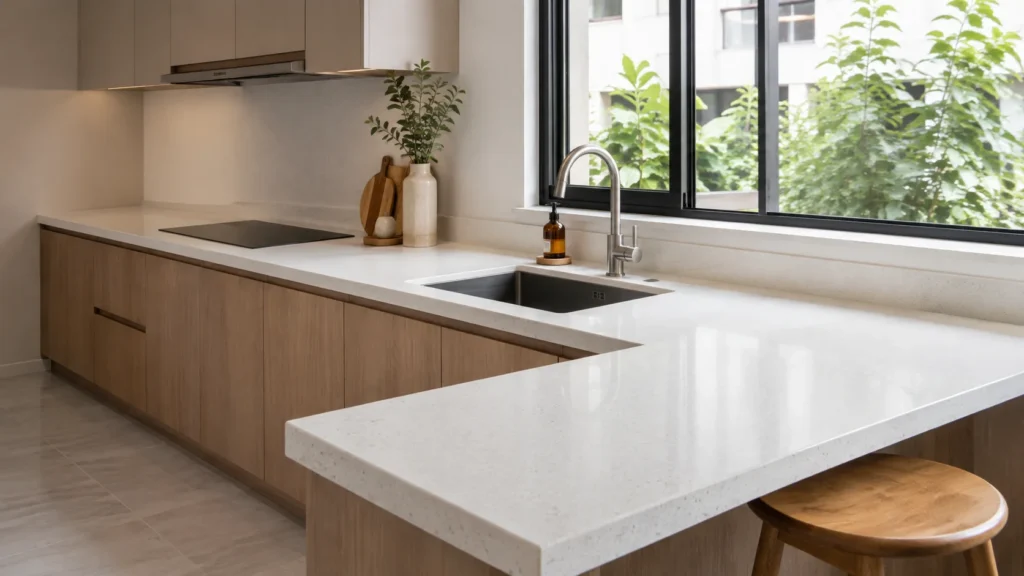
Quartz stone’s biggest advantages are its non-porous surface, near-zero maintenance, and consistent colour from slab to slab. Its main drawbacks are a ceiling on heat, yellowing under direct sun, and a higher upfront price than tile or laminate. For most Malaysian kitchens the trade is worth making, as long as you know what you’re trading.
Key Takeaways
- Quartz is non-porous, so turmeric, kicap manis, and belacan wipe off instead of soaking in, and it never needs sealing the way granite does.
- Heat has a ceiling of roughly 150°C, but everyday cooking rarely reaches it. Boiling water sits at 100°C, so a pot of soup set down briefly does no harm.
- The genuine risk is bakeware straight from the oven at 180°C to 220°C, and hot pans landing on the same spot day after day.
- Supply and install pricing in Malaysia runs from about RM110 per square foot for local brands like Zenstone up to RM689 for premium Caesarstone collections.
- Seams are not a quartz problem. Every slab material joins somewhere, and only solid surface can be joined invisibly.
- Quartz resin is not UV-stable. Under direct daily sunlight it yellows over one to two years, which matters in a Malaysian kitchen with west-facing glass.
- Quartz suits almost every Malaysian kitchen. Keep one trivet by the oven and the heat question mostly takes care of itself.
What Is Quartz Stone, and Why Do Malaysian Kitchens Use So Much of It?
Quartz stone is an engineered surface, not a natural one. It is made by crushing natural quartz crystals, binding them with polymer resin and pigment, then pressing and curing the mix into slabs. Most quality quartz sits at around 90% to 93% natural quartz content with the balance made up of resin and colour.
That manufacturing route explains almost everything else in this article. Because the surface is bound with resin, nothing soaks in, and nothing needs sealing. Because it is bound with resin, there is a ceiling on how much heat it will take. One process, two consequences, pulling in opposite directions. If you want the full production story, we’ve covered how quartz stone is made in detail.
Granite, by contrast, comes out of the ground as it is. That single difference in origin drives the practical gap between quartz and granite kitchen tops in daily use.
What Are the Pros of Quartz Stone Kitchen Tops?
The main advantages are stain resistance, no sealing, hygiene in a humid climate, consistent appearance across slabs, and a long service life that spreads the cost thin.
Does quartz really resist Malaysian cooking stains?
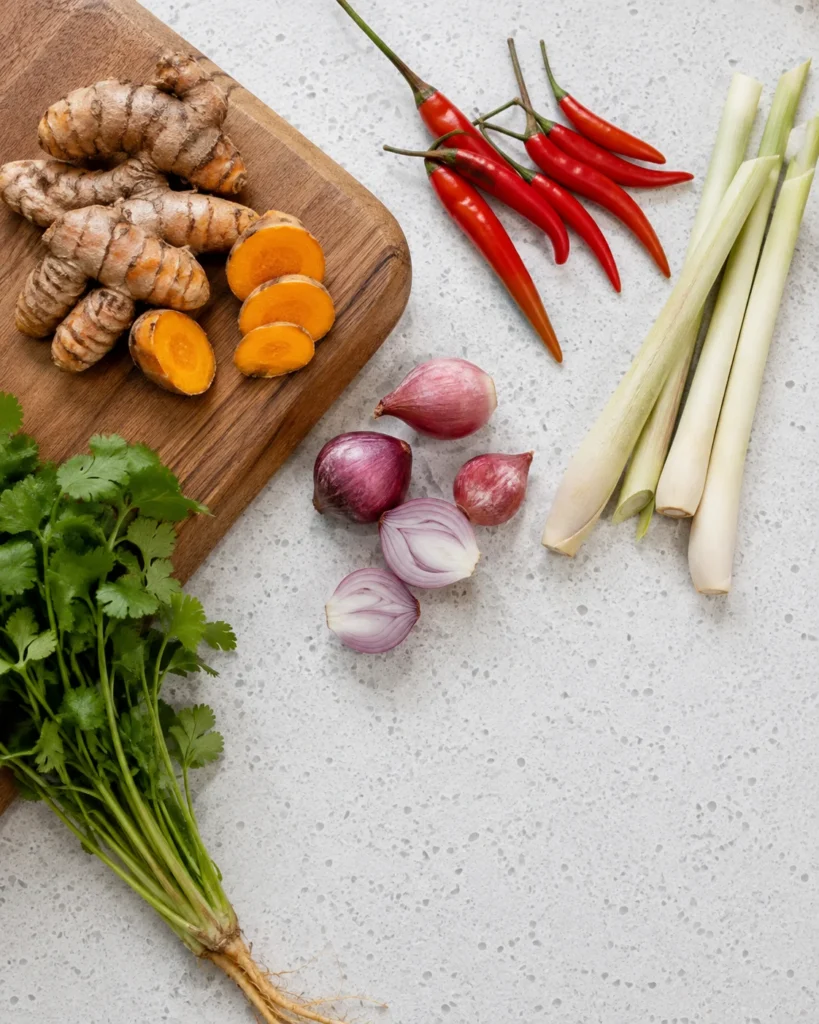
Yes. Quartz is non-porous, so pigment from turmeric, curry paste, soy sauce, or beetroot sits on the surface instead of sinking into it. Wipe it within a reasonable time and the colour goes with the cloth.
This is the single clearest daily win over natural stone. Granite and marble are porous and need sealing on a cycle to hold that line. Quartz needs none. That said, non-porous is not the same as indestructible, and a turmeric stain left overnight still needs a proper clean rather than a wipe, which is why it’s worth knowing how to clean a quartz countertop the right way.
How much maintenance does quartz actually need?
Almost none. Warm water, a soft cloth, and mild dish soap handle daily cleaning. There is no annual sealing, no impregnator, no specialist product.
What you do need to avoid is harsh chemistry. Bleach, oven cleaner, drain cleaner, and abrasive scouring pads attack the resin and dull the finish. The rule is simple: if it strips paint, keep it off your countertop.
Is quartz hygienic enough for a Malaysian kitchen?
Yes, and the humidity here makes that matter more than it would in a drier climate. With no pores to hold moisture, there is nowhere for bacteria, mould, or mildew to establish. That is a genuine advantage when you’re handling raw chicken or seafood on the same surface where the kids eat breakfast.
Premium brands go further. Silestone carries NSF-51 certification for food-contact surfaces, which means the material has been tested against a published standard rather than described as safe in a brochure.
Will the slabs actually match each other?
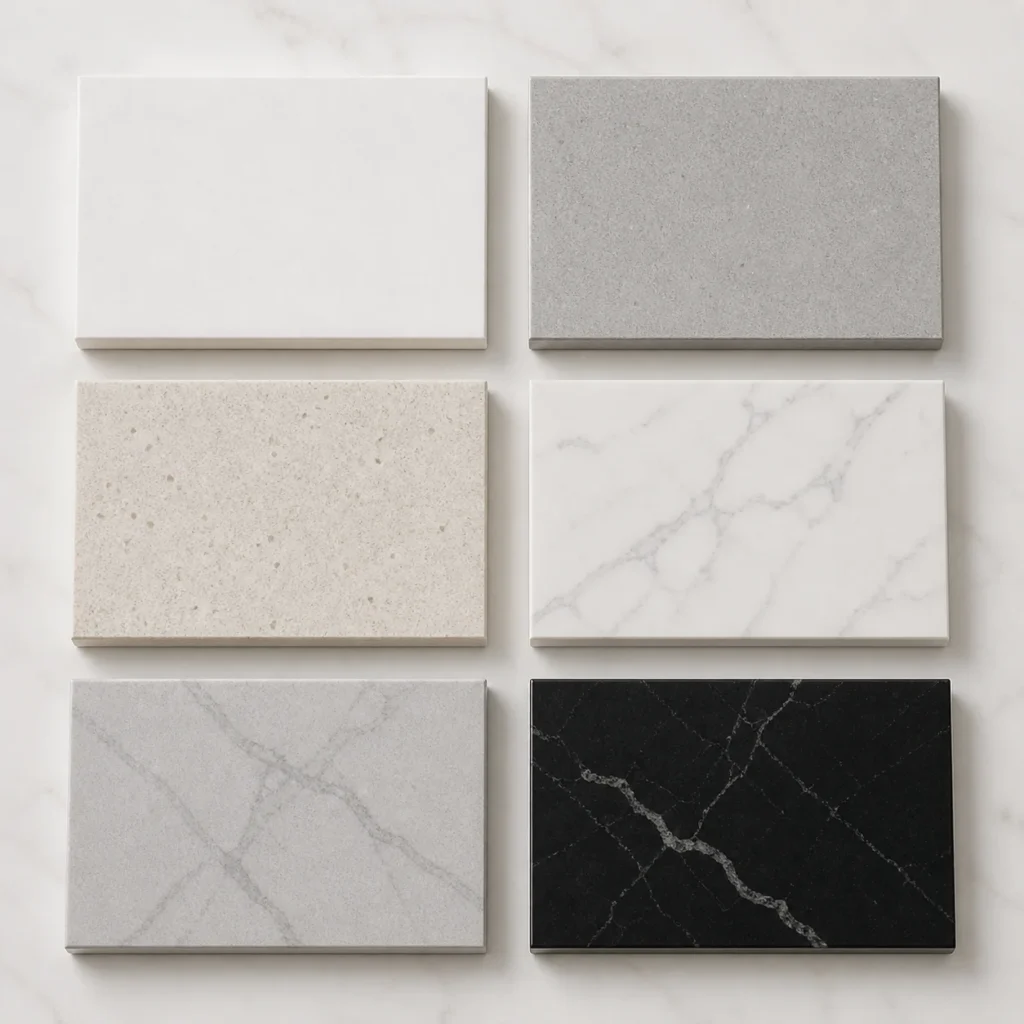
They will, and this is quietly one of quartz’s most useful properties. Because the colour and pattern are engineered rather than quarried, what you saw on the sample is what arrives on site, and a second slab for your island will match the first.
Try that with natural stone and you are at the mercy of the block. Marble and granite vary from slab to slab, sometimes dramatically. For a kitchen with an L-shaped run plus an island, or a renovation done in phases, quartz removes an entire category of unpleasant surprise.
Does quartz hold its value over 15 years?
It does, once you divide the cost across its lifespan. A properly fabricated quartz top lasts 15 to 25 years with ordinary care, with no resealing bills and no mid-life replacement. Tile grout, by comparison, discolours and cracks long before that.
There’s a resale angle too. In the Klang Valley property market, a named-brand quartz top reads as a finished kitchen rather than a job someone cut corners on. We’ve made the longer case for this in 5 reasons quartz countertops are worth every penny.
What Are the Cons of Quartz Stone Kitchen Tops?
The real drawbacks are a ceiling on heat, upfront cost, UV yellowing, and a manufactured look that not everyone warms to. Seams get raised often enough that they deserve an answer too, though as you’ll see, they belong to slabs in general rather than to quartz.
How much does quartz stone cost in Malaysia in 2026?
Supply and install pricing spans a wide range depending on brand and collection. Here is what the current range looks like:
| Brand | Segment | Supply & install (per sqft) |
|---|---|---|
| Zenstone | Local | RM110 – RM160 |
| Moonstone | Local | RM182 – RM226 |
| Silestone (Spain) | International | RM282 – RM634 |
| Caesarstone | International | RM332 – RM689 |
The gap between the cheapest local white and a premium imported Calacatta pattern is more than six times. That’s why “quartz countertop” on a quotation, with no brand or collection named, tells you almost nothing about what you’re paying for.
To put it in project terms: a 30 square foot kitchen run comes to roughly RM3,300 in entry-level Zenstone, or about RM10,290 in a mid-tier Silestone. Both are quartz. Neither quote is wrong. They are simply not the same product. For the full breakdown by collection, see our quartz stone price guide for Malaysia.
How much heat can a quartz kitchen top actually take?
Quartz handles everyday cooking heat without complaint. The resin binder starts to soften and discolour from roughly 150°C, and most of what happens in a home kitchen never gets near that. This limitation is real, but it is far narrower than the internet suggests.
Think about the numbers. Water boils at 100°C and stays there, so a pot of soup, a pan of Maggi mee, or a kettle set down on the counter for a moment is nowhere close to the threshold. Brief contact from cookware that has been holding liquid is fine.
Two situations are the actual risk:
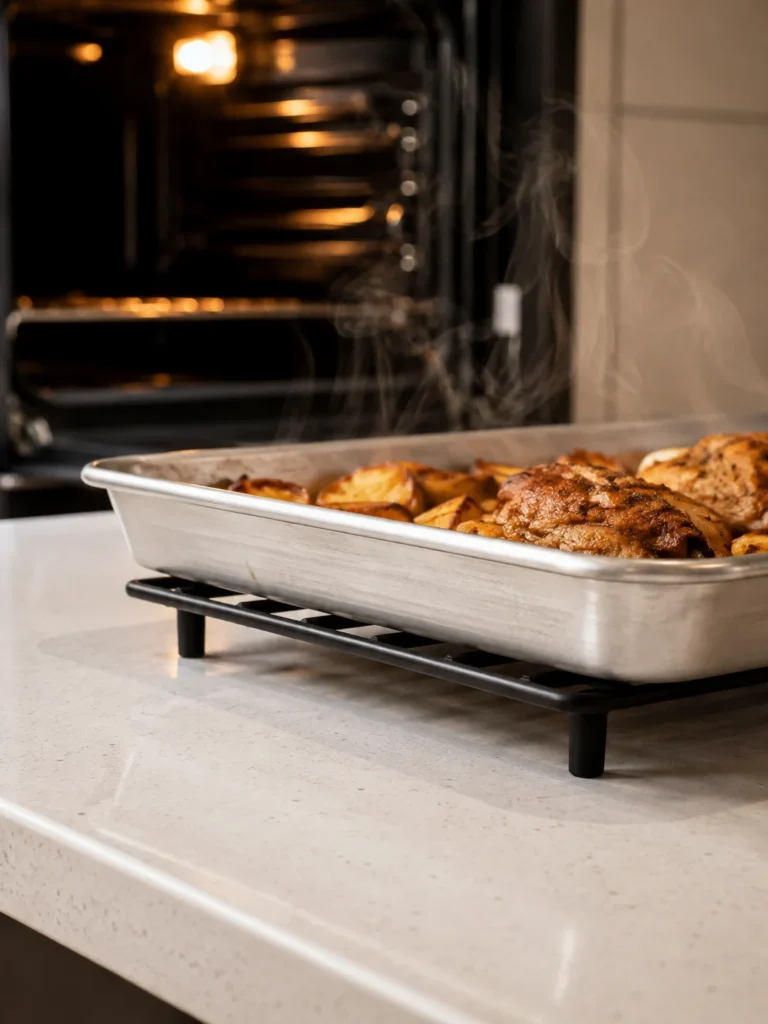
- Bakeware fresh from the oven. An aluminium cake tin or baking tray comes out at 180°C to 220°C, well past what the resin will take, and metal transfers that heat fast. Put one straight onto the stone and you can leave a permanent burn mark in seconds. This is the single most common way Malaysian homeowners damage a quartz top.
- The same spot, every day. A dry wok off a high flame, or a pan that lands in the same place after every meal, builds up repeated thermal stress. One time is usually survivable. A year of it is how a dull, discoloured patch appears next to the hob.
The habit that solves both costs almost nothing: keep one trivet beside the oven and one near the hob. Air fryers, rice cookers, and slow cookers sitting in a fixed position deserve a mat under them for the same reason. If you want the detail on what actually happens at the surface, we’ve covered putting hot pans directly on a quartz stone kitchen top separately. And if you bake heavily or run a wet kitchen at full tilt every day, sintered stone or granite removes the question altogether.
Will your kitchen have visible seams?
If the run is longer than one slab, yes, but this is a slab reality rather than a quartz fault. Granite, quartzite, marble, porcelain slab, and sintered stone all arrive as finite pieces and all need joining on a long run. Quartz slabs finish at roughly 3000mm to 3300mm depending on brand and collection, which is broadly in line with the rest.
Where quartz actually does better than most is at the join itself. Because the colour and pattern are engineered rather than quarried, the two pieces match each other, and a fabricator can tint the adhesive to the exact colour. On a light, lightly patterned quartz the seam is genuinely hard to find. Natural stone rarely gives you that, since the veining on one slab won’t continue neatly into the next.
If a truly seamless top is non-negotiable, the honest answer is solid surface. It is the one countertop material that can be joined and sanded back into a continuous surface with no visible line, which is why it still turns up in laboratories and commercial fit-outs. The trade is that it scratches, marks under heat, and doesn’t read as premium next to stone. We’ve weighed that up in is solid surface still a good choice for your kitchen countertop.
Does quartz turn yellow in Malaysian sunlight?
It can. The resin binder is not UV-stable, and under direct daily sun quartz yellows or fades over about one to two years. In a country with year-round intense sun, an island next to floor-to-ceiling glass or a west-facing window is a real risk, and light colours show it first.
Blinds during peak hours, darker colours, or repositioning the layout all reduce the exposure. If the sun is unavoidable, sintered stone contains no resin and doesn’t have this problem. We’ve gone deeper on this and the other limitations in the disadvantages of quartz stone countertops.
The same resin issue rules quartz out for outdoor kitchens and uncovered patios entirely.
Does quartz look too perfect?
For some people, yes. The consistency that makes quartz easy to plan around also makes it read as manufactured. Veining repeats. Nothing surprises you. If part of what you love about marble is that no two slabs are alike, quartz will feel flat by comparison.
Modern printing and veining techniques have narrowed that gap considerably, and premium marble-look collections hold up well at arm’s length. But if you want stone with a bit of geology in it, quartz is the wrong material and no amount of pattern development will change that.
Quartz Pros and Cons at a Glance
| Factor | How quartz performs |
|---|---|
| Stain resistance | Excellent. Non-porous, nothing soaks in |
| Sealing required | None, ever |
| Heat tolerance | Fine for everyday cooking. Ceiling around 150°C, so oven bakeware needs a trivet |
| Scratch resistance | Very good under normal kitchen use |
| Hygiene | Excellent. No pores for mould or bacteria |
| Colour consistency | Excellent. Slabs match each other |
| UV stability | Poor. Yellows under direct sun |
| Seams | Beyond 3000–3300mm, as with all slab materials. Joins match well |
| Outdoor use | Not suitable |
| Price (supply & install) | RM110 – RM689 per sqft |
| Expected lifespan | 15 to 25 years |
How Does Quartz Compare to Other Countertop Materials?
Quartz sits in the middle of the market: less maintenance than natural stone, less heat tolerance than sintered stone, and a wider design range than either.
| Material | Beats quartz at | Loses to quartz at |
|---|---|---|
| Granite | Heat resistance, natural character, outdoor use | Needs sealing, stains, slab-to-slab variation |
| Sintered stone | Heat, UV stability, outdoor use | Higher cost, chips at edges, fewer designs |
| Porcelain slab | Lighter, heat tolerant | Thin body, not all grades are countertop-rated |
| Solid surface | Seamless joins, repairable | Scratches, marks with heat, less premium finish |
One caution on porcelain: not every porcelain slab is suitable for a kitchen countertop. Thickness and body grade both matter, and plenty of what’s sold as slab is really oversized wall tile.

Which Quartz Myths Should You Ignore?
Three keep coming up in showroom conversations, and all three are wrong.
“Thicker quartz is stronger.” Not meaningfully. Stone thickness doesn’t matter much in Malaysian kitchens once the substrate underneath is properly built. Standard 15mm and 20mm slabs both perform fine in a residential kitchen. Thickness is mostly an appearance decision.
“All quartz is the same.” It isn’t. Quartz content, resin quality, pigment stability, and warranty terms vary widely between brands, which is exactly why the price spans RM110 to RM689. Caesarstone and Silestone sit at one end for a reason, and compressed marble sold as quartz sits well below the other.
“Quartz is maintenance-free.” Low maintenance, not zero. You still clean it daily, still keep harsh chemicals off it, and still reach for a trivet when the oven tray comes out. We’ve collected the rest in 5 stone countertop myths worth dropping.
Is Quartz Stone Right for Your Kitchen?
Quartz is the right call for most Malaysian kitchens, but not all of them. Here’s the honest split.
Choose quartz if you:
- Want a surface that shrugs off spices and sauces with a wipe
- Would rather not think about sealing, ever
- Need matching slabs across a run, an island, and a backsplash
- Can keep a trivet by the oven for bakeware coming out hot
- Have a countertop position that isn’t sitting in direct afternoon sun
Look elsewhere if you:
- Bake often, or know that hot pans will land on the same bare spot every single day
- Want natural variation and one-of-a-kind veining
- Are fitting an outdoor or uncovered kitchen
- Need a genuinely seamless top, in which case solid surface is the only material that delivers it
FAQ
Is quartz stone good for a Malaysian kitchen?
Yes, for most homes. Its non-porous surface handles the spices, sauces, and humidity that define Malaysian cooking without sealing or special care. Everyday cooking heat is not a problem either, as long as bakeware coming out of the oven lands on a trivet rather than bare stone.
What is the biggest disadvantage of quartz countertops?
UV yellowing under direct sunlight, because it happens gradually and cannot be reversed. Heat gets more attention, but the 150°C ceiling only bites with oven bakeware or the same hot pan landing in the same place daily, and one trivet handles both.
How much does a quartz kitchen top cost in Malaysia?
Supply and install runs from about RM110 per square foot for entry-level local brands like Zenstone, up to RM689 for premium Caesarstone collections. Silestone sits between RM282 and RM634, and Moonstone between RM182 and RM226. Always get the brand and collection named on the quotation.
Does quartz stone stain?
Not easily. Because it’s non-porous, most spills wipe off with no trace. Prolonged contact with strong pigments such as turmeric can leave surface marking, which a proper clean will usually lift. What quartz cannot recover from is heat damage or chemical damage from bleach and oven cleaner.
How long does a quartz countertop last?
Fifteen to twenty-five years with normal care, and often longer. There is no resealing cycle and no scheduled maintenance, so the main risks to its lifespan are heat marks, chemical damage, and impact on an unsupported edge.
Can quartz be used outdoors in Malaysia?
No. UV exposure breaks down the resin binder and causes yellowing and fading. For an outdoor kitchen or an uncovered patio, sintered stone or granite is the correct material.
Conclusion
Quartz stone earns its place in Malaysian kitchens by being the surface that asks least of you day to day. No sealing, no stain anxiety, no mismatched slabs. What it asks for in return is a trivet by the oven, a countertop position out of the direct afternoon sun, and a bigger cheque at the start.
None of that is demanding. The homeowners who end up disappointed are usually the ones nobody warned about the cake tin, or the ones whose island sits behind west-facing glass. Know those two things going in and quartz will still look right in year 15.
Not sure how your kitchen layout and cooking habits stack up? Talk to us about both, and we’ll tell you plainly which material fits, along with the price per square foot before you commit to anything.