

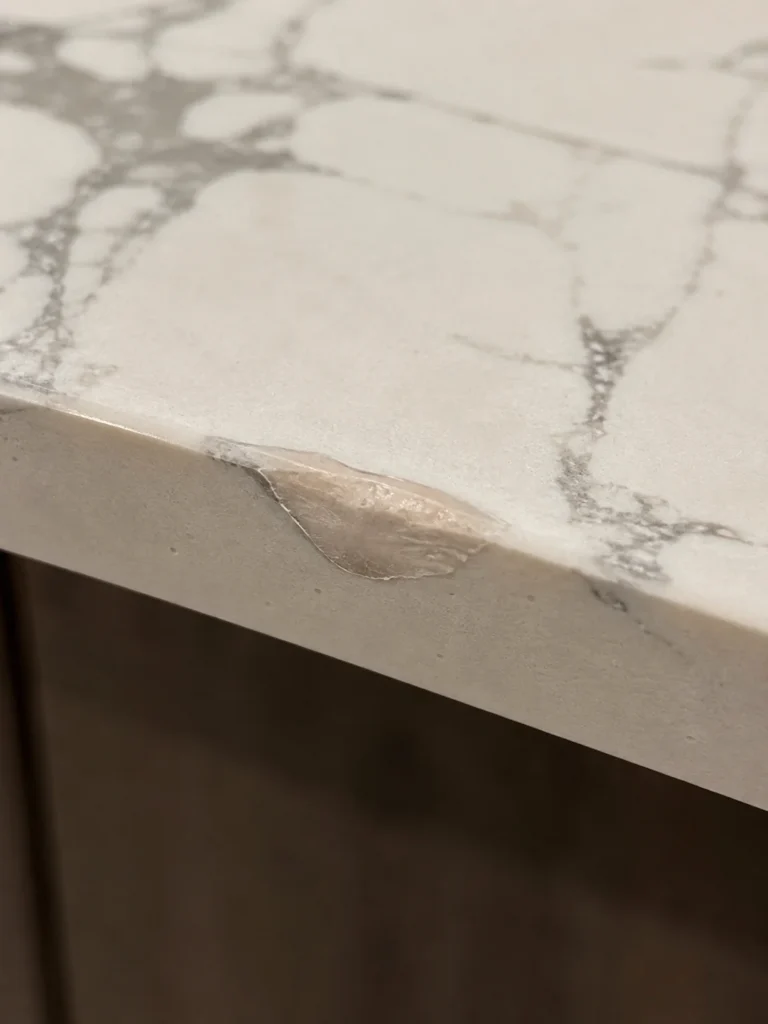
Porcelain countertops have five disadvantages that rarely come up in a showroom: the material is brittle at edges and corners, it limits you to one reliable edge profile, it costs more to fabricate and install than quartz, chips and cracks can never be repaired invisibly, and the marble veining you fell in love with is printed only about 1mm deep. None of this makes porcelain a bad material. It makes it a material with a specific job, and a primary kitchen countertop may not be that job.
Porcelain slabs are genuinely impressive. They shrug off UV, handle heat better than almost anything else on the market, and copy natural stone convincingly. But every material trades something away, and porcelain trades away toughness and repairability. Here is what that costs you in a real Malaysian kitchen.
Key Takeaways
- Porcelain has no resin binder, so it is hard but brittle. Edges chip on impact and the surface can crack if a heavy item drops from an overhead cabinet.
- A pencil edge with a 3mm chamfer on top and bottom is the only edge profile we consider safe on porcelain. Decorative profiles like ogee or bullnose are off the table.
- Porcelain slabs cannot be rested on the floor at any point. They need padded A-frame racks, specialist blades, and a fabricator who has handled the material before.
- Chips and cracks in porcelain can be filled or stabilised, but the repair stays visible because there is no resin to colour-match into.
- The marble veining is a printed layer roughly 1mm thick over a body that carries no pattern, which is why cut edges never match the surface.
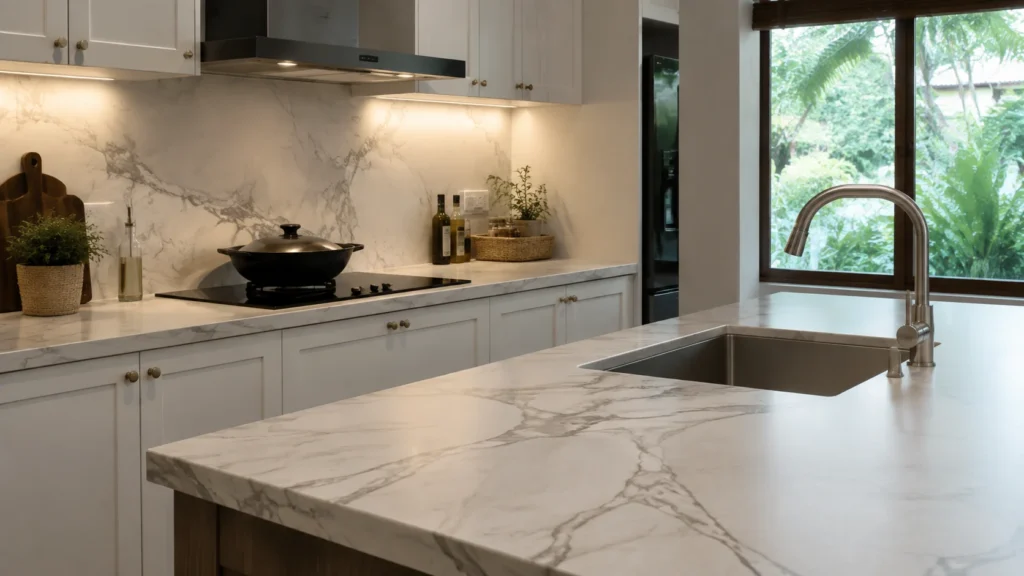
Why Do Porcelain Countertops Chip So Easily at the Edges?
Because porcelain is hard but not tough, and those are two different things. Porcelain is fired under extreme heat and pressure into a dense, uniform body with no binding agent inside it. That density is what makes it scratch-resistant. It is also what makes it brittle: there is nothing in the slab to absorb a sudden impact, so the energy goes straight into a chip or a crack. Quartz stone contains resin, which flexes a little and cushions a knock. Porcelain has no such cushion, top to bottom.
This is the distinction between hardness and toughness that trips up most buyers, and it is worth understanding how the Mohs hardness scale actually works before you take a showroom scratch test as proof of durability.
It Starts Before the Slab Reaches Your House
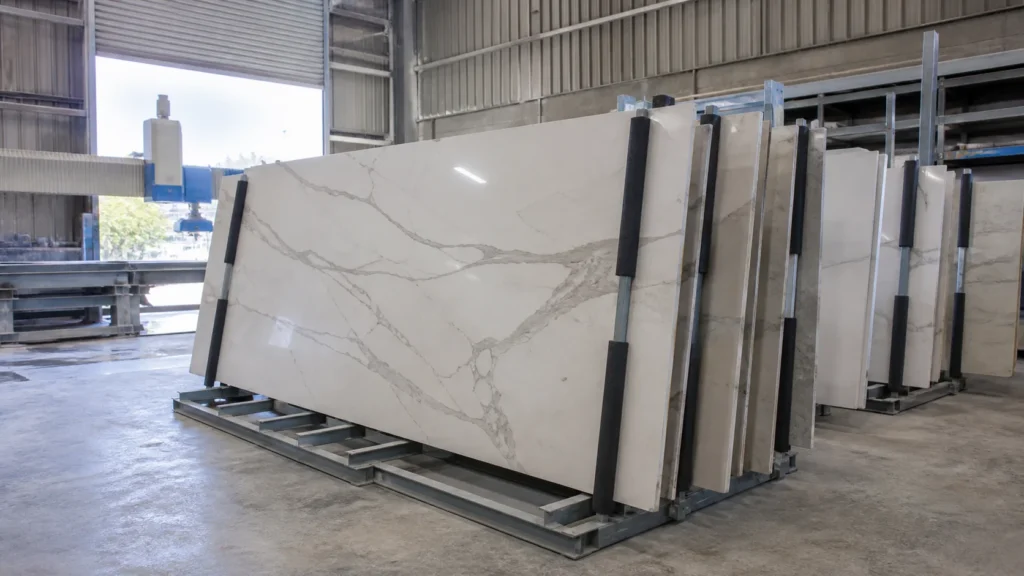
Porcelain slabs are so fragile at the edge that they cannot be set down on the floor. Not on tile, not on concrete, not even for a second while someone repositions their grip. The edge chips on contact.
Fabricators who handle porcelain properly store every slab on padded A-frame racks with soft contact points. If your renovation stalls and the slab has to wait for your cabinets, it waits on a rack in a workshop, not leaning against a wall the way granite or quartz can. In practice this means:
- Higher delivery and handling costs, because the job needs specialist gear
- A real risk of damage before installation even starts
- Delays if a slab arrives chipped and has to be reordered
- Storage space that not every fabricator actually has
What This Looks Like in a Malaysian Kitchen
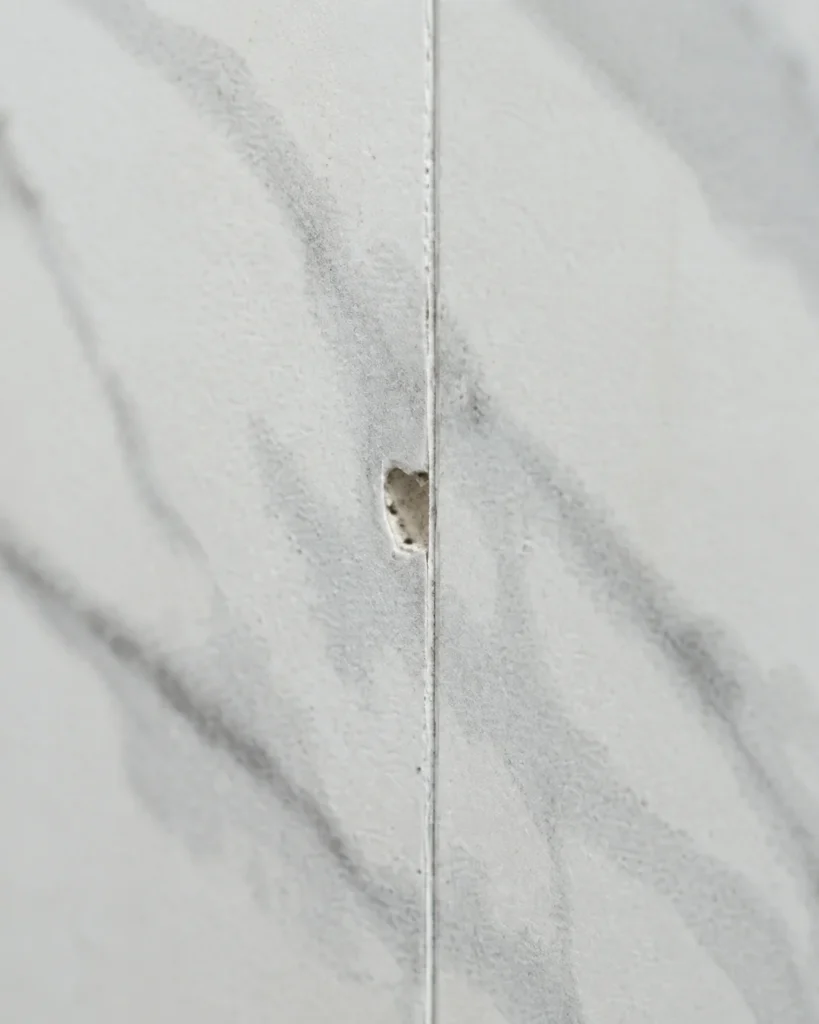
Malaysian cooking runs on heavy cast iron woks, stainless steel stockpots, and claypots that get moved around all day. Knock one against a porcelain edge and you get a chip that cannot be blended away. We see the damage cluster near the hob, where heavy cookware is lifted, slid, and set down constantly.
Corners take it worse. If children run through your kitchen, or you tend to swing round quickly with a hot pan in hand, exposed corners become something you think about every day.
The Overhead Cabinet Risk Nobody Mentions
Edges are the obvious weak point. The surface is the one that catches people out. A rice cooker, a glass jar of preserved vegetables, or a stone mortar falling from an overhead cabinet at 1.5 to 2 metres can crack a porcelain countertop on impact. Depending on where it lands, you get cracks radiating from the impact point, a star-pattern fracture that compromises the whole slab, or subsurface damage that you will not see until it spreads.
Malaysian kitchens are set up almost perfectly to cause this. Rice cookers and blenders live in overhead cabinets. Glass jars of spices and preserved food line the upper shelves. Heavy grinding stones get stored above counter height because there is nowhere else for them. And someone reaching for one item will eventually dislodge another.
Quartz is not immune to impact cracking either, but its resin content absorbs enough energy to survive drops that would fracture porcelain. If you want the full picture on where each material gives way, our guide to pounding lemongrass on quartz and sintered stone covers the same impact problem from the cooking side.
Notice what showrooms demonstrate: they drag a key across the surface to prove scratch resistance. They never drop anything on the edge.
Why Are Your Edge Profile Options So Limited With Porcelain?
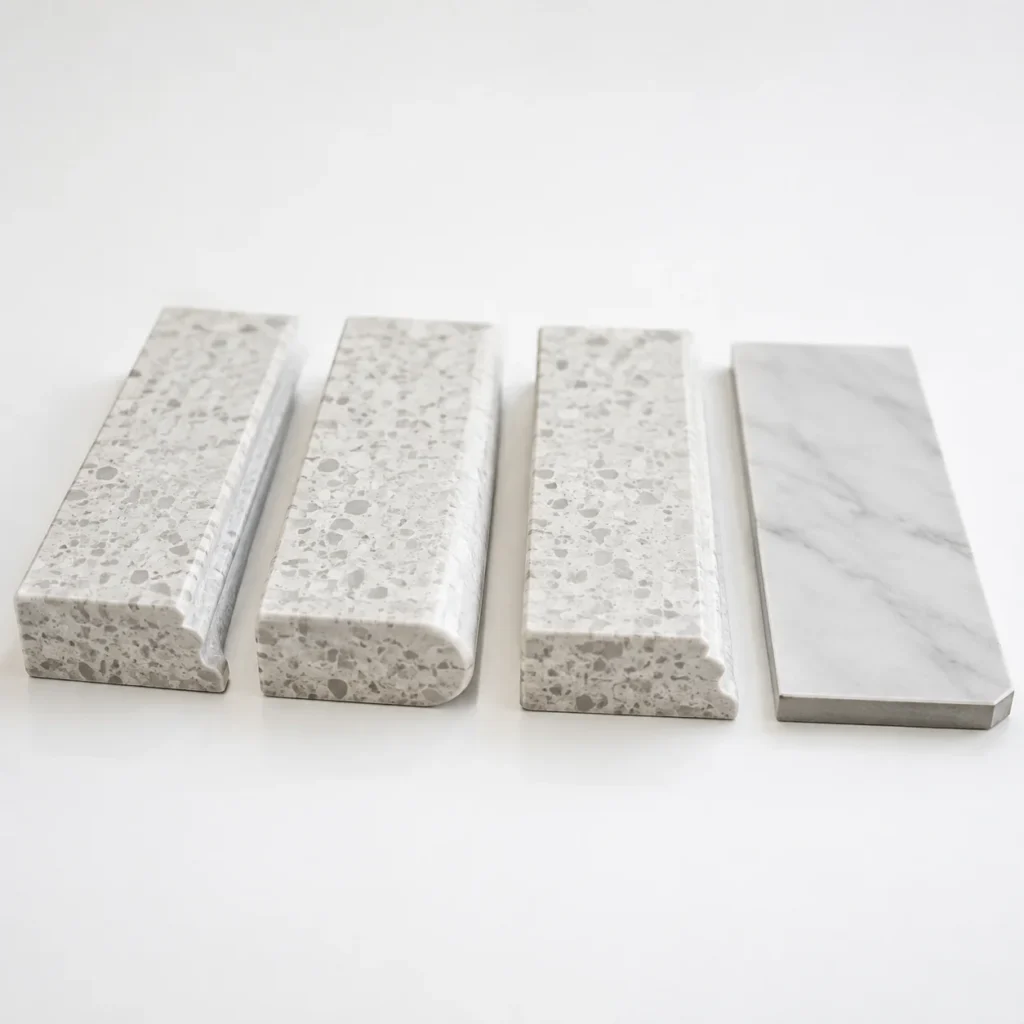
Because every decorative edge profile removes material and creates thin, unsupported sections, and porcelain fractures at exactly those points. Quartz can be fabricated into ogee, bullnose, dupont, or detailed waterfall edges. Porcelain realistically gives you a square edge, a light bevel, or a minimal round-over. Push past that and the risk of chipping during fabrication is high enough that most fabricators will decline the job.
Why the 3mm Chamfer Matters
For porcelain slabs, the edge treatment we consider correct is a pencil edge with a 3mm chamfer on both the top and bottom. That number is not arbitrary. It came out of years of trial and error and consultation with Spanish porcelain technicians, Spain being the centre of porcelain slab technology.
Here is a quick way to date an installation. If you walk into a showroom and see porcelain countertops with a 1mm chamfer, you are almost certainly looking at work completed before 2021. That was the industry standard until fabricators worked out it was not enough.
What changed our mind:
Before 2022, we polished porcelain edges with a 1mm chamfer, the same as everyone else. Two to four clients a year came back with edge chipping, and those were only the ones who bothered to report it. How many lived with a small chip and never called? The real rate was certainly higher.
Since switching to a 3mm chamfer pencil edge in 2022, chipping complaints have stopped. Not dropped. Stopped.
So Why Doesn’t Every Fabricator Do It?
Time and money. A 3mm chamfer takes longer to polish, burns through more polishing pads, and removes more material than a quick 1mm pass. From a production standpoint, 1mm is faster and more profitable.
Could we polish 1mm and move on to the next job? Of course. But the chamfer is what stands between your countertop and a chipped edge in year two, so it is not a corner worth cutting. The larger chamfer protects the edge while keeping the sharp, modern line porcelain is chosen for. After enough testing, 3mm turned out to be the sweet spot: big enough to prevent chipping, small enough to still look clean.
When you compare porcelain quotes, ask three questions:
- What chamfer size do you use on porcelain edges?
- When did you switch to a larger chamfer?
- What has your chipping complaint rate been since?
A fabricator still running 1mm, or one who tells you chamfer size makes no difference, has not learned from the past few years of industry experience. Add these to the rest of the questions worth asking before you buy a countertop.
The Design Trade-Off
The 3mm chamfer pencil edge solves the chipping problem and looks sharp. It is still, fundamentally, one simple edge. In a modern minimalist kitchen that is exactly right. In a traditional or transitional kitchen with moulded cabinet doors and classical detailing, an ultra-minimal edge can read as disconnected from everything around it.
Quartz, by comparison, accommodates ogee edges for traditional cabinetry, bullnose for a softer family-friendly look, multi-angle bevels, and dupont edges for contemporary work. With porcelain, the pencil edge is not your best option. It is your only reliable one.
Does Porcelain Cost More to Fabricate and Install Than Quartz?
Yes, and the gap sits in labour and risk rather than in the slab itself. Porcelain demands specialist blades, specialist adhesives, specialist storage, and a fabricator who has cut enough of it to know where it will fail. All of that is priced into the installation line on your quote.
The Skills the Job Actually Needs
Installing porcelain is not a job for a general stone fabricator. The material can crack during cutting, lifting, or setting if it is handled without the right equipment and technique. Fabricators need diamond blades rated for ultra-hard material, adhesives suited to a non-porous body, and genuine experience with large-format slabs that flex more than people expect.
The care starts before any cutting happens. As covered above, a porcelain slab cannot touch the floor, which means your fabricator needs proper racking infrastructure, not just a saw. If you want to see how much handling a countertop goes through before it reaches your kitchen, our walkthrough of how a kitchen countertop is made in Malaysia shows every stage where porcelain can be lost.
The Coverage Problem Outside the Klang Valley
Kuala Lumpur, Penang, and Johor Bahru have experienced porcelain installers. Coverage thins out quickly beyond them. In Ipoh, Kuantan, or Malacca, a qualified team may need to travel in, and travel time, an extra templating trip, and occasionally an overnight stay all land on your invoice.
These charges are legitimate. What causes arguments is finding them on the final bill rather than the quotation. Ask for them to be itemised upfront, and use our breakdown of what every line item on a countertop quote means to check that nothing has been left off. For reference, quartz and sintered stone both start from around RM110 per square foot supply and install on entry collections, which gives you a baseline to measure any porcelain quote against.
What Poor Installation Costs You
If your installer lacks porcelain-specific experience, the failure modes are expensive:
- Cracks during template fitting or final placement
- Adhesive applied wrongly, leading to delamination later
- Uneven support that builds stress points and cracks over time
- Visible lippage at the seam, which is close to impossible to correct after the fact
And the detail that should give you pause: plenty of fabricators will not warranty porcelain work at all, because they know how easily it goes wrong.
Can a Chipped or Cracked Porcelain Countertop Be Repaired Invisibly?
No. Porcelain can be filled, stabilised, or replaced, but no repair on porcelain disappears under close inspection. The material is uniform through its thickness with no resin in it, so there is nothing for a repair compound to blend into. What helps porcelain shrug off deep scratches is exactly what makes chips permanent.
For edge chips:
- Epoxy fills leave a visible colour mismatch, worst of all on veined patterns
- Professional porcelain repair compounds match colour better, but the texture difference still shows
- Replacing the section is expensive, and may not match if your colour has been discontinued
For surface cracks:
- Resin injection stabilises the crack but leaves the line visible
- Professional restoration rarely achieves an invisible result on veined or patterned porcelain
- Slab replacement is often the only genuinely satisfying fix, at full material and labour cost again
Quartz handles this better. Small chips take colour-matched resin reasonably well, since the slab already contains resin, and minor surface damage can sometimes be polished out. Our honest look at the pros and cons of quartz stone kitchen tops covers where quartz gives way in return.
The Prevention Burden
Over five to ten years, accumulated chips and repair marks can leave a countertop looking tired even though the main surface is untouched. Avoiding that means living carefully around the material:
- Always use a cutting board, even though porcelain resists scratches
- Never slide heavy pots or pans across the surface
- Treat edges and corners as permanent caution zones
- Take real care reaching into overhead cabinets, since one dropped rice cooker can crack the top
- Store your heaviest items in base cabinets rather than above the countertop
- Consider a mat or trivet directly beneath frequently used overhead storage
For a busy Malaysian family who cook properly every day, that level of constant vigilance stops feeling like maintenance and starts feeling like stress. You are living with the knowledge that a single accident from above means a repair you will always be able to see.
Why Don’t the Veins Run Through a Porcelain Countertop’s Edge?
Because the veining is printed, not structural, and the printed layer is only about 1mm deep. Manufacturers scan top-tier natural marble, granite, onyx, and travertine in high definition, then print those patterns onto the porcelain surface. The technology is impressive, and from across a room a good porcelain slab is convincing. Look at a cut edge and the illusion ends.
The Body Carries No Pattern
Underneath that printed skin, the slab body has no veining at all. Most porcelain on the Malaysian market has a body tone roughly in the family of the surface colour, but with none of the movement. A dramatic dark marble surface can sit on a plain, flat body.
This is the same structural fact behind a wider problem: not all porcelain slabs are suitable for kitchen countertops, because wall-grade slabs expose a white core the moment a sink cutout is made.
Where You Will Notice It
With a flat square edge, which is common on porcelain precisely because of its brittleness, no veins carry down the edge. You get a solid band of uniform colour running along a patterned surface. It shows up most on:
- Kitchen islands, where the edge is visible from several angles at once
- Surfaces under bright downlights, where the contrast sharpens
- Dark or heavily veined patterns, where a plain edge stands out furthest
Mitred edges help, then create their own problem. Folding a thin strip of the printed surface down over the edge makes the veining appear to continue through the thickness. But once the 3mm chamfer is polished onto that corner, the body colour underneath shows through alongside the printed face, producing a two-tone line that direct lighting picks up immediately. Mitring also adds fabrication cost, complexity, and another vulnerable point to chip.
Quartz carries its colour and pattern through the full thickness, so the edge matches the surface. Granite and marble have veining running all the way through by nature. Porcelain’s surface-only pattern is a limitation of the material itself, and no amount of fabrication skill fully solves it. If you are weighing the two directly, our porcelain slab versus quartz stone comparison sets them side by side.

So Should You Avoid Porcelain Countertops Altogether?
No. Porcelain earns its place in specific applications, and in those it beats nearly everything else:
- Outdoor kitchens and facades, where its UV resistance handles Malaysian sun without fading
- Wall cladding and backsplashes, where impact risk is low and the visual payoff is highest
- Homes where stain resistance is the top priority, since near-zero porosity means turmeric, curry, and sambal wipe off cleanly
For a primary kitchen countertop, where impact damage, repairability, and edge design all matter daily, quartz stone or sintered stone usually serve Malaysian homeowners better. If you want to compare full costs before deciding, our 2026 stone countertop price guide sets out what each material actually runs to, supply and install.
FAQ
Do porcelain countertops chip easily? Yes, at the edges and corners. Porcelain has no resin binder to absorb impact, so a knock from a heavy wok or stockpot against an exposed edge is likely to chip it. A pencil edge with a 3mm chamfer on both faces is the most effective protection available.
Can porcelain countertops crack from something dropped on them? Yes. A heavy item falling from an overhead cabinet at 1.5 to 2 metres can crack the surface, produce a star-pattern fracture, or cause subsurface damage that spreads later. Store your heaviest kitchen items in base cabinets instead.
Can a chipped porcelain countertop be repaired? It can be filled with epoxy or a porcelain repair compound, but the repair always remains visible on close inspection because there is no resin in the body for the filler to blend into. On veined patterns the mismatch is more obvious still.
Why does the edge of my porcelain countertop not match the top? Because the pattern is printed roughly 1mm deep onto a body that carries no veining. Any cut edge exposes that plain body. Mitred edges disguise it, though the polished chamfer usually reveals a two-tone line under direct light.
Is porcelain or quartz better for a Malaysian kitchen? For most kitchens, quartz. It absorbs impact better, repairs more cleanly, carries its pattern through the full thickness, and supports decorative edge profiles. Porcelain still wins outdoors and on wall cladding, where UV resistance matters and impact risk is low.
Conclusion
Every countertop material trades something away. Porcelain trades toughness and repairability for scratch resistance, heat resistance, and UV stability, which is a good trade for a facade or a feature wall and a questionable one for the surface where you drop things every day. Before you commit, be honest about how your kitchen runs: heavy wok cooking or light use, how much sits in your overhead cabinets, whether an edge that does not match the surface will bother you in year three, and whether your fabricator has genuinely done porcelain before.
If you are still weighing your options, come and see the materials side by side in our showroom. Run your hand along the edges, look at a cut section, and ask us what goes wrong with each one. We will give you the disadvantages as readily as the advantages, so whatever you choose, you choose it with your eyes open.