

Your countertop quotation can change after site measurement because the first price was an estimate built on whatever information was available at the time: a layout drawing, a hand sketch or two numbers sent over WhatsApp. Stone surfaces may have been added, the measurements may differ from the sketch, or a rate, inclusion or assumption may have changed. Whatever the cause, you should be able to see it on the quotation.
Here’s one scenario. A homeowner sends “8 ft + 8 ft, quartz, how much?” and gets a quick figure. At site measurement, the plan grows to a waterfall on both sides and a full-height backsplash, and the final quotation comes in at more than double. In that case, the two prices describe two different kitchens. If your kitchen hasn’t changed, the higher price still needs an explanation, and this guide shows you how to ask for one.

Key Takeaways
- A countertop estimate from a layout drawing, hand sketch or “8 ft + 8 ft” is a ballpark, not a fixed price. It can only price what it was told about.
- Stone is charged per square foot. Backsplash, waterfall, side panel and mitred edge are all extra square feet added to the countertop area.
- Added features can move the price sharply. A mitred edge, full-height backsplash and two waterfalls take our 8 ft + 8 ft example from 28 sqft to 73.6 sqft.
- If you didn’t add anything, compare your original requirements, quantities, rates, inclusions and assumptions against the revised quotation, and ask for an explanation of each difference.
- A quotation is ready to confirm once the measurements, material, stone surfaces, slab layout and inclusions are settled in writing.
Why Can’t You Get a Fixed Price From “8 ft + 8 ft”?
You can’t get a fixed price from “8 ft + 8 ft” because two lengths only tell us how long the countertop runs, not how much stone the job needs. Stone countertops in Malaysia are priced per square foot of area, and length is only one side of that area.
To turn your kitchen into square feet, a stone advisor needs to know:
- The depth of each run. Most base cabinets are about 2 ft (600 mm), but islands, bar tops and wet kitchens vary a lot.
- Every surface that will be stone, not just the flat top. Backsplash, waterfall and side panels all count.
- The edge you want, since a mitred edge adds a strip of stone along the front.
- Where the sink and hob go, and whether the layout has corners, angles or curves.

A layout drawing from your carpenter or designer usually shows the countertop outline and nothing else. A hand sketch shows even less. The advisor can still give you a figure, but it’s a figure for the simplest version of your kitchen. If you want to see how the per-square-foot rate turns into a full budget, our stone countertop cost guide walks through it.
What Does Your Sales Advisor Need to Know Before Quoting?
Your sales advisor needs to know every surface that will be covered in stone, because each one adds square feet to the total. That’s why a good advisor replies to your sketch with questions instead of a number.
Here are the questions our advisors ask most, and what each one does to the price.

| Question | What it means | Effect on price |
|---|---|---|
| Is there a mitred edge? | A stone strip glued to the front edge at 45 degrees, so the top looks thicker | Adds the strip’s area along every exposed edge |
| Is there a backsplash? | Stone on the wall behind the countertop | A short upstand adds a little. Full height (countertop to wall cabinet) can add more area than the countertop itself |
| Is there a side panel? | Stone covering the side of a cabinet, such as a tall unit or the end of a run | Adds the panel’s full area |
| Is there a waterfall? One side or both? | The countertop continues down the end of the cabinet to the floor | Each waterfall adds roughly the height of the cabinet times its depth |
| What is the cabinet depth? | Standard 600 mm, or deeper for an island | A deeper top means more area on every foot of run |
| Where are the sink and hob? | Cutout positions | Affects how the stone is laid out on the slab and where joints fall |
None of these questions are there to complicate things. Every “yes” adds stone to the job, and every unanswered one is a gap in the estimate. If a backsplash is still undecided, it’s worth reading whether you actually need a kitchen backsplash before you commit.
How Much Can the Price Change? A Worked Example
The price can change by more than double when a full-height backsplash and waterfalls are added to a countertop-only estimate. Here’s the same “8 ft + 8 ft” L-shaped kitchen, priced at four levels of scope.
We’ve used Zenstone Smoothie White 20 mm quartz at RM 110 per sqft, supply and install, with a standard 2 ft cabinet depth. Measurements are rounded to keep the maths readable.
Both 8 ft figures are outside lengths, measured to the same outer corner. Each leg is 8 ft × 2 ft = 16 sqft, but the 2 ft × 2 ft corner sits inside both legs, so we count it once: 16 + 16 − 4 = 28 sqft.
| Scope | Added area | Total area | Total price |
|---|---|---|---|
| Countertop only (8 ft + 8 ft outside lengths, 2 ft deep, corner counted once) | 28 sqft | 28 sqft | RM 3,080 |
| + Mitred front edge (about 50 mm drop along 12 ft of front edge) | +2 sqft | 30 sqft | RM 3,300 |
| + Full-height backsplash (16 ft of wall, about 2 ft high) | +32 sqft | 62 sqft | RM 6,820 |
| + Waterfall on both ends (2 ft deep, about 2.9 ft high each) | +11.6 sqft | 73.6 sqft | RM 8,096 |
Look at the backsplash line. On this kitchen, a full-height backsplash adds more stone than the countertop itself. That single decision, made here while standing in the kitchen during site measurement, takes the job from about RM 3,300 to about RM 6,800.
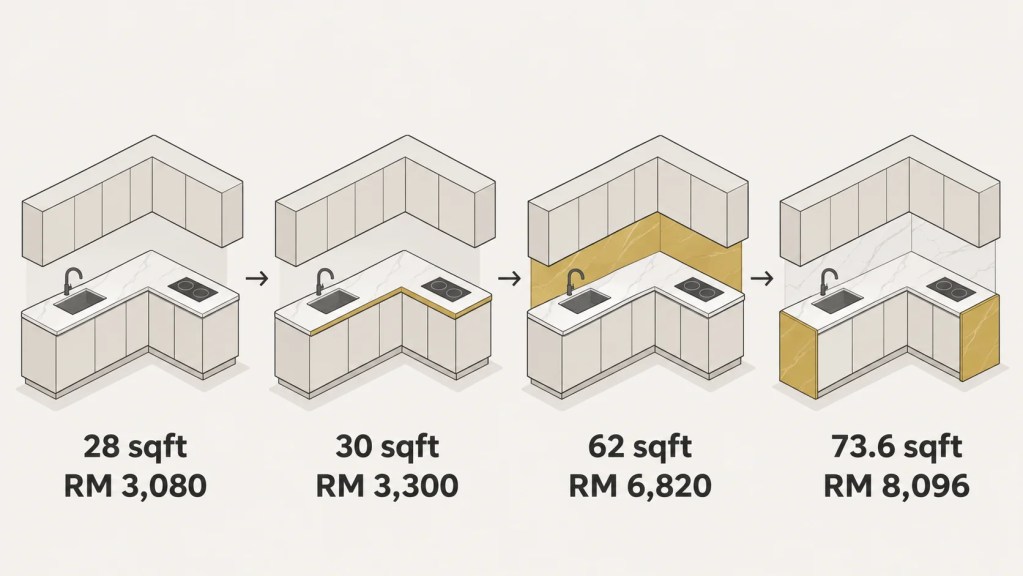
In this scenario, the homeowner agreed to RM 3,080 for a countertop, then chose to add a mitred edge, a backsplash and two waterfalls. Those are perfectly good decisions, but the job is now 73.6 sqft of stone, not 28.
The figures above are illustrative sqft sums. Your actual area depends on your exact measurements and layout, other materials and colours carry different rates, and slab yield can push the final figure higher if the extra pieces need another slab. Settle any extra slab before you treat the quotation as final.
What Should You Do If Your Countertop Price Increased?
If your countertop price increased, compare your original requirements with the revised quotation line by line, then ask for an explanation of every difference. A big jump feels unfair when nobody has shown you where it came from, and asking is completely reasonable.
If you added stone surfaces
Features can be added gradually. A homeowner who said “don’t know” to the waterfall question at the start may decide on site that two waterfalls would look great. From their side, nothing major has changed. From the stone side, that’s two full panels.
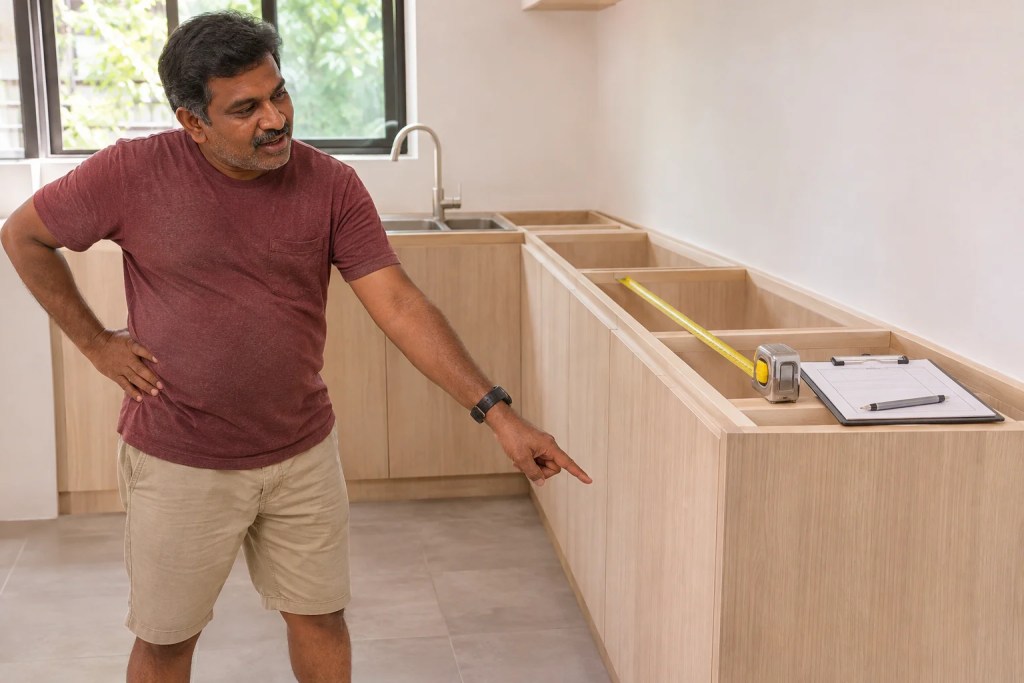
In that case, you’re not paying more for the same kitchen, you’re paying for more kitchen. The revised quotation should show each addition with its area and price, so you can decide whether to keep it.
If your requirements stayed the same
Put what you sent at the start, such as your WhatsApp message or drawing, beside the estimate and the revised quotation. Then work through these five checks:
| Compare | What to look for | What to ask |
|---|---|---|
| Written requirements | The surfaces, edge and sizes you told the advisor about | Was everything I asked for priced in the estimate? |
| Quantities | The length, depth and sqft of each surface | Which measurement changed, and by how much? |
| Rates | The per-sqft rate, brand, colour and thickness | Why is the rate different for the same material? |
| Inclusions | Cut-outs, edge profiling, transport and access surcharges | Which item was added, or moved out of the rate? |
| Assumptions | The slab count, layout and anything else the estimate assumed | Which assumption changed after measurement? |
Ask for the answers in writing, even if it’s only a WhatsApp message. A run that measures longer than your sketch is a fair reason, as long as the advisor can show you the measurement. If a difference can’t be explained, you don’t have to confirm the quotation until it is.
Is it ever the supplier’s fault?
Yes, and it’s fair to ask. If you clearly told the advisor about a waterfall and a backsplash, and these were left off the estimate, the advisor should own that mistake. The same goes for a wrong rate or a calculation error on either document. That’s why it pays to get your requirements in writing from the start. If the estimate lists its assumptions, both sides can check what changed.
“Just Quote Me First” – What Do You Actually Get?
When you ask for a price before answering the advisor’s questions, you get a ballpark for the simplest version of your countertop. It’s useful for budgeting, but it isn’t a commitment on either side.
There’s nothing wrong with asking for a rough figure early. Many homeowners need one before the cabinets are even built, and you can get a preliminary quote before your cabinets are installed for exactly this reason. The trouble starts when that rough figure gets treated as the final price.
A quick comparison:
| Estimate (from drawing or sketch) | Final quotation (after site measurement) | |
|---|---|---|
| Based on | Rough sizes and your answers so far | Measured cabinets, walls and confirmed features |
| Includes | Only the items you mentioned | Every surface you’ve decided to cover in stone |
| Purpose | Budgeting and comparing options | Confirming the job before fabrication |
| Can it change? | Yes, up or down | Only through a revised quotation you agree to in writing before fabrication |
When is a quotation ready to confirm?
A quotation is ready to confirm once site measurement is done and everything that affects the price is written on it. Check that it shows:
- The measured size and area of every stone surface
- The brand, colour, finish, thickness and rate
- Your decisions on the edge, backsplash, waterfall and side panels
- The sink and hob positions, and the number of cut-outs
- The slab layout, including whether the job needs an extra slab
- What’s included, what’s excluded and how long the quotation is valid
If something changes after that, such as an added waterfall or a different colour, ask for a revised quotation showing the item, its area and the price difference. Agree to it in writing before fabrication starts, because changes after the stone is cut are harder and may cost more.
Can the supplier just honour the estimate?
Not when the scope has grown, because the extra stone, cutting and installation are real costs. Honouring an RM 3,080 estimate for a 73.6 sqft job would mean giving away about 45 sqft of quartz. No fabricator can run that way for long. What a supplier can and should do is show you which additions account for the difference, and explain any change to the items that stayed the same.
Can the Price Go Down After Site Measurement?
Yes, the price can go down after site measurement. If your cabinets are shorter than the sketch suggested, or you decide to drop a waterfall or tile the backsplash instead, the measured area shrinks and the quotation follows.
This is why we call the first figure an estimate rather than a “starting price”. It’s an honest guess in both directions. Measurement simply replaces the guess with the real number.
How Do You Get an Estimate That Matches the Final Price?
You get an estimate close to the final price by telling your advisor about every stone surface up front, even the ones you’re unsure about. The more complete the brief, the smaller the gap.
Before you ask for a quotation, prepare these:
- Photos of the kitchen from a few angles, or your carpenter’s drawing with cabinet depths marked.
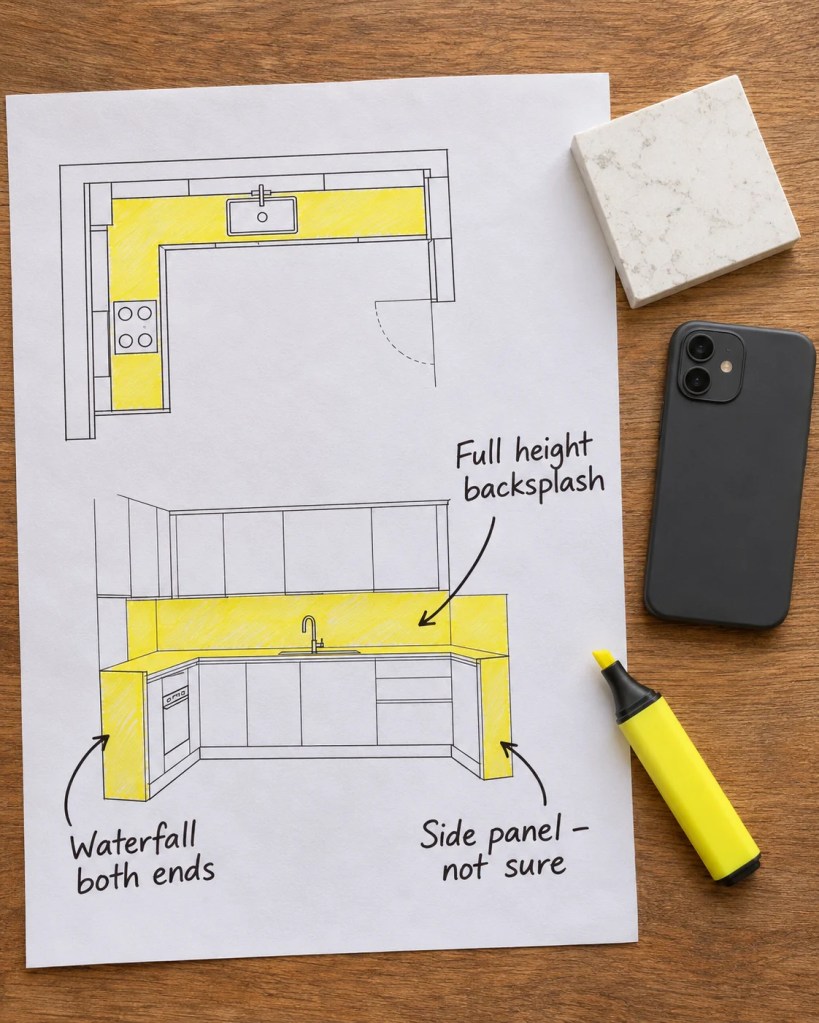
- Mark every stone surface on the drawing. Shade the countertop, backsplash, waterfall ends and side panels so nothing is assumed.
- Decide the backsplash height, or ask for two prices: short upstand and full height.
- Decide the waterfall: none, one side or both. If you’re torn, ask for each option separately.
- Say “not sure” instead of “no”. “No” removes the item from the estimate. “Not sure” lets the advisor price it as an option.
- Ask what the estimate does not include. A good advisor will list the assumptions in writing.
When the quotation arrives, check it line by line. Our guide on how to read a countertop quotation explains what to look for, including the costs that never appear on a stone quote, such as plumbing and old countertop removal.
FAQ
Why is my countertop quote higher after measurement? Your countertop quote can be higher after measurement because the measured scope includes more stone than the estimate assumed, the cabinets measure larger than the drawing, or a rate, inclusion or assumption has changed. Compare the revised quote with your original requirements and ask the advisor to explain each difference.
Can I get an accurate countertop quotation from a layout drawing? You can get a close countertop quotation from a layout drawing if it shows cabinet depths and marks every stone surface, including backsplash, waterfall and side panels. A drawing that only shows the countertop outline will produce a countertop-only estimate.
Is the first countertop estimate binding? The first countertop estimate isn’t binding on either side, because it’s based on information that hasn’t been measured yet. The final quotation after site measurement is the one you confirm before fabrication starts.
How much does a waterfall or full-height backsplash add to the cost? A waterfall or full-height backsplash adds its full area at the same per-square-foot rate as the countertop. On a typical 8 ft + 8 ft L-shaped kitchen, a full-height backsplash can add around 32 sqft and two waterfalls around 11.6 sqft.
What should I do if my final quotation is very different from the estimate? Ask the advisor to show you which items, measurements, rates or assumptions caused the difference, item by item. If the difference comes from features you added, decide whether to keep them. If it comes from something you’d already told them about, raise it, because it should have been in the estimate. If you can’t get a clear explanation, hold off confirming the quotation.
Conclusion
A countertop estimate is only as complete as the information behind it. “8 ft + 8 ft” prices a countertop. Site measurement prices your kitchen, with every backsplash, waterfall, side panel and mitred edge you decide to add. When the two numbers are far apart, added stone is one explanation. If you didn’t add anything, check your original requirements against the revised quotation and ask for each difference to be explained before you confirm.
You can narrow the gap by telling your advisor everything you’re considering at the start, including the “maybe” items. If you’d like a quotation that reflects what you actually have in mind, send us your drawing or photos with the stone surfaces marked, and we’ll price each option before you commit to anything.