

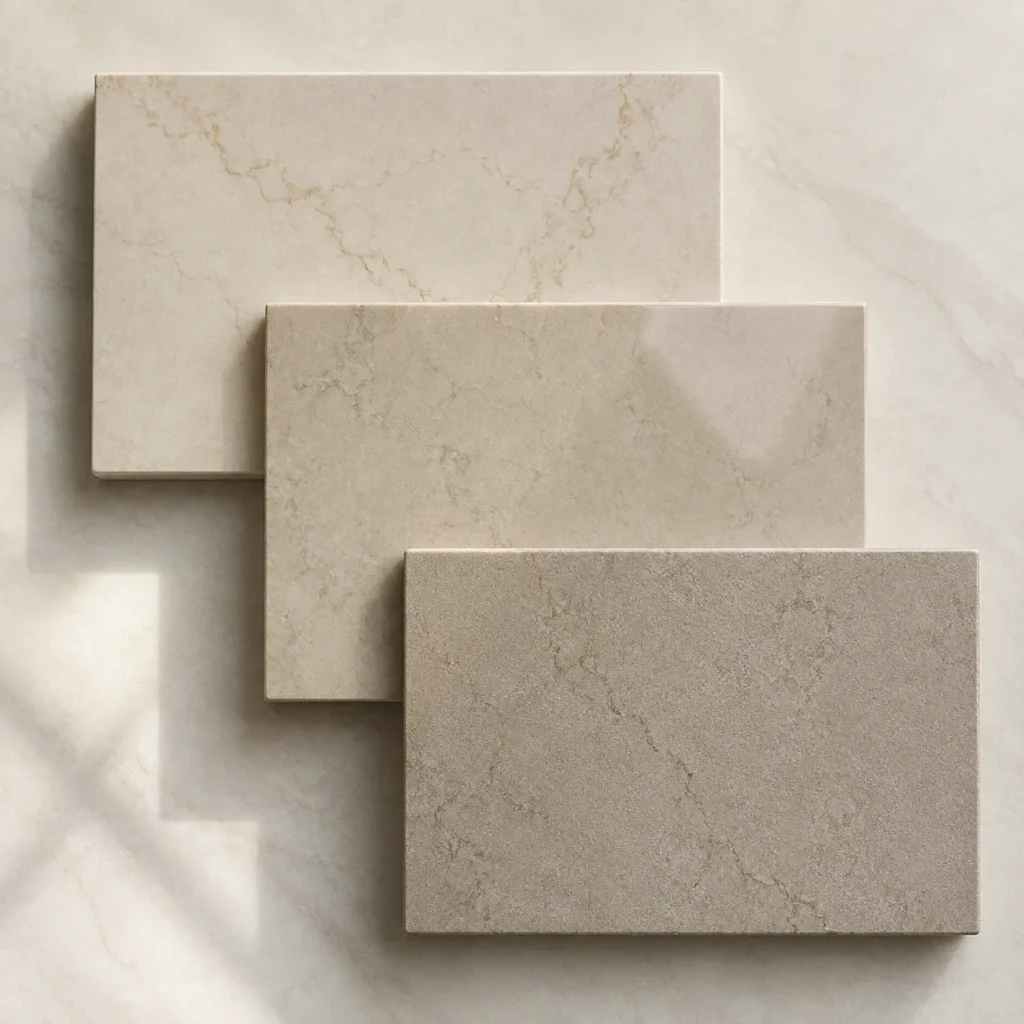
Choosing a different colour for each countertop costs more because stone is sold by the slab, not by the metre. A white main counter, a black island, and a grey dry kitchen means three separate slabs, and whatever you don’t use from each one has nowhere else to go in your kitchen. The countertop area stays the same. The material you pay for does not.
Key Takeaways
- Quartz, sintered stone, and porcelain are supplied as full slabs, typically 3000×1400mm or 3200×1600mm, so partial slabs aren’t a thing you can buy
- One colour lets your fabricator nest all your pieces across the fewest slabs; multiple colours kill that nesting entirely
- The offcut from each extra colour is usually too big to discard and too small to reuse, and that cost gets priced into your quote
- Fabrication also takes longer, because three colours are three separate setups on the machine rather than one continuous run
- Different finishes, a contrast backsplash, or a waterfall edge give you visual variety without paying for a second and third slab
Why Does Stone Get Sold by the Slab Instead of by the Metre?
Stone surfaces arrive at your fabricator as full slabs, and that’s the smallest unit anyone in the supply chain can buy. Your fabricator can’t order 40% of a Calacatta slab any more than you can buy a third of a bathroom tile carton.
Slab sizes in the Malaysian market cluster around a few standards:
| Slab size | Approximate area | Common for |
|---|---|---|
| 3000 × 1400mm | 45 sqft | Most quartz collections |
| 3200 × 1600mm | 55 sqft | Jumbo quartz and sintered stone |
| 3300 × 1600mm | 57 sqft | Premium imported quartz |
| 3000 × 1500mm | 48 sqft | Selected quartz collections |
When you pick one colour, your fabricator plans the cutting layout across the fewest slabs possible. Sink cutout offcuts become a small breakfast bar. A leftover strip becomes your backsplash. When you pick three colours, every one of those slabs gets opened, and only part of each one ends up in your kitchen.
If you’re still choosing a material at this stage, our guide on the pros and cons of quartz stone kitchen tops covers what quartz does well before you get into colour decisions.
How Much Extra Material Are You Actually Paying For?
Take a fairly typical Malaysian kitchen: a 3-metre main run at 600mm deep, a 2-metre island at 900mm wide, and a 1.5-metre dry kitchen counter at 600mm deep. That’s roughly 48 square feet of finished countertop.
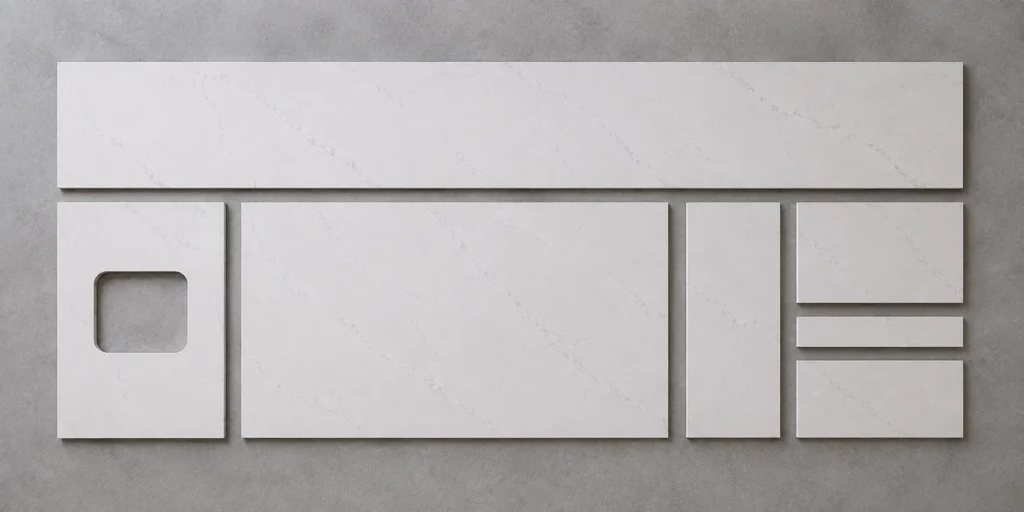
With one colour, your fabricator can lay those three pieces across two 3000×1400mm slabs, around 90 sqft of material. Not perfect yield, but the leftovers are all the same colour, so they’re still useful — a windowsill, a small shelf, a spare piece if something chips during installation.
With three colours, you open three slabs, around 135 sqft of material, for the same 48 sqft of countertop. The white slab gives you 18 sqft and keeps 27. The black slab gives you 18 sqft and keeps 37. The grey slab gives you 9 sqft and keeps 36. None of those balances can be used anywhere else in your kitchen, because they’re the wrong colour for every other surface.
What Does That Unused Balance Actually Cost in Ringgit?
The clearest way to see the premium is to price the balance you’re not using at the same rate as the countertop you are.
Supply-and-install rates in Malaysia vary widely by brand:
| Brand | Supply & install, per sqft |
|---|---|
| Zenstone | RM 110 – RM 160 |
| Moonstone | RM 182 – RM 226 |
| Silestone | RM 282 – RM 634 |
| Caesarstone | RM 332 – RM 689 |
A third slab that contributes only 9 sqft to your dry kitchen leaves roughly 36 sqft of stone with nowhere to go. At Zenstone’s entry rate, that unused balance sits at around RM 3,900 of stone. On Caesarstone, the same 36 sqft crosses RM 11,000.
Your fabricator will not always show this as a separate line. Some absorb part of it into a higher per-square-foot rate, some apply a minimum slab charge per colour. Either way, it’s in the number. Ask which method they’re using, and ask for it as its own line item so you can compare quotes properly. Our breakdown of what every line item in a countertop quote means explains where this typically hides.
For current pricing across every collection, our 2026 quartz stone price guide lists rates by brand and colour.
Why Does Fabrication Take Longer With Multiple Colours?
Three colours means three separate setups rather than one continuous run. Each slab has to be loaded onto the bridge saw, cut, unloaded, moved to the CNC for cutouts and edge profiling, then unloaded again. The cutting itself isn’t much slower. The handling between machines is where the days go.
In practice that’s an extra 2 to 3 working days on most jobs, and more if one of your colours is a special order that has to be brought in. On a renovation where the cabinet maker, plumber, and electrician are all queuing behind the countertop install, those days have a cost of their own. Our walkthrough of how your countertop is made in Malaysia shows each stage the slab has to pass through.
Are There Cheaper Ways to Get Visual Variety?
Yes, and most of them look better than a hard colour change anyway.
Change the finish, not the colour. A polished main counter with a honed or leather island in the same colour gives you a clear visual break, and both pieces can still be cut from the same slabs. Our finish comparison guide covers how each one reads under Malaysian kitchen lighting.
Put the contrast on the backsplash. A feature backsplash in a bolder stone uses a fraction of the material a full island top does, so the offcut waste is much smaller.
Use a waterfall edge on the island. Running the same stone down both sides of the island turns it into a statement piece without a second colour. It uses more of your existing slab rather than opening a new one.
Contrast with cabinetry instead. Dark cabinet doors under a light countertop create far more visual separation than two similar stones sitting side by side, and cabinet colour costs nothing extra to choose.
When Is Paying for Multiple Colours Actually Worth It?
When the surfaces are far enough apart that they read as separate rooms, or when the budget makes the premium proportionally small.
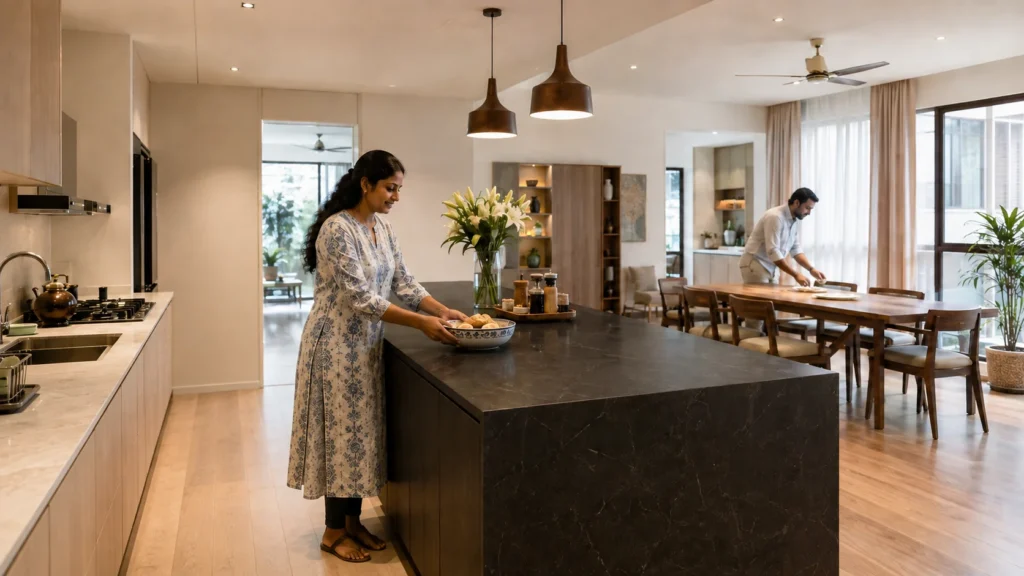
An open-plan layout where the island sits in the dining zone genuinely benefits from colour separation, because the two surfaces are never in the same line of sight as a mismatched pair. Same for a dry kitchen tucked behind a wall from the wet kitchen. In those cases you’re zoning a space, not just decorating.
It also makes sense on a forever home where you’ll live with the result for 15 to 20 years, and on renovations already committed to premium appliances and custom cabinetry, where an extra RM 5,000 to RM 8,000 sits inside a much larger number.
Where it usually isn’t worth it: a small condo kitchen where all three surfaces are visible at once, and any property you plan to sell or rent out within a few years.
How Do You Plan a Multi-Colour Kitchen Properly?
If you’ve decided the premium is worth paying, plan the palette rather than picking colours one at a time.
- Match the undertone first. Warm whites, beiges, and browns sit together comfortably. A cool grey-white next to a warm cream reads as a mistake, not a design choice.
- Follow a 60-30-10 split. Let one colour cover roughly 60% of your countertop area, a second take 30%, and an accent take 10%. Three colours at equal weight fights for attention.
- View the actual slabs, not sample chips. Colour shifts between production batches, and a chip can’t show you how two stones look side by side at full size. Our guide on why you shouldn’t choose a countertop from a sample alone explains what the chip hides.
- Check them under your own lighting. A pairing that works under showroom halogen can look off under a cool-white LED strip at 8pm.
FAQ
How much more does a two-colour countertop cost than a single colour? Expect to pay for at least one additional slab, which on entry-level quartz means roughly RM 3,000 to RM 5,000 more, and considerably more on premium brands where per-square-foot rates run three to six times higher.
Can my fabricator use leftover stone from another customer to save me money? Sometimes, if they happen to hold a remnant in your exact colour that’s large enough for your piece, but you can’t plan around it — remnant availability is luck, not a strategy, and most fabricators won’t guarantee it at quotation stage.
Is it cheaper to use two colours if one of them is only for a small vanity top? Usually not, because a small piece still requires opening a full slab in that colour, so the smaller the piece the worse the yield and the higher the effective cost per square foot.
Do sintered stone and porcelain slabs have the same colour premium as quartz? Yes, and often more, since sintered stone and porcelain slabs come in larger jumbo formats, meaning the unused balance from an extra colour is bigger.
Will mixing colours make my kitchen harder to resell? It can narrow the pool of buyers who like the combination, which is why a single neutral colour is the safer choice for a property you plan to sell or rent within a few years.
Conclusion
The premium on multi-colour countertops isn’t your fabricator marking you up for wanting something nice. It’s the arithmetic of buying stone in full slabs and only using part of each one. Once you can see where the money goes, the decision gets easier: pay it when the surfaces genuinely sit in different zones and the budget can carry it, and reach for a finish change or a contrast backsplash when it can’t.
Before you commit either way, ask your supplier to quote both options side by side with the slab count shown, and read it against our guide on how to spot hidden costs in a countertop quotation. If you’d like to see the colour combinations against each other at full slab size, come by our Sungai Buloh showroom and we’ll lay them out for you.