

A stone countertop finish is the surface treatment applied to a slab after it is made, and in Malaysia you will realistically choose between four: polished, honed, leather, and gloss. The finish decides how shiny the surface looks, how it feels under your palm, and how often you will be wiping fingerprints off it.
Picking the material is only half the decision. A polished quartz and a honed quartz can come off the same production line, from the same brand, in the same colour, and still behave like two different countertops in your kitchen. This guide covers every finish sold here for quartz, sintered stone, and porcelain slab, including the awkward part most showrooms skip: what is actually in stock.
Key Takeaways
- Polished (quartz) and gloss (sintered stone and porcelain) are the shiniest finishes, the easiest to wipe, and the worst at hiding fingerprints and water marks.
- Honed is the smooth matte middle ground, and leather is the textured option that hides marks best in a heavy-cooking Malaysian kitchen.
- Roughly 95% of quartz slabs brought into Malaysia by wholesalers are polished, so honed and leather usually mean a special order and a longer wait.
- Silestone and Caesarstone stock two finishes here, polished and honed, while Moonstone Quartz specialises in honed and leathered.
- As a rough guide, honed costs around 10% more than polished and leather around 10% more again, though some fabricators price polished and honed the same.
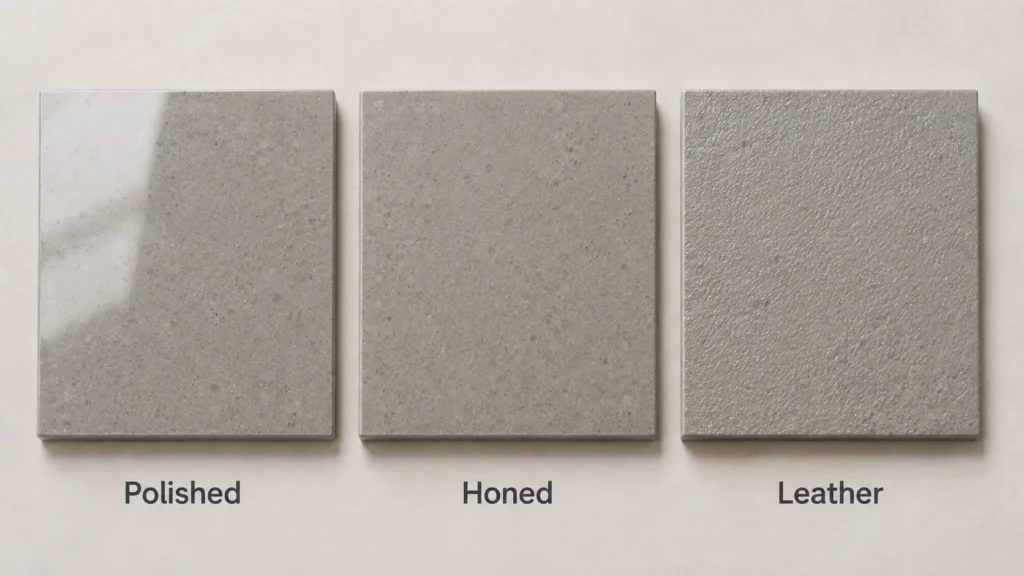
What Does “Stone Finish” Actually Mean?
The finish is the surface treatment applied to a slab after it is cut or manufactured, and it changes four things at once.
- How the surface looks — shiny, flat, textured, or somewhere in between
- How it feels to the touch — smooth, velvety, pebbled, or coarse
- How it performs day to day — fingerprints, water marks, scratches, cleaning effort
- The mood it sets — contemporary, rustic, luxurious, or industrial
For engineered stones like quartz, the finish is applied mechanically during manufacturing. For sintered stone and porcelain slabs, the finish is largely set during the kiln-firing process and refined afterwards.
One thing to keep front of mind: not every finish is available for every material in Malaysia. This guide separates quartz from sintered stone and porcelain so you can narrow your shortlist to what is genuinely on the market here, not what appears in an overseas catalogue.
Which Quartz Finishes Can You Actually Get in Malaysia?
Four: polished, honed, leather, and rough. Polished dominates, honed and leather are available with effort, and rough is a specialist item you are unlikely to want on a kitchen top.
Quartz is an engineered material made mostly from crushed quartz bound with resin. Because it is manufactured rather than quarried, the surface finish can be controlled precisely.
Polished Finish
Polished is the standard finish most quartz brands produce by default, and the one you will meet in almost every Malaysian showroom.
The surface is buffed to a high sheen, creating a smooth, reflective face that catches light. Colours look deeper and veining looks sharper. If you are choosing a dramatic Calacatta marble-look or a deep charcoal quartz, polished is what makes the pattern come alive.
What to expect in daily use:
- Easy to wipe clean, since spills sit on the surface rather than soaking in
- Shows fingerprints, water marks, and greasy smudges more readily than any other quartz finish
- In a kitchen where cooking happens daily and hands are constantly moving, it needs frequent wiping to look clean
- The reflective surface highlights minor abrasions over time
Best for: homeowners who want a classic, luxurious look and don’t mind wiping the counter regularly. It works especially well in bright kitchens, where the reflectivity adds to the light in the room.
For a closer look at polished against honed specifically, our guide on honed vs polished quartz finishes goes deeper into the practical differences.
Honed Finish
Honed is polished’s opposite. Instead of buffing to a high shine, the process stops at a matte or low-sheen stage, producing a surface that is smooth to touch but non-reflective.
Think of satin paint versus gloss paint. Same wall, same colour, completely different behaviour under light.
What to expect in daily use:
- Noticeably better at hiding fingerprints, smudges, and water marks
- Still perfectly smooth, with no texture or grip, just less shine
- Colours and veining read softer and more subdued than the polished version of the same slab
- Just as easy to clean, since a damp cloth handles most spills
- Forgiving in households with young children or heavy daily use
Best for: homeowners who want a sophisticated, understated look without polished’s maintenance demands. Honed quartz has been climbing steadily in Malaysian kitchens leaning towards Japandi and minimalist styling.
Leather Finish
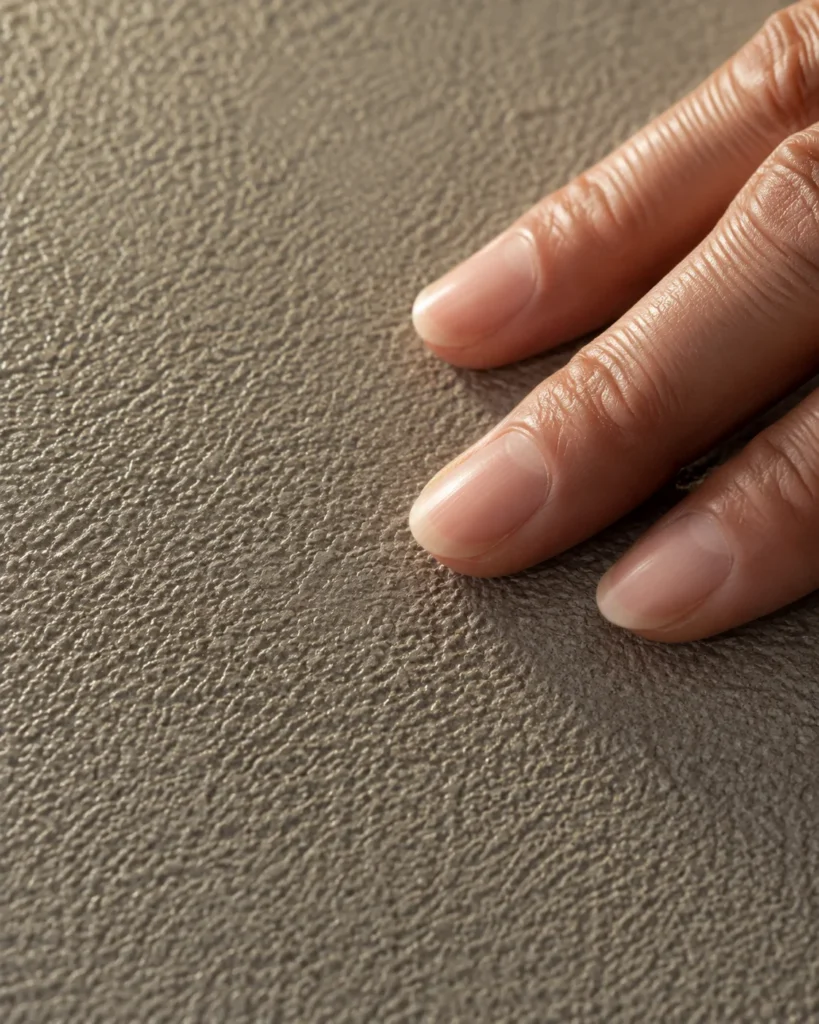
Leather is the most distinctive quartz surface sold in Malaysia, and the one that gets the most attention in a showroom. The name fits: the surface carries a subtle, tactile grain that feels like genuine leather.
It is made by running diamond-tipped brushes across the quartz during manufacturing, which opens the texture slightly and leaves a gently pebbled feel. It is neither glassy like polished nor flat like honed. It has a three-dimensional quality your fingertips pick up immediately.
What to expect in daily use:
- The best of all finishes at hiding fingerprints and water marks, because the texture breaks up the visibility of smudges
- Needs a little more care when cleaning, since the texture can trap fine particles. A soft damp cloth works well; skip abrasive scrubbers
- Creates a warm, natural look that pairs beautifully with timber cabinetry and earthy palettes
- Less commonly stocked than polished or honed, so check availability and allow for longer lead times
Best for: homeowners who want a countertop that feels as good as it looks, and who are building a warm, artisanal, or nature-led kitchen.
Rough Finish
Rough finish quartz is the least common surface treatment here. It has a coarse, raw-looking texture, closer to brushed natural stone than a refined countertop.
In practice, it is rarely used as a primary kitchen surface in Malaysian homes. It turns up in feature walls, outdoor surfaces, and commercial jobs where a raw, industrial look is the point. Some suppliers carry it, but availability is thin and it is usually special order.
What to expect in daily use:
- The texture traps dirt, food particles, and moisture more readily than any other finish
- Cleaning means scrubbing into the texture regularly to prevent build-up
- Not suitable as a main food preparation surface in a kitchen doing wok cooking and daily spice prep
Best for: accent panels, feature walls, and outdoor surfaces. Not a practical first choice for a Malaysian kitchen top.
Why Are Honed and Leather Quartz So Hard to Find in Malaysia?
Because stocking every finish across every colour is commercially unworkable, and polished sells fastest. Knowing what exists on paper is one thing. Knowing what you can walk in and buy today is another.
The inventory maths behind the shortage
Visit most quartz wholesalers here and ask for honed or leather, and you will often be shown polished. That is not an oversight. It is a deliberate business decision.
Consider the scale. A wholesaler carrying 80 colour options would need three separate slabs per colour to offer polished, honed, and leather across the range. That is 240 slab variants to hold, store, and finance, and the honed and leather ones move far slower. The inventory risk is not worth it for most businesses.
The result: roughly 95% of quartz slabs brought into Malaysia by wholesalers are polished. Honed and leather exist, but they take searching, longer lead times, and often a special-order commitment.
China quartz: almost entirely polished
If you are sourcing China quartz, which makes up a large share of the affordable quartz market here, expect polished as the default and usually the only option. The sheer volume and colour variety makes maintaining multiple finish variants impractical for importers.
Silestone and Caesarstone: two finishes, uneven stock
Premium brands like Silestone and Caesarstone take a more curated approach. Most of their Malaysian colour range comes in two finishes, polished and honed, which already puts them ahead of the wider China quartz market.
The catch is stock depth. Even for these brands, honed variants are held in much smaller quantities than polished. If you have your eye on a specific Silestone or Caesarstone colour in honed, confirm it early in your renovation planning rather than assuming it will be on the shelf when you are ready to order.
Moonstone Quartz: the honed and leather specialist
Moonstone Quartz works differently from most quartz suppliers here by specialising in honed and leathered finishes. Rather than treating polished as the primary finish, it holds deeper stock of honed and leather, which makes it one of the more reliable sources if those are what you want.
What this means for your renovation timeline
If you have settled on honed or leather quartz, plan around these:
- Confirm availability before you finalise your kitchen cabinet design. Don’t design around a finish that may not be in stock
- For Silestone and Caesarstone honed, speak to your supplier early and check lead times
- For leather specifically, expect a special order with most suppliers, which means a longer wait
- If honed or leather is the priority, Moonstone Quartz is worth exploring as a dedicated source
The market is moving the right way. Honed quartz demand has been growing in Malaysia, and more wholesalers are likely to widen their non-polished offerings over the next few years. Availability tends to follow demand.
Which Finishes Are Available for Sintered Stone and Porcelain Slabs?
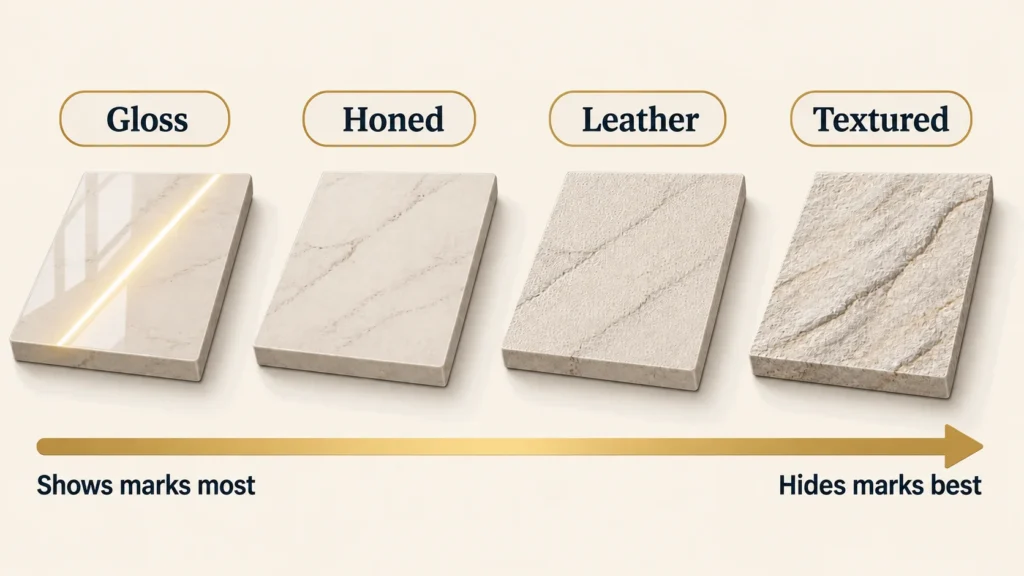
Four again: gloss, honed (matte), leather, and textured. The naming differs from quartz, but the behaviour follows the same shine-versus-forgiveness trade-off.
Sintered stone and porcelain slabs are made by a completely different process from quartz. They are fired under extreme heat and pressure, so their surface characteristics are distinct.
If you are still unclear on how these two materials differ from each other, this guide on sintered stone vs porcelain slab sorts that out before you start comparing finishes.
Gloss Finish
Gloss is to sintered stone and porcelain what polished is to quartz: the most common finish, and the one most Malaysians reach for first.
A gloss slab has a highly reflective, mirror-like surface that makes a space feel brighter and larger. Veining and colour depth show at their most intense.
What to expect in daily use:
- The least forgiving finish for fingerprints, water marks, and smudges. Every mark shows against the reflection
- Also the easiest to wipe clean, because the smooth non-porous surface gives nothing for grime to bond to
- In a Malaysian kitchen dealing with oil splatter and humidity, it needs frequent wiping to stay looking sharp
- Extremely durable and scratch-resistant, since the high-fire process produces a surface harder than most natural stones
Despite the well-known smudge problem, gloss remains the most popular porcelain slab finish among Malaysian homeowners. We unpack why in a separate post, and the answer involves aesthetics, practicality, and a couple of persistent misconceptions.
Best for: kitchens where visual drama and a bright, clean look matter most, and where regular wiping is already part of the routine.
Honed (Matte) Finish
For sintered stone and porcelain, honed and matte are used interchangeably. Both mean a low-sheen, non-reflective surface that feels smooth to touch.
The difference between a honed porcelain slab and a honed quartz comes down to density. Sintered stone and porcelain are fired at far higher temperatures than quartz is manufactured at, making them harder and denser. The honed surface is equally smooth and equally non-porous; the material underneath is simply tougher.
What to expect in daily use:
- Much better at hiding everyday marks than gloss, with fingerprints and water spots far less visible
- Creates a calm, contemporary look that suits Scandinavian, Japandi, and minimalist Malaysian interiors
- Easy to clean with a damp cloth for most spills
- Some darker honed porcelain colours show a faint chalky watermark if water dries on the surface, so wipe dry after cleaning
Best for: homeowners who want sintered stone or porcelain performance with a quieter, more understated surface. It works particularly well in open-plan kitchens where the countertop is on view from the living area all day.
Leather Finish
As with quartz, leather finish is available on certain sintered stone and porcelain products in Malaysia. The texture comes from surface brushing or embossing during manufacturing.
The grain tends to be slightly more pronounced than on quartz, giving the surface a more stone-like, natural character. It is often used to mimic natural stone, slate, or aged concrete, and it does so convincingly.
What to expect in daily use:
- Excellent at concealing fingerprints and marks, since the texture scatters light and makes smudges nearly invisible
- Slightly more effort to clean into the texture, though the non-porous body means nothing is actually absorbed
- Delivers a strong organic look, especially on slabs mimicking travertine, slate, or raw stone
- A practical choice for kitchen islands, where the surface gets used for prep, hosting, and everyday gathering
Best for: homeowners who want sintered stone durability but prefer a tactile surface to a glass-smooth one. It also suits islands that double as dining or serving tops.
Textured Finish
Textured is a broader category covering treatments with more pronounced surface relief: patterns, grooves, anti-slip treatments, and effects that go well beyond leather’s subtle grain.
In Malaysia, textured sintered stone and porcelain slabs mostly appear in flooring, where grip matters in wet areas like bathrooms, laundry rooms, and outdoor spaces. For countertops they are uncommon, though they do turn up in designs replicating raw concrete, sandstone, or brushed basalt.
What to expect in daily use:
- More relief means more surface area to trap food, grease, and moisture, so cleaning takes deliberate effort in an oil-heavy kitchen
- Anti-slip variants are genuinely useful for wet areas and flooring
- The visual effect can be striking, since heavily textured slabs make a bold architectural statement
- Not recommended as a primary countertop surface unless the design specifically calls for it
Best for: flooring, feature walls, bathroom floors, outdoor surfaces, and laundry areas. As a countertop, keep it to light-use zones rather than the main cooking run.
Quartz vs Sintered Stone: Which Finishes Are Actually Available?
| Finish | Quartz Stone | Sintered Stone / Porcelain Slab |
|---|---|---|
| Polished / Gloss | Common | Common (called Gloss) |
| Honed / Matte | Available, limited stock | Common |
| Leather | Available, often special order | Available |
| Rough / Textured | Rare | Available, mainly flooring |
How Does Finish Affect Daily Maintenance in a Malaysian Kitchen?
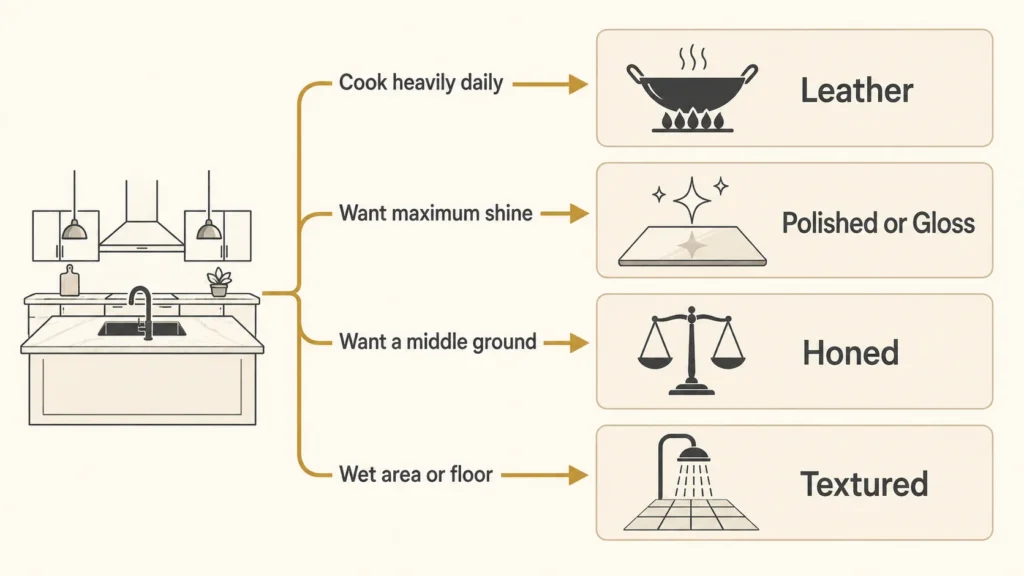
Significantly. Wok hei cooking, daily spice prep, oil splatter, and tropical humidity mean a Malaysian countertop takes real punishment, not light meal assembly, and the finish decides how much of that punishment shows.
If you cook heavily and want the least maintenance: leather, on either quartz or sintered stone. It hides marks better than anything else and still wipes clean easily.
If you want the brightest, sharpest look and don’t mind wiping: polished quartz or gloss sintered stone. Expect to wipe after most cooking sessions.
If you want the middle ground: honed on either material. Smooth, easy to clean, far more forgiving than polished or gloss, without leather’s texture.
If you are doing a bathroom or laundry floor: textured sintered stone or porcelain, for grip in wet conditions.
Does Finish Affect the Price of Your Countertop?
Yes, and there is a rough pattern in Malaysia worth knowing before you walk into a showroom.
As a general guide:
- Polished is the baseline, since it is the standard finish and the most widely stocked
- Honed typically runs around 10% above polished for the same colour and thickness
- Leather typically runs around 10% above honed, so roughly 20% above polished overall
That is a pattern, not a formula. Pricing varies between suppliers, and some fabrication shops here price polished and honed at the same rate, with leather carrying only a small premium. Others follow the tiered structure strictly.
Rough and textured finishes on quartz are uncommon enough that pricing swings widely by supplier. Ask directly.
The only reliable way to confirm finish pricing is to check with your stone fabrication shop before committing. Prices shift depending on the brand, the specific colour collection, and whether the finish is in stock or needs ordering in. Always ask about availability and lead times alongside the price, particularly for leather or anything less common.
For context on how sourcing and lead times work here, this guide on sourcing your kitchen countertop explains what to expect from each supply channel.

Which Finish Should You Choose?
| Your priority | Recommended finish |
|---|---|
| Maximum shine and visual drama | Polished (quartz) or Gloss (sintered / porcelain) |
| Understated, sophisticated look | Honed / Matte |
| Hides fingerprints and marks best | Leather |
| Natural, tactile feel | Leather |
| Heavy-use Malaysian kitchen | Honed or Leather |
| Wet areas and flooring | Textured (sintered / porcelain) |
| Budget-conscious, widely stocked | Polished, or Honed |
FAQ
Which countertop finish hides fingerprints best? Leather finish hides fingerprints best, on both quartz and sintered stone. The subtle texture scatters light and breaks up smudges, so marks that would be obvious on a polished or gloss surface simply don’t register. Honed comes second, and polished or gloss shows the most.
Is honed quartz harder to clean than polished? No. Honed quartz is exactly as easy to clean as polished, since both are smooth and non-porous, and a damp cloth handles most spills on either. The difference is how often you feel the need to clean, and honed needs it less because it hides marks better.
Can I get honed or leather finish quartz in Malaysia? Yes, but expect to search. Around 95% of quartz slabs brought in by wholesalers are polished, so honed and leather usually mean a special order and a longer lead time. Silestone and Caesarstone stock polished and honed in limited quantities, while Moonstone Quartz specialises in honed and leathered finishes.
Is gloss or matte better for a Malaysian kitchen? Matte, in most cases. Malaysian kitchens deal with oil splatter, high humidity, and heavy daily cooking, and a matte or honed surface hides the resulting marks far better than gloss. Choose gloss if you want maximum brightness and are comfortable wiping down the surface after each cooking session.
Does a leather finish cost more than polished? Usually, yes. As a rough guide, leather runs about 20% above polished and honed about 10% above, though pricing varies by supplier and some fabricators charge the same for polished and honed. Confirm the figure with your fabricator, along with the lead time.
Conclusion
The finish shapes how your countertop looks, how it behaves, and how much daily effort it asks of you. There is no universally best one. There is only the finish that matches your cooking habits, your tolerance for wiping, and the look you are building towards.
For most Malaysian homeowners running a busy kitchen, honed or leather will serve you better than polished or gloss, purely because they carry the evidence of daily life more gracefully. But if a reflective surface is what draws you, and you are happy to wipe it down, polished quartz and gloss sintered stone will never stop looking striking.
Whichever way you lean, ask your supplier for a physical sample rather than judging from catalogue images. The difference between finishes lives in how they feel under your hand and how they behave in your own lighting, and neither of those survives a screen.
Still choosing between the materials themselves before you get to finishes? This comparison of quartz vs sintered stone is the right place to start, and our team is happy to walk you through samples of both in either finish.