

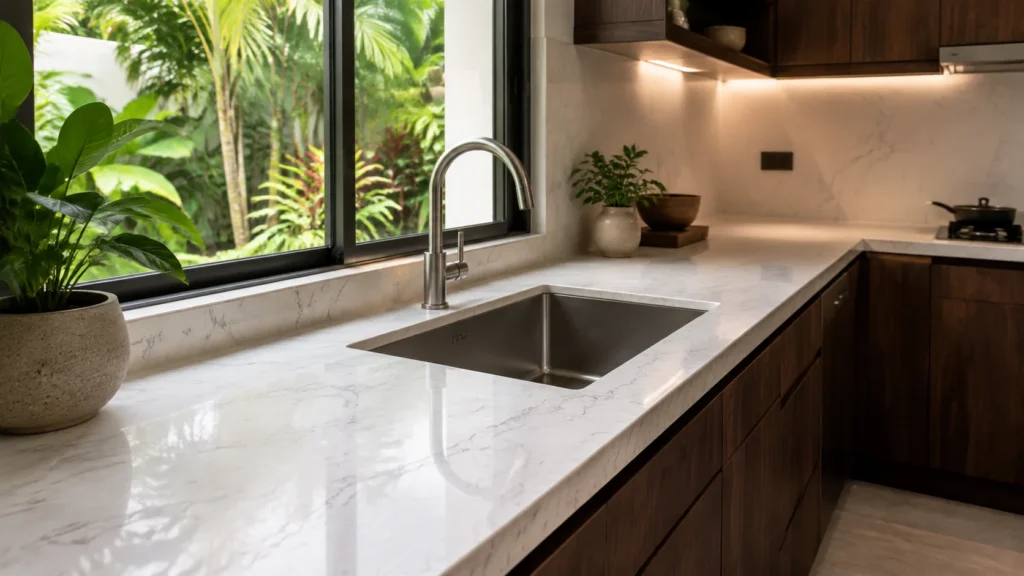
Quartz stone is an engineered surface made by binding ground natural quartz crystals with polymer resin and pigment, then compacting the mixture under vacuum and curing it into a solid slab. It is not quarried like granite or marble. It is manufactured in a factory, which is exactly why it behaves so predictably in a Malaysian kitchen.
That single fact explains most of what homeowners want to know about quartz: why colours match across slabs, why it never needs sealing, why turmeric does not stain it, and why you still need a trivet under a hot wok. Here is what goes into a quartz slab, how it is made, and what it means when you are standing in a showroom deciding where your renovation budget goes.
Key Takeaways
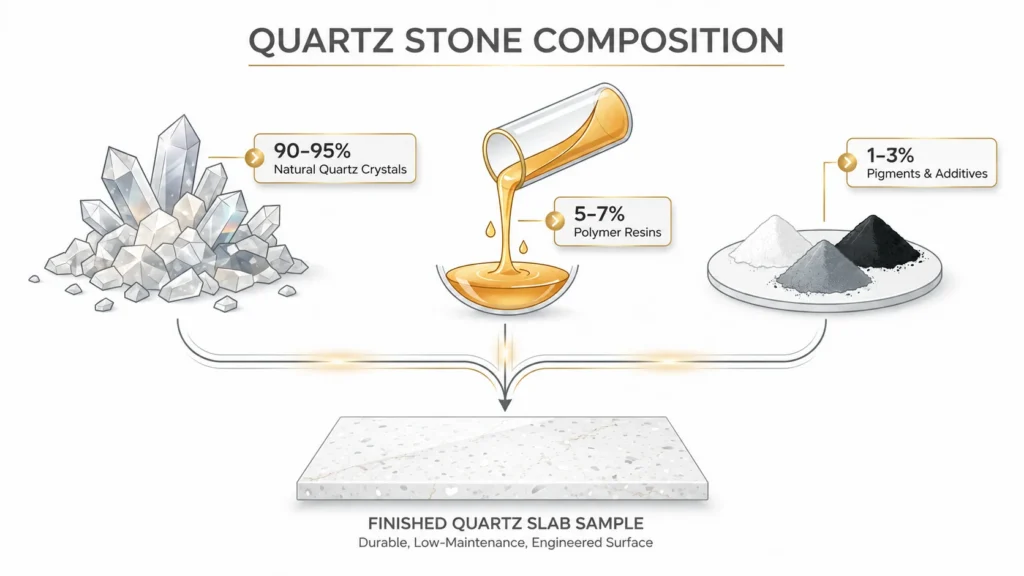
- Quartz stone is engineered, not quarried: roughly 90 to 95% ground natural quartz, 5 to 7% polymer resin, and 1 to 3% pigment.
- The resin is what makes quartz non-porous and crack-resistant, and it is also the reason quartz is heat-sensitive above about 150°C.
- Vacuum compaction under around 100 tonnes of pressure is the step that removes air pockets and gives quartz its stain resistance.
- Genuine quartz in Malaysia runs from RM110 per square foot (Zenstone) to RM689 per square foot (Caesarstone), supply and install.
- A plain white slab is the quickest read on factory quality: the fewer tiny black dots, the more mature the manufacturing process, and dotted whites are usually graded B and priced lower.
What Is Quartz Stone?
Quartz stone, also sold as engineered quartz or engineered stone, is a man-made slab created by combining natural quartz crystals with polymer resins and pigments under heat and pressure.
The name causes confusion, so it is worth being precise. The “quartz” refers to the raw material: ground natural quartz crystals, which make up 90 to 95% of the finished slab. The remaining 5 to 10% is resin, which binds everything together, and pigment, which creates the colour and pattern.
Being engineered is quartz stone’s biggest practical advantage. Because it comes out of a controlled production line rather than a quarry, colour and pattern stay consistent from slab to slab. If your kitchen needs three pieces of the same colour for the counter run, the island, and the wet kitchen, quartz will give you three pieces that actually look the same.
Quartz Stone vs Natural Quartz: What Is the Difference?
Natural quartz is a mineral, one of the most abundant on Earth. It is the crystalline form of silicon dioxide and it turns up inside rocks like granite. In its raw form it is too brittle and irregular to cut into a countertop.
Engineered quartz stone takes that mineral, crushes it, and binds it into a slab that outperforms the raw material in every way that matters in a kitchen. Natural quartz is the ingredient. Quartz stone is the finished dish.
What Is Quartz Stone Made Of?
A quartz slab has three components, and each one controls a different part of how the countertop performs.
| Component | Share of slab | What it does |
|---|---|---|
| Ground natural quartz | 90–95% | Provides hardness and scratch resistance (Mohs 7) |
| Polymer resin | 5–7% | Binds particles, seals pores, adds crack resistance |
| Pigment and additives | 1–3% | Creates colour, veining, and decorative flecks |
Natural Quartz Crystals (90 to 95%)
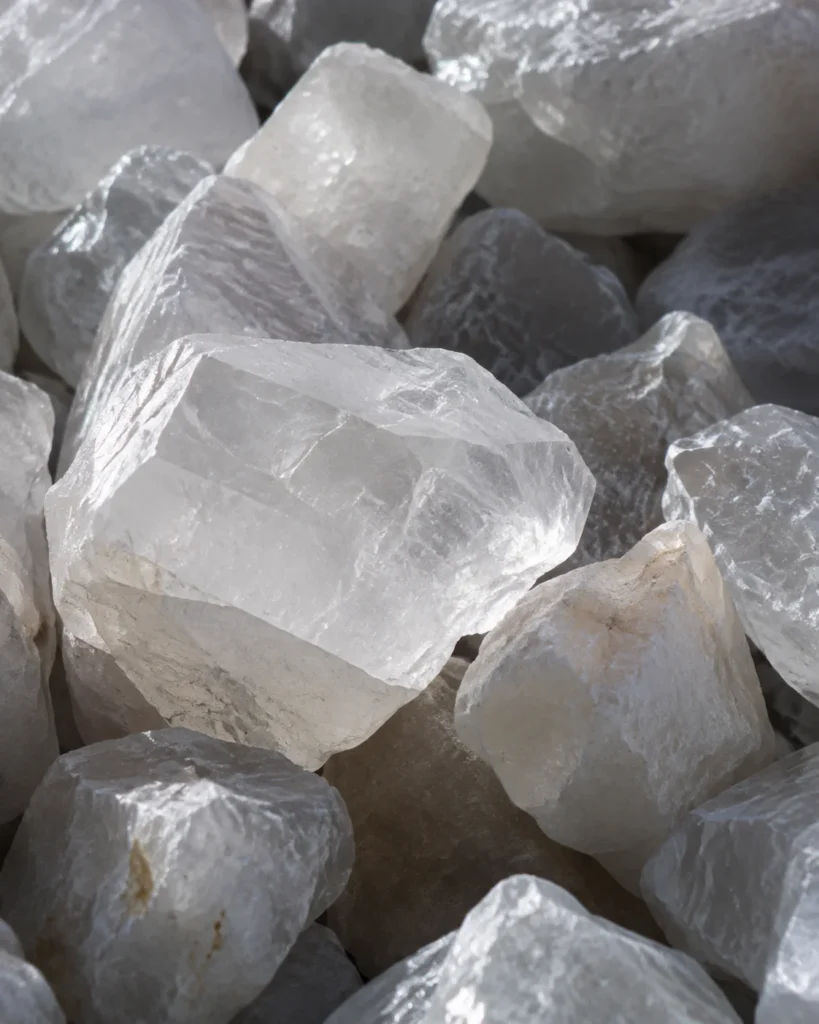
Manufacturers source quartz crystals from quarries worldwide, then crush and grind them into particles. Some use a fine, uniform powder for a smooth consistent look. Others deliberately mix coarse and fine particles to produce a more natural, granular appearance.
The high quartz content is where the hardness comes from. Natural quartz sits at 7 on the Mohs hardness scale, where diamond is 10, which makes quartz countertops highly resistant to the scratches of everyday cooking. If you want the full picture of what that number means when you compare materials, read our guide to the Mohs hardness scale.
Polymer Resins (5 to 7%)
Resin is what turns loose quartz powder into a solid slab. Most manufacturers use polyester or acrylic resin, and premium brands are steadily moving towards lower-emission formulations.
The resin does three jobs at once. It binds the quartz particles, it fills the microscopic gaps that would otherwise let liquid soak in, and it adds a slight flexibility that stops the slab from behaving like glass. This is the part most homeowners get backwards: the resin is not a cheap filler diluting the quartz. Pure compacted quartz would be brittle and crack-prone. The resin is what makes the countertop survive real use.
Pigments and Additives (1 to 3%)
Pigment is where the design happens. Manufacturers blend colourants to produce everything from pure white to jet black, and some formulations add recycled glass, metallic flecks, or mirror chips for visual interest.
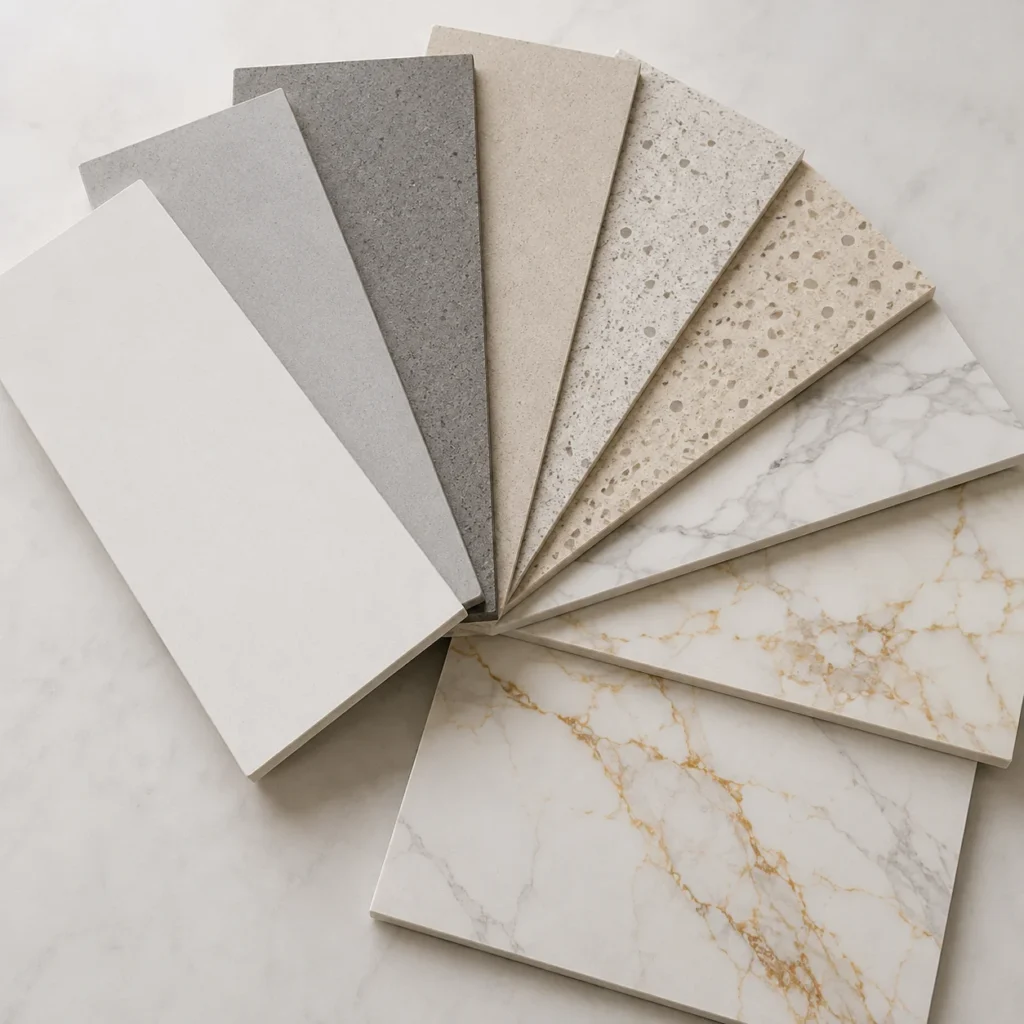
How the pigment is distributed during mixing decides whether a slab reads as a flat solid colour, a soft speckle, or a dramatic marble-look vein. Premium brands spend heavily on developing vein patterns that convincingly imitate Calacatta or Carrara marble, without the sealing and etching problems that come with real marble.
How Is Quartz Stone Made?
Quartz stone is made in seven stages: raw material preparation, mixing, vacuum compaction, curing, calibration, polishing, and quality control. Getting from a pile of crushed crystal to a finished slab takes under a day on a modern line, and each stage explains something about how the slab will behave in your kitchen.
Step 1: Raw Material Selection and Preparation
Production starts with sourcing quartz crystals and testing them for purity and consistency. The crystals are cleaned to strip out impurities that would show up as discolouration or weak points later, then crushed and ground.
Different manufacturers grind to different particle sizes. Uniformly fine particles produce a smooth, even look. A deliberate mix of coarse and fine produces something closer to natural stone.
Step 2: Mixing and Blending
The ground quartz goes into industrial mixers with resin and pigment. This is where each brand’s proprietary recipe matters: the exact ratios, the resin type, and the mixing technique all shape the finished product.
For marble-look slabs, manufacturers run multiple batches in different colours and fold them together to create veining. Producing a vein that looks geological rather than printed is genuinely difficult, and it is a large part of why heavily veined colours cost more than plain ones.
Step 3: Compaction Under Vacuum
This is the stage that matters most. The mixed material is poured into moulds and put through vacuum compaction, commonly using Breton technology, named after the Italian company that pioneered the process.
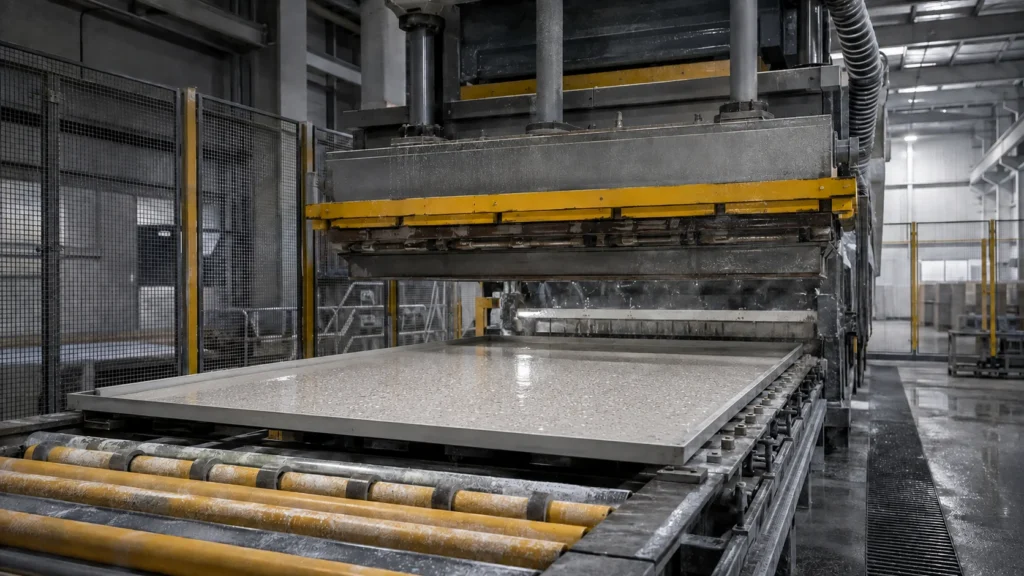
The mixture is vibrated under vacuum while roughly 100 tonnes of pressure compresses it. The vacuum pulls out trapped air, the vibration settles the material evenly, and the pressure locks it solid. This combination is the reason quartz is non-porous. Skip it or rush it and the slab keeps microscopic voids that hold moisture and bacteria, which is exactly the failure mode you see in cheap unbranded quartz.
Step 4: Curing and Hardening
Compacted slabs move into curing ovens at around 85 to 100°C. The heat triggers the resin to polymerise and harden, typically over 30 to 45 minutes depending on the manufacturer and slab thickness.
Curing is tightly controlled for good reason. Too little heat leaves a soft surface that damages easily. Too much causes discolouration or internal stress.
Step 5: Gauging and Calibration
Each cured slab passes through calibration machines that grind both faces to a uniform thickness. Countertop slabs are usually 20mm, though 12mm, 15mm, and 30mm options exist for specific applications.
Consistent thickness is what makes clean fabrication possible. A slab that varies across its length causes problems at templating and cutting, and the result shows up as an uneven countertop in someone’s kitchen. Our walkthrough of how your kitchen countertop is made in Malaysia covers what happens to the slab after it leaves the factory.
Step 6: Polishing and Finishing
The slab surface is then polished to the intended finish. Polished gloss remains the default, though honed and matte finishes have become common in contemporary Malaysian kitchens. If you are weighing those up, our comparison of honed vs polished quartz breaks down how each one lives day to day.
Industrial polishing heads work through progressively finer abrasives, often starting around 50-grit and stepping up through 400, 800, 1500, and 3000-grit pads. That sequence is what produces the smooth reflective surface people recognise as quartz.
Step 7: Quality Control and Inspection
Before a slab ships, inspectors check colour consistency, surface defects, dimensional accuracy, and structural integrity. Slabs that fail get rejected or downgraded.
This is a real part of what you pay for with an established brand. Caesarstone and Silestone run stringent QC protocols, and that consistency is a genuine cost, not just a logo premium.
Why Does the Manufacturing Process Matter for Malaysian Homeowners?
It matters because quality varies enormously between manufacturers, and the differences only surface after a few years of living with the countertop.
Quality Varies Between Manufacturers
Cheap quartz cuts corners in predictable places. Lower-grade resins yellow over time, particularly near windows. Insufficient vacuum compaction leaves porosity that lets stains set in on a surface that was sold to you as stain-proof.
Malaysia’s climate makes this worse. Sustained humidity and heat accelerate the degradation of weak resin formulations, so the gap between a good slab and a bad one widens faster here than it would in a temperate country. Our breakdown of why quartz countertops are worth the investment goes further into what you actually get for the extra ringgit.
How Can You Tell One Manufacturer Is Better Than Another?
Look at their pure white slab. If everything else is equal, the same quartz content, the same resin type, the same certifications, then the cleanliness of a plain white slab is the fastest read on how mature a factory’s process really is.
Pure white is unforgiving. There is no veining or speckle to hide behind, so anything that contaminated the mix shows up as tiny black dots scattered across the surface. Those specks come from impurities in the raw quartz, worn machinery, or dust picked up somewhere along the production line. A factory with tight raw material screening, clean equipment, and disciplined handling turns out white slabs with very few dots, or none at all. A factory still finding its feet cannot.
This is not a question of which country the slab came from. Export-grade pure white from Chinese manufacturers usually shows very few black dots, and most of the time none. The dots tell you about that specific factory and that specific production run, not the address on the shipping document.
The market already prices this in. A pure white slab with visible black dots is typically labelled Grade B and sold cheaper than the same colour graded A. That is a fair discount for a cosmetic defect, and for a wet kitchen or a laundry top you might decide it is a sensible trade. The problem is only when a Grade B slab gets quoted at a Grade A price and nobody mentions the grading.
So when you are in the showroom, ask to see the pure white in the brand you are considering, look across a full slab under good light rather than at a 100mm sample, and ask directly whether you are being quoted Grade A or Grade B.
Understanding Composition Helps You Avoid Scams
The Malaysian market has a persistent problem with compressed marble sold as quartz. Knowing what genuine quartz is made of is the fastest way to protect yourself.
Compressed marble, also called engineered marble or cultite, uses marble dust instead of quartz crystal as its primary filler. Marble sits at 3 to 4 on the Mohs scale against quartz at 7, so it scratches easily, stains readily, and has no business on a kitchen countertop. Some sellers still market it as “quartz” to homeowners who have no way to tell the difference by eye.
Resin Content Affects Heat Resistance
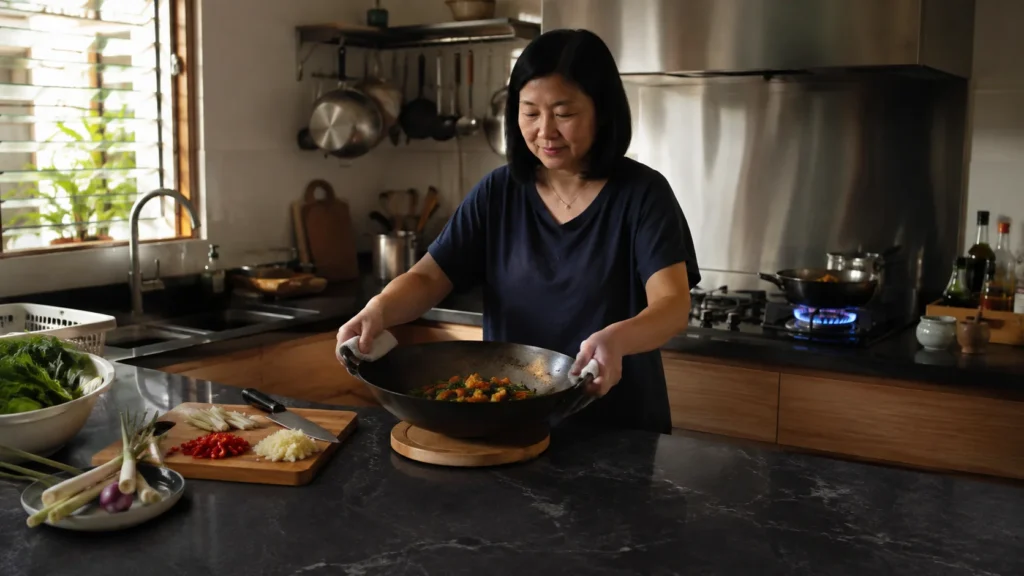
Quartz has one real limitation, and the resin is the reason. Polymer resin begins to suffer above roughly 150°C, so a pot straight off the flame can leave a scorch mark or a hairline crack from thermal shock. Trivets are not optional on quartz.
In a Malaysian kitchen this deserves attention, because wok cooking runs hot and the wok often comes off the fire with nowhere obvious to land. The resin is not a design flaw. It is the same ingredient that makes quartz non-porous and crack-resistant. It just asks for a bit of heat discipline in return. Our full answer on putting hot pans directly on quartz explains what actually happens to the surface.
What Are the Key Properties of Quartz Stone?
Quartz is non-porous, hard, visually consistent, and low maintenance, and those four properties come directly from the manufacturing process described above.
Non-porous surface. Properly compacted quartz does not absorb liquid, oil, or bacteria. In a kitchen that handles turmeric, chilli oil, and belacan, that is worth more than any spec sheet number. It also means quartz never needs sealing, unlike granite and marble, which need resealing periodically to hold their stain resistance.
Scratch and impact resistance. At Mohs 7, quartz outranks marble at 3 to 4 and matches or beats granite at 6 to 7. The resin content also gives it better impact resistance than natural stone, so chipping from a dropped pan is less likely. It is not indestructible, though. Quartz can crack under concentrated stress or rapid temperature change, which is why proper support during installation matters.
Consistent appearance. Engineered production means slabs from one batch match closely. If your kitchen needs several matching pieces or a large island, that predictability is a practical advantage that natural stone cannot offer.
Low maintenance. Mild soap and water handles daily cleaning. No sealing, no specialist products, no polishing routine. Our guide on how to clean a quartz countertop the right way covers the few cleaners that genuinely do damage.
Design range. Modern manufacturing can reproduce nearly any natural stone look, from restrained Carrara veining to bold exotic patterns, alongside plain solids. That range is why quartz fits both a traditional terrace house kitchen and a minimalist condo.
How Much Does Quartz Stone Cost in Malaysia?
Genuine quartz in Malaysia runs from RM110 to RM689 per square foot, supply and install, depending on the brand and the colour you choose.
| Brand | Price range (RM/SF, supply & install) | Where it sits |
|---|---|---|
| Zenstone | RM110–160 | Entry-level, widest colour range at the budget end |
| Moonstone | RM182–226 | Mid-range, polished and leather finishes |
| Silestone | RM282–634 | Premium international, Spain |
| Caesarstone | RM332–689 | Premium international, Israel |
Those figures include material, fabrication, and professional installation. The spread within each brand comes down mostly to colour: plain whites, greys, and blacks sit at the bottom of each range, while marble-look designs with heavy veining sit at the top. A Caesarstone Statuario Maximus at RM689 and a Caesarstone Fresh Concrete at RM332 are the same brand and the same quality control, separated only by pattern complexity.
Several other things move the final number on your quote:
Colour and pattern complexity. Calacatta and Statuario-style veining requires more sophisticated production, and the price reflects it in every brand’s line-up.
Slab thickness. Standard 20mm is the most economical. A 30mm slab or a mitred edge built up to look thicker adds cost.
Edge profile. Eased and bevelled edges are usually in the base price. Ogee, bullnose, and waterfall edges add fabrication hours.
Installation complexity. Sink and hob cutouts, corner joins, and support framing all add up. A straight rectangular counter costs less than an L-shape with three cutouts.
For the full colour-by-colour breakdown across all four brands, see our quartz stone price guide for Malaysia.
How Does Quartz Compare to Other Countertop Materials?
Quartz sits in the middle of the countertop market: harder and lower-maintenance than natural stone, less heat-resistant than sintered stone, and more durable than solid surface.
| Material | Heat resistance | Porosity | Needs sealing | UV stable |
|---|---|---|---|---|
| Quartz stone | Moderate (to ~150°C) | Non-porous | No | No |
| Granite | High | Slightly porous | Yes | Yes |
| Sintered stone | Very high | Non-porous | No | Yes |
| Porcelain slab | Very high | Non-porous | No | Yes |
| Solid surface | Low | Non-porous | No | Varies |
Quartz vs granite. Granite is quarried, so every slab is unique, but it needs periodic sealing and its microscopic pores can hold stains. Quartz trades that uniqueness for consistency and zero maintenance. Our side-by-side on quartz and granite kitchen tops goes deeper.
Quartz vs sintered stone. Sintered stone is made with extreme heat and pressure and no polymer resin at all, which makes it far more heat-resistant and UV-stable than quartz. Those two properties matter for outdoor kitchens and sun-exposed counters. The trade-off is that sintered stone is more brittle and demands more skill to fabricate. Read quartz vs sintered stone if you are choosing between the two.
Quartz vs porcelain slab. Porcelain slabs are fired clay minerals, sharing sintered stone’s heat and UV resistance along with its tendency to chip at exposed edges. Our porcelain slab vs quartz comparison sets out where each one wins.
Quartz vs solid surface. Solid surface such as Corian is fully synthetic, made from acrylic or polyester resin with mineral filler. It costs less and repairs beautifully, but it scratches and scorches far more easily than quartz. For a kitchen that cooks daily, quartz lasts better.

Is Quartz Stone Right for Your Malaysian Home?
Quartz suits indoor kitchens and bathrooms in Malaysian homes very well, and suits outdoor or extreme-heat applications poorly.
Quartz works well when:
You have a humid kitchen, which in Malaysia is most of them. A non-porous surface resists the mould and mildew that can take hold on more absorbent stone.
You cook often and want a surface that shrugs off spills, stains, and daily wear without a maintenance routine attached.
You need multiple pieces to match, whether that is a long counter run, an island, or matching wet and dry kitchen tops.
Consider something else when:
The countertop goes outdoors. Quartz is not UV-stable and will yellow or fade under sustained sun. Sintered stone is the right answer for an outdoor kitchen or a sun-drenched balcony bar.
You genuinely will not use a trivet. If pots come straight from the flame onto the counter, sintered stone or granite will forgive you and quartz will not.
You want something one-of-a-kind. The consistency that makes quartz easy to plan with is the same thing that makes it look manufactured next to a dramatic natural granite or quartzite slab.
How Do You Choose Quality Quartz in Malaysia?
Four checks separate a good quartz purchase from an expensive regret.
Buy an established brand. Caesarstone, Silestone, Moonstone, and Zenstone all have real distribution and warranty support in Malaysia. Unbranded slabs of unknown origin have neither, and no recourse when the colour shifts in year three.
Verify what you are actually buying. Ask for brand documentation, the colour code, and the grade. Genuine slabs from major manufacturers carry markings that can be checked through official channels. If a quote comes in far below the ranges above, ask what the material actually is and whether it is Grade A or Grade B before you sign.
Check certifications if food safety matters to you. Premium quartz brands often carry NSF-51 for food contact and Greenguard for low emissions. Our piece on NSF-51 certified quartz explains what the certification actually covers.
Choose the fabricator as carefully as the slab. A premium slab cut by someone without the right equipment becomes a countertop with visible seams, chipped edges, and unsupported overhangs. The fabrication is at least half of what you are buying.
FAQ
Is quartz stone natural or man-made?
Quartz stone is man-made. It is engineered from 90 to 95% ground natural quartz crystal bound with polymer resin and pigment, then compacted and cured into slabs. The quartz mineral inside it is natural, but the slab itself is manufactured.
Is quartz stone the same as quartzite?
No. Quartzite is a natural metamorphic rock quarried in slab form, while quartz stone is an engineered product made from crushed quartz and resin. They look similar in a showroom and behave differently in a kitchen, particularly on heat resistance and sealing requirements.
Can quartz stone be used outdoors in Malaysia?
No, quartz should not be installed outdoors. The polymer resin is not UV-stable and will yellow or fade under direct sunlight over time. For outdoor countertops, sintered stone or granite holds up far better in Malaysian sun.
Does quartz stone need sealing?
Quartz never needs sealing. Vacuum compaction and resin binding make it non-porous from the factory, unlike granite and marble, which need resealing periodically to maintain stain resistance.
How much does quartz stone cost per square foot in Malaysia?
Genuine quartz costs between RM110 and RM689 per square foot supply and install, with Zenstone at the entry end and Caesarstone’s marble-look collections at the top. Anything priced well below RM110 and sold as quartz is worth verifying carefully.
Conclusion
Quartz stone is crushed natural quartz held together by resin and pressed into a slab under vacuum. Once you know that, the rest of the material makes sense: the non-porous surface, the colour consistency, the zero maintenance, and the one honest limitation around heat.
For most Malaysian kitchens, that combination is a good trade. Quartz handles humidity, heavy cooking, and staining ingredients without fuss, and it looks the same in year ten as it did on installation day, provided you bought a properly manufactured slab and had it fabricated by someone who knew what they were doing.
If you are still weighing quartz against the alternatives, our rundown of the pros and cons of quartz stone kitchen tops is a good next read. When you are ready to talk numbers for your own kitchen, we are happy to walk you through the pricing before you commit to anything.