

Malaysians keep choosing gloss finish porcelain slabs because the visual payoff is immediate and emotional, while the maintenance cost only shows up weeks later. A gloss finish makes a compact kitchen feel brighter and more premium on day one, and most homeowners weigh that feeling more heavily than the water marks and fine scratches they haven’t lived with yet.
We see this pattern constantly at Sinno Stone. We explain the trade-offs clearly, right there in the showroom: the constant wiping, the visible streaks after cleaning, the extra care needed in Malaysia’s humidity. Then the customer points at the glossy slab and says, “I want that one.”
This isn’t customers ignoring good advice. It’s a genuine trade-off, made for reasons that make sense once you understand what actually drives kitchen decisions in Malaysian homes, and why the emotional appeal of a glossy surface often outweighs the practical concerns we raise.
Key Takeaways
- Gloss finish porcelain wins on immediate visual impact: it reflects light, makes small kitchens feel larger, and reads as premium in a way matt finishes don’t
- The two drawbacks that actually bite in Malaysia’s climate are water spotting from humidity and fine scratches that catch the light on a reflective surface
- Fingerprints are the most overstated concern. They only show from certain angles, they’re worst on dark slabs, and the light colours most Malaysians choose hide them well
- Showroom conditions are the best-case scenario. What you fall in love with is a professionally maintained slab under dramatic lighting, not a slab after six months of daily wok cooking
- Gloss suits low-use kitchens, homes being staged for resale, and households with cleaning help; for everyone else a hybrid layout works, with gloss on the island and matt around the sink and prep zones
What Makes Gloss Finish Porcelain So Visually Appealing?
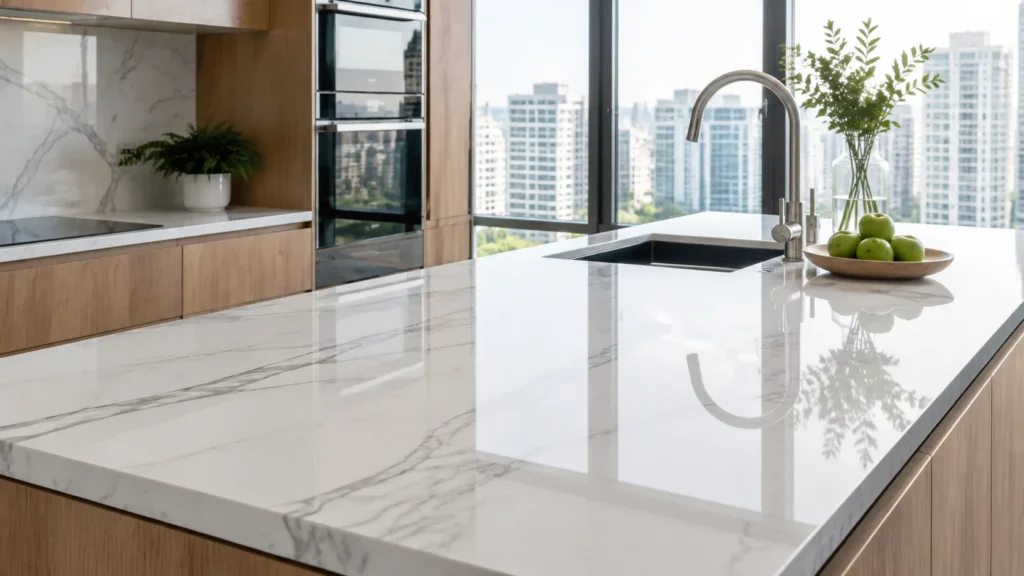
Gloss finish porcelain appeals because it reflects light. That mirror-like depth makes a surface look like it has more dimension than it physically does, and matt finishes can’t replicate it.
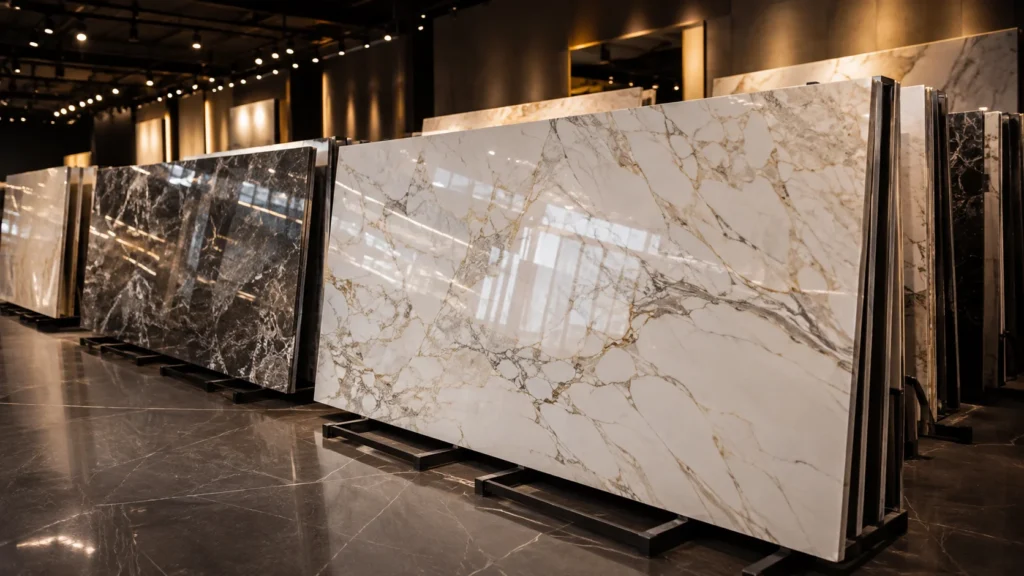
There’s a reason showrooms light their gloss slabs so dramatically. Under proper lighting, the surface appears to glow, bouncing light around the room in a way that makes the kitchen feel larger and brighter.
For Malaysian homeowners in high-rise condominiums with limited natural light, that reflective quality matters more than it would in a landed home with windows on three sides. A gloss Calacatta-style porcelain slab can make a compact 800 square foot unit feel noticeably more open.
Why is gloss associated with luxury in Malaysia?
Because Malaysian show units taught homeowners to associate it that way. Walk through premium developments in Mont Kiara, KLCC, or Penang, and you’ll consistently find gloss surfaces in the display kitchens. Developers know glossy materials photograph dramatically and create an immediate reaction during viewings.
That association sticks. When homeowners commit a serious slice of their renovation budget to a countertop, they want it to convey the same level of finish they saw in those show units. A matt finish, whichever way you argue its practical merits, doesn’t deliver that same first-glance punch.
What does the showroom not show you?
The showroom shows you day one. It doesn’t show you day 365.
In a showroom, customers see pristine gloss porcelain under perfect lighting, professionally maintained and spotlessly clean. The surface looks like liquid glass frozen in place.
What they don’t see is the same slab after three months in a working Malaysian kitchen: the water marks ringing the sink area, the faint haze that develops even after careful cleaning, the fine scratches that only appear when the afternoon light comes in low.
The showroom presents the best-case scenario, and that’s understandably the version people fall in love with.
What Are the Real Drawbacks of Gloss Porcelain in a Malaysian Kitchen?
The real drawbacks are water spotting, cleaning product residue, and micro-scratches that catch the light. These aren’t theoretical concerns. They’re the things customers ring us about weeks or months after installation.
Fingerprints get raised more often than any of them, usually before installation rather than after. In practice they’re the least of it, and we’ll come to why.
If you want the full picture across every surface type, our complete stone finish guide compares polished, honed, leather, and gloss side by side for quartz, sintered stone, and porcelain.
Why does water spotting happen so quickly in Malaysia?
Because our humidity slows evaporation, and slow evaporation leaves mineral deposits behind.
When you wipe down a gloss porcelain countertop here, the water doesn’t dry off cleanly the way it might in a drier climate. It sits, evaporates slowly, and leaves visible marks. With humidity levels regularly above 70%, those spots can reappear within hours of cleaning.
The fix is straightforward on paper: buff the surface dry with a microfibre cloth every time. In practice, most Malaysian families cooking two or three meals a day don’t sustain that routine for long.

Do fingerprints really show on gloss porcelain?
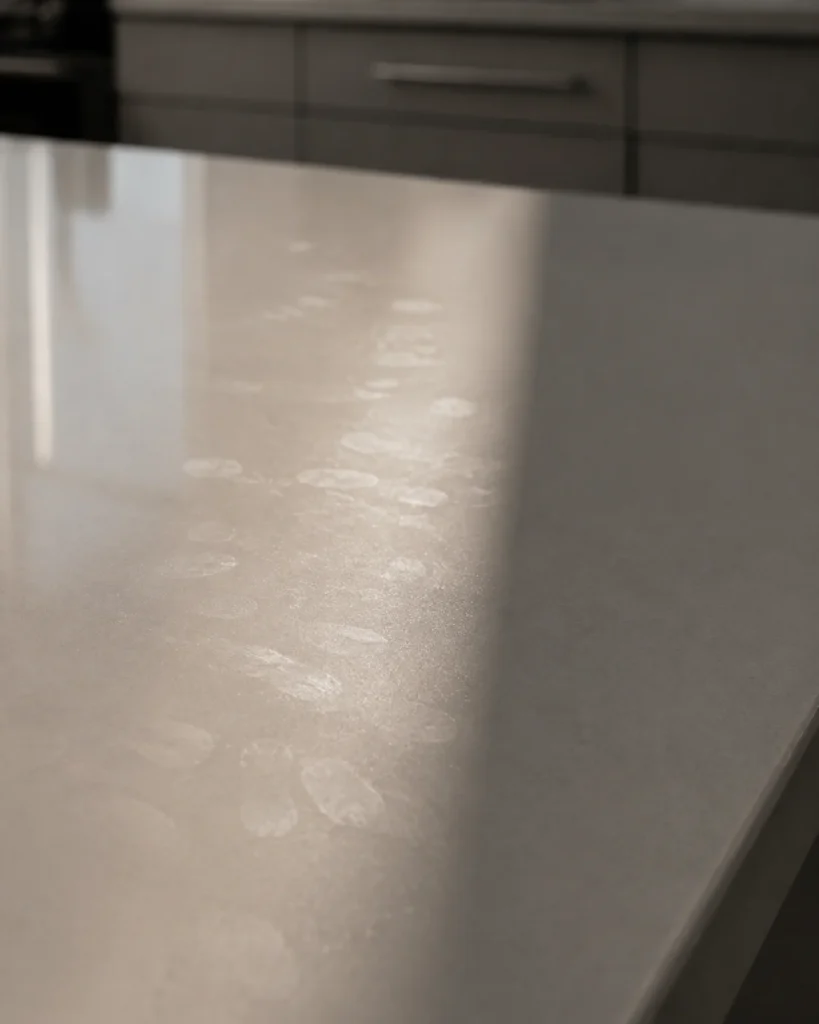
Less than most people expect. Fingerprints on gloss porcelain are angle-dependent: you notice them when light rakes across the surface from the side, and you stop noticing them when you stand square to the counter under normal kitchen lighting. Walk past the same slab at a different time of day and the marks you spotted earlier have effectively disappeared.
Two other things work in your favour. The first is colour. Dark slabs do show marks more readily, but the gloss colours Malaysians actually buy are overwhelmingly light: whites, creams, and pale greys. Those hide fingerprints well enough that most owners never think about it.
The second is how kitchens genuinely get used. People who cook are handling pot handles, taps, and cabinet doors, not resting their palms flat on the countertop. The surface collecting the most marks in a busy Malaysian kitchen is usually the fridge door, not the stone.
Where it does become noticeable is a dark gloss island sitting under low-angle downlights, or a breakfast counter that people lean on rather than cook at. If you have your heart set on a charcoal or black gloss slab in one of those spots, that’s the case worth thinking twice about. For a light-coloured gloss worktop in a normal cooking kitchen, fingerprints shouldn’t drive your decision.
Can the wrong cleaning product damage a gloss finish?
It won’t damage the porcelain itself, but it can leave a residue that dulls the shine, and most homeowners mistake that for the material degrading.
Many Malaysian households reach for whatever’s on the supermarket shelf. Some of those products aren’t pH-neutral, and over time they leave a film or faint haze on gloss porcelain. We recommend pH-neutral cleaners, but people grab what’s convenient.
When the finish starts looking less brilliant, the assumption is usually that the slab has worn out. Nine times out of ten it’s cleaning product buildup, and it can be corrected.
Do scratches show more on a gloss finish?
Yes. Porcelain slabs are highly scratch-resistant but not scratch-proof, and gloss surfaces make small scratches far more visible because they catch light at certain angles.
In Malaysian kitchens where wok cooking is common and heavy pots move across the counter daily, micro-scratches build up over the years. On a matt finish they’re effectively invisible. On gloss, they announce themselves whenever the light hits right, making the surface look older than it is.
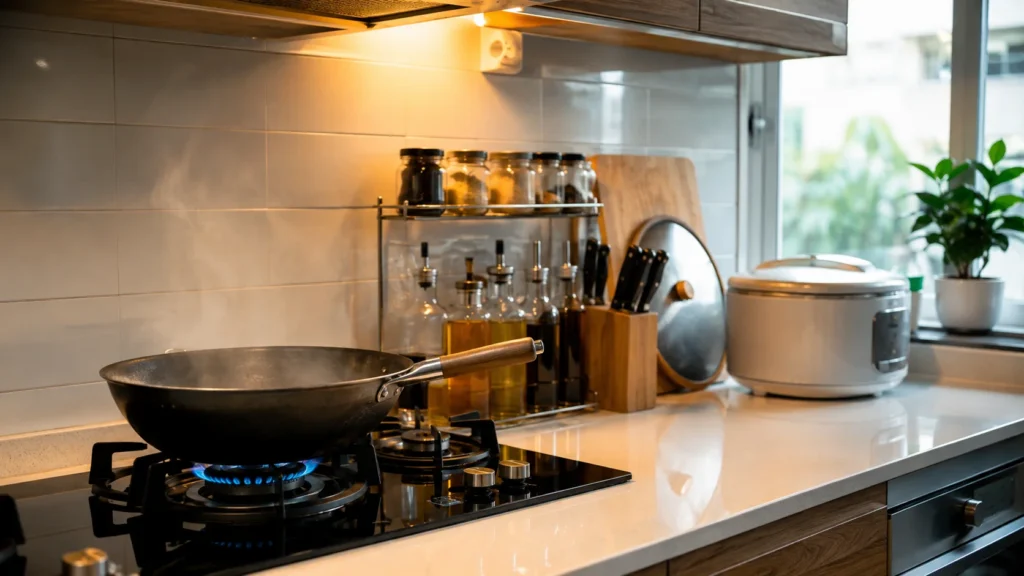
That said, one of our customers pushed back on this concern, and she had a point. After installation, she told us: “I don’t really care about minor scratches on the gloss finish. My kitchen countertop always has cooking wares and spices on it, these reduce the visual of seeing the minor scratches anyway.”
She’s right about how real kitchens actually work. An active Malaysian kitchen counter isn’t an empty display surface. There’s the rice cooker in the corner, the cooking oil near the stove, the spice rack, the knife block, the dish rack. When two-thirds of the counter is occupied with daily cooking essentials, scratches you’d only spot under gallery lighting simply don’t register.
That doesn’t make scratch visibility a non-issue. It means that for some households with busy, practical kitchens, it genuinely never becomes a problem in daily life.
Why Do Malaysian Homeowners Choose Gloss Anyway?
Homeowners choose gloss because the reward arrives immediately and the cost arrives slowly. By the time the maintenance reality sets in, they’ve already emotionally committed, and most adjust their routine rather than regret the choice.
Beyond that timing gap, a few cultural and practical factors are at work.
The home as a statement
In Malaysian culture, the home reflects how well you’re doing. When relatives visit for Hari Raya, when friends come over during Chinese New Year, when the in-laws stay for a week, the kitchen gets seen.
A gloss finish countertop makes a statement without anyone having to say anything. That might sound superficial, but it reflects real values around hospitality and presentation that run deep here.
The belief in personal discipline
Plenty of homeowners think they’ll be the exception. “Other people struggle with the maintenance, but I’ll keep mine perfect.”
Some actually do. Households with domestic helpers, families with strict cleaning routines, or people who genuinely enjoy keeping their home spotless maintain gloss finishes beautifully for years. For them the extra effort is a fair trade.
Many don’t know matt porcelain exists
This one surprises people. A lot of homeowners assume porcelain simply comes glossy, the same way bathroom tiles do. They’ve never seen a matt porcelain slab until we put one in front of them, and some switch on the spot.
Others look at both and still choose gloss. They acknowledge the practical case for matt and pick the aesthetic impact anyway, which is a legitimate decision as long as it’s an informed one.
Design media favours gloss
Browse Instagram, Pinterest, or local interior magazines and you’ll mostly see gloss surfaces, because glossy materials photograph dramatically well. Professional photography rewards reflection.
That creates a loop where gloss looks like the design-forward choice and matt looks utilitarian, even though international design has been moving the other way for years. Many homeowners also aren’t aware of the differences between porcelain slabs and porcelain tiles, which shapes what finishes and formats they think are available to them.
When Does Gloss Finish Porcelain Actually Make Sense?
Gloss makes sense when the kitchen isn’t used intensively, when the priority is resale presentation, when the household has help maintaining it, or when it’s used strategically in low-contact areas only.
Low-use kitchens
Some Malaysian condominiums genuinely aren’t cooked in much. Professionals who eat out most nights, couples without children, secondary units that see occasional use. These kitchens never face the maintenance burden we describe, and gloss holds its appearance with minimal effort.
The drawbacks are real, but they’re only relevant if the kitchen is actually working hard.
Kitchens being prepared for resale
If you’re renovating with a sale in mind in the next three to five years, gloss is a strategic choice. Property photography favours reflective surfaces, and staging a unit is easier with that bright, luxurious finish. Long-term maintenance matters less when your timeline is short.
Households with cleaning routines already in place
Families with domestic help, or homeowners who tidy daily and don’t mind buffing the counter dry, keep gloss porcelain looking excellent for years. The extra five minutes a day is negligible when it’s already part of the routine.
A hybrid layout
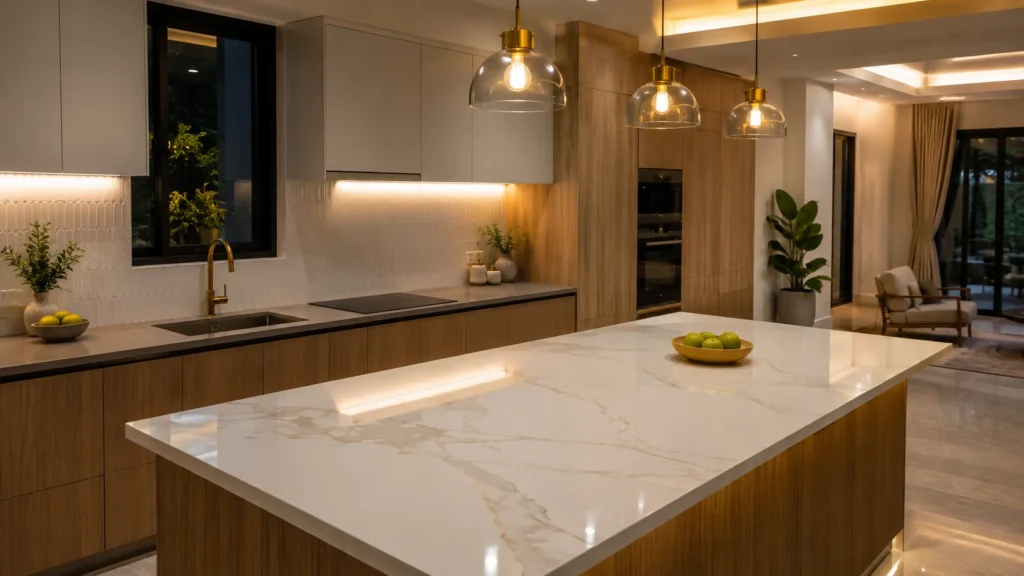
You don’t have to choose one finish for the whole kitchen. Some homeowners run gloss on the island or breakfast counter, where it acts as a visual centrepiece and sees lighter use, and matt on the main prep zone and around the sink.
This is the most sensible compromise we install. You get the impact where people look, and the practicality where the water and the wok actually are. It takes planning with your fabricator so the transition reads as intentional rather than accidental.
How Does Matt Finish Porcelain Compare?
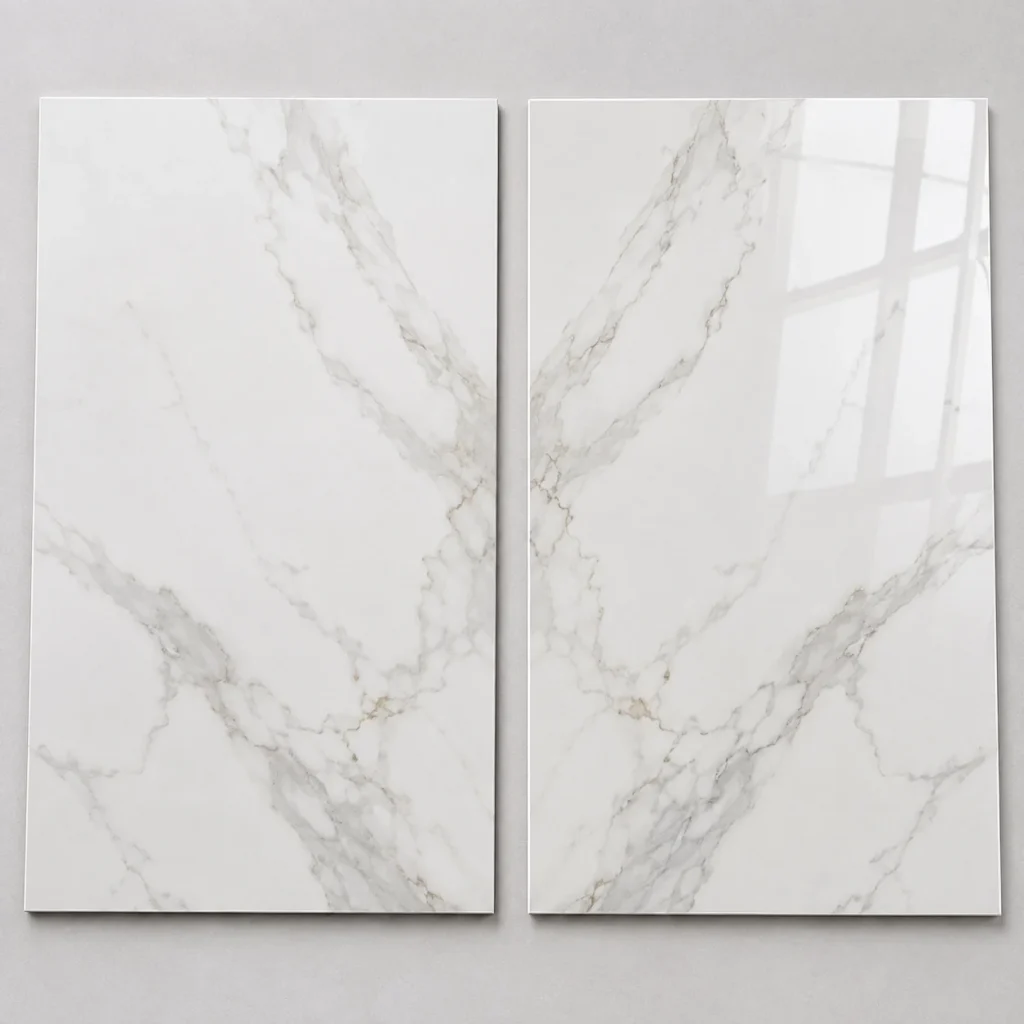
Matt finish porcelain gives you most of the visual quality of gloss with a fraction of the maintenance, because it doesn’t reflect light and therefore doesn’t advertise water marks, fingerprints, or fine scratches.
| Factor | Gloss finish | Matt finish |
|---|---|---|
| Light reflection | High, mirror-like depth | Low, soft and velvety |
| Water spotting in humidity | Highly visible, appears within hours | Barely visible |
| Fingerprints | Visible from certain angles on dark colours; light colours hide them well | Not visible |
| Fine scratch visibility | Catches light, shows over time | Effectively hidden |
| Daily upkeep | Wipe plus buff dry to look its best | Wipe down only |
| Best suited to | Low-use kitchens, islands, resale staging | Daily-use Malaysian kitchens, sink and prep zones |
Modern matt porcelain isn’t rough or cheap-looking, which is the assumption we most often have to correct. It’s smooth to the touch and visually soft, closer to what people describe as European or contemporary minimalist.
In our climate the difference is practical, not just stylistic. Water evaporates without leaving deposits, and fine scratches never catch the light. Fingerprints don’t register at any angle, which matters most if you’re set on a dark colour.
Homeowners who move from gloss to matt on a later renovation tell us the same thing every time: the counter looks clean with less effort. A quick wipe leaves it looking finished rather than revealing a fresh set of water marks.
If you’re rethinking the material as well as the finish, it’s worth comparing porcelain against quartz stone before you commit, since the two behave quite differently in a Malaysian kitchen.
How Should You Decide Between Gloss and Matt for Your Kitchen?
Decide based on how your household actually cooks, not on how the slab looks in the showroom. The honest questions below sort most people out quickly.
About your lifestyle: How often does your household cook? Are you preparing Malaysian food daily, with the oil splatter and spice prep that comes with it? Are there children who’ll touch every surface? Do you entertain often?
About your maintenance capacity: Do you have domestic help? Do you enjoy keeping surfaces pristine, or does it feel like a chore? Will it bother you if the counter isn’t spotless?
About your expectations: Are you choosing gloss mainly because the showroom sample looked stunning? Have you seen gloss porcelain in a real Malaysian home after six months of use?
About your priorities: Is the visual impact worth a daily wipe-and-buff routine? Would matt achieve the same overall look you’re after?
See both finishes outside a showroom
Don’t decide on showroom samples alone. If friends, family, or colleagues have porcelain countertops, ask to see them, ideally ones installed at least six to twelve months ago.
Ask them the honest questions: how much time do they spend on it, do the water marks bother them, would they choose the same finish again? A gloss counter that’s been through six months of daily cooking looks quite different from the display sample.
If you don’t know anyone with porcelain countertops, be extra careful about choosing gloss on showroom appearance alone. The showroom is day one. You’re buying for day 365.
Ask your fabricator what they see
Fabricators aren’t steering you towards matt to save themselves work. We install either finish with the same effort. Our recommendations come from years of watching how each one performs in real Malaysian kitchens and from fielding the calls that come afterwards.
When we suggest matt, we’re sharing a pattern: what tends to produce long-term satisfaction versus what tends to produce a maintenance question three months in.
FAQ
Is gloss finish porcelain slab bad for a Malaysian kitchen? No, it’s demanding rather than bad. Gloss porcelain performs perfectly well as a material, but Malaysia’s humidity makes water spots appear faster and more visibly than in drier climates, so it needs a consistent wipe-and-buff routine to look its best.
Do gloss porcelain countertops show fingerprints? Only from certain angles, and mostly on dark colours. Fingerprints on gloss porcelain appear when light rakes across the surface from the side and vanish when you look at it straight on. Since most Malaysian homeowners choose light gloss colours, and since people who cook are handling pots and taps rather than pressing their palms on the counter, it rarely becomes a daily annoyance.
Does gloss porcelain scratch more easily than matt? No. Both have the same scratch resistance because it’s the same material. The difference is visibility: a fine scratch that disappears into a matt surface will catch the light on a gloss one.
Can I use gloss and matt porcelain in the same kitchen? Yes, and it’s a strategy we recommend often. Gloss on the island or breakfast counter for visual impact, matt around the sink and main prep zone where the maintenance load is heaviest. Plan it with your fabricator so the transition looks deliberate.
Will a gloss porcelain countertop lose its shine over time? The finish itself doesn’t wear off, but it can look dull from cleaning product residue building up. Using a pH-neutral cleaner and drying the surface properly keeps the shine intact for years.
Conclusion
Here’s what we see at Sinno Stone after hundreds of installations: some homeowners love their gloss porcelain and wouldn’t change a thing. Others call us within months asking whether anything can be done to make it less demanding. A noticeable number choose matt for their next renovation.
Gloss finish porcelain isn’t the wrong choice. It’s the high-maintenance one, and whether that’s a problem depends entirely on how your household actually lives. The people who thrive with it tend to have help with cleaning, cook less often, or care enough about the look that the extra effort feels worthwhile.
For everyone else, matt porcelain delivers most of the visual appeal for a small share of the upkeep, and that maths increasingly makes sense to practical-minded Malaysian homeowners.
If gloss speaks to your vision and you understand what maintaining it involves, choose it without hesitation. Just don’t choose it because you assumed gloss was automatically better, or because the showroom sample looked perfect under a spotlight. Come and see both finishes in person, tell us how your kitchen actually gets used, and we’ll help you pick the one you’ll still be happy with in year two.