

Porcelain slab wins on heat and UV resistance and suits outdoor or wok-heavy kitchens, while quartz stone wins on impact resistance, edge options and fabricator availability, and suits most indoor Malaysian kitchens. Both are non-porous and easy to clean, so the decision comes down to where the countertop sits and how you cook on it.
Renovating in Malaysia means choosing between a long list of countertop materials, and these two come up in almost every showroom conversation. This guide compares them across the things that matter in a Malaysian home: cost, durability, heat, maintenance, looks and how each copes with our climate.
Key Takeaways
- Porcelain slab takes heat and direct sunlight better than quartz, which makes it the pick for outdoor counters and balcony kitchens.
- Quartz stone is homogenous through the slab, so a chip on the edge is far less visible than on porcelain, where the pattern is printed on the surface.
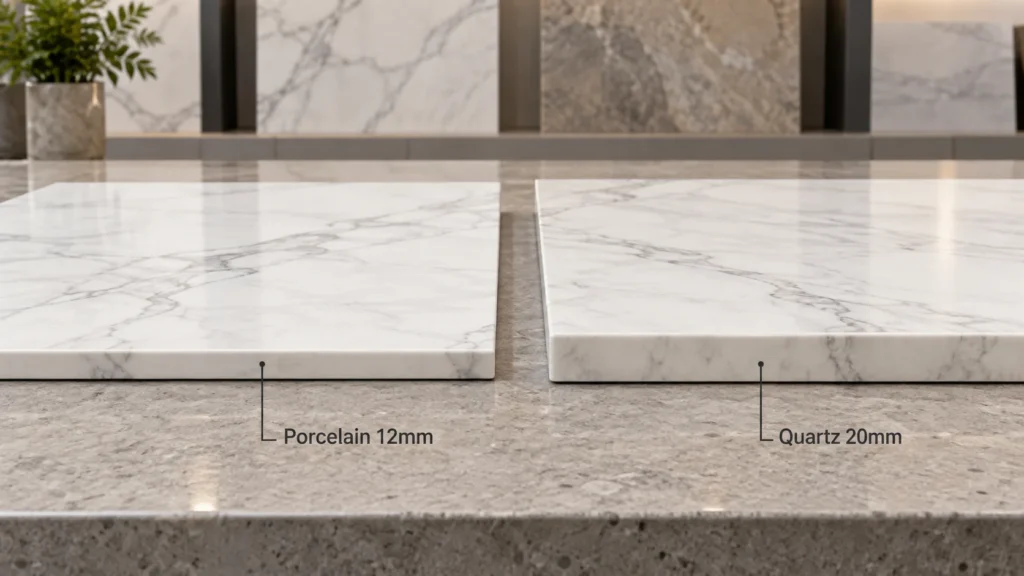
- Porcelain is usually 12mm and light; quartz is 15mm to 30mm and heavier, but the extra thickness gives you more edge-profile choices.
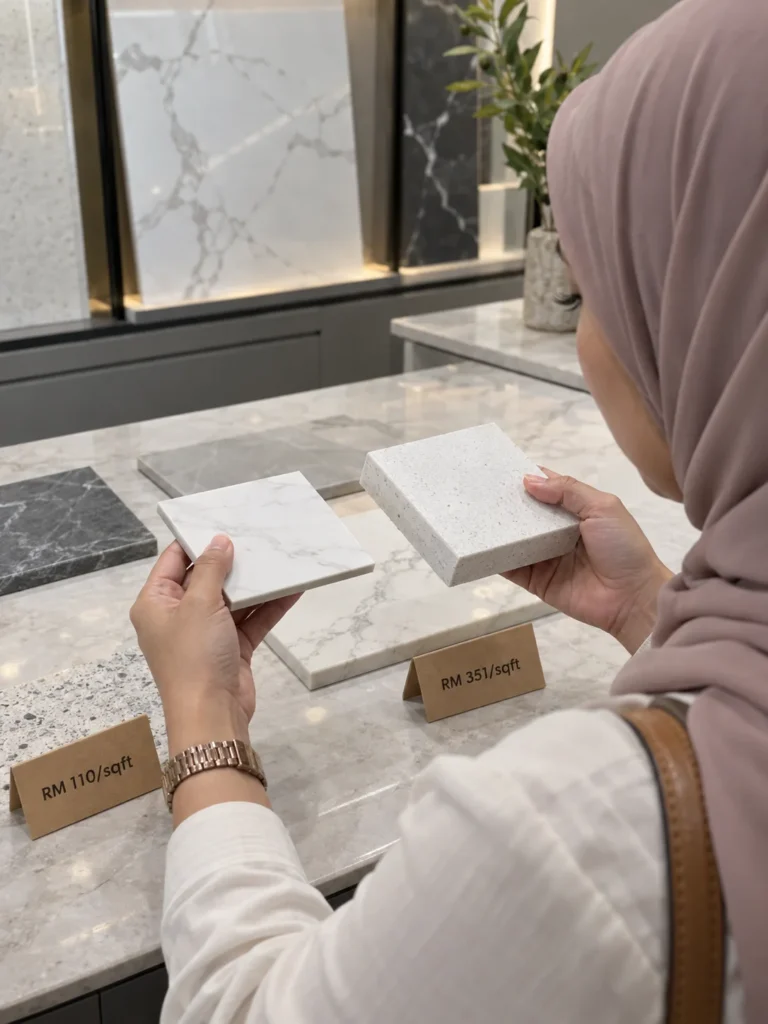
- Quartz supply-and-install pricing at Sinno runs from RM 110 per sqft (Zenstone) to RM 689 per sqft (Caesarstone), so “quartz” is not one price.
- Quartz has many more experienced fabricators in Malaysia. Porcelain needs a specialist who has handled thin slabs before.
What Is a Porcelain Slab Countertop?
A porcelain slab is a large-format tile, pressed from refined clay and mineral powders and fired above 1,200°C until it becomes dense and non-porous. The pattern you see is printed onto the surface before firing, then sealed under a glaze. It is a close cousin of sintered stone, and the difference between sintered stone and porcelain slab trips up a lot of buyers, so it is worth reading that guide before you visit a showroom.
What you get:
- Standard countertop thickness of 12mm, which keeps the slab light
- Large-format sizes up to 3.2m by 1.6m, so fewer joints on a long run
- Printed designs that copy marble, concrete, timber and even fabric
- UV-stable colour, suitable for outdoor use
- Very hard surface that shrugs off scratches and everyday stains
- Works on walls and floors as well as countertops
What Is a Quartz Stone Countertop?
Quartz stone, also called engineered quartz, is made by binding crushed natural quartz with polymer resin and pigment, then compressing and curing it into a solid slab. The colour and pattern run all the way through, not just across the top. If you want the full picture of how it is made, start with what quartz stone is and how it is made.
What you get:
- Hard, dense surface that handles daily chopping and prep
- Consistent colour and pattern from slab to slab
- Non-porous, so curry, kopi and cooking oil wipe off
- Wide range from plain whites to bold marble veining
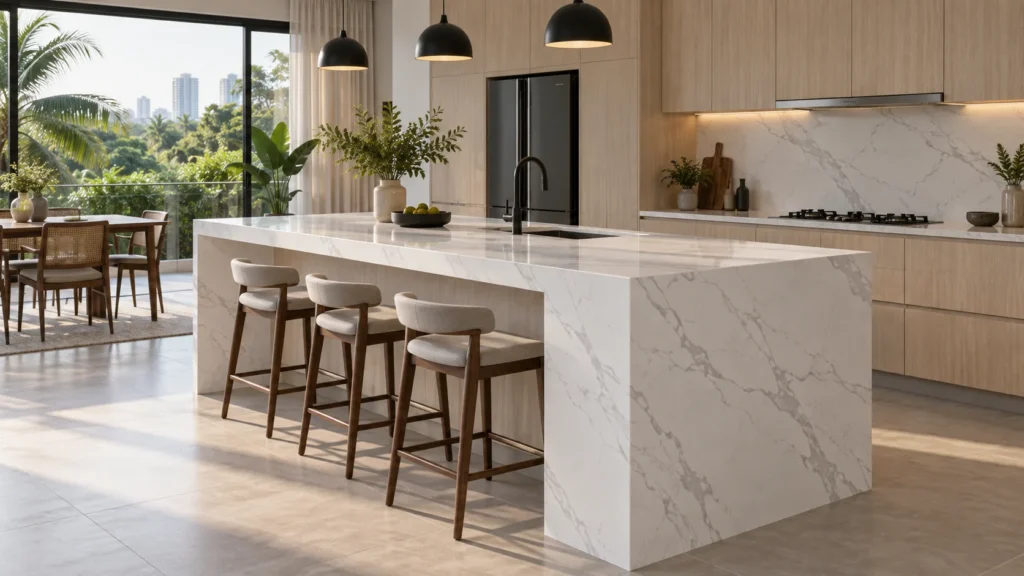
- Thicker slabs (15mm, 20mm, 30mm) that allow decorative edges and waterfall islands
You may still see “93% quartz” on brochures. That number no longer tells you much about quality, and why the 93% benchmark is outdated covers what to look at instead.
Porcelain Slab vs Quartz Stone: How Do They Compare?
Quartz and porcelain tie on scratch and stain resistance. Porcelain wins on heat, UV and weight. Quartz wins on chip resistance, edge profiles and fabricator availability. Price overlaps at the entry level and splits at the top end.
| Factor | Porcelain slab | Quartz stone |
|---|---|---|
| Scratch resistance | Mohs 7 to 8 | Mohs around 7 |
| Heat resistance | High. Resin-free, so no yellowing | Moderate. Resin can scorch or discolour |
| UV resistance | Stable. Suitable outdoors | Can yellow in direct sun. Indoors only |
| Chip and impact | Prone at edges. Chips show the body colour | Better. Chips blend because colour runs through |
| Stain resistance | Non-porous, no sealing | Non-porous, no sealing |
| Thickness and weight | 12mm, light | 15mm to 30mm, heavier |
| Edge profiles | Limited. Mitred edges to fake thickness | Bevelled, bullnose, ogee and more |
| Fabricators in Malaysia | Fewer, specialist | Many, well established |
| Supply and install (Sinno) | See note on pricing below | RM 110 to RM 689 per sqft by brand |
Which is more durable and scratch-resistant?
Both are hard enough for a Malaysian kitchen. Porcelain rates 7 to 8 on the Mohs scale and quartz sits around 7, and in daily use you will not notice the gap. A chopping board still makes sense on either surface, mainly to protect your knives.
Where they differ is impact. A 12mm porcelain slab is more likely to chip at an exposed edge if a heavy pot or pestle catches it, and because the design is printed on the surface, the chip exposes a plain body underneath. Quartz is more forgiving on both counts. This is the single most common complaint we hear about porcelain, and it features in the hidden disadvantages of porcelain countertops.
Verdict: Tie on scratches, quartz on chips.
Which handles heat better?
Porcelain handles heat better. It is fired above 1,200°C and contains no resin, so a hot pot will not scorch or yellow it. Quartz is heat-resistant but not heatproof: the resin binder can discolour or crack if you put a hot pan directly on a quartz kitchen top, especially a wok straight off a high flame.
Use a trivet on both. Porcelain will not burn, but a thin 12mm slab can still crack from thermal shock if a very hot pan lands on a cold spot near an edge or cut-out. The trivet costs RM 15. The slab does not.
Verdict: Porcelain, with a trivet still on the counter.

Which is easier to maintain?
Both are equally easy. Neither is porous, so neither needs sealing, and both clean up with a soft cloth and mild dish soap. Turmeric, sambal and kopi wipe off if you get to them the same day.
The one difference is gloss porcelain. High-gloss porcelain shows fine scratches and water marks more readily than a polished quartz, which is one reason Malaysians still choosing gloss porcelain often regret it after a year. Pick a matt or satin finish if you go porcelain.
Verdict: Tie.
Which looks better?
Porcelain gives you the more realistic natural stone look, because the pattern is a high-resolution print of real marble or stone. Bookmatched slabs and large formats mean fewer joints on an island. Quartz veining is convincing on premium brands but tends to look more uniform and “designed” on budget ranges.
The trade-off is depth. Quartz has colour all the way through, so the edge matches the top. Porcelain edges have to be mitred, so the printed face wraps around the corner, and a poorly cut mitre shows a thin line of the plain body.
Verdict: Porcelain for realism, quartz for edge consistency.
Which is easier to install?
Porcelain is lighter, so it is easier to carry up a condo staircase in Mont Kiara or Bangsar South and puts less load on cabinets. But it is harder to fabricate. Thin slabs crack easily during cutting and transport, so you need a fabricator who has worked with them before, and there are fewer of those in Malaysia.
Quartz is heavier and needs sound cabinets underneath, but every established fabricator in the Klang Valley, Penang and Johor Bahru handles it every week. If you are wondering whether the extra thickness of quartz matters, why stone thickness doesn’t matter much will save you some money.
Verdict: Porcelain for weight, quartz for fabrication.
Which suits outdoor use?
Porcelain, without question. It is UV-stable, so a balcony counter or garden kitchen stays the same colour through years of afternoon sun. Quartz resin yellows under direct sunlight, and we do not recommend it for anywhere the sun reaches for hours a day.
Verdict: Porcelain.
How Much Do Porcelain Slab and Quartz Countertops Cost in Malaysia?
At Sinno, quartz stone supply-and-install pricing in 2026 runs from RM 110 per sqft for Zenstone to RM 689 per sqft for the top Caesarstone designs. The brand and design you pick moves the price far more than the material name does.
| Quartz brand (Sinno, 2026) | Supply and install, per sqft |
|---|---|
| Zenstone | RM 110 to RM 160 |
| Moonstone | RM 182 to RM 226 |
| Silestone | RM 282 to RM 634 |
| Caesarstone | RM 332 to RM 689 |
Entry-level porcelain slab in the Malaysian market sits in the same band as Zenstone, roughly RM 110 to RM 180 per sqft installed, with imported Italian and Spanish brands above that. Porcelain also carries more fabrication cost per sqft because of the mitred edges and the extra care in cutting, so a “cheap” slab does not always mean a cheap countertop.
Two things to check on any quote: whether the price is per sqft installed or per slab, and what the edge profile costs. For a brand-by-brand breakdown, see the quartz stone price guide for Malaysia and the wider stone countertop cost guide.
Verdict: Comparable at entry level. Quartz has a much wider range at the top.
Where Does Each Material Work Best in a Malaysian Home?
Porcelain works best where heat and sun are the problem: outdoor kitchens, balcony bars, and full-height backsplashes behind a wok burner. Quartz works best in indoor kitchens that take a daily beating: islands, prep counters, wet kitchens and vanity tops.
Best uses for porcelain slab
- Outdoor and balcony counters in landed homes, where UV would yellow quartz
- Full-height backsplashes behind the hob, where a 12mm slab and large format mean no grout lines
- Feature walls that continue the countertop pattern up the wall
- Wall-hung bathroom vanities, where the light slab puts less strain on brackets
Best uses for quartz stone
- Waterfall islands, where the thick slab and solid edge make the mitre clean
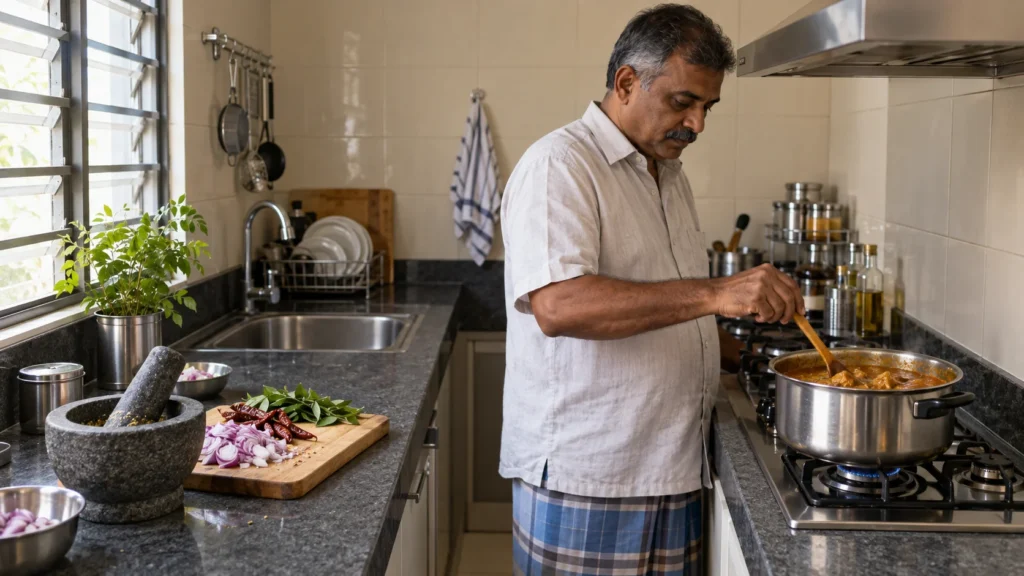
- Heavy prep areas where pestles, pots and heavy pans land on the edge
- Wet kitchens, the daily workhorse of a Malaysian home; see the best countertop for a wet kitchen in Malaysia
- Undermount sinks, where the thicker slab gives the sink proper support
Which Should You Choose?
Choose porcelain if your countertop will see direct sun or you want the most realistic marble look on a large island. Choose quartz if the kitchen is indoors, you want decorative edges, or you want the widest choice of fabricators and the least risk of chipped edges.
Choose porcelain slab if you:
- Want an outdoor kitchen, balcony counter or alfresco bar
- Want a bookmatched marble look with minimal joints
- Are matching the countertop to a full-height backsplash or feature wall
- Need a light slab for a wall-hung vanity or upper-floor condo
- Are happy to hunt for a fabricator with porcelain experience
Choose quartz stone if you:
- Are fitting an indoor kitchen that gets daily heavy use
- Want a bevelled, bullnose or ogee edge
- Want a chip at the edge to stay invisible
- Prefer a material every local fabricator knows well
- Want the widest price range, from RM 110 to RM 689 per sqft, to fit your budget
FAQ
Is porcelain slab better than quartz for a Malaysian kitchen? For most indoor Malaysian kitchens, quartz is the safer choice because it resists chipping, offers more edge profiles and has far more experienced fabricators. Porcelain is better where heat and UV matter, such as outdoor kitchens and balcony counters.
Can you put a hot wok directly on a porcelain slab countertop? Porcelain will not scorch or yellow from a hot wok, but a 12mm slab can still crack from thermal shock near an edge or cut-out, so use a trivet. Quartz should never take a hot wok directly, because the resin can discolour or crack.
Does porcelain slab chip more easily than quartz? Yes. A 12mm porcelain slab is more likely to chip at exposed edges, and because the design is printed on the surface, the chip shows the plain body underneath. Quartz has colour all the way through, so a chip is far less noticeable.
Is porcelain slab cheaper than quartz in Malaysia? Entry-level porcelain and entry-level quartz cost about the same, roughly RM 110 to RM 180 per sqft installed. Quartz has a much wider range above that, with Silestone and Caesarstone running from RM 282 to RM 689 per sqft at Sinno in 2026.
Can porcelain slab be used for an outdoor kitchen in Malaysia? Yes. Porcelain is UV-stable and will not fade or yellow in tropical sun, which makes it the better choice for balcony and garden kitchens. Quartz is not recommended outdoors because the resin yellows under direct sunlight.
Conclusion
Porcelain slab and quartz stone are both good countertops. Neither stains, neither needs sealing, and both will outlast the cabinets under them. The difference is where they belong. Porcelain earns its place outdoors, behind the hob and on large marble-look islands. Quartz earns its place in the indoor kitchen that gets cooked in every day, where a chipped edge and a limited fabricator pool are the bigger risks.
If you are still torn, bring your kitchen layout to the showroom and put a full slab of each next to your cabinet colour. Ten minutes with the real thing beats an hour of reading.