

For most Malaysian homes, quartz stone and sintered stone are the two best materials for a bathroom vanity top. Both are non-porous, need no sealing, and shrug off the humidity that sits in a Malaysian bathroom all year round. Porcelain slab and granite work too, with conditions attached. Compressed marble is the one to avoid.
The vanity top usually gets decided in the last five minutes of a bathroom renovation, when the budget is nearly spent. That is a shame, because it takes more chemical abuse than any surface in your home. Hair dye, makeup remover, toothpaste, perfume, AHA toners, bleach-based cleaners. Every day, on a surface the size of a coffee table.
Then add the climate. Malaysian bathrooms sit near saturation for hours after a shower, and porous surfaces stay under that stress for years. Pick wrong and you get stains that never lift, etching around the tap, and a replacement in year four. Pick right and the vanity still looks sharp in year fifteen.

Key Takeaways
- Quartz stone is the best all-round choice for most Malaysian bathrooms, from RM 110 per square foot supplied and installed.
- Sintered stone performs best where the bathroom gets direct sunlight or heavy styling-tool use, from RM 110 per square foot.
- Porcelain slab works well for vanity tops, but only at 12mm thickness or above, and in a honed or matte finish.
- Granite needs sealing and resealing to survive bathroom chemicals, which most homeowners never keep up with.
- Compressed marble is porous and acid-sensitive, and does not belong on a bathroom vanity top.
Why is a bathroom vanity top harder to choose than a kitchen countertop?
A vanity top faces chemical and moisture exposure, whilst a kitchen top faces heat and impact. They are different problems, so the material that wins in your kitchen does not automatically win in your bathroom.
Chemical exposure. Hairspray, acetone, hair dye and acidic skincare are more aggressive on stone than a spilt curry ever will be. Active-ingredient skincare has gone mainstream, and a cotton pad soaked in a high-strength AHA toner left sitting on the surface is exactly the kind of sustained acid contact that dulls a finish over months.
Constant humidity. A kitchen ventilates itself through cooking heat and an extractor. A Malaysian bathroom does the opposite: it heats up during a shower, cools down after, and repeats that cycle daily for years. Porous surfaces never fully dry out, and that is where mould takes hold.
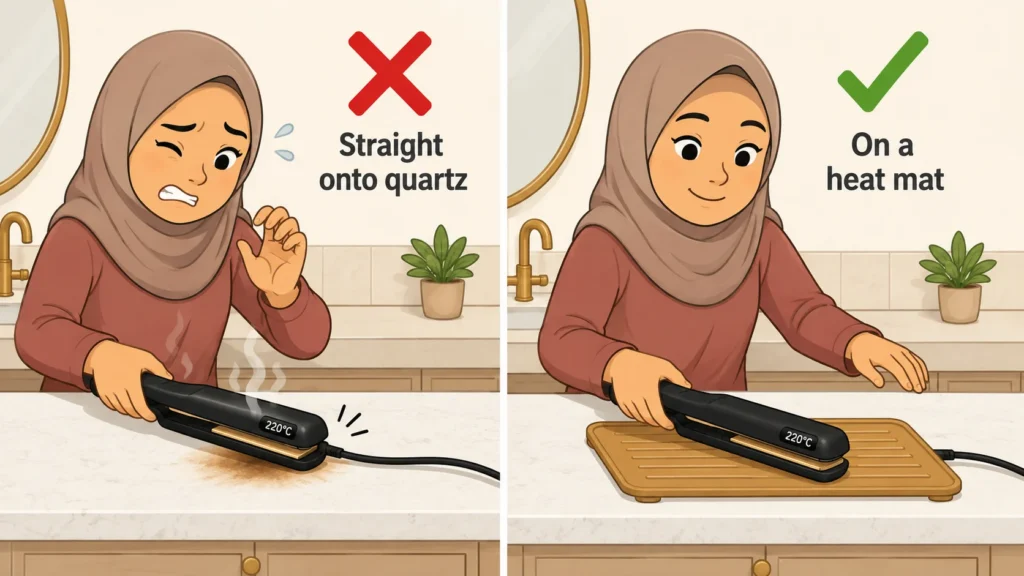
Heat from styling tools. A hair straightener runs at 150°C to 220°C. Set it face-down on the wrong surface and you get a permanent mark shaped like a hair straightener.
Small area, high visibility. A vanity top is usually 3 to 8 square feet. Every flaw sits at eye level, 30cm from your face, under a mirror light. The upside is that the price gap between a budget material and a premium one is measured in hundreds of ringgit here, not thousands.

What are the 5 best stone materials for bathroom vanity tops?
Ranked for Malaysian conditions, the five are quartz stone, sintered stone, porcelain slab, granite, and compressed marble. The first two are safe picks for almost any bathroom. The next two need specific conditions met. The fifth is on this list so you know why to skip it.
1. Quartz stone: the best all-round choice
Quartz stone is engineered from roughly 90% natural quartz crystals bound with polymer resins and pigment. That gives you a dense, non-porous slab with predictable colour, which matters when you are matching a vanity to wall tiles you have already bought.
Why it works in a bathroom:
- Non-porous. Water, soap scum and beauty products sit on the surface instead of soaking in. No mould inside the slab.
- No sealing, ever. Unlike natural stone, quartz needs no annual treatment.
- Widest design range of any material here. Hundreds of colours and marble-look patterns, with slab-to-slab consistency.
- Handles everyday bathroom chemicals. Acetone is safe on quartz. Fabricators use it to clean the surface during installation.
What to watch:
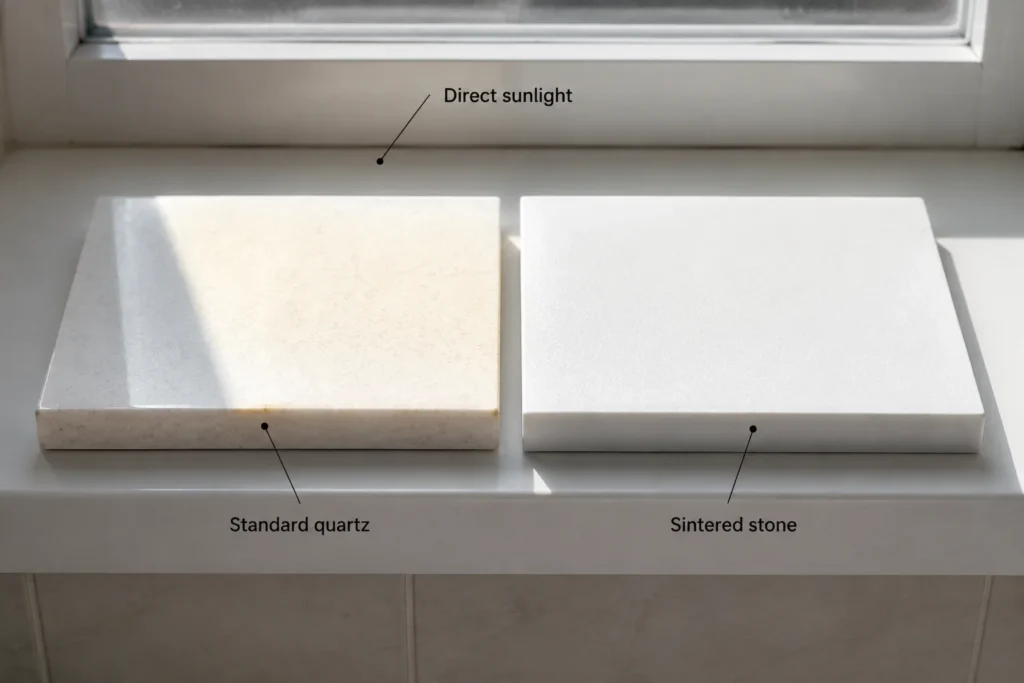
- UV sensitivity. Standard quartz can yellow over years of direct sunlight. If your bathroom has a window straight above the vanity, ask for a UV-stable line or go with sintered stone.
- Heat. The resin binders start degrading above roughly 150°C. A straightener placed directly on the surface can discolour or craze it. Use a mat.
- Skip black and very dark colours. Fine micro-scratches from bottles, holders and rings are invisible on white, grey and beige, and glaringly obvious on dark quartz. A black vanity top can look tired within a year.
Verdict: for most Malaysian bathrooms, quartz is the sensible answer. It handles the full range of daily exposure and asks for almost nothing back.
For a closer look at the trade-offs between the top two, read quartz versus sintered stone for your bathroom vanity top.
2. Sintered stone: best performance, especially near a window
Sintered stone is made by fusing raw minerals under extreme heat and pressure until the slab is effectively non-porous. It is the highest-performing surface on this list, and in a bathroom it has one advantage that genuinely matters in Malaysia: it does not yellow.
Why it works in a bathroom:
- Fully non-porous. No sealing, no mould risk, nothing penetrates.
- UV stable. A sunlit bathroom window is no threat. This is the single strongest reason to pick sintered stone over quartz here.
- Heat resistant well past 300°C. Styling tools make no impression on it.
- Very hard surface. Resists the daily scratching that dulls other materials.
What to watch:
- Brittle at the edges. It is hard, not tough. A sharp knock on an exposed corner can chip it, so keep edge profiles simple rather than sharp and fussy.
- Fewer fabricators handle it well. Sintered stone needs different tooling and a steadier hand than quartz. Ask what your fabricator has actually cut before.
- Standard 12mm can read as slightly thin next to a chunky polished quartz edge. Worth comparing with samples in hand if the vanity is a design feature.
Verdict: if the bathroom gets direct sunlight, or someone in the house uses a straightener every morning, sintered stone is the better buy. Entry-level sintered stone starts at the same price as entry-level quartz, so the upgrade is not always an upgrade in cost.
3. Porcelain slab: stylish and UV stable, if you get the thickness right
Porcelain slab has become a common bathroom choice in Malaysia, mostly for design range and UV stability. It behaves much like sintered stone, because the two are close cousins in how they are made.
Why it works in a bathroom:
- Non-porous and resistant to water, staining and mould.
- UV stable. No yellowing in a bright bathroom.
- Large-format design range in marble, concrete and stone looks.
- Easy to keep hygienic. Nothing to harbour bacteria.
What to watch:
- Thickness is the whole game. A vanity top needs a slab of at least 12mm. Thin porcelain wall tiles are sold in the same showrooms and are not a countertop product.
- Brittle edges, same as sintered stone. Avoid sharp profiles.
- Gloss shows every water mark. In a bathroom, where splashes and soap residue are constant, a honed or matte finish stays looking clean far longer. The complete stone finish guide explains how each finish behaves day to day.
Verdict: a strong option when design variety is the priority. Specify 12mm or thicker and a matte finish, and it performs.
4. Granite: the natural classic, if you keep up the maintenance
Granite has been going into bathrooms for decades, and it earns its place on hardness alone. It sits at 6 to 7 on the Mohs hardness scale, so it resists scratching better than most engineered surfaces, and it laughs at styling-tool heat.
Why it still works:
- Genuinely unique. No two slabs match, and engineered stone cannot replicate that.
- Very hard. Everyday bathroom items will not mark it.
- Heat resistant. No mat needed.
What to watch:
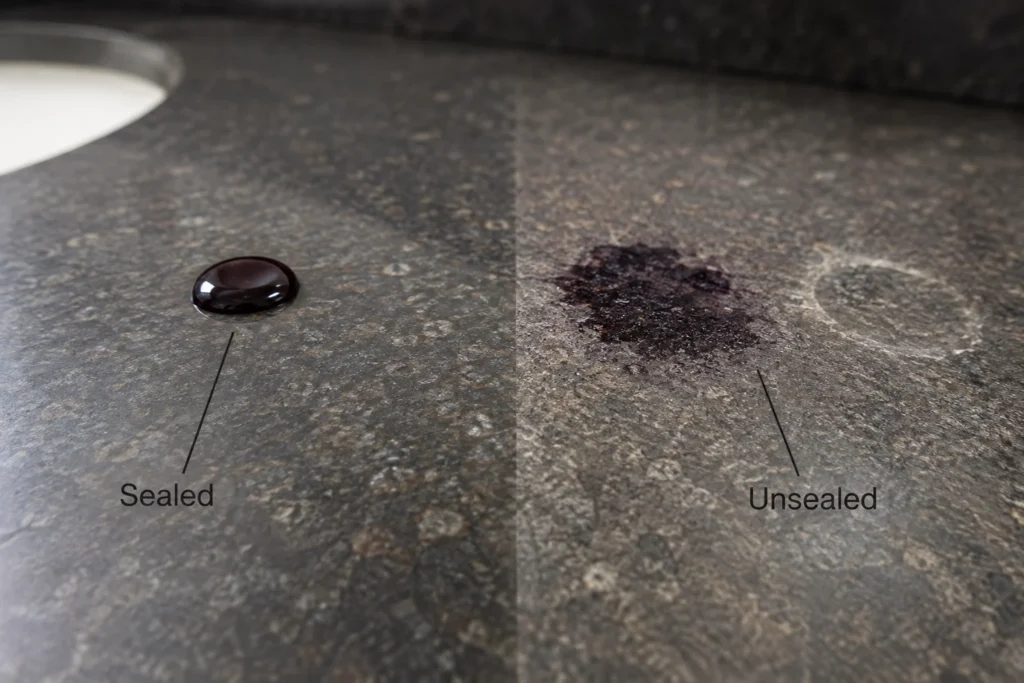
- It is porous. Granite must be sealed at installation and resealed periodically. In practice, most homeowners seal once and never think about it again.
- Acids etch it. Hair dye, acidic skincare and certain cleaners will mark unsealed granite, and a bathroom is full of all three.
- The slab you see is not always the slab you get. Natural stone varies from one end of a block to the other, so view your actual slab before it is cut.
Verdict: granite is a fair choice if you love natural stone and will genuinely keep the sealing schedule. If that sounds like admin you will forget, quartz or sintered stone will look better in year ten.
5. Compressed marble: beautiful, and wrong for a bathroom
Compressed marble, also sold as engineered marble, is made from marble offcuts and dust bound with resin. It gives you a marble look at a lower price than a natural marble slab. In a bathroom, that is where the good news stops.
Why bathrooms are the worst place for it:
- Still porous. Despite being engineered, it absorbs. Soap, toothpaste, hair dye and skincare all stain it.
- Needs sealing and ongoing maintenance, like natural marble.
- Acid-sensitive even when sealed. It etches from products you use daily without thinking.
- Humidity works against it. A porous surface in a Malaysian bathroom never gets a break.
It is also the material most often mis-sold. Before you commit to it anywhere in the house, read Thinking of a Compressed Marble Countertop? Read This First.
Verdict: we do not recommend compressed marble for a bathroom vanity top. If you want the marble look, a Calacatta-pattern quartz or sintered stone gives you the same appearance and none of the problems.
How do the five materials compare side by side?
Quartz and sintered stone lead on every measure that matters in a Malaysian bathroom, and compressed marble trails on all of them.
| Material | Humidity | Stain resistance | Heat | UV stability | Maintenance | From (supply & install) |
|---|---|---|---|---|---|---|
| Quartz stone | Excellent | Excellent | Moderate | Moderate | Low | RM 110/sqft |
| Sintered stone | Excellent | Excellent | Excellent | Excellent | Very low | RM 110/sqft |
| Porcelain slab | Excellent | Excellent | Good | Excellent | Low | Quote-based |
| Granite | Good* | Good* | Excellent | Good | High | Quote-based |
| Compressed marble | Poor | Poor | Moderate | Poor | Very high | Quote-based |
*Granite only holds these ratings whilst the sealing is maintained.
What does a bathroom vanity top cost in Malaysia in 2026?
A vanity top runs from around RM 550 to RM 1,700 supplied and installed for a typical 5 square foot top, depending on brand. Here is what the per-square-foot rates work out to at that size.
| Brand | Material | Supply & install per sqft | 5 sqft vanity top from |
|---|---|---|---|
| Zenstone | Quartz stone | RM 110 to RM 160 | RM 550 |
| Moca Compact | Sintered stone | RM 110 to RM 150 | RM 550 |
| Moonstone | Quartz stone | RM 182 to RM 226 | RM 910 |
| Dekton | Sintered stone | RM 248 to RM 469 | RM 1,240 |
| Silestone | Quartz stone | RM 282 to RM 634 | RM 1,410 |
| Caesarstone | Quartz stone | RM 332 to RM 689 | RM 1,660 |
Two things worth knowing before you compare quotes.
First, on a top this small, fabrication is a bigger share of the bill than it would be on a kitchen run. The basin cutout, the tap holes and the edge profiling take the same work whether the top is 5 square feet or 25, so the labour does not shrink in proportion to the stone.
Second, entry-level sintered stone costs the same as entry-level quartz. If your bathroom has a sunlit window, you can have UV stability without paying more for it. That is a rare thing in renovation.
Granite, porcelain slab and compressed marble are priced per slab selected rather than from a fixed rate card, so ask for them on the quotation by name. For the full picture across every brand and room, see our 2026 Malaysia stone countertop price guide.

Which stone is right for your bathroom vanity?
Match the material to the bathroom you actually have, not the one in the showroom photo.
Choose quartz stone if you want the best balance of performance, colour choice and price, and your vanity is not sitting under direct sunlight. A local brand like Zenstone covers most renovations comfortably. Stick to white, grey or beige.
Choose sintered stone if the bathroom has a sunlit window, or styling tools live on the vanity, or you simply want the lowest-maintenance surface available. Moca Compact puts that performance within reach of a Zenstone budget.
Choose porcelain slab if design variety leads your decision. Specify 12mm minimum and a honed or matte finish, and check your fabricator has cut large-format porcelain before.
Choose granite if you want real natural stone and will keep it sealed. Be honest with yourself about that second part.
Skip compressed marble. The look is achievable in quartz or sintered stone without the porosity, the sealing or the etching.

FAQ
What is the best stone for a bathroom vanity top in Malaysia? Quartz stone is the best choice for most Malaysian bathrooms, with sintered stone ahead of it where the bathroom gets direct sunlight or heavy styling-tool use. Both are non-porous, need no sealing, and start from RM 110 per square foot supplied and installed. Granite and porcelain slab both work with conditions attached, and compressed marble is best avoided entirely.
Can I put a hair straightener directly on a quartz vanity top? No, use a heat mat. Quartz resin binders begin to degrade above roughly 150°C, and a straightener runs at 150°C to 220°C, so direct contact can discolour or craze the surface permanently. Sintered stone and granite both handle that heat without a mat.
Does quartz turn yellow in a bathroom? Standard quartz can yellow over years of direct sunlight exposure, so it is a real consideration if your vanity sits under a clear window. It is not caused by humidity or bathroom products, only UV. If your bathroom is bright, ask for a UV-stable quartz line or choose sintered stone or porcelain slab, both of which are UV stable.
How thick should a bathroom vanity top be? A vanity top should be at least 12mm for porcelain and sintered stone, or 15mm to 20mm for quartz, which is what the standard slabs come in anyway. Thin porcelain wall tiles at 6mm to 9mm are sold in the same showrooms and are not a countertop product, so confirm the thickness on your quotation.
Is marble a good idea for a bathroom vanity in Malaysia? Natural and compressed marble are both porous and acid-sensitive, which makes them a poor match for a bathroom full of skincare, hair dye and cleaning products. A Calacatta or Carrara-pattern quartz gives you the same look with none of the staining and etching risk.
Conclusion
Your bathroom vanity top takes more chemical punishment per square foot than anything else in the house, and Malaysia’s humidity keeps it under load year-round. The good news is that the safe answer is also the affordable one.
Quartz stone handles almost every Malaysian bathroom, from RM 110 per square foot installed. Sintered stone costs the same at entry level and adds UV stability and full heat resistance, which makes it the better call for a sunlit bathroom. Porcelain slab and granite both work when specified properly. Compressed marble does not, and no amount of sealing will change that.
If you are weighing up the top two in more detail, our comparison of quartz versus sintered stone for your bathroom vanity top goes deeper on how each behaves day to day. And if you would rather just get a straight number for your bathroom, send us the measurements and we will quote it properly, line by line.