

Sintered stone is the best countertop for a Malaysian wet kitchen if you cook hard every day, and quartz stone is the best choice for everyone else. Sintered stone takes a wok straight off the flame without a trivet, while quartz costs less, resists turmeric and curry just as well, and only asks that you keep a trivet within reach.
That is the short answer. The longer one depends on your hob, your cooking, and how much maintenance you are willing to live with. A wet kitchen is a harsher room than the dry kitchen it sits behind, and a surface that performs beautifully in a showroom can look tired within a year of real Malaysian cooking. This guide compares the four materials people actually shortlist, with current supply-and-install pricing.

Key Takeaways
- The right wet kitchen countertop depends on how you cook, not on which material is hardest on paper.
- Sintered stone is the strongest all-round performer for daily wok cooking. Hot pans go straight down, no trivet needed.
- Quartz suits most Malaysian homes on stain and moisture resistance, but its resin binders can discolour above roughly 150°C, so trivets are not optional.
- Granite handles heat well but needs periodic sealing. Sensa Granite arrives pre-sealed with a 15-year written stain warranty.
- 2026 supply and install: quartz runs RM110 to RM689 per sqft, sintered stone RM110 to RM469, Sensa Granite RM349 to RM780.
What makes a Malaysian wet kitchen different?
A wet kitchen combines direct flame heat, constant steam, pigmented spills and heavy impact in one room, which is a load no other surface in the house has to carry. The dry kitchen gets the coffee machine and the toaster. The wet kitchen gets everything else.
Here is what a wet kitchen countertop lives with in a normal week:
- High heat. Wok burners run far hotter than a domestic hob, and pans come off the flame and go somewhere. Usually the counter.
- Sustained moisture. Steaming, boiling and washing up keep the air humid for hours, on top of Malaysia’s baseline humidity.
- Pigmented, acidic spills. Turmeric, curry paste, chilli oil, kicap manis, tamarind and santan all stain, and turmeric stains fastest.
- Impact. Pounding lemongrass, cracking crab, splitting a whole chicken. Malaysian prep is physical.
- Oil mist. Regular deep-frying settles a fine film on every surface within reach of the hob.
Any material can survive one of those. The question is which one survives all five for fifteen years. If you are still at the shortlisting stage, the complete guide to kitchen countertop materials in Malaysia compares 14 options before you narrow down to these four.

What should a wet kitchen countertop be able to do?
Four things, and a material that fails any one of them will annoy you daily. Judge every quote against this list rather than against the sample colour:
- Take heat from hot pots, pans and radiant wok heat without discolouring or cracking.
- Resist stains from turmeric, curry, chilli oil and acidic liquids, without a sealing schedule you will forget.
- Shed moisture, because a porous surface in Malaysian humidity is an invitation to mould.
- Clean easily with a damp cloth and a mild detergent, not a specialist product from overseas.
With that benchmark set, here is how each material performs.
Is quartz a good countertop for a wet kitchen?
Yes, for most Malaysian households, provided you use a trivet. Quartz is non-porous, holds off turmeric and curry better than any natural stone, and cleans with a damp cloth. Its one real weakness is direct heat.
Quartz stone is engineered from natural quartz crystals bound with resin, which is what gives it a consistent colour, a non-porous surface and a wide colour range. That resin is also the reason it cannot take a wok straight off the flame.
Where quartz wins
Stain resistance. Nothing soaks in. Turmeric, curry paste and soy sauce sit on the surface and wipe off, which is exactly what you want on a wet kitchen counter. Our guide to cleaning a quartz countertop the right way covers what to use and what to keep away from it.
Moisture resistance. Water cannot penetrate, so there is no pore structure for mould to colonise. If you have seen black spots creeping along a countertop joint, that is usually the silicone, not the stone.
No sealing. Ever. That alone puts it ahead of granite for anyone who does not want a maintenance calendar.
Where quartz falls short
Heat. The resin binders can discolour, and in the worst case crack, under sustained contact above roughly 150°C. A cast iron pan lifted off a burner and set down on quartz is enough to leave a permanent pale patch, and thermal shock damage cannot be polished out.
This does not rule quartz out of a wet kitchen. It does mean a trivet has to become a habit rather than an intention. Can you put hot pans directly on a quartz stone kitchen top explains what actually happens at the resin level.

Quartz pricing in Malaysia (2026)
| Brand | Origin | Supply and install per sqft |
|---|---|---|
| Zenstone | Local | RM110 to RM160 |
| Moonstone | Local | RM182 to RM226 |
| Silestone | Spain | RM282 to RM634 |
| Caesarstone | Israel / USA | RM332 to RM689 |
For a fuller view of the trade-offs before you commit, read the pros and cons of quartz stone kitchen tops.
Is sintered stone the best choice for heavy cooks?
Yes. If wok cooking, deep-frying and daily heavy prep describe your kitchen, sintered stone is the material that stops asking anything of you. Hot pans go straight down, turmeric wipes off, and there is no sealing schedule.
Sintered stone is made by compressing mineral powders and firing them above 1,200°C until the slab is fully vitrified. There are no resin binders, which is why it is genuinely heat-proof rather than heat-resistant. The science behind sintered stone explains the process properly.
Where sintered stone wins
Heat. A wok off high flame does not mark it. For a household cooking three hot meals a day, that removes the single biggest daily risk to the counter. Here is what heat resistance actually means in practice.
Stains. A fully vitrified surface has nowhere for pigment to go. Turmeric, chilli oil and kicap manis all wipe clean.
UV stability. It holds colour under direct tropical sun, which matters in wet kitchens with a large window or a grille door to the back yard.
Scratch resistance. It sits high on the Mohs scale. Cutting straight on it is still a bad idea, but only because it will dull your knives.
Where sintered stone falls short
Hardness is not toughness. Sintered stone is more brittle than quartz, and a sharp point impact on an edge can chip it. A cleaver brought down on the counter lip, or a cast iron pot dropped at an angle, will do damage that is difficult to repair invisibly. Edges and cutouts are the vulnerable spots, which is why fabrication skill matters more here than with any other material. The full list of disadvantages is worth reading before you commit.
Impact is also the reason we tell homeowners to keep the batu lesung on a chopping board rather than pounding lemongrass straight on the stone.

Sintered stone pricing in Malaysia (2026)
| Brand | Range | Supply and install per sqft |
|---|---|---|
| Moca Compact | Regular | from RM110 |
| Moca Compact | Leather and premium series | RM130 to RM150 |
| Dekton | Group 0 to Group 5 | RM248 to RM469 |
Local sintered stone starts at the same price as entry-level quartz, which surprises most people. Dekton sits at the premium end, with Cosentino’s technical backing and warranty behind it.
Does granite still work in a Malaysian wet kitchen?
Granite works well on heat and hardness, and poorly on stains unless it is sealed and kept sealed. In a kitchen that sees turmeric weekly, that maintenance commitment is the whole decision.
Granite is an igneous rock that formed under heat far beyond anything a hob produces, so hot pans are not a problem. It is also hard enough to shrug off everyday knives and tools, and granite counters fitted in Malaysian homes 20 years ago are still in service.
Where granite falls short
Porosity. Granite has microscopic gaps between its mineral crystals, and pigment works into them. Turmeric is the one that catches people out because it stains fast and it stains yellow, which shows on nearly every granite colour. Unsealed or lapsed-seal granite in a humid wet kitchen also gives mould somewhere to settle.
Standard granite needs resealing roughly every one to two years. Sensa Granite by Cosentino sidesteps this: the SenGuard treatment is applied at the factory and carries a 15-year written warranty against oil, coffee and acid stains, with no resealing.
Quality also varies more than buyers expect. Tighter-grained slabs perform better and need sealing less often than cheap material. For the full picture, read is granite still the best countertop choice for Malaysian kitchens.

Granite pricing in Malaysia (2026)
- Sensa Granite (factory pre-sealed): RM349 to RM780 per sqft, supply and install
- Unbranded granite: quoted per slab, so ask for the price converted to per sqft on your actual scope before you compare it against anything
Is porcelain slab safe for a wet kitchen?
Countertop-grade porcelain is safe in a wet kitchen. Tile-grade porcelain is not, and telling the two apart is where most homeowners get caught.
Proper countertop-grade porcelain is non-porous, stain-resistant, heat-tolerant and easy to clean, and it delivers marble-look designs at a lower price than natural marble. In a wet kitchen it performs close to sintered stone, which is unsurprising given how similar the two materials are. The differences are worth understanding.
The warning that matters
Many countertops sold as porcelain are thin-body wall or floor tiles, typically under 12mm, that were never rated for countertop use. They chip at the edges, crack across cutouts, and fail exactly where a wet kitchen puts the most stress.
There is a second issue that photos rarely show. Porcelain tiles carry a printed surface pattern over a body of a different colour. Cut an edge or profile a sink cutout and that body colour becomes visible, so a white marble-look top can reveal a beige or grey line along every edge. Homeowners usually discover this on installation day.
Pricing: countertop-grade porcelain is quoted per project in Malaysia rather than from a fixed brand list, so get it priced on your actual scope alongside a quartz and a sintered stone quote.

How do the four materials compare side by side?
| Feature | Quartz | Sintered Stone | Granite | Porcelain Slab |
|---|---|---|---|---|
| Heat resistance | Moderate, trivet required | Excellent | Very good | Very good |
| Stain resistance | Excellent | Excellent | Needs sealing | Excellent |
| Moisture resistance | Excellent | Excellent | Needs sealing | Excellent |
| Impact resistance | Good | Can chip at edges | Excellent | Variable by grade |
| Sealing required | None | None | Every 1 to 2 years (none for Sensa) | None |
| Repairability | Moderate | Difficult | Moderate | Difficult |
| 2026 supply and install per sqft | RM110 to RM689 | RM110 to RM469 | RM349 to RM780 (Sensa); unbranded per slab | Quoted per project |
| Best suited to | Most households | Heavy daily cooks | Heat-first cooks who will seal | Design-led renovations |
Which countertop suits your cooking style?
Match the material to how your kitchen actually runs, not to how you imagine it will run after the renovation.
You cook a few times a week and want low maintenance. Quartz stone. It handles the stains and the humidity, needs no sealing, and starts at RM110 per sqft with Zenstone. Keep two trivets by the hob and it will still look right in year fifteen.
You cook hot and hard every day. Sintered stone. Wok work, deep-frying and heavy pots stop being a risk to the counter, and Moca Compact starts at the same RM110 per sqft as entry quartz. Step up to Dekton if you want Cosentino’s warranty behind it. Our quartz versus sintered stone comparison goes deeper on this decision.
You want real natural stone and will keep it sealed. Granite. Choose Sensa if you would rather not think about sealing again, and budget from RM349 per sqft.
You are chasing a specific high-end look. Porcelain slab, but only countertop-grade from a supplier who will state the thickness in writing. Do not accept tile-grade as a substitute.
What should you avoid in a Malaysian wet kitchen?
Four materials that look fine on a mood board and fail in a wet kitchen:
- Laminate and timber. Both absorb moisture. In a room that runs humid for hours a day, swelling and delamination are a matter of when.
- Marble. Porous, soft and acid-sensitive. Turmeric and lime juice will mark it, and a wet kitchen gives it no mercy. Save it for a dry kitchen island or a vanity top.
- Thin porcelain tile. Not rated for countertop use. It will chip.
- Unsealed granite. Stains and harbours mould in Malaysian humidity. Sealed granite is a good countertop. Unsealed granite is a problem waiting to surface.
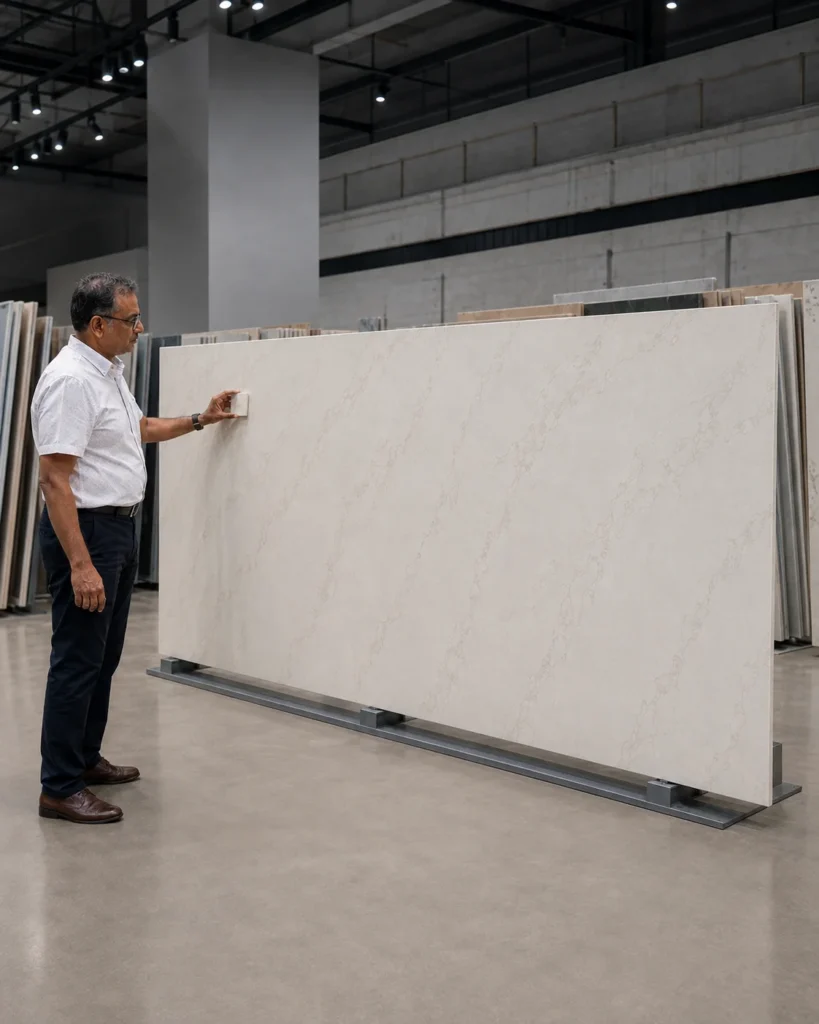
One more thing to avoid: judging a slab from a 100mm sample. Batch variation and veining scale are only visible on the full slab, which is why we ask homeowners to view the actual slab before it goes into fabrication.
FAQ
What is the best countertop for a wet kitchen in Malaysia? Sintered stone is the best performer for daily heavy cooking, and quartz stone is the best choice for most other households. Sintered stone takes direct heat from a wok with no trivet, while quartz matches it on stains and moisture at a lower entry price, provided you use a trivet consistently.
Can I put a hot wok directly on my wet kitchen countertop? Only on sintered stone or granite. Quartz can discolour or crack from thermal shock above roughly 150°C, and the damage is permanent. Porcelain slab handles heat well, but a trivet is still sensible on the edges and around cutouts.
Will turmeric stain my wet kitchen countertop permanently? Not on quartz, sintered stone or countertop-grade porcelain, because none of them are porous. On granite it can, especially if the seal has lapsed. Wipe it quickly on granite, and reseal on schedule or choose a factory pre-sealed option such as Sensa.
Is quartz or granite better for a Malaysian wet kitchen? It depends on whether your kitchen sees more hot woks or more turmeric. Granite takes the heat and needs sealing; quartz takes the stains and needs a trivet. For most Malaysian homes the stain and maintenance advantage of quartz outweighs the heat advantage of granite.
How much does a wet kitchen countertop cost in Malaysia? Supply and install runs from RM110 per sqft for entry-level quartz or Moca Compact sintered stone, up to RM689 per sqft for premium Caesarstone and RM780 for Sensa Granite. A typical wet kitchen top of 30 to 40 sqft therefore starts around RM3,300 to RM4,400 at the entry level. Our 2026 quartz price guide breaks it down brand by brand.
Conclusion
The best countertop for a wet kitchen in Malaysia is the one that matches your cooking and your patience for maintenance. Sintered stone is the strongest performer if you cook hot and often, and it now starts at the same price as entry quartz. Quartz is the sensible default for most homes, low-maintenance and stain-proof as long as trivets become a habit. Granite still earns its place for heat-first cooks who will keep it sealed, and countertop-grade porcelain works when the specification is verified in writing.
Whichever you choose, fabrication and installation decide how it ages. A well-chosen slab cut badly will still disappoint. If you would like your wet kitchen priced across two or three materials on the same scope, send us your kitchen layout and we will quote it per square foot so you can compare like for like.