

Yes, mixing quartz and sintered stone in one L-shaped kitchen works, as long as each material sits where its strengths matter and the fabricator plans the corner joint, the height and the edges before cutting. Get those three details right and the change of material looks deliberate. Get them wrong and it looks like the shop ran out of slab.
We had this exact request recently. A homeowner planning an L-shaped countertop wanted one leg for dry use and the other for wet use, with sintered stone on the dry side and quartz on the wet side. Her reasoning was simple: why pick one material’s strengths when you can have both? It is a fair question, and the answer depends on a few things most showrooms never ask about.

Key Takeaways
- Mixing quartz and sintered stone in one countertop is a sound idea, and the corner of an L-shape is the natural place for the change.
- Where the hob sits decides the layout. Sintered stone belongs where the wok heat is; quartz belongs where knocks and dropped pots happen.
- Sintered stone is 12mm thick and quartz is 20mm, so the fabricator has to pack the thinner slab level and match the edge thickness.
- Seal the joint with a flexible, colour-matched sealant, or turn it into a design feature with a thin metal strip.
- Mixing does not raise the per-square-foot rate, but buying two different slabs can mean more offcuts and a higher total.
Can you use two countertop materials in one kitchen?
You can, and it is more common than most homeowners think. Designers have mixed materials for years, usually an island in one stone and the perimeter run in another. Using two countertop materials in one kitchen is a planned choice, provided both surfaces share a finish and an undertone.
An L-shaped countertop makes it even easier. An L almost always needs a joint at the corner anyway, because few slabs are long enough to cover both legs in one piece. That joint is going to exist whether you mix materials or not. Changing material at that line costs you nothing visually, and it gives each leg a clear job.
Malaysian homes add another reason. Many of our kitchens already split into a dry zone for coffee, toast and light prep, and a wet zone for wok cooking, washing and the heavy work. When one L-shaped countertop runs across both zones, matching the material to the job is good sense.
If you are still weighing the materials from scratch, our complete guide to Malaysian countertop materials compares 14 options side by side.
Which side should get sintered stone, and which gets quartz?
The hob decides. Put sintered stone on the side with the burner, and quartz on the side that takes the most knocks.

Here is how the two materials split on the things that matter in a mixed layout:
| What the countertop faces | Sintered stone | Quartz |
|---|---|---|
| Wok heat and hot pots | Strong. No resin to scorch | Weaker. The resin can mark under direct heat |
| Direct sunlight | Strong. Colour stays stable | Weaker. Can yellow over the years |
| Knocks and dropped pots | Weaker. Edges can chip | Strong. Tougher, and small chips repair well |
| Sink cutout | Possible, needs careful handling | Easy and forgiving |
| Turmeric, curry and daily spills | Handles them well | Handles them well |
Stains are a tie. Both materials shrug off turmeric and sambal with a daily wipe, so stain resistance should not drive the decision. Sun, heat and edges should. We cover those three failure points in more depth in our quartz vs sintered stone comparison.
When “sintered on the dry side, quartz on the wet side” works
Our client’s split makes sense in two common situations.
The dry kitchen faces the sun. Many Malaysian dry kitchens sit next to sliding doors, a big window or a bright dining area. Afternoon sun on quartz can yellow the resin over time. Sintered stone has no resin, so it holds its colour in that spot.
The wet side is mainly for washing. If the wet leg holds the sink and the dish rack, quartz is the better pick. Pots get dropped into sinks, and quartz takes those knocks without chipping the way a thin ceramic edge can.
When you should reverse it
If the wok burner sits on the wet leg, reverse the plan. A Malaysian wet kitchen is where the real heat happens: high-flame stir-frying, a claypot straight off the fire, a wok set down in a hurry. That is exactly where quartz is weakest and sintered stone is strongest. Our guide to the best countertop for a Malaysian wet kitchen explains why heavy cooks lean towards sintered stone there.
So before you settle the layout, ask one question. Where does the hob go? The answer usually settles the rest.
How do you level a 12mm slab against a 20mm slab?
The fabricator packs the thinner slab up from underneath so both top surfaces finish at exactly the same height. Nobody should feel a step when they slide a plate across the corner.
The numbers explain the problem. Sintered stone countertops are 12mm thick. Quartz is 20mm. Laid straight onto the same cabinets, the sintered side would sit 8mm lower than the quartz side. You would feel that ridge every time you wiped the counter, and crumbs would collect along it.
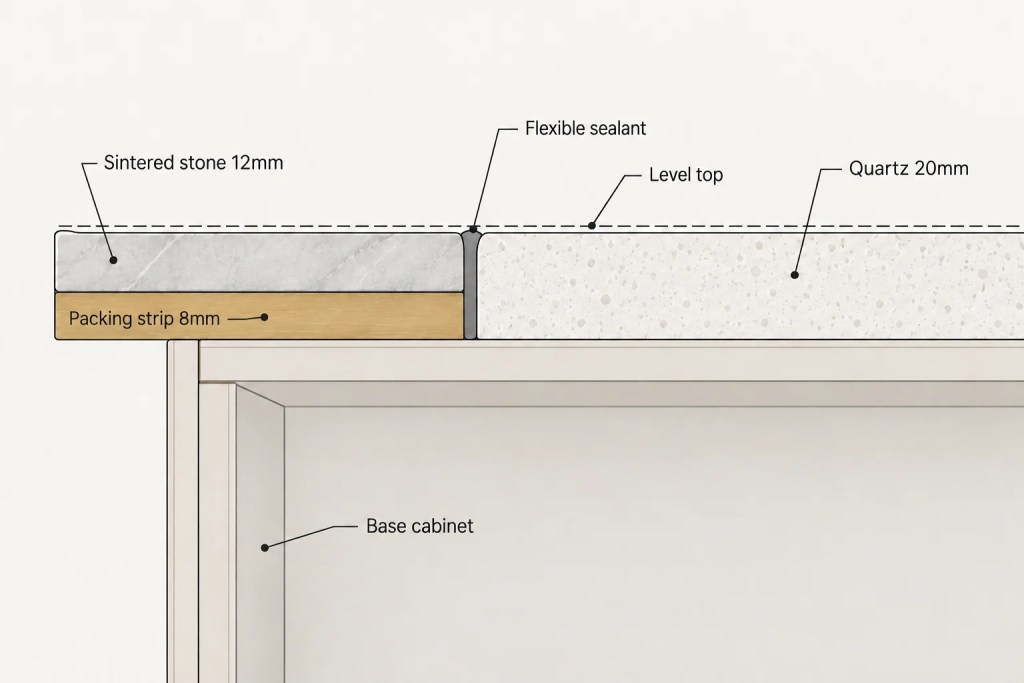
There are two standard fixes:
- Packing under the sintered slab. The installer fixes a strip of substrate or shims under the sintered stone to make up the difference. This is the most common method.
- Adjusting the cabinet top. On new cabinets, the carpenter can raise the carcass on the sintered leg so both slabs sit on a level line. This needs agreement between the carpenter and the stone installer before the cabinets go in.
Either way, the installer should check the joint with a straightedge before anything gets sealed. Fixing a step after the sealant cures is a much bigger job.
How should the edges match?
Choose one visible edge thickness for the whole L. Two different edge heights meeting at the corner is the giveaway of a mixed countertop done carelessly.
The cleanest approach is a mitred edge on both legs. The fabricator joins a strip of the same stone to the front at 45 degrees, so the edge reads as one thick block. Building both legs up to the same visible thickness, such as 40mm, makes the front of the countertop look like one continuous line, even though the material changes at the corner.
If you prefer a slim profile, the alternative is to keep the quartz at 20mm and build the sintered edge up to match it.
Sintered stone needs one extra detail. A sharp 90-degree edge chips easily, so ask for a small chamfer on the sintered leg’s top and bottom edges. The disadvantages of sintered stone are mostly about edges, and a 3mm chamfer prevents most of them.
Where does the joint go, and will it show?
The joint goes at the corner of the L, directly over solid cabinet support. It will be visible, because two different materials never look identical up close, so the goal is a joint that looks intentional rather than invisible.
Joint position
Put the seam where the cabinets give the slab full support underneath. The corner unit of an L-shaped kitchen usually does that well. A joint over an open gap or a dishwasher space flexes over time and cracks the sealant.
The usual layout runs one leg through the corner as a full square, and the other leg butts up against it. Your fabricator will decide which leg runs through based on slab size and where the joint line looks neatest.
Joint finish
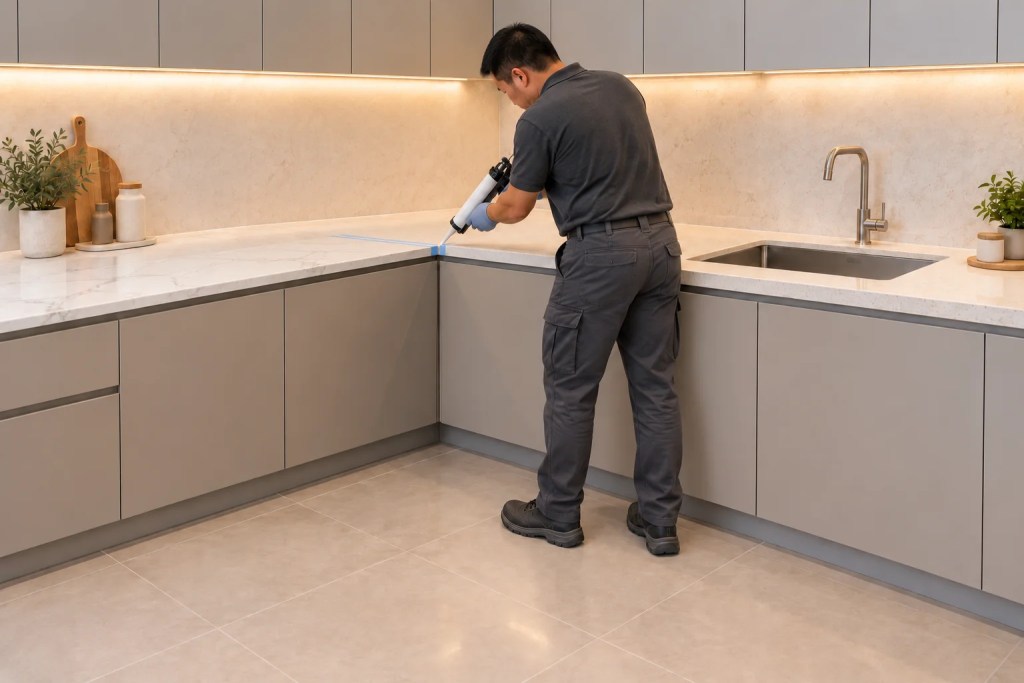
You have two good options:
- Flexible, colour-matched sealant. Quartz and sintered stone are made differently and do not respond to heat in exactly the same way. A flexible sealant gives a little as the two pieces move. A hard, rigid filler is more likely to crack along the line over the years.
- A deliberate design break. A thin stainless steel or brass strip along the joint turns the change of material into a feature. This suits a contrasting pairing, where hiding the joint was never the plan.
How do you pair the colours?
Pick two surfaces that share an undertone and a finish, and stop trying to make them identical. A sintered marble look next to a quartz “close match” will always look slightly off. Two deliberately different surfaces that belong together look far better.
Three rules keep the pairing right:
- Match the finish. Gloss beside gloss, matte beside matte. Most quartz comes polished, while sintered stone comes in both gloss and matte. A matte sintered leg next to a polished quartz leg will look like two different kitchens.
- Match the undertone. Warm with warm, cool with cool. A creamy, warm-veined sintered stone beside a cool, blue-white quartz will clash even if both are “white”.
- Let one surface lead. Give the dramatic veining to one leg and keep the other plain. A bold veined sintered stone on the dry side, beside a soft quartz in a tone pulled from those veins, looks planned.
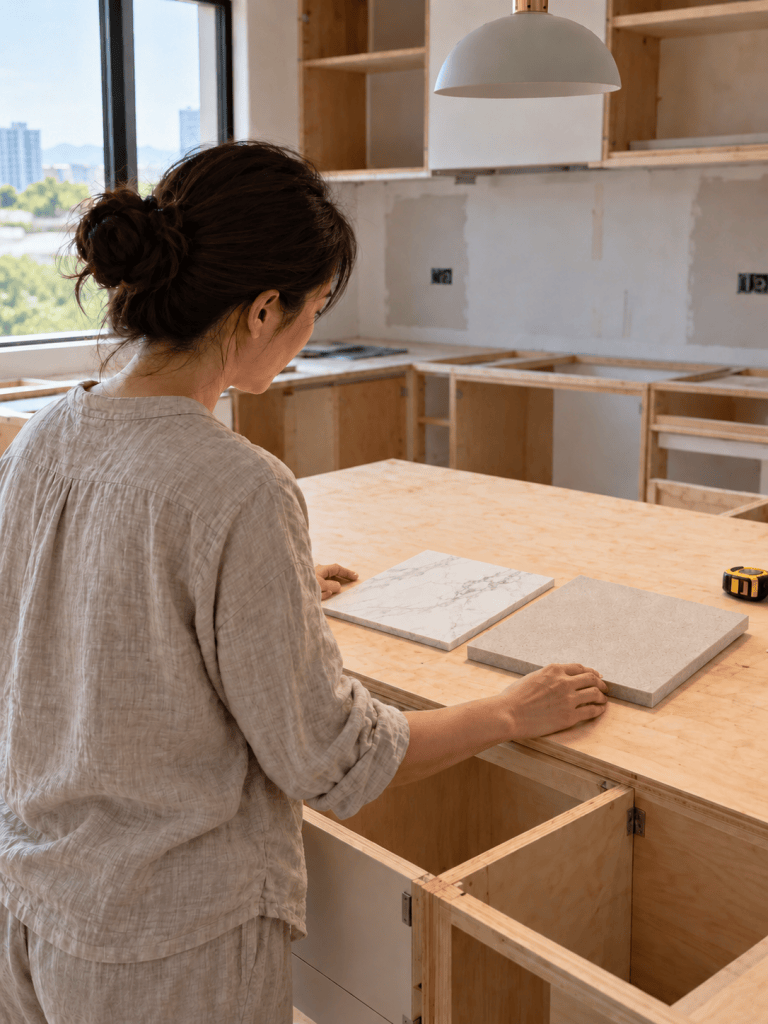
Always view the two materials side by side, under your own kitchen lighting, before anything gets cut. A small chip of sintered stone also hides how its veins flow across a full slab, which is why we suggest comparing a countertop sample against the full slab before deciding.
Does mixing quartz and sintered stone cost more?
The per-square-foot rate stays the same, but the total can come out higher. You pay each material’s own rate for its own leg. The extra cost comes from slab usage and fabrication work.
Here is where the 2026 supply-and-install prices start for each brand we carry:
| Material | Brand | Supply & install (per sqft) |
|---|---|---|
| Sintered stone | Moca Compact | RM110 to RM150 |
| Sintered stone | Dekton | RM248 to RM469 |
| Quartz | Zenstone | RM110 to RM160 |
| Quartz | Silestone | RM282 to RM634 |
| Quartz | Caesarstone | RM332 to RM689 |
At entry level, Moca Compact sintered stone and Zenstone quartz both start at RM110 per sqft, so a mixed countertop does not have to be a premium project. For the full breakdown by collection, see our guide to quartz stone price in Malaysia.
Three things can push the total up:
- Two slabs instead of one. A smaller L-shaped kitchen might fit on one slab of a single material. Splitting it across two materials means buying part of a slab of each, and the offcuts of both go unused.
- Levelling and edge build-up. Packing the sintered leg and mitring both edges to a matching thickness adds fabrication work.
- The joint detail. A metal strip insert costs more than a sealant line.
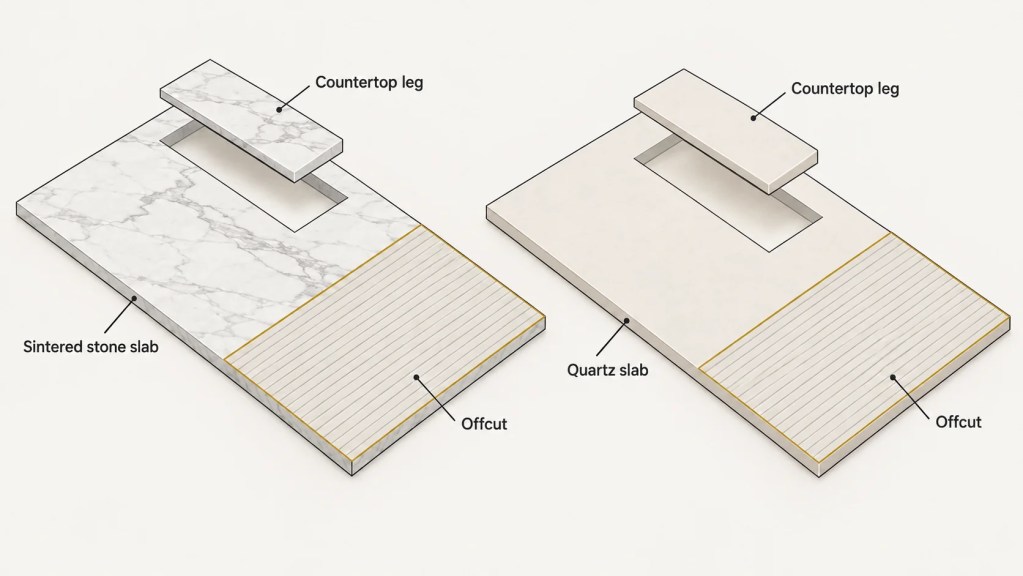
Ask your fabricator to quote each leg as its own line item, with the levelling, edges and joint listed separately. Then you can compare it fairly against a single-material quote.
What about warranty and care?
Two materials means two warranties and two sets of care instructions. Neither is complicated, but you should know which applies where.
- Warranty. Each material carries its own brand’s warranty, covering only that leg. Keep both warranty documents, and note which brand and colour sits on which side.
- Daily cleaning. Both clean with mild soap and water, and neither needs sealing. That keeps the routine simple.
- Heat habits. Keep using a trivet on the quartz leg, even if the sintered leg can take a hot pot. In a mixed kitchen it is easy to forget which side you are standing at.
- Edge care. Avoid knocking heavy cast-iron pans against the sintered edge, especially at the corner.

FAQ
Can you install quartz and sintered stone on the same countertop? Yes, quartz and sintered stone can share one countertop, ideally changing at a natural joint such as the corner of an L-shape. The fabricator packs the thinner sintered slab level with the quartz and matches the edge thickness so the two read as one surface.
Will the joint between quartz and sintered stone be obvious? The joint will be visible up close, because two different materials never look identical, but a well-planned joint looks intentional. Matching the finish and undertone, sealing with a colour-matched flexible sealant, or adding a thin metal strip all make the change look deliberate.
Should sintered stone go on the wet kitchen side or the dry side? Sintered stone should go on whichever side has the hob, because it handles wok heat far better than quartz. If the dry side faces strong sunlight and the wet side is mainly for washing, sintered stone on the dry side and quartz on the wet side is the better split.
Is a mixed-material countertop more expensive? A mixed-material countertop costs the same per square foot for each material, but the total can be higher because you may buy part of two slabs instead of one, and the levelling and edge work adds labour. Asking for each leg as a separate line item makes the comparison clear.
Do quartz and sintered stone need different maintenance? Daily care is the same for both: mild soap, water and no sealing. The difference is in habits. Use a trivet on the quartz side for hot pots, and avoid knocking heavy pans against the sintered edges.
Conclusion
Mixing quartz and sintered stone in one L-shaped kitchen is a smart way to get the best of both materials, as long as the layout follows the hob and the sun rather than habit. Put sintered stone where the heat and the sunlight are, put quartz where the knocks happen, and have your fabricator plan the levelling, edges and corner joint before a single cut is made.
Planning a split countertop of your own? Send us your kitchen layout and tell us where the hob and sink will go. We will suggest which material belongs on which leg and quote each side separately, so you can see exactly what the combination costs before you commit.