

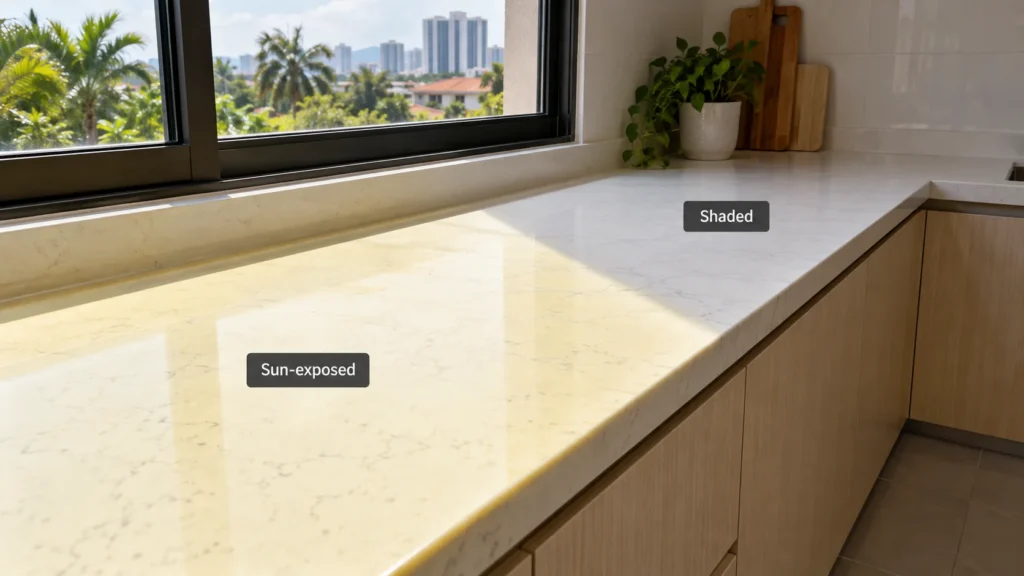
The most expensive quartz vs sintered stone mistake in a Malaysian kitchen is putting quartz where direct sunlight lands on it. The resin that binds quartz stone yellows under UV, and a premium quartz top on a sun-facing island can be a two-tone eyesore within two years, with full replacement as the only real fix. Sintered stone has no resin and does not yellow, but it carries its own trap: a sharp, unchamfered edge that chips the first time a heavy pot catches it.
Neither material is the wrong choice. The mistake is choosing without looking at where the countertop will sit and how it will be fabricated. This guide walks through the five mistakes we see most often when homeowners decide between the two, what each one costs, and the three questions that settle the decision. If you want the full material-by-material comparison first, start with the complete guide to kitchen countertop materials in Malaysia.
Key Takeaways
- Quartz stone yellows under direct UV because its resin binder is not UV-stable. Sintered stone has no resin and stays colour-fast in full sun.
- Sintered stone’s weak point is the edge. A pencil edge with a 3mm chamfer top and bottom is what keeps it from chipping.
- A 50 sqft kitchen in premium quartz costs roughly RM17,000 to RM22,000 installed. Yellowing means paying that twice, because UV damage cannot be polished out.
- Most quartz manufacturer warranties exclude outdoor use and UV discolouration, and impact chips on sintered stone count as accidental damage.
- Decide by placement first (does sun land on it), cooking habits second (wok and hot pot), and looks and budget last.
What Is the RM20,000 Mistake?
The RM20,000 mistake is paying for a premium countertop twice because the first one was the wrong material for the spot. Here is how the number adds up. A mid-size L-shaped kitchen in Kuala Lumpur or Selangor has roughly 50 sqft of countertop. Fit that in a premium quartz such as Silestone Blanco Zeus at RM448 per sqft supply and install, and the top alone comes to about RM22,400. Caesarstone Snow at RM351 per sqft brings a similar kitchen to RM17,550.
Now put that top on an island under a skylight, or along a wall with an east-facing window. Within one to two years the sun-exposed section drifts yellow while the shaded section stays white. The stone has not failed structurally. It has failed cosmetically, and there is no polish that reverses it. The fix is dismantling the old top, disposing of it, and installing a new one, which means paying the full amount again plus the hassle of a second renovation in a kitchen you already use daily.
That is the mistake this article exists to prevent. It is not that quartz is bad. Quartz is the right pick for most indoor Malaysian kitchens. It is that quartz in the wrong spot is a slow-motion write-off.
Why Does Quartz Yellow Under Malaysian Sun?
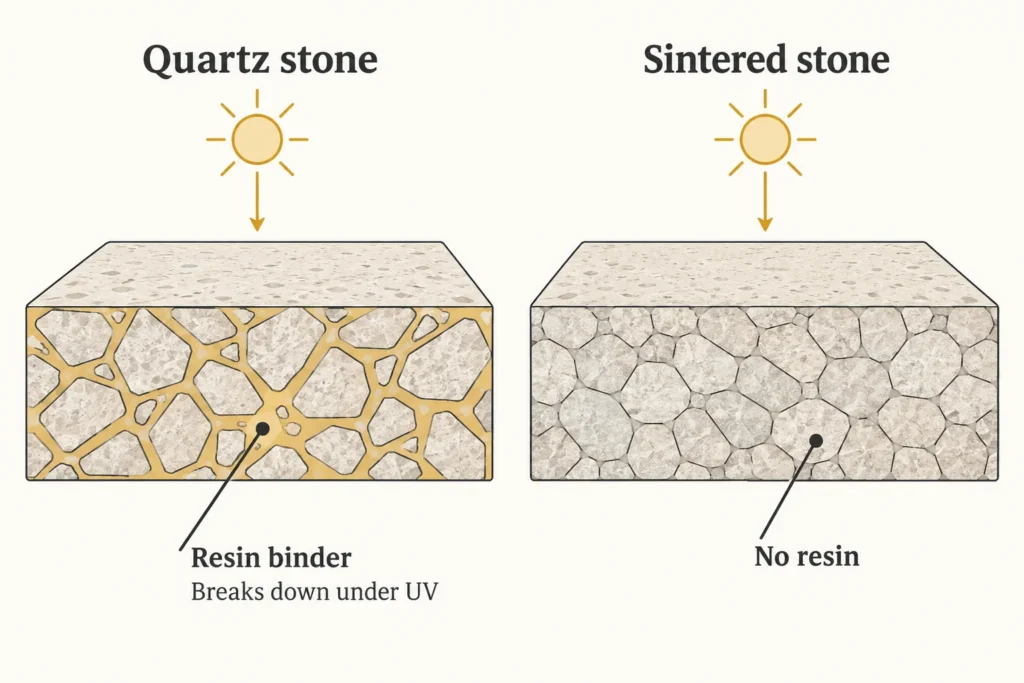
Quartz stone yellows because it is roughly 90% crushed natural quartz held together by polyester resin, and that resin breaks down under ultraviolet light. The quartz crystals themselves are stable. The resin is not. Give it enough direct sunlight, and the resin discolours, taking the pigment with it. On a white or light-coloured top the shift is obvious; on a dark or heavily patterned top it is less visible but still happening.
Malaysia makes this worse than most markets. We sit on the equator, so the sun is high and intense year-round, and there is no winter to give the countertop a break. A kitchen window facing east gets strong morning sun straight onto the surface. A west-facing one gets the harsher afternoon version. Skylights, a popular feature in newer semi-Ds and bungalows in Shah Alam and Petaling Jaya, put the countertop directly under the sun for hours a day.
Three things speed up the damage:
- Direct, unfiltered sun through clear glass with no tint or blinds
- Light colours, which show the yellow shift most clearly
- Consistent daily exposure on the same patch, which is what creates the two-tone look
If you want the full list of what quartz does and does not cope with, the disadvantages of quartz stone countertops covers UV, seams and fabrication in more depth.
Why Doesn’t Sintered Stone Have This Problem?
Sintered stone does not yellow because there is no resin in it to break down. It is made by compressing natural minerals such as quartz, feldspar and clay under extreme pressure and firing them at around 1,200°C until they fuse into one dense slab. The colour is fired in, not held in place by a plastic binder, so UV has nothing to attack. The same process is why it takes a hot wok without scorching and why it works in an outdoor or wet kitchen.
The trade-off sits at the edge. Sintered stone is extremely hard but comparatively thin at 12mm, and hardness without thickness means brittleness at a sharp corner. A heavy stock pot or a glass jar knocked against an unprotected edge can chip it. That chip is not a polish-out repair either. Repair options for sintered stone in Malaysia are still limited, and a chip on a visible front edge usually means replacing the piece.
So each material has one failure mode that turns into a replacement bill. Quartz fails in the sun. Sintered stone fails at the edge. Both failures are avoidable, and both are decided before the slab is even cut.
What Are the Five Mistakes Homeowners Make Choosing Between Quartz and Sintered Stone?
The five mistakes are picking without checking sun exposure, assuming quartz is heat-proof, skipping the chamfer on sintered stone, comparing on price per sqft alone, and assuming the warranty will cover the damage. Each one is common enough that we raise it in nearly every site measurement.
Mistake 1: Not Checking Where the Sun Lands
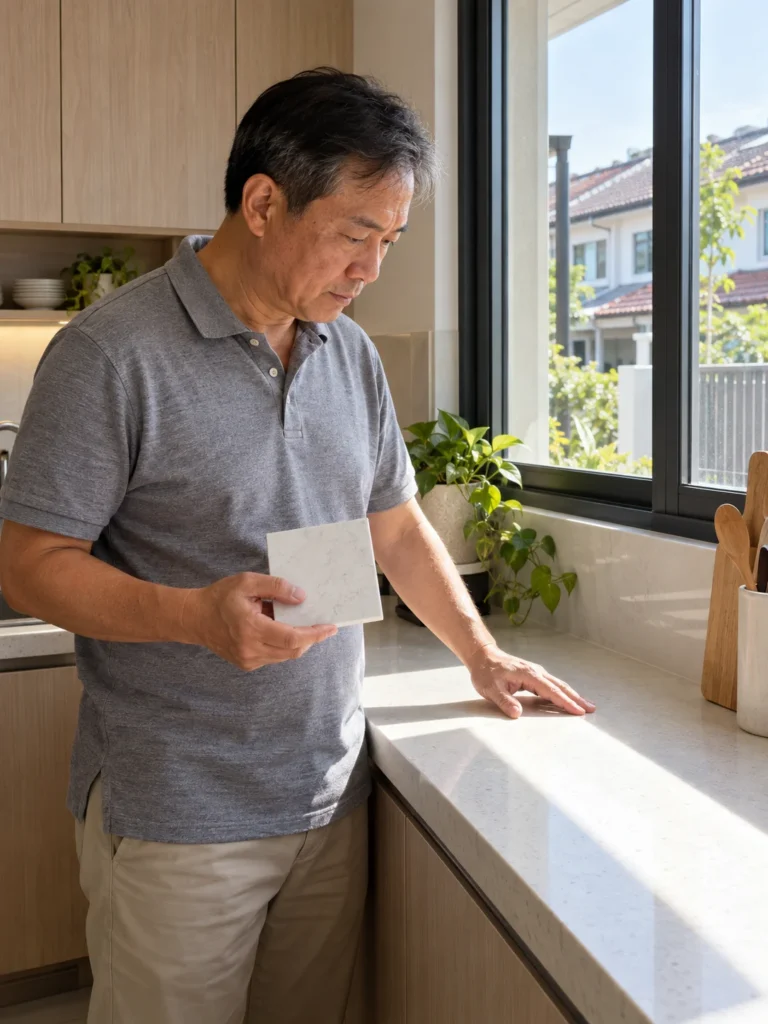
Stand in your kitchen at 9am and again at 4pm and look at where the light falls. If direct sun lands on any part of the countertop, quartz is the wrong material for that run. This is the mistake behind almost every yellowing complaint we hear about, and it is the cheapest to avoid because it only costs you two visits to the kitchen with your handphone camera.
Common trouble spots in Malaysian homes:
- An island directly under a skylight
- A countertop along a wall with a large east or west window
- A wet kitchen that opens onto the back yard or car porch
- A dry kitchen next to sliding doors leading to a balcony
For those spots, sintered stone is the safer material. For a shaded run in the same kitchen, quartz is fine. Mixing the two in one kitchen is reasonable, and a good fabricator will lay it out for you.
Mistake 2: Assuming Quartz Handles a Hot Wok
Quartz tolerates warm, not hot. The same resin that yellows under UV also softens and scorches under prolonged direct heat. A wok straight off a high-flame gas hob, or a claypot from the oven, left on a quartz top can leave a burn mark that does not come off. Most quartz brands advise a trivet for anything hot, full stop.
Sintered stone takes direct heat far better because there is no resin to scorch. Whether you can put a hot pan on a sintered stone countertop is covered in its own post, but the short version is that sintered stone shrugs off the kind of heat that marks quartz. Even so, a trivet is a good habit on both because thermal shock on a thin slab is a separate risk from scorching.
If your household does daily wok cooking, weekend steamboat, or heavy Deepavali and Hari Raya cooking marathons, the heat difference is real and worth weighing.
Mistake 3: Skipping the 3mm Chamfer on Sintered Stone
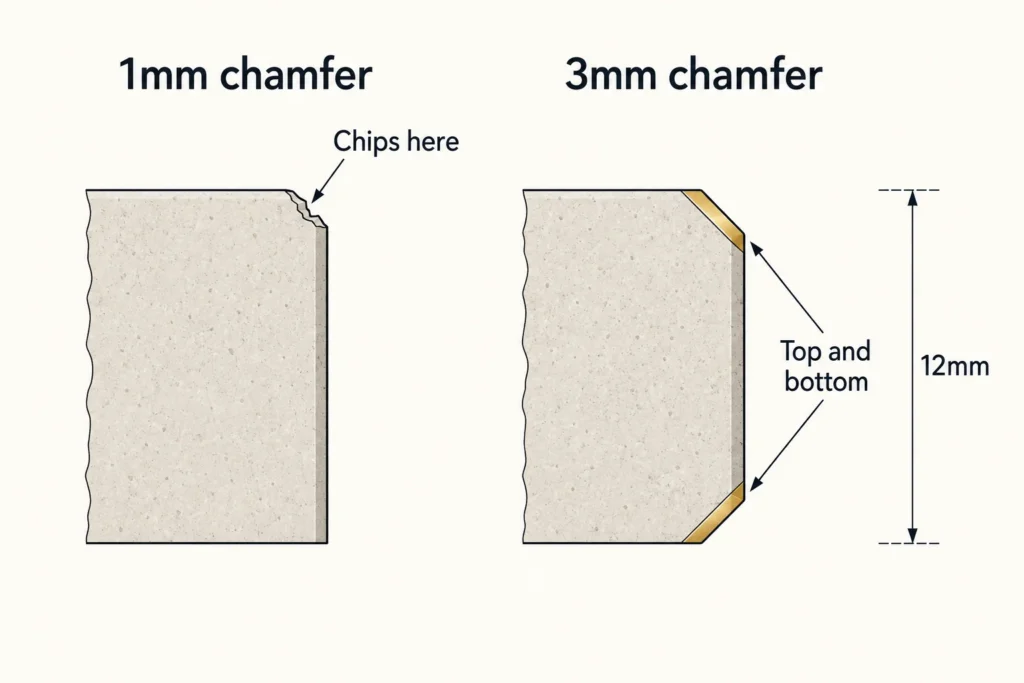
A sharp 90° edge on sintered stone is a chip waiting to happen. The fix is a pencil edge with a 3mm chamfer on both the top and bottom of the slab. That small bevel takes the brittle corner out of harm’s way, so a knock spreads across the bevel instead of concentrating on a point.
This is a fabrication detail, and it is where inexperienced suppliers cut corners. A 1mm chamfer looks sharper and more “seamless,” and before 2021 it was the industry norm, but it chips. If a supplier shows you a sintered stone sample with a crisp, near-square edge, ask what chamfer they use. If the answer is anything under 3mm, or a blank look, keep shopping. Decorative profiles such as ogee or bullnose are off the table entirely for sintered stone; they expose too much thin material. The disadvantages of sintered stone explains the edge issue and the other limits in full.
Mistake 4: Comparing on Price per Square Foot Alone
Price per sqft tells you what the top costs today. It does not tell you what it costs over fifteen years. A cheaper quartz on a sun-facing island is not a saving if it needs replacing in year two. A dearer sintered stone with a proper chamfer that still looks new in year ten is.
That said, the entry prices for both materials are closer than most people expect, and the ranges overlap:
| Material | Brand | Supply & install (per sqft) |
|---|---|---|
| Quartz stone | Zenstone | RM110 to RM160 |
| Quartz stone | Moonstone | RM182 to RM226 |
| Quartz stone | Silestone | RM282 to RM634 |
| Quartz stone | Caesarstone | RM332 to RM689 |
| Sintered stone | Moca Compact | RM110 to RM150 |
| Sintered stone | Dekton | RM248 to RM469 |
At the entry level, Zenstone quartz and Moca Compact sintered stone both start at RM110 per sqft, so for a sun-exposed run you are not paying a premium to pick the material that will not yellow. The gap opens at the top end, where a Caesarstone Calacatta Nuvo at RM689 per sqft is a different budget conversation from a Dekton Group 2 colour at RM351. For a breakdown by brand and collection, see quartz stone price in Malaysia.
Mistake 5: Assuming the Warranty Covers It
Read the warranty before you sign, not after the damage shows. Most quartz manufacturer warranties exclude outdoor installation and UV discolouration outright. If your kitchen top yellows because it sat under a skylight, the brand will point to the exclusion. Likewise, an edge chip on sintered stone from a dropped pot is accidental damage, and accidental damage is not a manufacturing defect.
Sinno Stone’s own 12-month workmanship warranty covers the fabrication and installation, which is what a chamfer decision falls under. It does not, and cannot, cover a material placed somewhere the manufacturer says it should not go. The point is not to scare you off either material. It is that the warranty is a backstop for defects, not a substitute for choosing the right stone for the spot.
Quartz vs Sintered Stone: Where Does Each One Fail?
Quartz fails in direct sun and under direct heat, while sintered stone fails at an unprotected edge. Everything else is close to a tie for a Malaysian kitchen.
| Factor | Quartz stone | Sintered stone | Edge |
|---|---|---|---|
| Direct UV / sunlight | Resin yellows over 1 to 2 years | Colour-fast, no resin | Sintered stone |
| Direct heat (wok, claypot) | Trivet required; resin scorches | Handles direct heat; trivet still good practice | Sintered stone |
| Edge chipping | Resin gives it some flex; chips less | Chips on sharp edges; needs 3mm chamfer | Quartz |
| Turmeric, curry, kopi stains | Non-porous, wipes clean | Non-porous, wipes clean | Tie |
| Humidity and mould | Unaffected | Unaffected | Tie |
| Repair after damage | Light scratches can be polished; UV damage cannot | Chips usually mean replacing the piece | Neither is forgiving |
| Entry price (supply & install) | From RM110 per sqft (Zenstone) | From RM110 per sqft (Moca Compact) | Tie |
Notice that stains, humidity and daily cleaning are ties. In a Malaysian kitchen, both materials handle turmeric, sambal and daily wipe-downs without fuss. The decision comes down to sun, heat and edges. For a wider comparison that goes beyond these failure points, is sintered stone better than quartz weighs the two across design choice, lifespan and maintenance.

Which Should You Choose? Three Questions That Settle It
Answer these three in order and the decision usually makes itself.
Does direct sunlight land on the countertop?
If yes, for any part of the day, choose sintered stone for that run. This includes skylights, large windows, wet kitchens open to the outside, and anything on a balcony or porch. The best countertop for a wet kitchen in Malaysia goes deeper on the outdoor and semi-outdoor case. If no, continue.
How do you cook?
Daily wok cooking, regular steamboat, or festive cooking marathons lean towards sintered stone for heat. Occasional cooking, or mostly Grab and reheating, means either material works and you move to the last question.
What matters more to you: toughness or looks?
Quartz gives you a slightly more forgiving edge, consistent colour across the slab, and a wider range of edge profiles. Sintered stone gives you the closest thing to natural marble or stone veining without the porosity, and it holds that look in any light. Budget sits inside this question too: at the entry level the two cost the same, so the choice is about how the kitchen will be used, not what it costs.
Whatever you land on, confirm two fabrication details before paying a deposit. For sintered stone, the chamfer is 3mm top and bottom. For quartz, the layout keeps it out of the sun.
FAQ
Does quartz really turn yellow in Malaysia? Yes, quartz stone yellows when direct sunlight hits it consistently, usually showing after one to two years. The cause is the resin binder, not the quartz crystals, and light colours show it most. A shaded quartz countertop with no direct sun stays white for its full lifespan.
Can I put a hot wok directly on sintered stone? Sintered stone handles direct heat far better than quartz and will not scorch the way resin does, so a hot wok will not mark it. A trivet is still sensible because a thin 12mm slab can be affected by sudden thermal shock, especially near a cutout or an edge.
Why does sintered stone chip if it is so hard? Sintered stone chips because hardness and toughness are different things. It is very hard but only 12mm thick, so a sharp corner has no give when a heavy pot lands on it. A pencil edge with a 3mm chamfer top and bottom removes the fragile corner and is the standard fix.
Which is cheaper, quartz or sintered stone? At the entry level they cost the same: Zenstone quartz and Moca Compact sintered stone both start at RM110 per sqft supply and install. Premium brands separate them, with Silestone and Caesarstone quartz running RM282 to RM689 per sqft and Dekton sintered stone RM248 to RM469 per sqft.
Can I mix quartz and sintered stone in one kitchen? Yes, and it is often the sensible answer. Use sintered stone on the sun-exposed run or the wet kitchen and quartz on the shaded dry kitchen. Choose colours from each range that sit well together, and confirm with your fabricator that the two thicknesses will be levelled at the join.
Conclusion
The quartz vs sintered stone decision is not about which material is better. It is about which one fails in your kitchen, and both have exactly one failure mode that leads to a replacement bill. Quartz yellows in direct sun and scorches under direct heat. Sintered stone chips on a sharp, unchamfered edge. Check where the sun lands, be honest about how you cook, and insist on the 3mm chamfer if you go with sintered stone. Do those three things and the RM20,000 mistake stays somebody else’s story.
Not sure which way your kitchen leans? Send us a photo of the space at 9am and 4pm, and we will tell you which runs need sintered stone and which can take quartz before you commit to anything.