

Sintered stone’s main disadvantages are brittleness at edges and corners, damage that cannot be repaired invisibly, a shorter list of fabricators who can work it properly, and a narrower colour range than quartz. Cost is on that list too, but only for certain brands, and that nuance gets lost in most showroom conversations.
Sintered stone deserves its reputation. It takes a hot wok without flinching, holds its colour under Malaysian sun, and will not stain. But no material is right for every kitchen, and the honest trade-offs rarely make it into a sales pitch. Here is what we have seen matter after fabricating and installing across Klang Valley.
Key Takeaways
- Sintered stone is not automatically the expensive option. Moca Compact starts at RM110 per sqft supply and install, whilst Dekton runs RM248 to RM469.
- It is harder than quartz but also more brittle, so edges, corners and cutouts chip more readily.
- Damage cannot be polished out or resin-filled. The pattern is printed on the surface layer, so any repair stays visible.
- Fewer Malaysian fabricators own the right tooling and training, which narrows your choice of installer considerably.
- Colour range, custom matching and lead times are all more limited than quartz.
What Is Sintered Stone, and Why Is It Recommended So Often?
Sintered stone is made by pressing natural minerals under roughly 400 bar and firing them above 1,200°C, with no resin binder at any stage. That process is the source of both its strengths and its weaknesses.
Because there is no resin to soften or scorch, the material handles a hot pan straight off the flame without a trivet. Because it is effectively non-porous, it does not stain or need sealing. Because the pigments are mineral rather than organic, it holds colour under direct sun, which matters for a west-facing kitchen window or a semi-covered wet kitchen. The full manufacturing process explains why those properties come as a package.
Those advantages are real. What follows is the other half of the picture.
Is Sintered Stone Too Expensive for a Malaysian Kitchen?
Not necessarily, and this is where most advice gets it wrong. Sintered stone is not a single price band. It spans the cheapest countertop on our list and one of the dearest, depending on brand.
Here is what the 2026 supply and install pricing actually looks like:
| Brand | Material | Per sqft | 45 sqft kitchen |
|---|---|---|---|
| Moca Compact | Sintered stone | RM110 to RM150 | RM4,950 to RM6,750 |
| Zenstone | Quartz | RM110 to RM160 | RM4,950 to RM7,200 |
| Moonstone | Quartz | RM182 to RM226 | RM8,190 to RM10,170 |
| Dekton | Sintered stone | RM248 to RM469 | RM11,160 to RM21,105 |
| Silestone | Quartz | RM282 to RM634 | RM12,690 to RM28,530 |
| Caesarstone | Quartz | RM332 to RM689 | RM14,940 to RM31,005 |
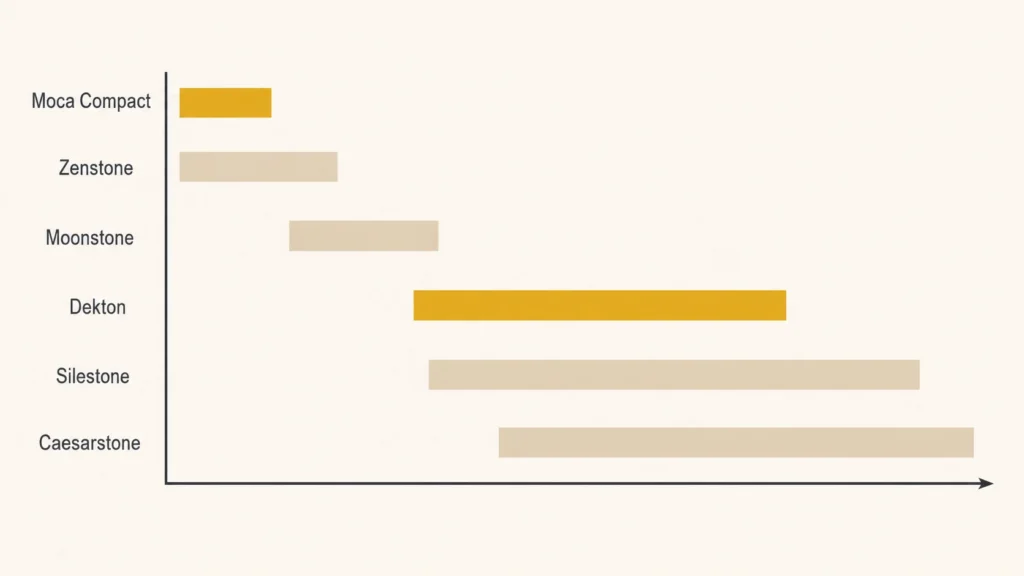
Read that table again, because it contradicts the usual line. Moca Compact sintered stone starts at the same RM110 as entry-level Zenstone quartz, and costs less than half of what premium quartz from Caesarstone or Silestone does. “Sintered stone is expensive” is a statement about Dekton, not about sintered stone.
So what is the genuine cost disadvantage? Two things.
Dekton specifically is a serious investment. At RM248 to RM469 per sqft, a normal kitchen lands between RM11,000 and RM21,000 for the countertop alone. That is money that could otherwise go to cabinetry, appliances or flooring. The honest question is whether your household actually needs what Dekton adds over a budget sintered stone, which for most indoor kitchens is warranty backing, tighter quality control and a wider colour range rather than any difference in heat resistance.
Cheaper sintered stone shifts the risk elsewhere. A RM110 sintered stone slab still needs the same specialist tooling and the same careful installation as a RM469 one. You save on material, not on the fabrication expertise the material demands. Skimp on that second part and the saving disappears fast.
Our 2026 stone countertop price guide breaks down every brand and the factors that move a quote up or down.
Why Does Sintered Stone Chip If It Is Harder Than Quartz?
Because hardness and toughness are two different properties, and sintered stone trades one for the other. It sits around 8 on the Mohs scale against quartz at 7, so it resists scratching better. It is also more brittle, so it resists impact worse.
Think of it like glass against plastic. Glass is far harder and will not scratch from a key, but drop it and it shatters where the plastic would only dent. Sintered stone leans the same way. Our guide to the Mohs hardness scale covers why the two properties get confused so often.
That brittleness shows up in three places:
- During delivery and handling. A rigid slab has no give. An impact on a corner during transport is far more likely to chip sintered stone than quartz.
- During fabrication. Cutouts and edge work are where slabs crack, which is why the fabricator matters so much.
- In daily use. A cast iron pan dropped near an edge carries a higher chip risk than it would on quartz.
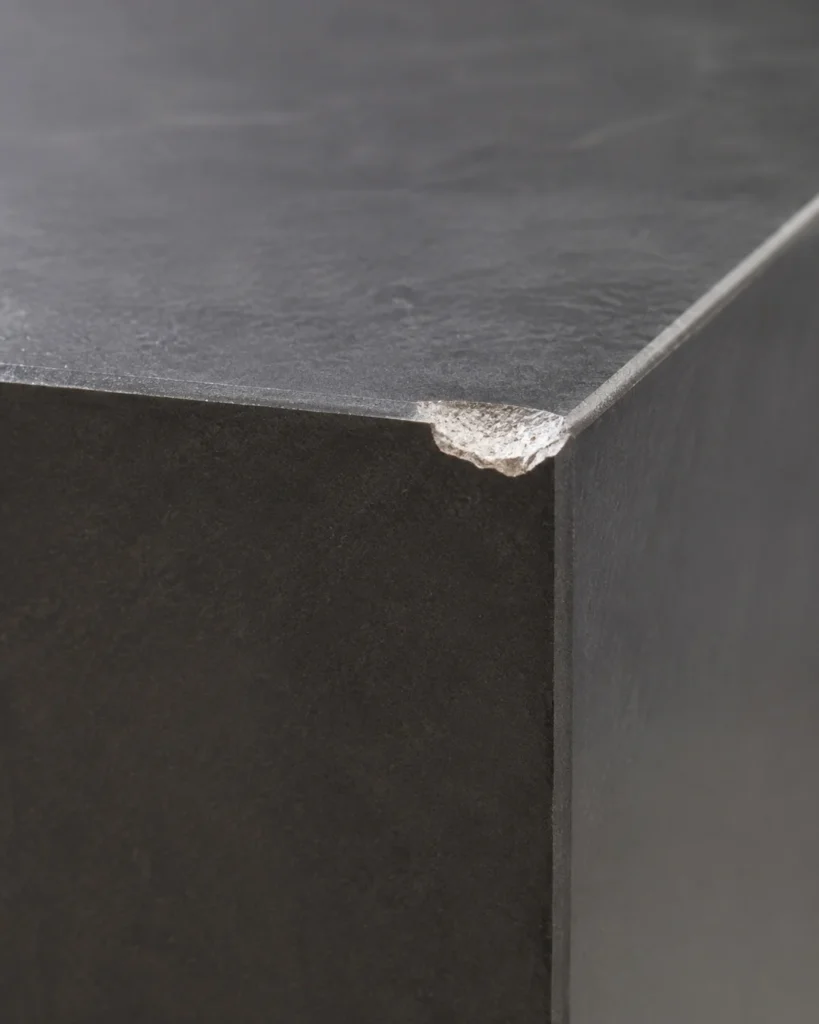
It also limits your edge profile. Quartz handles decorative edges like ogee or bullnose comfortably. Sintered stone does not, and most fabricators will steer you towards a simple eased or chamfered edge specifically to reduce the chipping risk. If you had a shaped edge in mind, that is a genuine constraint rather than a fabricator being unhelpful.
For a household with young children and a habit of dropping things, this is worth weighing properly.
Can You Find a Malaysian Fabricator Who Handles Sintered Stone Properly?
Fewer than you would think. Most stone shops in Malaysia built their business on quartz and granite, and sintered stone is not simply a harder version of the same job.
Working it properly needs:
- Different blades. Diamond tooling specified for ultra-compact surfaces, not the blades used for quartz.
- Different cutting technique. Feed rates and water cooling that suit a brittle material, or the slab cracks on the saw.
- Different adhesives. Standard stone adhesives bond poorly to a non-porous body.
- Different support planning. More on that below.
When a shop attempts sintered stone without that grounding, the failures are not always immediate. Rough edges you can see on day one. Stress cracks that open weeks after installation are the ones that hurt, because by then the kitchen is finished and everything else has to come apart.
This creates two practical problems. Your shortlist of installers shrinks considerably compared to quartz. And if you choose on price alone, you are effectively betting the cost of a replacement slab against a saving on labour. It is not a good bet on a material this brittle.
The related trap is buying slabs yourself and hiring a separate installer. If you are considering that route, read why most Malaysian fabricators refuse to touch independently imported sintered stone before you commit any money.
Seams and cutouts are less forgiving
Two details deserve their own mention. Sintered stone seams show more than quartz seams do, because there is no resin to help blend the join and the printed patterns must be aligned by eye. And sink or hob cutouts must be exact, since the brittleness means a small error tends to propagate as a crack running out from the corner of the cutout rather than staying local.
Neither makes sintered stone impractical. Both mean the margin for error is smaller than you get with quartz.
What Happens When a Sintered Stone Countertop Gets Damaged?
You live with it, or you replace the piece. Invisible repair is not realistic, and this is arguably the most important disadvantage on this list.
With quartz, a skilled technician fills a chip with colour-matched resin that bonds to the resin already in the slab. The repair disappears at normal viewing distance. Sintered stone blocks that approach twice over.
There is no resin to bond to. The repair chemistry that works on quartz has nothing to grip.
The pattern is printed, not through-body. Most sintered stone sold in Malaysia carries its veining as a decorated surface layer over a plain body colour that is a close match but not identical. Polish a scratch out and you remove the print, exposing the plain body underneath. The scratch goes, and a patch with no veining appears in its place.
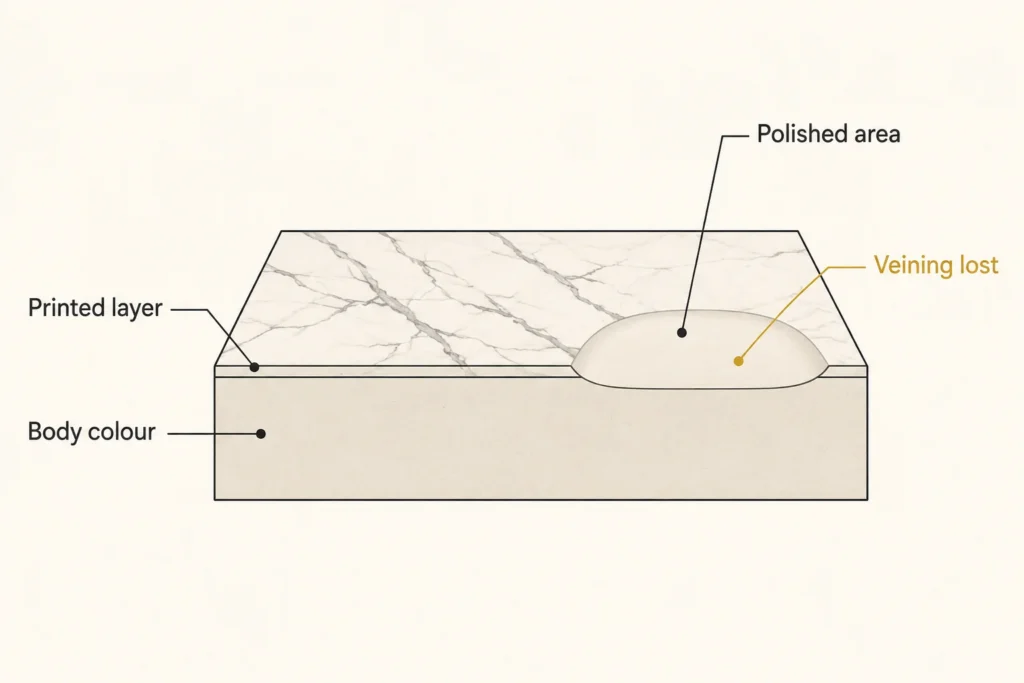
For a deep chip or a crack, the practical answer is usually replacing the affected piece. On a Dekton island that is a meaningful sum.
This is not a claim that sintered stone damages easily, because it does not. It is a claim about what your options look like on the day something does go wrong. If knowing a surface can be made good again gives you peace of mind, quartz serves that instinct better.
Is Sintered Stone Suitable for Public or Commercial Counters?
Not for busy counters. A reception desk, café counter, shoplot service counter or washroom vanity in an office or mall takes far more knocks than a home kitchen, and sintered stone’s brittle edges are exactly where those knocks land.
At home, a few people use the counter and treat it with some care. In a public space, hundreds of people walk past every day, and nobody thinks twice about the edge. Three everyday habits cause most of the damage:
- Bags with metal parts. Handbags, backpacks and sling bags often carry metal buckles, zips, chains and corner studs. As people walk past, lean in to pay, or swing a bag onto the counter, that hard metal point strikes the edge. On a brittle surface, one sharp hit is enough to take a chip out of the corner.
- Trolleys. Shopping trolleys, luggage trolleys, cleaners’ carts and delivery trolleys all bump into counter fronts and corners. A trolley knock carries the weight of the trolley and its load behind it, and that is a common cause of edge chipping.
- Heavy boxes put down hard. It is not only couriers and customers. Your own staff might drop a carton of condensed milk tins onto the counter while restocking, or a supplier might plonk down a box of canned sardines during a delivery. A heavy box landing hard puts a sudden point load on the slab, and the hard edges of the cans inside concentrate that force. That can crack the slab or chip the edge, especially near sink cutouts, joints and unsupported overhangs.
Then the earlier problems pile on. People also sit, lean or even stand on public counters, which a thin slab only tolerates with full support underneath. And every chip stays visible, because the printed pattern cannot be repaired invisibly. In a shop or lobby, a chipped counter is the first thing customers see.
Where sintered stone still works in public spaces
The material is not wrong for commercial projects. It just belongs on surfaces that do not take direct hits:
- Walls, cladding and facades, where its UV and weather resistance shine. See our guide to sintered stone feature walls.
- Flooring with a matt or anti-slip finish, covered in sintered stone flooring in Malaysia.
- Counters built to protect the edge, meaning thicker 12mm to 20mm slabs, eased or bevelled edges rather than sharp mitres, full-body slabs so chips show less, and metal trims on exposed corners.
For a counter that faces the public all day, quartz or granite is the more forgiving choice. Our sintered stone vs granite comparison covers how the two hold up.
Does the Weight and Thickness Cause Problems in Malaysian Homes?
The issue is not weight so much as thinness. Sintered stone is usually supplied here at 12mm, against the 15mm or 20mm most quartz kitchens use, and a thin brittle slab has to be supported differently.
That changes a few things:
- Continuous support underneath. A 12mm slab generally wants a full substrate beneath it rather than spanning between cabinet carcasses on its own. That is an extra layer of material and labour in the quote.
- Shorter unsupported overhangs. A breakfast bar or island overhang that quartz would carry unaided may need steel brackets or a corbel in sintered stone.
- Large slabs are awkward to move. Sintered stone comes in big formats, commonly 3200x1600mm. Getting one intact up a stairwell in a condominium without lift access is a real logistical problem, and it is where a lot of chips happen.
- Two to three installers minimum. A rigid large-format slab cannot be flexed or walked in by one pair of hands.
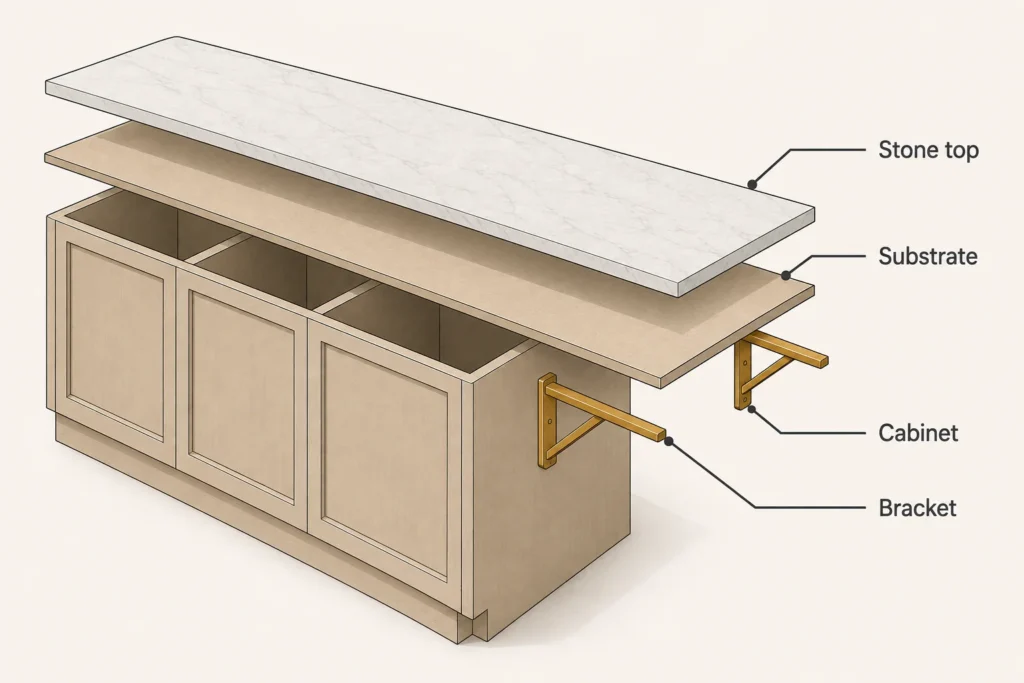
None of this rules sintered stone out. It does mean the support detail should be settled before you sign, not discovered on installation day. Understanding how a countertop actually gets fabricated and fitted makes those conversations much easier to have.
Does Sintered Stone Limit Your Design Choices?
Yes, noticeably. The range is good but it is not as broad as quartz, and custom work is largely off the table.
Colour and pattern count. Dekton’s range runs to roughly 50 colours. Put Caesarstone, Silestone, Moonstone and Zenstone together and you are choosing from several times that. If you have a specific look in mind, the odds of finding it in quartz are simply better.
Veining character. Sintered stone renders marble and natural stone beautifully, but tends towards restrained, natural-looking patterns. For bold, high-contrast dramatic veining, quartz has more to offer.
Custom matching. Quartz manufacturers will occasionally colour-match for a large project. That option effectively does not exist in sintered stone.
If you have already fallen for a particular quartz slab, that preference is legitimate. Choosing a material you find beautiful over one that performs marginally better in ways you will never notice is a reasonable decision, not a mistake.
The cold, industrial feel
This one is subjective but it comes up often enough to mention. The same density that makes sintered stone practical gives it a harder, cooler feel under the hand than quartz. Some homeowners read that as sleek and modern. Others find it clinical in a family kitchen.
There is no resolving this in an article. Go to a showroom, rest your hands on both for a minute, and see which one you would rather live with.
How Long Will You Wait, and Can You Match It Later?
Longer than quartz on both counts, because the Malaysian market for sintered stone is smaller.
Stock. Popular colours are usually available. Anything less common may need ordering from overseas, and that can run to several months rather than weeks.
Batch matching. If you later want a matching backsplash or bar top, getting a slab from the same production batch may not be possible. Print batches vary slightly, and on a printed surface that variation is visible.
Fabricator diary. With fewer shops handling the material, the one you want may not be free when you need them.
Buy the material for the whole job at once, including any future backsplash, rather than assuming you can top up later. If your renovation runs to a fixed handover date, confirm colour availability in writing before committing. Our guide to countertop installation timelines in Malaysia sets out what is realistic to expect.
Is That “Sintered Stone” Actually a Porcelain Slab?
Sometimes, and the confusion is profitable enough that some suppliers do not rush to clear it up.
Sintered stone and porcelain slab are related but different materials. Both are fired at high temperature, both are non-porous, and they look similar on a sample board. Porcelain slab generally costs less and varies far more in density and quality, because the category grew out of tile manufacturing rather than countertop engineering.
That gap creates room for a slab to be sold as sintered stone at sintered stone pricing. This is not a disadvantage of the material itself, but it is a genuine purchasing risk attached to buying it. Ask for the brand name, the collection, and the thickness in writing on your quotation. A supplier who cannot name what they are selling you is telling you something.
So Should You Still Choose Sintered Stone?
For a kitchen that gets hard sun, heavy wok use, or sits outdoors, usually yes. For an ordinary indoor kitchen where a trivet is no hardship, quartz often makes more sense.
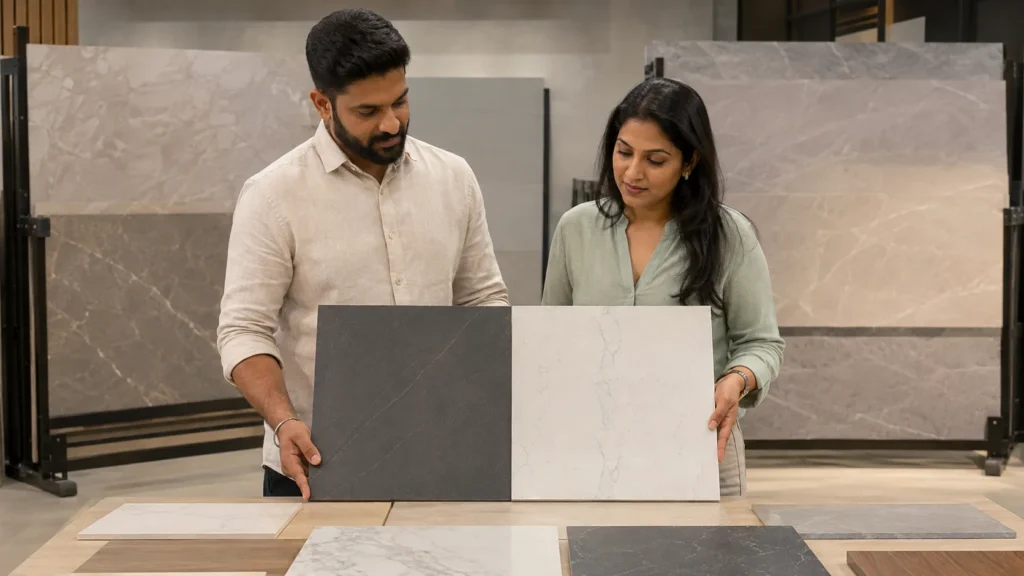
Sintered stone earns its place when:
- Your kitchen takes strong direct sunlight from an east or west-facing window
- You are fitting an outdoor kitchen, BBQ area, or open wet kitchen
- You cook at high heat regularly and would rather not think about trivets
- You want a surface that will never need sealing
- You have found a colour you genuinely like within the range
Quartz probably suits you better when:
- You want the widest possible choice of colour and veining
- Being able to repair a chip matters to your peace of mind
- You prefer a decorative edge profile
- Your kitchen gets little direct sun and you cook at moderate heat
- Your renovation timeline has no room for a long lead time
If you are still weighing the two, our direct comparison of sintered stone and quartz works through the decision material by material.
FAQ
What is the biggest disadvantage of sintered stone? That damage cannot be repaired invisibly. The veining is printed on a surface layer over a plain body, so polishing out a scratch removes the pattern, and with no resin in the material, colour-matched fillers do not bond the way they do on quartz.
Is sintered stone more expensive than quartz in Malaysia? It depends entirely on brand. Moca Compact sintered stone starts at RM110 per sqft supply and install, matching entry-level Zenstone quartz and undercutting premium quartz considerably. Dekton is the expensive one at RM248 to RM469 per sqft.
Does sintered stone chip easily? It chips more readily than quartz at edges, corners and cutouts, because it is harder but more brittle. The flat surface is not the problem. Most chips happen during transport, fabrication, or from a heavy item dropped near an edge.
Can a chipped sintered stone countertop be repaired? Only partially. A filler can be colour-matched to reduce how obvious a chip is, but the repair remains visible on close inspection, and polishing is not an option. Significant damage usually means replacing the affected piece.
Why do some fabricators refuse to work with sintered stone? Because it needs specific diamond tooling, slower cutting technique, and different adhesives. A shop tooled up for quartz and granite risks cracking the slab on the saw or producing joints that fail weeks later, so many sensibly decline the work rather than take the risk.
Conclusion
Every countertop material asks you to give something up. Sintered stone asks for a smaller colour range, unforgiving repairs, a shorter list of capable installers, and edges you have to treat with a bit of respect. In return it gives you heat resistance, UV stability and a surface you will never seal.
What it does not necessarily ask for is a bigger budget. That is the myth worth putting down. Moca Compact starts where entry-level quartz starts, so if the properties suit your kitchen, the price need not be the obstacle everyone assumes it is.
The material to choose is the one whose advantages you will actually use and whose disadvantages you can live with. For a sun-drenched kitchen with a wok going most nights, that is often sintered stone. For a kitchen where a trivet is no burden and you want a particular marble look, quartz will serve you better and cost you less worry.
Not sure which side of that line your kitchen falls on? Send us your layout and how you cook, and we will quote both materials side by side with the full breakdown, so the decision comes down to numbers rather than a showroom pitch.