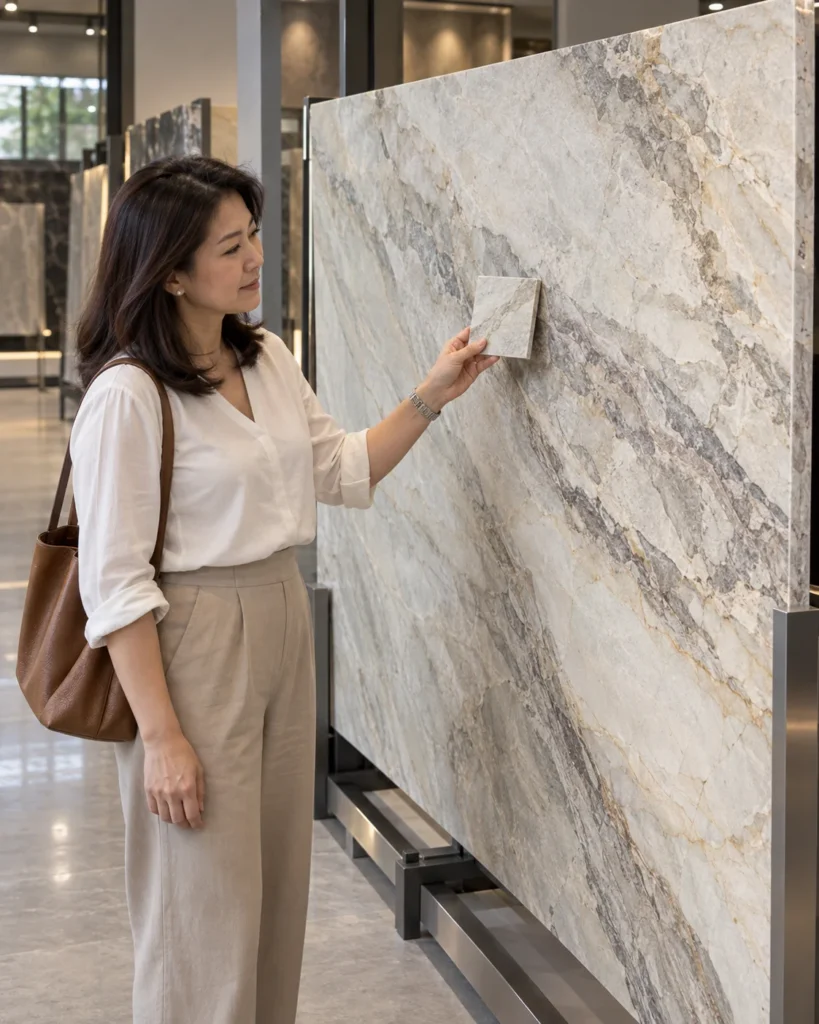
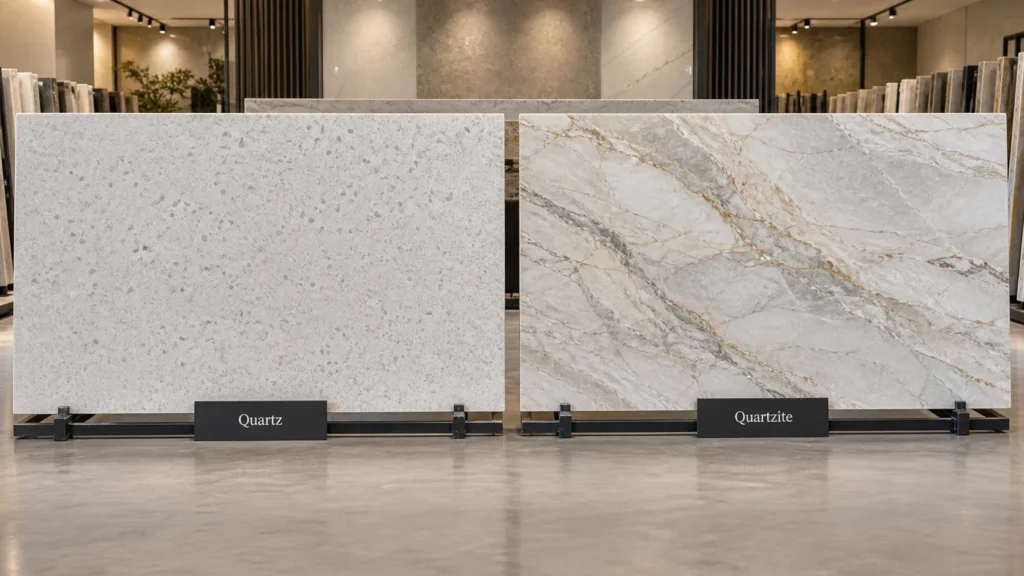
Quartz is a man-made engineered stone. Quartzite is a natural rock formed deep in the earth under heat and pressure. They sit side by side in a showroom looking almost identical, but once they’re doing daily duty in a Malaysian kitchen, they behave very differently.
Key Takeaways
- Quartz is engineered from roughly 90% ground quartz crystals plus polymer resin; quartzite is a natural metamorphic rock, so no two slabs look exactly alike.
- Quartz is non-porous and never needs sealing. Quartzite is porous and needs sealing on installation, then roughly once a year after that.
- Quartzite is harder and handles a hot pan straight off the stove better. Quartz is tougher and resists chipping from a dropped pot.
- Zenstone quartz runs from RM110 to RM160 per sqft (supply and install). Quartzite is natural stone, so it’s priced per slab and needs a quote against the actual piece.
- Quartzite is slower and more expensive to fabricate, and Malaysian fabricators stock far less of it, so lead times and offcut wastage both run higher.
- Some stone labelled “quartzite” on the Malaysian market is mislabelled granite, so always ask for the geological classification before you commit.
What Is Quartz? The Engineered Option
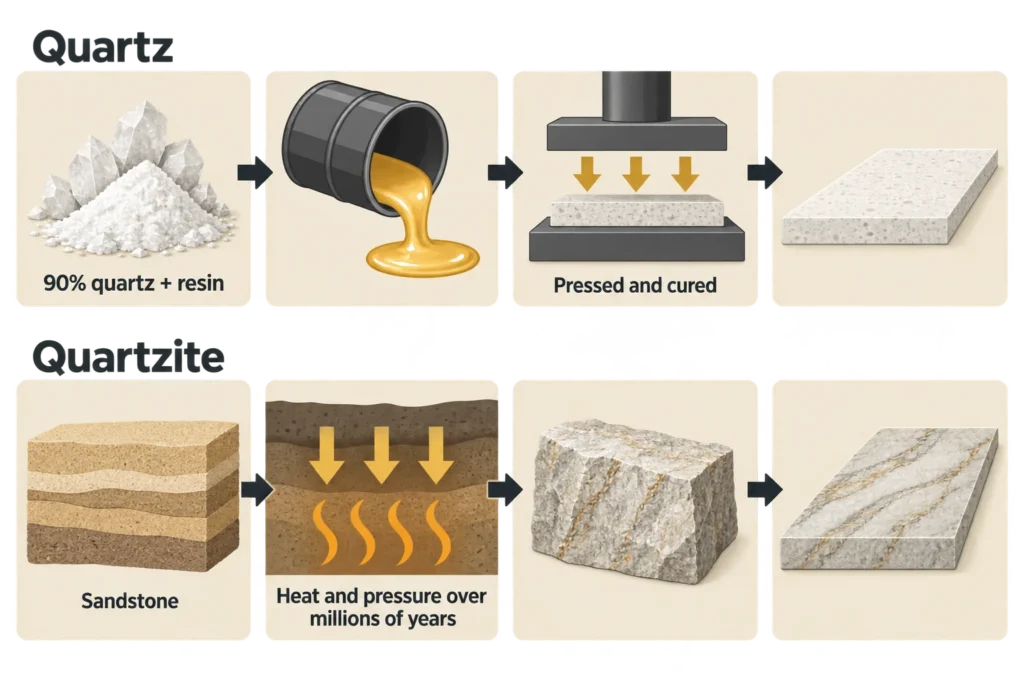
Quartz is a factory-made slab, not a quarried one. Manufacturers combine roughly 90% ground natural quartz crystals with polymer resins and pigments, then compress and cure the mixture under vacuum and heat. Because it’s made to a recipe rather than dug out of a hillside, the colour and pattern on the sample is what turns up in your kitchen.
That engineering also makes quartz non-porous. The resin binds the crystals tightly enough that liquids can’t seep in, which is why quartz never needs sealing. It’s also why the resin sets the material’s limits: heat and prolonged UV both act on the resin long before they touch the quartz itself.
If you want the full manufacturing picture, our guide on what quartz stone is and how it’s made walks through the process end to end.
What Is Quartzite? The Natural Option
Quartzite is a metamorphic rock, quarried and cut, never manufactured. It starts as quartz-rich sandstone, which gets subjected to immense heat and pressure over millions of years until the grains recrystallise into a dense, hard stone. Quarries cut it into blocks, then slabs, then polish it, the same journey as granite or marble.
Because it’s natural, every quartzite slab has its own veining and colour variation. If you want a countertop nobody else has, quartzite delivers that in a way an engineered product can’t.
One thing worth settling before you shop: quartzite and quartz stone are not related products with slightly different names. One is quarried rock, the other is a factory slab. The similar names cause real confusion on showroom floors, and some suppliers in Malaysia add to it by labelling granite as “quartzite” (and occasionally the reverse). Our guide on why some suppliers call granite “quartzite” walks through exactly how to tell them apart and what to ask before you buy.
Quartz vs Quartzite: Full Comparison
| Feature | Quartz (Engineered) | Quartzite (Natural) |
|---|---|---|
| Origin | Manufactured from crushed quartz and resin | Quarried, metamorphosed sandstone |
| Appearance | Consistent colour and pattern | Unique, one-of-a-kind veining |
| Mohs hardness | Around 7 | Around 7 to 8 |
| Chip resistance | Higher, resin adds flexibility | Lower, more brittle on impact |
| Porosity | Non-porous | Porous, needs sealing |
| Heat tolerance | Good, but use a trivet for very hot pans | Excellent, handles a hot pot off the stove |
| UV stability | Can discolour under prolonged direct sun | Stable, suitable for semi-outdoor areas |
| Maintenance | Very low, no sealing | Moderate, reseal roughly once a year |
| Fabrication | Standard tooling, routine lead times | Slower, harder on blades, higher cost |
| Availability in Malaysia | Widely stocked by collection | Limited, slab-by-slab selection |
| Starting price (supply and install) | From RM110/sqft (Zenstone) | Priced per slab, request a quote |
For a broader look at how these two stack up against every other option on the market, our complete guide to kitchen countertop materials in Malaysia compares 14 materials side by side.
Which Looks Better in a Malaysian Kitchen?
Neither wins outright. It depends on whether you want to control the look or be surprised by it.
If you want a specific result, a solid white, a concrete grey, or a perfectly consistent marble pattern running across an island, quartz is the safer bet. The slab you approve is the slab you get, and a second slab from the same collection will match the first closely enough to run a long counter without a visible break in pattern.
If you’re drawn to the unpredictable beauty of natural stone, quartzite delivers something quartz can’t replicate. Each slab carries its own veining, so the countertop ends up genuinely one-of-a-kind. It’s the same appeal that makes marble popular, without marble’s fragility.
There’s a practical catch with natural stone, though. What you see on a 100mm sample tile tells you very little about a 3-metre slab, because veining shifts across the block. With quartzite you need to view and reserve the actual slab, which is exactly the point our guide on why you shouldn’t choose a countertop from a sample alone makes.
Which Is Tougher: Hardness vs Chip Resistance
Quartzite is harder, quartz is tougher, and those two words describe different things. This is where most comparisons go wrong.
Quartzite sits higher on the Mohs scale, which is why it resists surface scratches so well. But hardness only measures scratch resistance. It says nothing about resistance to impact. As a crystalline natural stone with no binder, quartzite is more brittle and more prone to chipping when something heavy lands on it, particularly along an exposed edge or the rim of a sink cutout.
Quartz, thanks to the resin in its composition, has a little give. That flexibility gives it better toughness, so it absorbs the shock of a dropped pot better than a purely mineral surface does. For a busy wet kitchen where heavy pots get moved around daily, that difference matters more than a Mohs number.
For a deeper explanation of why “harder” doesn’t automatically mean “tougher”, our guide on the Mohs hardness scale and what it actually means for a countertop breaks down the distinction in plain English.
Which Resists Stains and Water Better?
Quartz, comfortably. This is the biggest practical difference between the two, and it shows up every single day in a Malaysian kitchen.
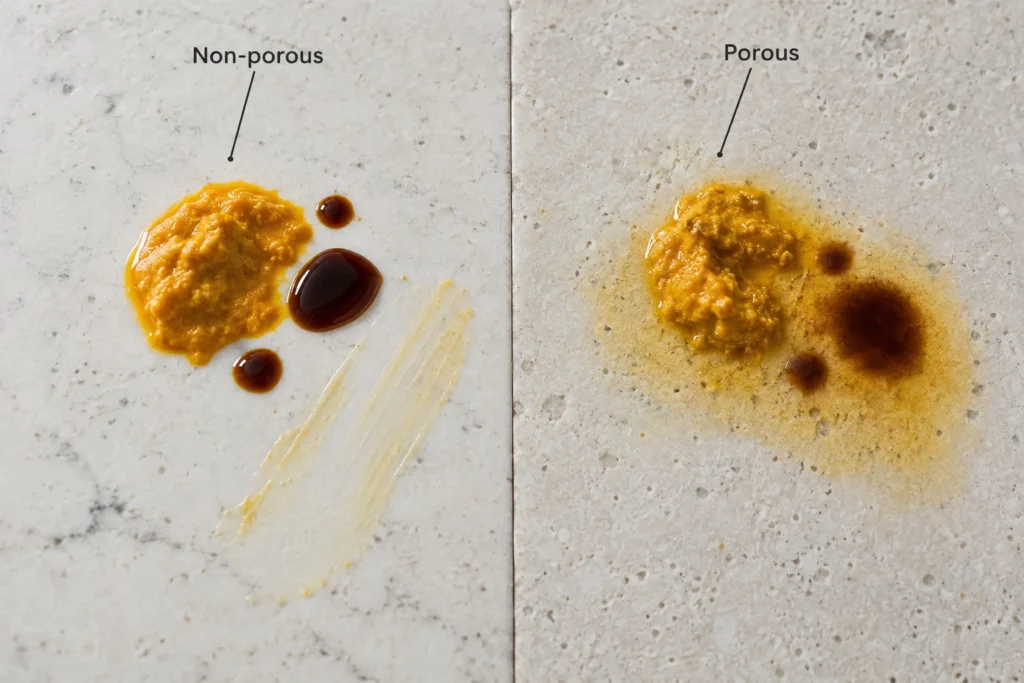
Quartz is non-porous. The resin binds the crystals with no gaps for liquids to seep into. Turmeric, dark soy sauce, curry oil, or a glass of red wine sit on the surface rather than soaking in, and quartz never needs sealing to stay that way.
Quartzite is porous, similar to granite or marble. It needs sealing when it’s installed, then resealing roughly once a year to keep resisting stains. Skip that and you risk the same staining that catches out unsealed granite: a faint yellow shadow where turmeric sat overnight, or a dark patch under the oil bottle that never quite lifts.
There’s a second trap worth knowing about. Some slabs sold as quartzite are actually dolomitic marble, a softer stone that looks similar but etches when it meets anything acidic. Calamansi juice, vinegar, or asam paste will leave a dull mark on it that no amount of cleaning removes, because the acid has eaten into the surface rather than stained it. A supplier who can produce a technical data sheet can tell you which one you’re buying.
If you’d like a wider view of how sealing and daily upkeep differ across materials, our guide on cleaning a quartz countertop the right way covers what actually works against turmeric and other stubborn Malaysian kitchen stains.
Which Handles Malaysian Kitchen Heat Better?
Quartzite, clearly. As a natural stone forged by heat and pressure, it takes a hot pot or pan set directly on its surface without much concern.
The resin in quartz is the weak link. Sustained direct contact with a very hot pan straight off a gas hob after wok cooking can scorch the surface or cause discolouration over time. Fabricators consistently recommend a trivet with quartz, and it’s a habit worth building either way, since even quartzite can suffer thermal shock from a sudden extreme temperature swing.
The same resin explains a difference that catches out Malaysian homes in particular. Prolonged direct sunlight can yellow or fade quartz over the years, which is why fabricators steer homeowners away from quartz for a counter that sits under an open wet-kitchen window or a skylight. Quartzite is UV-stable and doesn’t have that limitation. If heat and sun are the deciding factors in your kitchen, our guide on the best countertop for a wet kitchen in Malaysia is worth a read alongside this one.

Which Is Easier to Fabricate and Install in Malaysia?
Quartz, by a clear margin, and this is the difference most comparison articles leave out entirely.
Quartz is an engineered product with predictable density, so it cuts and polishes with standard tooling on a routine schedule. Sink cutouts, edge profiles, and mitred joints are all well-trodden work. If the colour is in stock, the timeline runs like any other quartz job.
Quartzite is harder on equipment. Its density chews through diamond blades and polishing pads faster, cutting is slower, and a difficult slab carries a real risk of cracking during the sink cutout. Fabricators price that risk in, so quartzite fabrication costs more per job than quartz fabrication on the same kitchen layout.
Availability compounds it. Malaysian fabricators hold deep stock of quartz collections but only a handful of quartzite slabs at any time, and you buy the whole slab rather than the square footage you actually need. On a small kitchen, the offcut you pay for and don’t use can be a meaningful share of the bill. Add shipping time if the slab you want has to come in, and a quartzite job can run considerably longer than the usual countertop installation timeline.

How Much Do Quartz and Quartzite Cost in Malaysia?
Quartz has a published rate per square foot; quartzite doesn’t, because it’s priced per slab.
Quartz pricing is straightforward since it’s a manufactured product sold by collection. Zenstone, Sinno’s house quartz brand, runs from RM110 per sqft (supply and install) for entry colours up to RM160 per sqft for premium marble-look patterns. Global brands sit higher: Caesarstone ranges from RM332 to RM689 per sqft depending on the collection.
Quartzite doesn’t work that way. As a quarried natural stone, the price depends on the specific slab, its quarry of origin, and how dramatic the veining is. There’s no standard rate card the way there is for engineered quartz, and two slabs from the same shipment can be priced differently because one has better movement. On top of the slab cost, budget for the fabrication premium and the offcut you’ll pay for but not use.
If quartzite is on your shortlist, the reliable next step is a quote against the actual slab you’re considering, not a general estimate. For the full quartz picture across every major brand, see our 2026 quartz stone price guide.
FAQ
Is quartzite more expensive than quartz in Malaysia? Usually yes once fabrication and offcut wastage are counted, though there’s no single answer because quartzite is priced per slab by origin, rarity, and veining while quartz is sold by collection with published rates.
Does quartzite really need sealing every year? Yes, roughly once a year for most quartzite, because it’s a porous natural stone and skipping the reseal raises the risk of stains from turmeric, cooking oil, and other everyday Malaysian kitchen ingredients.
Can I put a hot pot directly on quartz? You can, but sustained contact with a very hot pan risks scorching the resin, so fabricators recommend a trivet. Quartzite tolerates direct heat noticeably better.
Is quartzite the same as quartz stone? No. Quartzite is a natural rock quarried from the ground, while quartz stone is a factory-made slab of ground quartz crystals bound in resin. The similar names are the single most common source of confusion in Malaysian showrooms.
Is the “quartzite” I’m being shown actually granite? Sometimes, since it’s a documented naming mix-up in Malaysia’s stone trade. Ask your supplier for the geological classification and a technical data sheet rather than relying on the name on the slab rack.
Which is better for a busy family kitchen, quartz or quartzite? Quartz suits most busy family kitchens better, because its non-porous, no-sealing surface and higher chip resistance need less ongoing attention than quartzite’s annual sealing routine.
Conclusion: Which One Is Right for You?
The choice comes down to your priorities, not which stone is objectively better.
Choose quartz if low maintenance, stain resistance, and a consistent, predictable design matter most. It suits busy households that want a reliable countertop without the upkeep, and it’s the easier material to budget and schedule around.
Choose quartzite if natural, one-of-a-kind beauty and heat resistance matter most. It suits homeowners who love the authentic look of natural stone, have a counter that catches direct sun, and don’t mind resealing it once a year.
The best way to decide is to see and feel both in person, and with quartzite, to view the actual slab rather than a sample tile. Sinno Stone fabricates and installs custom countertops in quartz, granite, and quartzite across Kuala Lumpur and Klang Valley. Visit our showroom and our team can walk you through both, along with a real quote for the slab you’re considering.