

Terrazzo is not a good choice for a kitchen countertop, because most mixes use marble chips that etch when they meet acidic food, and the cement or epoxy binder holding it together struggles with heat and daily kitchen use. It works beautifully on floors, feature walls, and furniture — just not on the surface where you cook.

Key Takeaways
- Marble chips in terrazzo react with acids like lime juice and vinegar, leaving permanent dull marks called etching.
- Epoxy-based terrazzo scorches under hot pots; cement-based terrazzo can crack from sudden temperature changes.
- Cement-based terrazzo needs periodic resealing, and Malaysia’s humidity raises the risk of mould if it’s skipped.
- Terrazzo chips can crack under a dropped heavy object, and repairs rarely match the original pattern.
- Quartz and sintered stone give you the same speckled look without the maintenance or damage risk.
What Exactly Is Terrazzo?
Terrazzo is a composite surface made by mixing chips of marble, granite, quartz, or glass into a binder, then grinding and polishing the cured slab smooth. The binder is either Portland cement or epoxy resin, and it’s that binder — plus the marble chips most mixes rely on — that creates terrazzo’s weak points in a kitchen.
| Feature | Cement-based Terrazzo | Epoxy-based Terrazzo |
|---|---|---|
| Binder | Portland cement | Epoxy resin |
| Porousness | More porous; needs regular sealing | Less porous; more stain-resistant |
| Heat resistance | Handles heat better; prone to thermal shock | Low heat resistance; scorches easily |
| Flexibility | Less flexible; more prone to cracking | More flexible; less prone to cracking |
| Weight | Heavier | Lighter |
| Common use | Flooring, outdoor applications | Wall cladding, indoor applications |

Terrazzo isn’t a bad material — it’s simply built for different jobs. If you love the look for a floor or a feature wall, that’s exactly where its strengths show up.
Why Shouldn’t You Use Terrazzo for a Kitchen Countertop?
Terrazzo struggles with four things a kitchen countertop deals with every day: acid, heat, moisture, and impact. Here’s what each risk looks like in practice.
Does Terrazzo Stain or Etch in a Kitchen?
Yes — most terrazzo mixes use marble chips, and marble is calcium carbonate, which reacts with common household acids. That reaction isn’t a stain you can wipe away; it’s a permanent corrosion of the surface that leaves a dull, whitish mark called etching.
Think about what touches your countertop on a normal cooking day in a Malaysian kitchen: a squeeze of limau nipis, a splash of vinegar, or tomato sauce simmering over. Any of these can leave a permanent dull spot on the marble chips within terrazzo, and no amount of scrubbing brings the shine back. Marble faces this same weakness in countertop form, which is why it’s rarely recommended for kitchens either.

Can Terrazzo Handle Hot Pots and Pans?
Not reliably. Placing a hot pot or pan directly on terrazzo is a real risk, and the outcome depends on which binder your terrazzo uses.
- Epoxy-based terrazzo, the more common type for countertops, uses a resin binder that scorches, burns, or discolours under high heat.
- Cement-based terrazzo tolerates heat better, but sudden temperature swings — like a hot wok going straight from the stove — can trigger thermal shock and crack the surface.
If wok cooking and hot-pan handling are part of your daily routine, a material built for direct heat contact will save you from constant trivet duty.

Does Terrazzo Need Regular Sealing?
Cement-based terrazzo does, and skipping it causes problems in Malaysia’s climate specifically.
- Cement-based terrazzo is naturally porous and needs sealing at installation, then resealing periodically to keep out stains and moisture. In a Klang Valley kitchen that sits humid most of the year, an improperly sealed top becomes a likely spot for mould and mildew to take hold.
- Epoxy-based terrazzo is less porous, but it can still stain and needs careful cleaning to keep its finish looking right.
Can Terrazzo Chip or Crack?
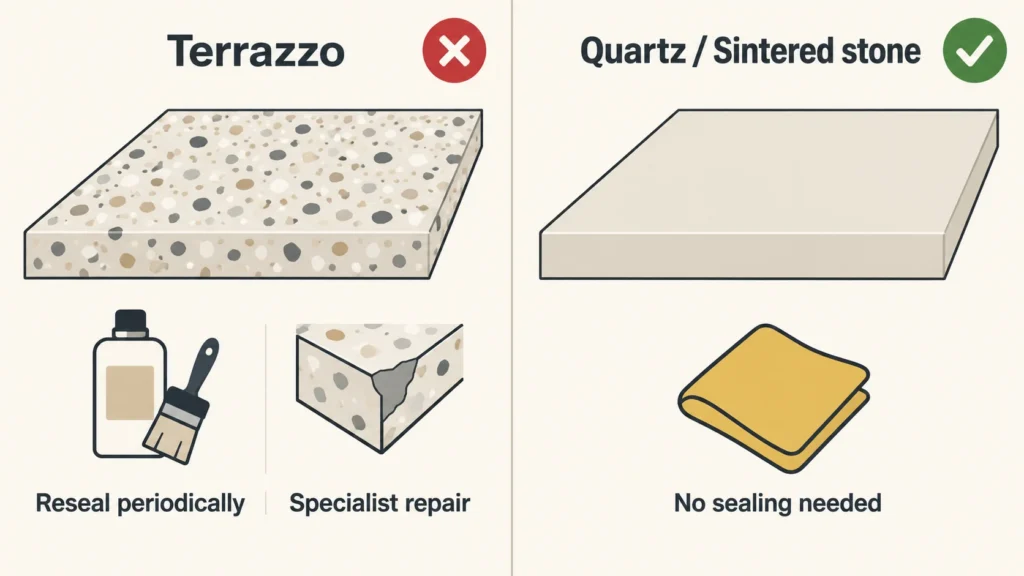
It can. Terrazzo is generally durable, but the embedded stone chips are prone to chipping if something heavy lands on an edge or corner. Repairing terrazzo is a specialised job, and matching the original chip pattern and colour exactly is difficult even for experienced fabricators.
What Are the Best Alternatives to Terrazzo for a Kitchen Countertop?
Quartz and sintered stone give you the same speckled, decorative look as terrazzo without the sealing, staining, or heat concerns.
- Quartz stone — Many quartz collections mimic terrazzo’s confetti pattern. Because quartz is non-porous and engineered from hard minerals, it resists stains, scratches, and etching, and needs zero sealing. Zenstone quartz starts from RM 110 per square foot supply and install for entry-level colours.
- Sintered stone — For homeowners who specifically want the terrazzo look, Moca Compact’s Tinsel Terrazzo pattern delivers it in sintered stone, from RM 110 per square foot supply and install. Sintered stone is heat-proof, stain-proof, and scratch-proof, which makes it well suited to busy home kitchens.
Still weighing your options? Our complete guide to kitchen countertop materials in Malaysia compares 14 of them side by side, terrazzo included.

FAQ
Is terrazzo waterproof enough for a kitchen countertop? Epoxy-based terrazzo resists water well, but cement-based terrazzo is porous and absorbs moisture unless it’s properly sealed and resealed over time.
Can you use terrazzo somewhere else in the kitchen if not the countertop? Yes — terrazzo flooring, backsplashes away from the hob, and kitchen island cladding all handle terrazzo’s limitations far better than a food-prep surface does.
Is quartz more expensive than terrazzo in Malaysia? Not necessarily. Entry-level quartz collections like Zenstone start from RM 110 per square foot supply and install, which is comparable to many terrazzo installations, without the ongoing sealing cost.
How do you fix a chipped terrazzo countertop? A fabricator fills the chip and re-polishes the area, but matching the original stone-chip pattern and sheen exactly is difficult, and the repair often remains slightly visible.
Does terrazzo scratch easily? The stone chips themselves resist scratching, but the binder around them — especially epoxy — can show fine scratches from knives and abrasive cleaning pads over time.
Conclusion: The Right Material for the Right Place
Terrazzo is a genuinely durable material for low-traffic applications like flooring, bathroom vanities, and decorative walls. But its vulnerability to acidic stains, heat damage, and its ongoing maintenance needs make it a poor fit for the high-impact environment of a home kitchen countertop.
Choose a high-performance material like quartz or sintered stone instead, and you get the same speckled aesthetic without trading away durability. If the terrazzo look is what you’re after, ask to see a Tinsel Terrazzo or terrazzo-pattern quartz sample against your cabinet colour before you commit — a 100mm chip never tells the whole story of a full slab.
