

Five reasons quartz earns its price in a Malaysian kitchen — and what it actually costs per square foot.
Quartz countertops are worth the price for most Malaysian kitchens because a good slab lasts 20 years or more with no sealing, no polishing and no specialist care — which brings the real cost down to somewhere between RM110 and RM345 a year, depending on the brand you pick. That’s the honest answer, and the rest of this post shows the numbers behind it.
The price tag is what makes people hesitate. Supply-and-install quartz in Malaysia runs from around RM110 per square foot for a local brand to RM689 per square foot for a premium imported collection, and when you’re already juggling cabinets, wiring and tiling, the countertop line item can feel like the easiest place to cut. So is it worth holding your ground on this one?
Here are five reasons we think it is.

Key Takeaways
- Quartz supply-and-install pricing in Malaysia ranges from around RM110 to RM689 per square foot depending on brand and collection — the gap is wide, so “quartz” alone tells you nothing about what you’re paying
- A 20 sq ft L-shaped run costs roughly RM2,200 in Zenstone and roughly RM6,900 in Caesarstone, which works out to about RM110 to RM345 per year over a 20-year life
- Quartz needs no sealing, no polishing and no specialist cleaner — unlike granite and marble, which need resealing every few years
- Non-porous means spills, turmeric and sambal sit on the surface instead of soaking in, and premium brands carry NSF-51 certification for direct food contact
- The catch: quartz isn’t heat-proof. A wok straight off the flame can mark it, so trivets aren’t optional in a Malaysian kitchen
Does Quartz Actually Last Long Enough to Justify the Price?
Yes — a properly fabricated and installed quartz countertop will comfortably outlast the kitchen cabinets underneath it, which is why the cost per year is far lower than the sticker price suggests.
Quartz is engineered from natural quartz crystals bound with polymer resin and pigment. Quartz is one of the hardest minerals around, and packing a slab full of it produces a surface that shrugs off knife work, dropped pots and the daily scrape of pans. It doesn’t develop the wear patterns you see on softer surfaces after a few years of heavy use.
What Does That Work Out To Per Year?
Take a fairly typical L-shaped kitchen run of about 20 square feet. Here’s what that costs across the quartz brands we carry, using real 2026 supply-and-install pricing:
| Brand | Supply & install (per sq ft) | 20 sq ft run | Roughly, per year over 20 years |
|---|---|---|---|
| Zenstone | RM110 – RM160 | RM2,200 – RM3,200 | RM110 – RM160 |
| Moonstone | RM182 – RM226 | RM3,640 – RM4,520 | RM182 – RM226 |
| Silestone | RM282 – RM634 | RM5,640 – RM12,680 | RM282 – RM634 |
| Caesarstone | RM332 – RM689 | RM6,640 – RM13,780 | RM332 – RM689 |
Prices are per square foot, supply and install. Your final quote will shift with cutouts, edge profile and site conditions — see our full quartz price breakdown by brand and collection for the detail.
Even at the top of that table, you’re looking at the annual cost of a decent phone contract for a surface your family touches every single day. At the bottom, a Zenstone top in white works out to roughly RM10 a month over its life.
We won’t quote you numbers for laminate or solid surface, because we don’t sell them and we’re not going to invent figures to make quartz look better. What we will say is this: the shorter a surface’s life, the more times you pay for demolition, refabrication, installation and the disruption of having your kitchen out of action. Those repeat costs are the part homeowners forget to budget for.

How Much Maintenance Does Quartz Really Need?
Almost none — and that’s the part of the value case people underestimate. Quartz requires no sealing, no polishing and no specialist stone cleaner, ever.
Compare that to natural stone. Granite and marble are porous, so they need an impregnating sealer applied periodically to stay stain-resistant, and marble in particular can need professional polishing once the surface dulls or etches. None of that is dramatic on its own, but it’s a recurring cost and a recurring chore for as long as you own the kitchen. If you’d like the detail on sealers, we’ve covered what an impregnator does and when it’s needed.
The quartz routine, in full:
- Wipe with warm water and a bit of dish soap after cooking
- For stubborn marks, a mild cream cleanser and a non-scratch pad
- That’s the whole list
Turmeric on a quartz top wipes off. Sambal splashes wipe off. Coffee rings, soy sauce, curry oil — all of it sits on the surface rather than soaking in, so a cloth handles what would be a permanent shadow on marble. Our guide on how to clean a quartz countertop the right way covers what to avoid too, because the one genuine risk with quartz is aggressive chemicals, not food.

Why Does Quartz Suit Malaysian Kitchens Specifically?
Because our two biggest countertop stressors are humidity and heavy cooking, and quartz handles the first one completely while handling the second one well enough for daily use.
Humidity Isn’t a Problem for a Non-Porous Surface
Humidity in most of Malaysia sits high year-round, and anything porous in your kitchen is quietly absorbing moisture. Quartz has effectively no porosity, so there’s nothing for moisture to move into. You won’t get swelling, delamination, or the musty smell that develops in materials that hold damp.
Worth clearing up a common misconception: if you’re seeing mould near your countertop, it’s almost always growing in the silicone joint, the cabinet carcass or the wall behind — not in the stone. We wrote a whole post on where countertop mould actually comes from because so many homeowners blame the wrong thing.
Heavy Cooking: What Quartz Handles, and What It Doesn’t
It handles: wok splatter, hot oil, spice pastes, acidic marinades, vigorous chopping, and the kind of volume prep that happens before Hari Raya or Chinese New Year. Lime juice and vinegar would etch marble; on quartz they wipe away.
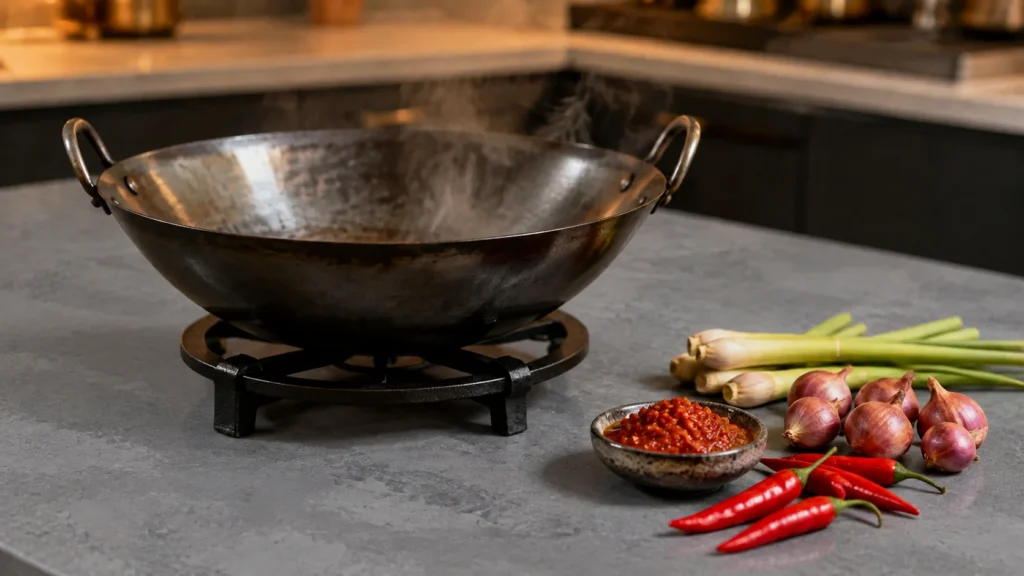
It doesn’t handle: direct heat. This is the honest limitation. The resin binder in quartz softens and discolours under high heat, so a wok lifted straight off the flame onto the counter can leave a mark you can’t undo. Use a trivet — every time, not most of the time. If your household cooks at high heat constantly and you know trivets won’t happen, sintered stone is the more forgiving material and we’d rather point you there than sell you a top you’ll damage in year one.
That trade-off is the main reason quartz isn’t automatically right for every kitchen, and it’s covered in more depth in our honest look at the disadvantages of quartz countertops.
Is Quartz Genuinely More Hygienic Than Natural Stone?
Yes, and the reason is structural rather than promotional: quartz has effectively no pores, so there is nowhere for bacteria, liquid or food residue to settle below the surface.
Granite and marble contain microscopic pores. Sealing reduces how much gets in, but sealer wears and needs reapplying, and in a hot, humid kitchen those pores are doing their job whether you’ve kept up with maintenance or not. On a non-porous surface, wiping with a disinfectant genuinely clears the surface, because the surface is all there is.
What NSF-51 Certification Actually Means
Premium quartz brands including Caesarstone and Silestone carry NSF-51 certification, which classifies the material as safe for direct food contact. It’s an independent standard, not a marketing badge — it tests the material for bacterial resistance, safe composition, and whether those properties hold up over time.
In practice, this matters most if you prepare food directly on the counter: rolling roti dough, kneading, handling raw chicken before it goes into the pot. We’ve explained why NSF-51 certified quartz matters for anyone who bakes in a separate post.
Not every quartz slab sold in Malaysia carries this certification, so if food safety is part of your reasoning, ask the supplier for it by name rather than assuming.
Does a Quartz Countertop Hold Its Value?
It holds its appearance, which is the part that matters when you eventually sell or refinance — a quartz top installed today will still look right in fifteen years, while a worn surface reads as “needs renovating” to any buyer walking through.
We’re not going to give you a percentage. Nobody can honestly tell you that a countertop adds a specific figure to a Malaysian property valuation, and any supplier who quotes you one is making it up.
What we can say from experience is simpler. Buyers judge kitchens fast, and they judge them on surfaces. A dated or damaged countertop invites a renovation deduction from an offer — usually estimated higher than the actual cost of replacing it. A countertop that still looks new doesn’t come up at all. That’s the practical value: not a number added, but a deduction avoided, plus fifteen or twenty years of using a kitchen you like.

What Should You Check Before You Commit?
Check the brand, the collection, the price per square foot, and who is actually fabricating and installing the slab — those four answers separate a fair quote from a vague one.
Match the Brand to the Job
- Zenstone (RM110 – RM160/sq ft): solid everyday performance, wide colour range, the sensible choice for most kitchens and for secondary areas like laundry tops
- Moonstone (RM182 – RM226/sq ft): larger 3200×1600 slabs and leather finishes, useful when you want fewer seams on a long run
- Silestone (RM282 – RM634/sq ft) and Caesarstone (RM332 – RM689/sq ft): imported, with manufacturer warranties, NSF-51 certification and the deepest pattern ranges — the Caesarstone and Silestone comparison explains how the two differ

Watch for Compressed Marble Sold as Quartz
This is the most common way homeowners get burnt in Malaysia. Compressed marble looks similar in a small sample, costs the supplier far less, and stains badly — which you discover the first time something acidic sits on it. Learn how to spot the compressed marble scam before you pay a deposit, and never confirm a slab from a photo or a 100mm sample alone.
Ask About Finish and Edge
Honed and polished quartz perform identically — the choice is purely about how you want the kitchen to look and feel. Edge detail matters more: a properly chamfered edge is what stops corners chipping over the years.
FAQ
Are quartz countertops worth it in Malaysia? For most kitchens, yes — the cost works out to roughly RM110 to RM345 a year over a 20-year life, with no sealing, polishing or specialist cleaning in between. The exception is a household that cooks at very high heat and won’t use trivets, where sintered stone is the better fit.
How much does a quartz countertop cost in Malaysia? Supply-and-install quartz runs from about RM110 per square foot for Zenstone to RM689 per square foot for premium Caesarstone collections. A typical 20 sq ft L-shaped kitchen run lands between RM2,200 and RM13,780 depending on the brand and collection you choose.
Can you put a hot pan on a quartz countertop? No. The resin binder in quartz can scorch or discolour under direct heat from a pan or wok taken straight off the flame, and the damage is permanent. Always use a trivet.
Do quartz countertops need sealing? No. Quartz is non-porous, so sealer has nothing to penetrate and serves no purpose. This is one of the clearest differences between quartz and natural stone like granite or marble, which do need periodic resealing.
Will turmeric or sambal stain a quartz countertop? No, provided you wipe it up rather than leaving it overnight. Quartz has no pores for pigment to soak into, so turmeric, curry oil and sambal come off with warm water and dish soap.
Conclusion
Quartz isn’t worth every penny because it’s expensive. It’s worth it because the price buys you two decades of a surface that doesn’t need sealing, doesn’t stain from Malaysian cooking, and still looks right long after the rest of the kitchen has been repainted twice.
It isn’t the right answer for every household — if trivets genuinely won’t happen in your kitchen, we’ll tell you to look at sintered stone instead. But if you want a countertop that holds up to daily cooking without becoming a maintenance project, quartz earns its cost more clearly than almost anything else on the market.
If you’d like a real number for your own kitchen rather than a range, send us your layout and we’ll quote it per square foot with the brand and collection named.