

Yes, you can put a hot pan straight onto a sintered stone countertop without a trivet. Sintered stone is fired above 1,200°C during manufacturing, so a wok at 250°C or a roasting tray at 200°C sits well below anything that could mark it.
That answer matters more in a Malaysian kitchen than in most. If you cook sambal tumis over a roaring flame, fry keropok, or run a wok hard enough to get proper wok hei, your countertop takes heat that a European kitchen rarely sees. Knowing exactly how much heat the surface can take, and where the genuine limits sit, is worth more than a vague reassurance from a showroom.

Key Takeaways
- Sintered stone handles direct hot pan contact without trivets, scorching, or discolouration.
- It is fired above 1,200°C in production, roughly four to five times hotter than a wok straight off the flame.
- Quartz is the main contrast: its 7 to 10% resin content can scorch or discolour above about 150°C.
- Sintered stone is not automatically the expensive option. Moca Compact starts at RM110 per sqft supply and install, the same as entry-level Zenstone quartz.
- The one real caution is damaged edges and cutouts, not the open surface of the slab.
What Makes Sintered Stone So Heat Resistant?
Sintered stone resists heat because heat is how it was made. There is no resin, glue, or binder inside it to soften, yellow, or burn.
How the material is made
Sintered stone starts as a blend of natural minerals, mainly quartz, feldspar, silica, and mineral pigments. These are ground to a fine powder, then put through two extreme conditions at once:
- Massive pressure, around 400 bar (about 5,800 psi)
- Extreme temperature, above 1,200°C
That process, called sintering, compresses what happens inside the earth over millions of years into a few hours in a factory. The particles fuse at a molecular level, and the result is a dense, effectively non-porous slab. If you want the full picture of how sintered stone is manufactured, the process is worth understanding before you compare it to anything else.

Why that makes hot pans a non-issue
A material fired above 1,200°C is stable at every temperature below that point. Put some numbers against it:
| Heat source | Typical temperature |
|---|---|
| Sintered stone firing temperature | 1,200°C and above |
| Wok at full flame | 250 to 300°C |
| Roasting tray straight from the oven | 200 to 250°C |
| Kettle or coffee pot base | 90 to 100°C |
Nothing in a home kitchen gets within four times of the temperature the slab was born in. This is not a marketing claim, it is the physics of the material.
What Actually Happens When You Set a Hot Pan Down?
Nothing happens. That is the honest answer, and it holds up across four specific failure modes that affect other countertop materials.
No thermal shock. The molecular structure is uniform, so the slab expands and contracts evenly. There is no sudden temperature gradient to crack it.
No scorching or discolouration. Nothing in the material burns or yellows. This is the biggest practical gap between sintered stone and quartz, which we cover below.
No pitting or bubbling. Repeated heat cycling over years does not degrade the surface.
No trivets needed. You can set the wok down wherever there is space. In a Malaysian kitchen where counter space runs out fast and cooking happens at pace, that is a real daily convenience rather than a spec sheet line.
How Does Sintered Stone Compare to Other Countertop Materials?
Sintered stone and granite both handle direct hot pans. Quartz and solid surface do not. Here is where each one sits.
| Material | Direct hot pan | Practical limit | Why |
|---|---|---|---|
| Sintered stone | Safe | 300°C and above | No resin, fired above 1,200°C |
| Granite | Generally safe | High | Naturally formed under heat and pressure |
| Porcelain slab | Usually safe | High | Also fired above 1,200°C, quality varies |
| Quartz | Not recommended | About 150°C | 7 to 10% polymer resin content |
| Solid surface | Avoid | Low | Acrylic or polyester resin base |

Sintered stone vs quartz
Quartz is the material most Malaysian homeowners compare sintered stone against, and heat is where the two genuinely part ways. Quartz is roughly 90% crushed quartz held together by 7 to 10% polymer resin. The stone content does not mind heat. The resin does.
Above about 150°C, that resin can scorch, discolour, or crack, which covers almost anything coming straight off a hob. Most quartz manufacturers state this plainly in their care guidance and recommend a trivet.
For a household that cooks Malaysian food at Malaysian heat, that limitation is the single strongest argument for sintered stone.
Sintered stone vs porcelain slab
Both are fired above 1,200°C and both handle hot pans. The difference is consistency rather than heat performance. Sintered stone is engineered specifically for countertops and tends to achieve higher density, whilst porcelain slabs grew out of tile manufacturing and vary far more widely between suppliers. The full comparison between sintered stone and porcelain slab covers composition and application in detail.
The practical takeaway: with a reputable sintered stone brand you know what heat performance you are getting. With an unbranded porcelain slab, you are trusting the supplier.
Sintered stone vs granite
Granite was formed under heat and pressure deep underground, so it takes hot pans without complaint in most cases. The trade-off sits elsewhere. Granite needs periodic sealing, absorbs liquids if that seal fails, and varies in quality depending on the quarry. Sintered stone gives you the same heat freedom with no sealing routine attached. Our sintered stone versus granite comparison weighs both across cost, durability, and maintenance.
Sintered stone vs solid surface
Solid surface materials such as Corian are built on acrylic or polyester resin, and heat is their weakest point. A hot pan can leave a burn mark, a warp, or a permanent dull patch. For a kitchen where heat is routine, solid surface is difficult to recommend as the main worktop.
How Does Sintered Stone Handle Real Malaysian Cooking?
It handles every common high-heat scenario in a Malaysian home without special treatment. Here are the four that come up most.
Wok cooking
A wok pushed hard for char kuey teow or nasi goreng runs at 250 to 300°C. You can lift it off the flame and set it straight down on sintered stone, no trivet, no pause to find somewhere safe. That freedom is exactly why sintered stone keeps appearing in guides to the best countertop for a Malaysian wet kitchen.
Steamboat and hot pot
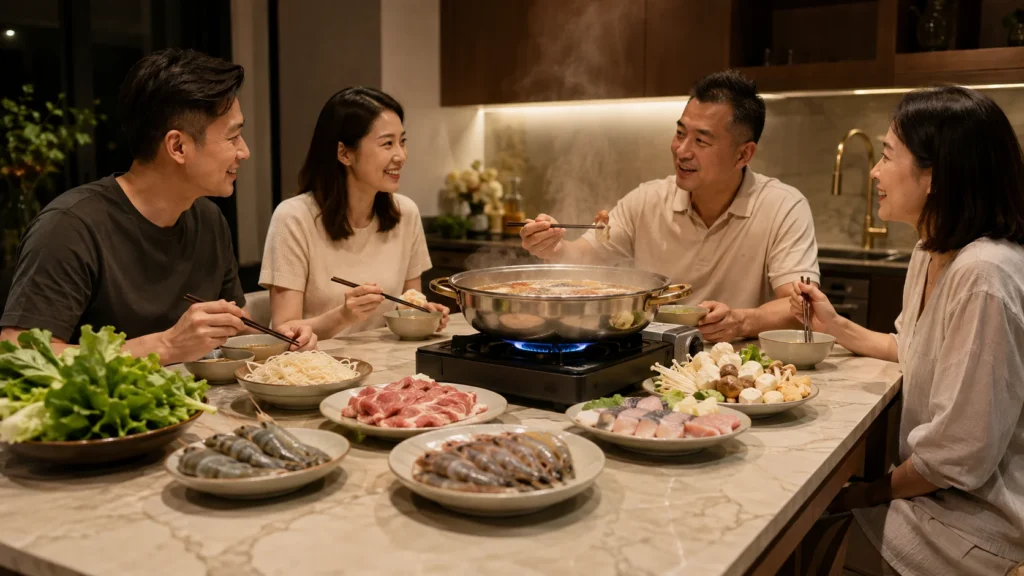
Hosting steamboat over Chinese New Year means a portable burner and a pot sitting in one spot for hours. Sustained heat is a different test from a brief pan contact, and sintered stone passes it. The surface underneath the burner will not mark or discolour.
Baking and roasting
Trays coming out of a 200°C oven can go straight onto the counter to cool. No cooling rack, no heat mat, no hunting for a safe landing spot mid-bake.
Kettles, coffee and tea
Small heat, but constant. A kettle base, a moka pot, a teapot fresh off the stove: all fine, all day, for years.
Are There Any Limits Worth Knowing?
Yes, three. None of them apply to an intact, well-installed slab, but they are worth understanding rather than glossing over.
Damaged edges and cutouts
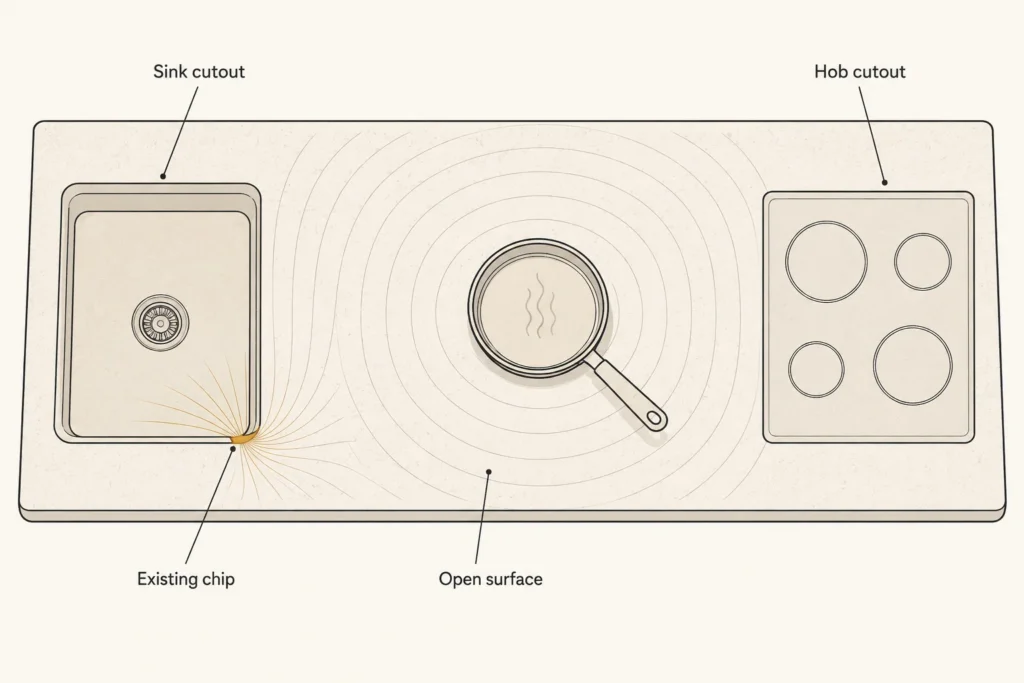
This is the one that genuinely matters. Heat stress concentrates at weak points. If a slab already has a chip, a micro-fracture, or a poorly finished cutout around the sink or hob, repeated thermal cycling can work on that existing flaw over time. The open field of the slab is not the risk. The edges are.
Inspect around your sink and hob cutouts occasionally, and get any chip attended to rather than left. This is also why fabrication quality matters as much as material choice, a point covered in our guide to the honest disadvantages of sintered stone.
Very hot items left in one spot
A pan straight off a burner at maximum, left in the same place for a long stretch, is more stress than normal cooking. Sintered stone will take it. Shifting it occasionally is still sensible practice, the same way you would with any surface.
It is a countertop, not a hob
Heat resistance means the surface withstands hot cookware. It does not mean you should cook on it directly. Common sense still applies.
What Does Sintered Stone Actually Cost in Malaysia?
Sintered stone is not automatically the expensive choice. This is the most common misconception we hear, and the 2026 price list contradicts it.
| Material | Brand | Supply and install, per sqft |
|---|---|---|
| Sintered stone | Moca Compact | RM110 to RM150 |
| Sintered stone | Dekton | RM248 to RM469 |
| Quartz | Zenstone | RM110 to RM160 |
Moca Compact sintered stone starts at RM110 per sqft, the same entry point as Zenstone quartz. If heat resistance is your priority and budget is tight, you do not have to pay a premium to get it.
Dekton sits at the other end. It is the premium tier, and what you pay for is the engineering and testing behind it rather than the basic heat resistance, which both brands share. For the full picture across every brand and material, see our 2026 stone countertop price guide.
Sintered stone makes sense if you:
- Cook with high heat regularly, particularly wok cooking
- Would rather not think about trivets at all
- Want a surface with no sealing routine for decades
- Are fitting an outdoor or semi-outdoor kitchen
- Want the material’s UV stability as well as its heat performance
Quartz may still suit you if you:
- Cook at moderate temperatures most of the time
- Do not mind reaching for a trivet
- Want a specific colour or veining that quartz does better
- Prefer the wider design range at a similar entry price
What About Dekton Specifically?
Dekton by Cosentino is the sintered stone brand most Malaysian homeowners will hear named, and it is tested to withstand direct contact with hot cookware well beyond normal cooking temperatures.
Beyond heat, Dekton is certified for outdoor use, which means it holds its colour under direct Malaysian sun without fading. That combination of heat and UV stability is why it turns up in outdoor kitchens and semi-covered wet kitchens as often as indoor ones. Our guide to what Dekton is and why it matters covers the range, the finishes, and where the price lands.
How Do You Care for Sintered Stone After Heat Exposure?
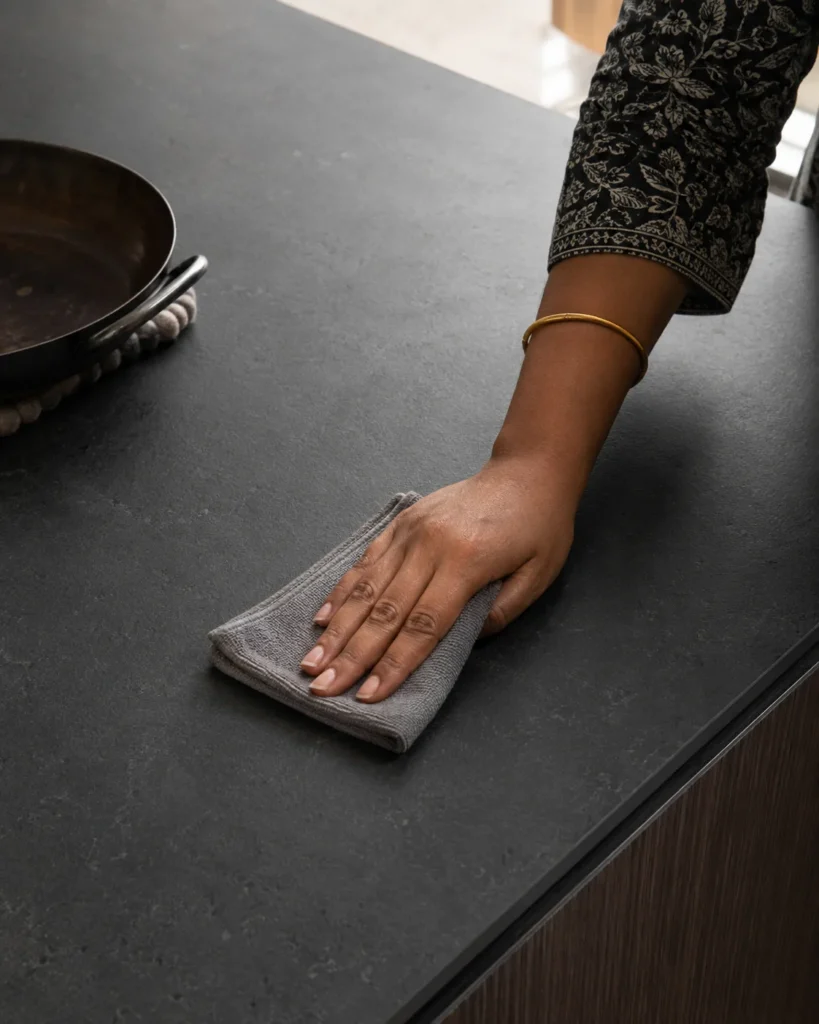
Wipe it down once it cools. That is the entire routine.
Daily cleaning. A damp cloth and mild soap. No specialist products, no polish.
After a hot pan. Nothing to treat, because nothing happened. Wipe away any oil splatter as you normally would.
No sealing, ever. Unlike granite, sintered stone never needs sealing to maintain its heat or stain resistance. It also means no impregnator or sealer is required, which is a common upsell worth declining.
FAQ
Can you put a hot pan on sintered stone without a trivet? Yes. Sintered stone contains no resin and was fired above 1,200°C, so direct contact with cookware at normal cooking temperatures causes no scorching, discolouration, or cracking.
What temperature can sintered stone withstand? Sintered stone comfortably handles 300°C and above at the surface, which covers a wok at full flame and anything coming out of a domestic oven. It was manufactured at more than four times that temperature.
Will a hot wok crack a sintered stone countertop? Not on an intact slab. Thermal shock cracking needs an uneven expansion path, and sintered stone’s uniform density does not provide one. The exception is a slab with an existing chip or micro-fracture at an edge or cutout, where stress can concentrate.
Is sintered stone more heat resistant than quartz? Considerably. Quartz contains 7 to 10% polymer resin that can scorch above about 150°C, which is why manufacturers recommend trivets. Sintered stone has no resin content at all.
Does sintered stone cost more than quartz in Malaysia? Not necessarily. Moca Compact sintered stone starts at RM110 per sqft supply and install, matching entry-level Zenstone quartz. Dekton is the premium option at RM248 to RM469 per sqft.
Conclusion
Can you put a hot pan on a sintered stone countertop? Yes, straight from the flame, repeatedly, for as long as the countertop is in your kitchen.
The reason is simple enough to check yourself: the slab was fired above 1,200°C before it ever reached your house. Nothing in a home kitchen comes close to that. The only thing worth watching is the edges and cutouts, and that comes down to fabrication quality rather than the material.
If wok cooking and high heat are part of how you actually cook, sintered stone removes a daily annoyance that quartz does not. And with Moca Compact starting at the same price as entry-level quartz, that freedom does not have to cost extra.
Not sure which material suits how your household really cooks? Send us your kitchen layout and we will quote both options side by side, with the full price breakdown, so you can decide on the numbers rather than a showroom pitch.