

For a kitchen that cooks daily, quartz stone is the better choice over marble in Malaysia. Marble is porous and reacts with acid, so lime juice, tamarind and turmeric leave permanent marks, while quartz is non-porous, needs no sealing and wipes clean after a rendang night. Marble still wins on natural beauty, which is why it belongs in the dry kitchen, the bathroom and on the wall rather than beside the wok.
If you are renovating in Kuala Lumpur, Penang or Johor Bahru, you have probably been drawn to marble, then heard someone warn you that it stains and needs constant attention. Then quartz enters the conversation, promising marble’s look without the headaches. Is that the full picture? Not quite. Both materials have real strengths and real limits, and what works in one household can be an expensive mistake in another. This guide compares the two on every factor that matters in a Malaysian kitchen, from how each surface handles sambal to what you will pay per square foot. For the wider picture across every material, start with the complete guide to kitchen countertop materials in Malaysia.

Key Takeaways
- Marble is porous and etches on contact with acid. Lime, tamarind, vinegar and tomato all leave permanent dull marks that no cleaning removes.
- Quartz is non-porous, never needs sealing and cleans with soap and water. Turmeric wipes off.
- Marble tolerates heat slightly better, but neither surface should take a hot wok straight from the hob. Use a trivet on both.
- Genuine quartz in Malaysia costs RM110 to RM689 per square foot supply and install. Marble is quoted per slab, so get a written quote before you compare.
- Marble-look quartz gives you the Calacatta or Carrara look with quartz performance, from RM155 per square foot.
What Is the Difference Between Marble and Quartz?
Marble is a natural stone quarried from the ground, while quartz stone is a manufactured slab made from crushed quartz crystals bound in resin. They can look alike on a showroom slab, but the way each one is made decides how it behaves in your kitchen.
What is marble?
Marble is a natural metamorphic rock made mostly of calcium carbonate. It forms when limestone is squeezed and heated deep underground over millions of years, which is what creates the veining and soft translucency that people love.
Every marble slab is one of a kind. No two pieces share the same veining, colour shift or mineral flecks, and no factory can copy that depth. Carrara, with its softer grey veining, and Calacatta, with bolder and more dramatic patterns, remain the two most requested varieties for luxury Malaysian interiors. Our guide on Calacatta vs Carrara marble explains how to tell them apart.
That same calcium carbonate is also marble’s weak point in a kitchen. It reacts chemically with acid, and that reaction leaves a permanent mark called etching.
What is quartz stone?
Quartz stone, also called engineered quartz, is a manufactured surface made from crushed natural quartz crystals bound with polymer resin and pigment. The mix is pressed under high pressure and heat into a dense, non-porous slab. Our post on the pros and cons of quartz stone kitchen tops covers the trade-offs in full.
Because quartz is engineered, manufacturers control colour, pattern and consistency precisely. Modern quartz designs copy the look of Carrara and Calacatta convincingly, veining and all, while performing in ways natural marble cannot.
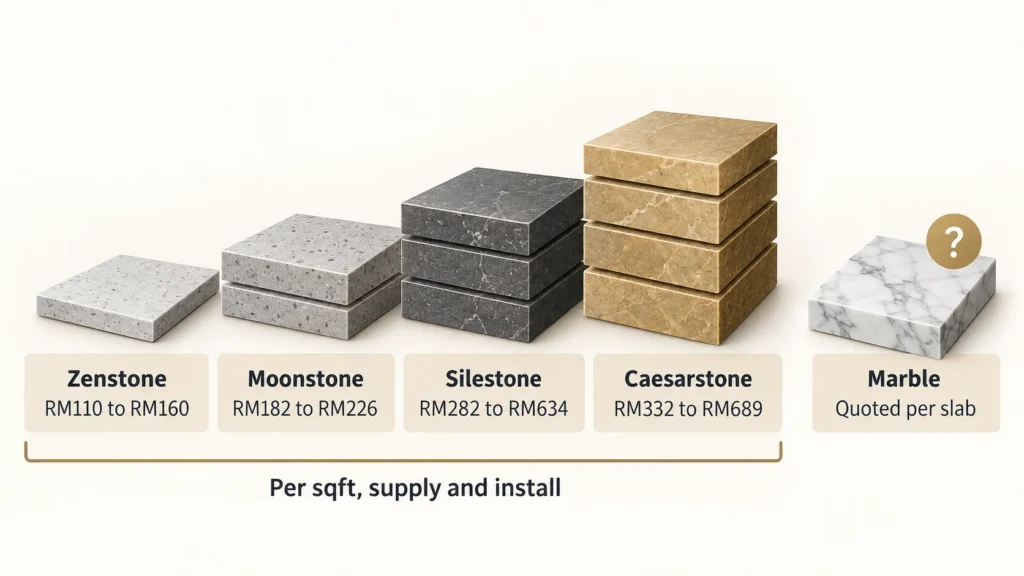
The quartz brands sold in Malaysia sit in clear price tiers. Caesarstone and Silestone are the premium imports, Moonstone sits in the middle, and Zenstone is the entry-level option. Each brand offers different collections at different price points, so there is a genuine quartz option at almost every budget.
Which Resists Stains Better in a Malaysian Kitchen?
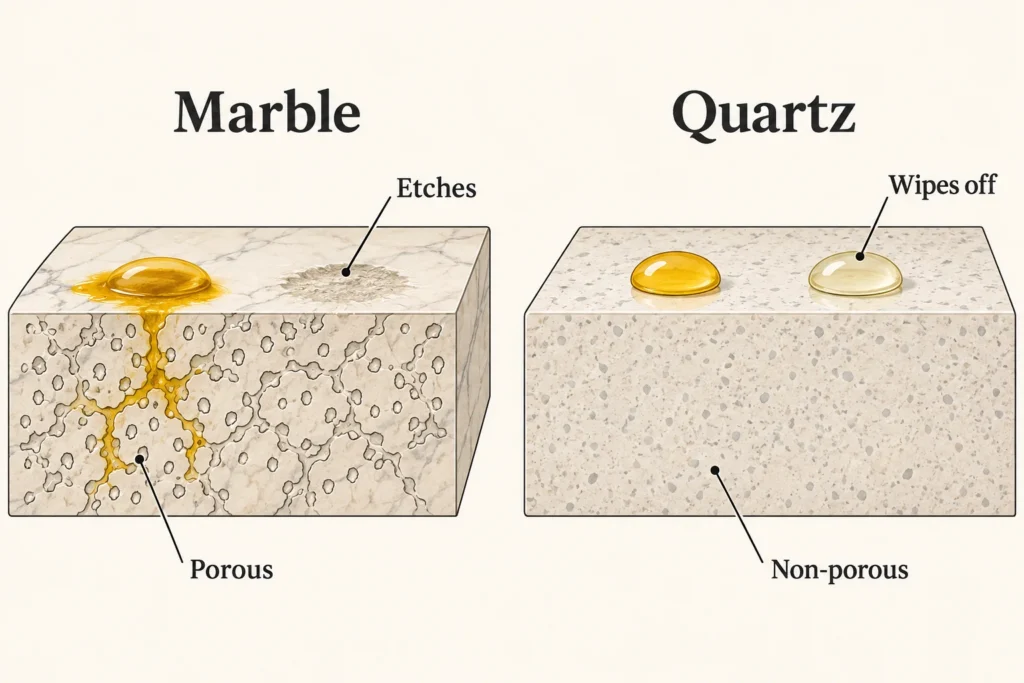
Quartz resists stains far better than marble, and this is the single biggest reason it wins for daily Malaysian cooking.
Marble is porous. It absorbs liquid readily, and once a stain gets below the surface it is very hard, sometimes impossible, to remove. Think about what lands on a Malaysian kitchen top in a normal week: turmeric from rendang, lime juice from sambal, vinegar from achar, soy sauce, kopi, tomato-based curries. Every one of them can mark marble permanently.
Worse, marble does not just stain. It etches. When acid touches calcium carbonate, it reacts and eats into the stone, leaving dull whitish patches that no amount of scrubbing brings back. This is not a maintenance failure. It is basic chemistry, and it happens even on a freshly sealed slab because sealer slows absorption but does not stop a surface reaction.
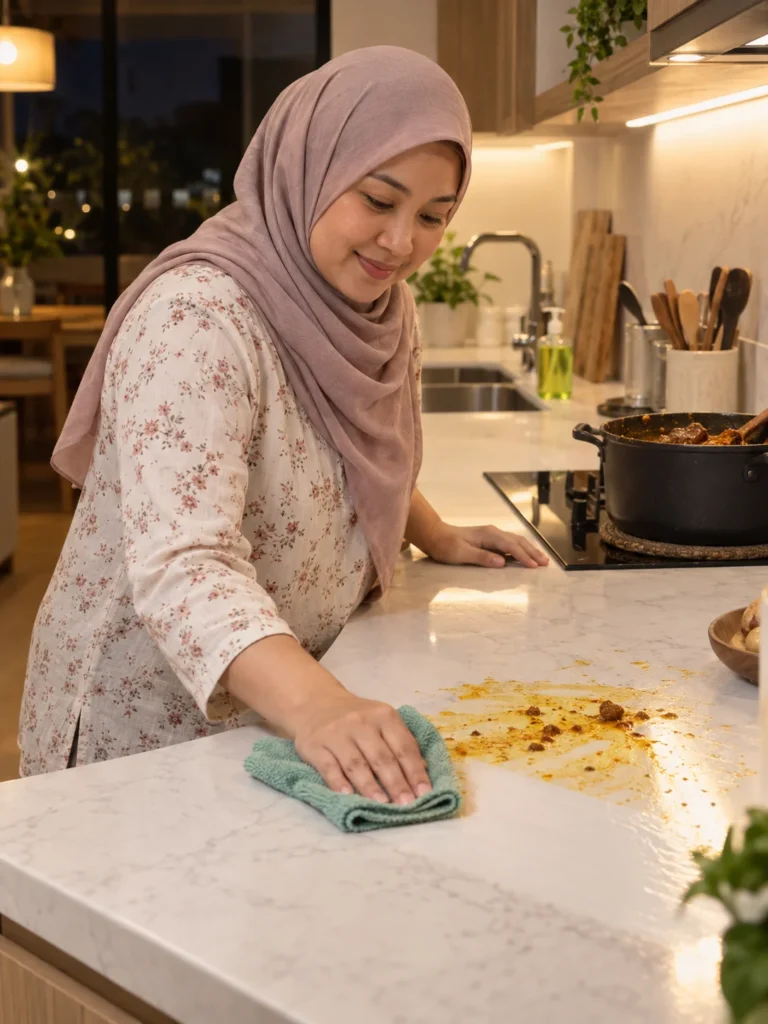
Quartz is non-porous. Turmeric, belacan, kicap manis and curry oil sit on top rather than soaking in, and a wipe with mild soap and water usually handles it. Even a turmeric stain left overnight comes off with a cream cleanser, which surprises homeowners who assume turmeric marks everything for life.
Verdict: Quartz wins outright. Malaysian cooking puts acidic, oily and heavily pigmented ingredients on the countertop every day, and marble cannot take that without damage.
Which Handles Heat Better?
Marble handles heat slightly better than quartz, but neither surface is built for a hot wok straight from the hob.
Marble is a natural stone, so warm cookware placed on it does no immediate harm. Extreme thermal shock, such as a searing-hot pan moved directly from a high flame, can still crack it.
Quartz is more sensitive because of its resin binder. Sustained contact above roughly 150°C can discolour, scorch or damage the resin, and that damage is permanent. Trivets and heat pads are not optional with quartz.
For Malaysian cooks who do high-heat wok cooking, deep-frying or use heavy cast iron, this matters. Reaching for a trivet becomes a habit you have to keep.
Verdict: Marble has a slight edge, but neither is the answer if hot-pan contact is your top concern. In that case sintered stone outperforms both.

Which Is More Durable and Scratch Resistant?
Quartz is substantially harder and more scratch resistant than marble.
Marble sits at around 3 on the Mohs hardness scale, which makes it one of the softer natural stones. Knives, ceramic bowls and even an abrasive scouring pad can scratch it, and edges and corners chip easily.
Quartz rates around 7 on the same scale. It shrugs off the scrapes of everyday cooking, and the resin binder absorbs impact, so chips and cracks are less likely. We still recommend a chopping board, but quartz takes the knocks of a busy kitchen far more gracefully.
Verdict: Quartz, by a wide margin.
Which Needs Less Maintenance?
Quartz needs almost no maintenance, while marble demands a routine most homeowners underestimate until after installation.
Marble needs sealing with a quality impregnator. Modern formulations last up to two years, but you will be reapplying for the life of the stone. Daily cleaning has to avoid acidic or abrasive products. Spills need attention on the spot, because lime juice or vinegar left for even a short while will etch. Periodic professional polishing may be needed to bring back the lustre.
Malaysia’s humidity of 70 to 90 per cent makes this harder. A porous surface absorbs more moisture in a damp climate, which speeds up staining and, once the sealer has worn thin, can let bacteria settle in.
Quartz asks for none of that. No sealing, ever. Mild soap and water for daily cleaning. No special products, no professional treatments, no rushing to wipe up a spill before it does harm. For busy families and working professionals, that is the practical difference between owning a countertop and serving one. Our quartz countertop cleaning guide covers the few things to avoid.
Verdict: Quartz wins comfortably. For most Malaysian households, low maintenance is not a convenience. It is a requirement.
Which Is More Hygienic?
Quartz is the more hygienic surface, because bacteria and mould have nowhere to go on a non-porous top.
Marble’s micro-pores can harbour bacteria, mould and mildew, especially once the sealer wears down. In a warm, humid Malaysian kitchen that is a genuine concern for a surface you prepare food on.
Quartz has no pores for anything to penetrate. Many premium brands also carry NSF-51 food safety certification, which confirms the surface is safe for direct food contact. That matters most for homeowners who bake or prepare food straight on the countertop.
Verdict: Quartz, particularly in a tropical climate.
Which Looks Better?
Marble wins on natural beauty, and quartz wins on consistency. This is the one comparison where the answer is personal rather than practical.
Marble has a depth, warmth and translucency that no engineered slab fully copies. Light passes into its crystalline structure and gives it a glow that designers and photographers chase. Every slab records a geological story, and that authenticity is why some homeowners will accept the upkeep.
Quartz has closed the gap fast. Caesarstone’s Statuario Maximus, Calacatta Nuvo and Empira White, and Silestone’s Eternal Calacatta Gold, are marble-look designs that fool most people at a glance. An experienced eye can still tell. Quartz veining tends to be more regular and predictable, without the random drift of the real thing.
Quartz has a practical advantage here too. If your island, worktop and backsplash all need to match, quartz delivers the same colour and pattern across every piece. With marble, matching several slabs is difficult and you will want to hand-pick each one at the yard.
Verdict: Marble for character. Quartz for consistency and design freedom. Your call.
How Much Do Marble and Quartz Cost in Malaysia?
Genuine quartz in Malaysia costs RM110 to RM689 per square foot supply and install, depending on brand and colour. Marble is quoted per slab, because every block differs in origin, grade and yield, so there is no fixed per-square-foot list to quote from. Ask for a written marble quote before you compare the two.
Quartz pricing by brand (supply and install, per square foot)
| Brand tier | Range | Marble-look examples |
|---|---|---|
| Zenstone (entry) | RM110 to RM160 | Carrara White RM155, Calacatta Gold RM160, Calacatta Storm RM160 |
| Moonstone (mid) | RM182 to RM226 | Calacatta Breeze RM226, Midnight Marquina RM226 |
| Silestone (premium) | RM282 to RM634 | Calacatta Themis RM343, Calacatta Tova RM343, Eternal Calacatta Gold RM571 |
| Caesarstone (premium) | RM332 to RM689 | Frosty Carrina RM406, Dreamy Carrara RM427, Statuario Maximus RM689, Calacatta Nuvo RM689 |
These prices include the material, fabrication and professional installation. Sink cutouts, hob cutouts and tap holes are usually itemised separately, and our guide to what every line item on a countertop quote means shows what to look for. For the full colour-by-colour breakdown, see the 2026 quartz stone price guide.
A worked example
Take a typical three-bedroom condo kitchen in the Klang Valley with about 25 square feet of countertop:
- Zenstone Carrara White at RM155 per square foot comes to about RM3,875 installed
- Silestone Calacatta Themis at RM343 per square foot comes to about RM8,575 installed
- Caesarstone Calacatta Nuvo at RM689 per square foot comes to about RM17,225 installed
Set a marble quote beside those numbers, then add what marble costs after installation: sealer every one to two years, specialist cleaners and the occasional professional re-polish to deal with etching. Over the life of the kitchen, the gap between marble and mid-range quartz widens.
One warning. If you are offered “quartz” below RM110 per square foot, be careful. That price usually means compressed marble being sold as quartz, and it costs Malaysian homeowners thousands in early replacement.
When Does Marble Still Make Sense?
Marble makes sense wherever food acid and daily heavy use are not part of the picture. It is not a bad material. It is a material in the wrong room when it sits beside a wok.
- Bathroom vanities and basins. No lime juice, no hot pans, far less wear. Marble’s beauty carries the room with much lower risk. See our guide to the best stone materials for bathroom vanity tops.
- Dry kitchen islands. In the dual-kitchen layout common in Malaysian landed homes, the dry kitchen is for display, coffee and light plating. A marble island there is a centrepiece without the staining and etching that the wet kitchen would inflict.
- Flooring and wall cladding. Food stains and acid etching are not a concern on a wall or a floor, and marble performs well in both.
- Homeowners who put looks first, understand the upkeep, accept the patina of wear and budget for periodic professional restoration.
One thing marble is not: a reason to buy compressed marble instead. It shares the same weaknesses at a lower price, and our post on compressed marble countertops explains why it struggles in a kitchen.
When Is Quartz the Clear Winner?
Quartz is the right choice for most Malaysian households, and it is the clear winner when you:
- Cook daily with turmeric, sambal, asam and curry pastes
- Want a surface that needs no sealing and no special cleaner
- Need matching colour and pattern across island, worktop and backsplash
- Put food hygiene first, especially with young children
- Want a surface that ignores Malaysia’s humidity
- Expect long-term performance backed by a manufacturer warranty from a reputable brand
Can You Get the Marble Look Without the Marble Problems?
Yes. Marble-look quartz is the most practical answer for homeowners who love marble’s appearance but need kitchen-grade performance, and it is the option most Malaysian buyers land on once they see the two side by side.
At the premium end, Caesarstone’s Statuario Maximus, Calacatta Nuvo and Empira White at RM689 per square foot, and Silestone’s Eternal Calacatta Gold at RM571, carry veining that reads as real from across the room. In the middle, Silestone Calacatta Themis at RM343 and Moonstone Calacatta Breeze at RM226 give a softer take. At entry level, Zenstone Carrara White at RM155 and Calacatta Gold at RM160 bring the look within reach of a first renovation.
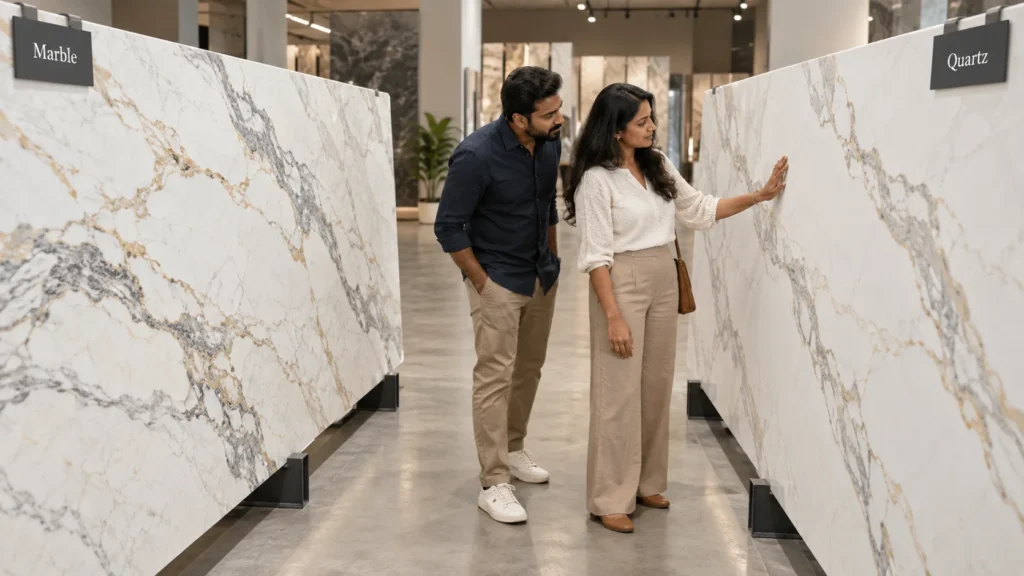
Whichever tier you choose, you get the drama of Calacatta or Carrara without worrying about the morning lime juice or last night’s rendang. Bring a sample home, but before you commit, read why you should never choose a countertop from a sample alone. Veining that looks right on a 10cm chip can look very different across a full slab.
How Do Installation and Lead Times Compare?
Both materials follow the same template, fabricate and install process in Malaysia, but marble needs a more experienced hand.
Marble is softer and more prone to cracking during cutting, so edge profiles and sink cutouts call for extra care. Not every fabricator in Malaysia works with natural marble regularly, so choose one with proven marble experience.
Quartz is more forgiving. Its resin content makes it less brittle and more predictable to cut and finish, and most established Malaysian fabricators handle it daily.
For either material, in-stock colours can typically be templated, fabricated and installed within about seven working days, while special-order slabs can take three to four weeks including shipping and customs. Installation itself is usually a single day for a standard kitchen. Our post on how long countertop installation takes in Malaysia walks through each stage.
Marble vs Quartz at a Glance
| Factor | Marble | Quartz |
|---|---|---|
| Stain resistance | Poor, porous and etches | Excellent, non-porous |
| Heat resistance | Moderate | Moderate, always use a trivet |
| Scratch resistance | Low, about 3 on Mohs | High, about 7 on Mohs |
| Maintenance | High, sealing every 1 to 2 years | Very low, soap and water |
| Hygiene | Poor once sealer wears | Excellent, NSF-51 options |
| Natural beauty | Unmatched | Convincing marble-look designs |
| Consistency | Every slab differs | Uniform across pieces |
| Price (supply and install) | Quoted per slab | RM110 to RM689 per sqft |
| Lifetime cost | Higher, ongoing sealing and repair | Lower, no upkeep cost |
| Warranty | Varies, often limited | Manufacturer-backed from reputable brands |
FAQ
Is marble or quartz better for a kitchen in Malaysia? Quartz is better for a Malaysian kitchen that cooks daily, because it is non-porous, needs no sealing and does not etch when lime, tamarind or vinegar touches it. Marble is the better choice for a dry kitchen island, a bathroom vanity or a feature wall, where its natural veining can be enjoyed without the daily assault of acidic ingredients.
Does turmeric stain quartz? No, turmeric does not stain genuine quartz permanently, because the surface is non-porous and the pigment sits on top. Wipe it with mild soap and water, and if it has dried overnight a cream cleanser lifts it. Turmeric will stain marble, and if the dish was acidic it will etch it too.
Does marble etch even if it is sealed? Yes, sealed marble still etches. Sealer slows how fast liquid soaks in, which helps with staining, but etching is a surface reaction between acid and calcium carbonate, and a sealer does not stop it. The only way to avoid etching on marble is to keep acid off it.
Can you put a hot wok on a quartz countertop? No, a hot wok should not go directly onto quartz. The resin binder can scorch or discolour above roughly 150°C, and the damage is permanent. Use a trivet or heat pad every time. Marble tolerates warm cookware a little better but can still crack from thermal shock, so the same habit applies.
How much does quartz cost compared with marble in Malaysia? Genuine quartz costs RM110 to RM689 per square foot supply and install, from Zenstone at the entry level to Caesarstone’s flagship marble-look collections at the top. Marble is priced per slab and varies with origin and grade, so ask for a written quote. Once you add sealing and restoration over the years, mid-range quartz usually costs less over the life of the kitchen.
Conclusion
Choosing between marble and quartz comes down to how you use your kitchen and what you value most. If you cook daily, handle acidic ingredients and want a surface that looks after itself, quartz is the practical choice, and you will spend your time enjoying the kitchen rather than maintaining it. If you rarely cook heavily, value natural beauty above everything and are genuinely prepared for the upkeep, marble brings a character nothing else matches. And if you want marble’s look with quartz’s behaviour, marble-look quartz from RM155 per square foot is the answer most Malaysian homeowners settle on once they have seen both up close.
Whichever way you lean, do not let common stone countertop myths cloud the decision. Visit a showroom, put your hands on a full slab of each, and pick the surface that suits how you actually live. If you would like a written quote for either material, we are happy to price your kitchen so you can compare on real numbers.