

Stone wall cladding is a thin layer of stone slab bonded over an existing wall as a decorative or protective finish. It carries no structural load, which is why a full feature wall can go up in a day or two without touching the wall behind it.
That distinction is the whole reason cladding has moved out of hotel lobbies and into ordinary Malaysian homes over the last few years. You are not building a stone wall. You are giving a plaster wall a new skin. This guide covers what the material actually is, which stones work on walls, where they belong in a Malaysian home, and what the job involves before you ring a supplier.
Key Takeaways
- Stone wall cladding is a non-structural stone layer bonded over an existing wall, not a wall built from stone.
- Sintered stone and porcelain slab dominate wall cladding in Malaysia because both are non-porous, which matters in a humid climate and in wet areas.
- Jumbo slabs up to 3,200mm x 1,600mm let a full feature wall go up with one or two joints instead of dozens of grout lines.
- Wall cladding is supplied and fitted by stone fabricators, not jubin shops, because the panels need templating, workshop cutting and suction lifters.
- Slab cost alone runs from RM1,600 to RM2,800 for Moca Compact and RM3,700 to RM11,900 for Dekton, before fabrication and installation.
What Is Stone Wall Cladding?
Stone wall cladding is the application of thin stone slabs or panels onto an existing wall surface. Unlike traditional stone construction, where the wall is built from stone, cladding bonds a layer of stone over a substrate that is already there.
Think of it as a high-end skin. The stone bears no load. It exists to change how the surface looks, feels, and holds up to moisture and daily contact.
Cladding gets applied to:
- Interior feature walls in living rooms, dining areas, and bedrooms
- Kitchen backsplashes behind the hob and counter
- Bathroom walls, full-height or as an accent panel
- Entrance foyers and corridors
- Exterior façades and garden feature walls
The result is a continuous, high-impact surface that outlasts paint or wallpaper by a wide margin in Malaysian conditions.

Why Are Malaysian Homeowners Choosing Stone Wall Cladding?
Because it changes a room dramatically without a structural renovation, and it survives our climate better than the alternatives.
Malaysia’s renovation culture has shifted. Developer-grade paint finishes no longer satisfy homeowners who plan to stay put for fifteen or twenty years. A few things make cladding land particularly well here:
It creates visual drama without knocking anything down. Adding stone to one feature wall is a surface treatment, not a rebuild. Your floor plan stays exactly as it is.
It suits a tropical climate. Wallpaper seams lift in high humidity. Paint chalks and fades on a west-facing wall that catches the Kuala Lumpur afternoon sun. Non-porous stone does neither.
It photographs well. Light raking across veined or textured stone creates depth that a flat painted wall cannot fake, which matters to homeowners who document a completed renovation.
It is versatile. Minimalist Japandi, bold contemporary, or something warmer and more traditional, there is a stone and a finish that fits.
Which Stone Materials Work Best for Wall Cladding?
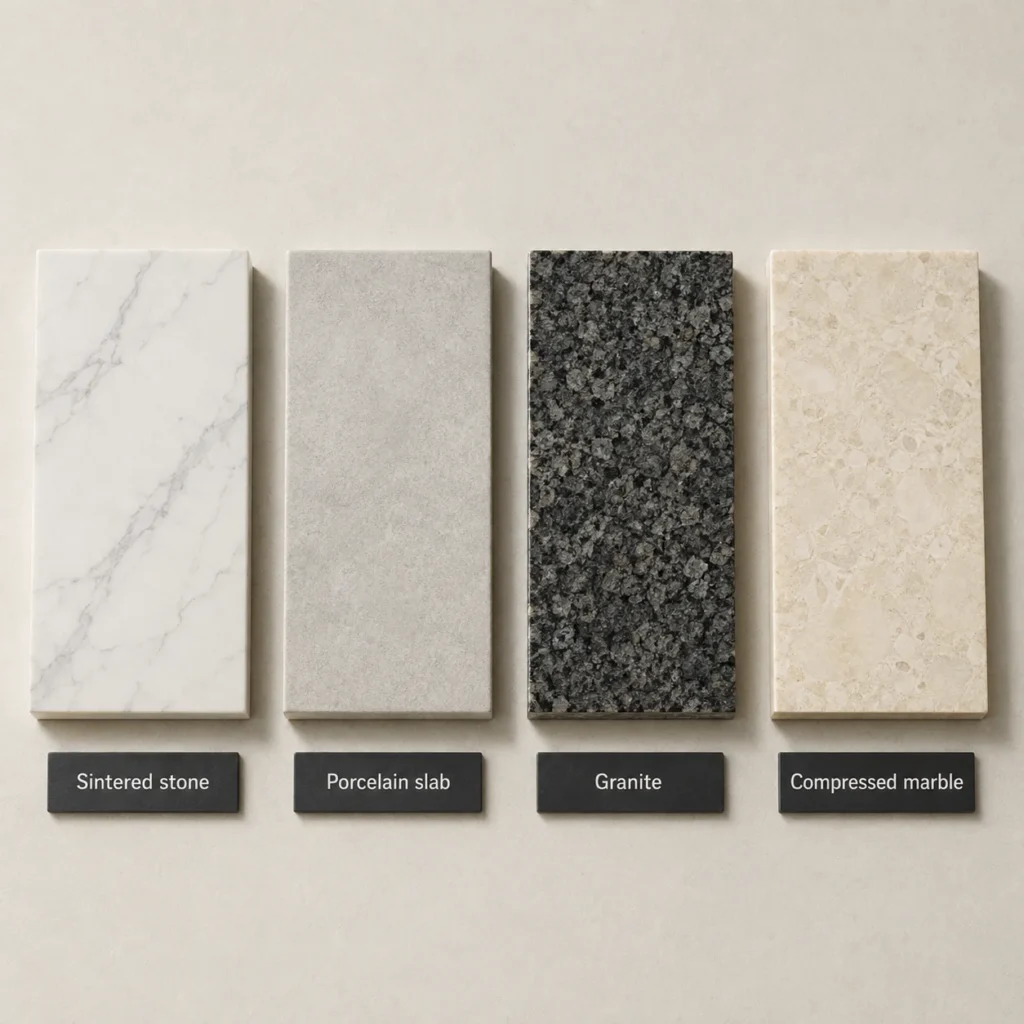
Sintered stone and porcelain slab are the two strongest performers for Malaysian walls, because both are non-porous and available in large formats. Granite and compressed marble have narrower uses.
| Material | Porosity | UV stable outdoors | Best wall use | Watch out for |
|---|---|---|---|---|
| Sintered stone | Near zero | Yes | Any wall, indoor or outdoor | No resin, so a sharp knock can crack it |
| Porcelain slab | Near zero | Yes | Feature walls, bathrooms, backsplashes | Thickness must suit wall use |
| Granite | Low, needs sealing | Yes | Exterior walls, small accent panels | Heavy, limiting in high-rise units |
| Compressed marble | Higher | No | Dry interior feature walls only | Stains and marks in humid areas |
Sintered Stone
Sintered stone is the most popular premium wall cladding material in Malaysia today. Natural mineral powders are compressed under extreme heat and pressure, replicating the geological process that forms natural stone, and the result is a dense slab in jumbo formats.
For walls, its advantages are specific:
- UV resistance so it does not fade or yellow, which makes it the default for outdoor walls
- Zero porosity so it absorbs no moisture, critical in bathrooms and on exterior walls
- Jumbo slab sizes up to 3,200mm x 1,600mm, allowing near joint-free coverage
- Wide design range, from Calacatta marble looks to raw concrete and moody darks
Moca Compact, Sinno’s house brand, and Dekton, made by Cosentino in Spain, are the two ranges used most often for cladding here. To understand how the material is manufactured and why those properties follow from the process, read our deep-dive into the science behind sintered stone. If you are weighing Dekton specifically, our guide to what Dekton is covers the brand in detail.
Porcelain Slab
Porcelain slabs are large-format panels, typically 6mm to 12mm thick, made from refined clay fired at very high temperatures. They are dense, hard, and non-porous, and they cost less than sintered stone at a similar visual scale.
The gap between a porcelain slab and a standard porcelain tile is enormous on a wall. Slabs give you a handful of joints instead of dozens of grout lines at eye level. Our guide on porcelain slab vs tiles for wall cladding works through that choice in full, including who supplies each and what it does to your renovation timeline.
Not every porcelain slab suits every job. If you are unsure whether the panel you have been quoted is porcelain or sintered stone, ask directly, because the two perform differently outdoors and under heat. Our guide on the difference between sintered stone and porcelain slab is the place to start.
Granite
Granite is familiar to Malaysian homeowners from kitchen countertops and vanities. On walls, it works best in smaller accent panels or on exterior-facing surfaces, where its natural variation and weather resistance earn their place. Weight is the limiting factor. A full-height granite interior wall is a difficult proposition in a high-rise condominium, both for handling and for what the wall can safely carry.
Compressed Marble
Compressed marble, also sold as engineered marble, turns up on bathroom and feature walls where a softer classical look is wanted. It is lighter than natural marble and more consistent in pattern. It is also more porous than sintered stone or porcelain slab, so it needs more care and is a poor choice for a wet wall in a Malaysian bathroom.
Where Can You Apply Stone Wall Cladding in Your Home?
Cladding works hardest in three places: the living room feature wall, the kitchen backsplash, and full-height bathroom walls. Everywhere else is a judgement call about visibility and budget.
Living Room Feature Walls
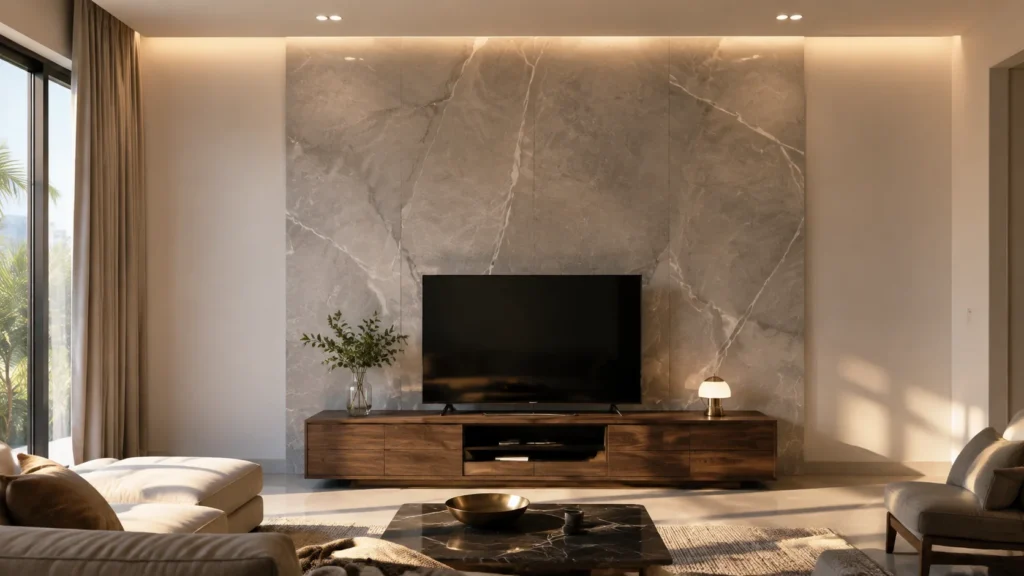
This is the most common application in Malaysian homes. One accent wall clad in stone, behind the TV console or framing a seating area, lifts the whole room.
When planning it, three things decide the result:
- Slab size and continuity. Fewer joints, more drama. Jumbo formats cover a full wall with minimal visible seams.
- Finish. Matte and textured finishes forgive direct lighting. Polished finishes look glamorous and show every fingerprint and dust mark.
- Pattern flow. Book-matched slabs, where two adjacent panels mirror each other’s veining, create a symmetrical effect that reads as one carved piece.
If you are trying to work out whether a stone feature wall justifies its cost against paint or wallpaper, our honest breakdown of sintered stone feature walls and whether they are worth the investment runs the numbers properly.
Kitchen Backsplashes
The backsplash is where cladding has gone mainstream in Malaysian renovations, and it is the most practical of the lot.
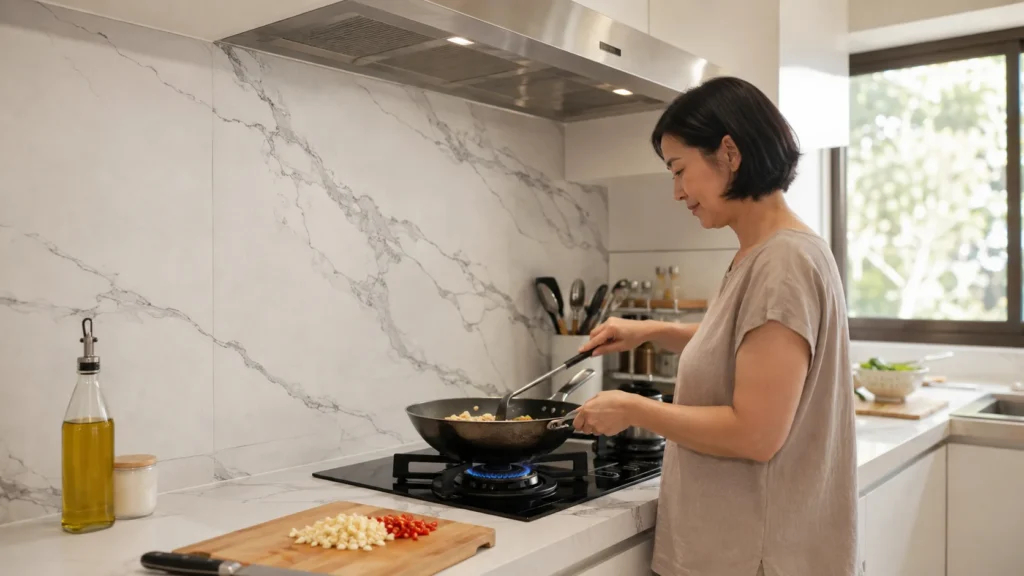
Malaysian kitchens take punishment: high-heat wok cooking, constant splashing, and the oil that comes with frying belacan or preparing curry. A stone backsplash wipes clean in seconds. A tiled one traps that oil in grout lines that darken within a few years no matter how diligently you scrub. If you are still deciding whether you need one at all, our guide on whether you actually need a kitchen backsplash is worth reading first.
The most popular approach is to match the backsplash to the countertop. Rather than introducing a second material, homeowners run the same stone from the bench up the wall. Marble-veined patterns suit this best. A Calacatta or Carrara-inspired stone carries its veining across both surfaces, so the countertop and the wall look cut from one slab. Pulling it off convincingly comes down to matching the veining direction and tone across the joint, which is a conversation to have with your fabricator at templating, not after installation.
Bathroom Walls
Full-height cladding from floor to ceiling is the single most transformative choice available in a bathroom, and the non-porosity of sintered stone and porcelain slab makes them genuinely suited to a wet area rather than merely decorative there.
Grout is the reason. In a Malaysian bathroom with poor ventilation, and that describes most condominium units in Kuala Lumpur and Petaling Jaya, grout lines grow mould faster than you can clean them. Slab panels joined with silicone at the edges remove almost all of that surface. Many homeowners extend the same material to the vanity top for one continuous material story.
Entrance Foyers and Corridors
The foyer wall is the first thing a guest sees, which makes it a high-return spot for a small area of stone. Lighter, subtler patterns open up a narrow corridor. Bold, dramatic stones suit a wider foyer where there is room to stand back and look at them.
Outdoor and Exterior Walls
For landed property owners, cladding a garden perimeter wall, the façade beside the gate, or the porch columns adds real kerb appeal. Sintered stone is the material of choice outdoors because it holds its colour under direct sun and shrugs off heavy rain. The same indoor-versus-outdoor logic that governs stone flooring applies to walls: not every slab in a supplier’s range is rated for exterior use, so ask before you commit to a colour.
How Do You Choose the Right Stone for Your Walls?
Start with the environment the wall lives in, then narrow by finish. Taste comes third, once the shortlist is already safe.
Match the Material to the Environment
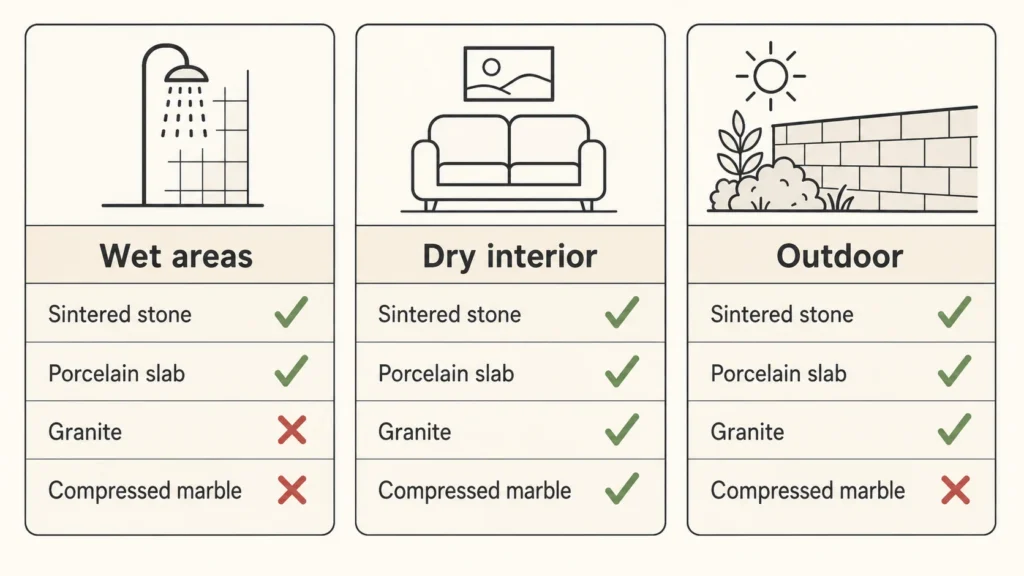
For wet areas, meaning bathrooms and outdoor walls, choose zero-porosity materials only: sintered stone or porcelain slab. Skip compressed marble and anything that needs regular sealing, because sealing intervals are impossible to keep up with in this humidity.
For dry interior walls, meaning living rooms, bedrooms, and corridors, the field opens up. Sintered stone, porcelain slab, and compressed marble all work.
For kitchen backsplashes, sintered stone and porcelain slab are the strongest performers given the heat, oil, and steam involved.
Consider Your Finish
Finish changes how a wall behaves day to day as much as how it looks:
- Polished or gloss is high-shine and reflective. It suits bathrooms and feature walls where drama is the point, and it shows dust and fingerprints.
- Matte or honed is flat and non-reflective. Contemporary, and far more forgiving of everyday marks.
- Textured or leather adds tactile depth. Well suited to feature walls and outdoor applications.
- Concrete look pairs with exposed beams and neutral palettes in modern Malaysian interiors.
Our complete stone finish guide compares all four in detail if you are torn between them.
Think About Continuity
Cladding a wall and the adjacent floor in the same material creates a transition that makes a space read as larger. This technique, linear matching, works especially well in bathrooms and open-plan living areas. Our guide on choosing linear match porcelain slab for your home flooring explains how the pattern is planned across panels, and the same principles apply on a wall.
Plan Around Malaysia’s Climate
Year-round heat and humidity narrow the sensible choices:
- Avoid anything needing frequent sealing in outdoor or bathroom applications.
- Prioritise UV-stable materials outdoors. Sintered stone keeps its colour and does not chalk under direct sun.
- Account for temperature swings. The gap between an air-conditioned room and outdoor heat works on natural stone over time, which is another reason engineered materials perform more consistently here.
Who Installs Stone Wall Cladding, and How?
Stone wall cladding is supplied and installed by stone fabricators, not by jubin shops or general tilers. The panels need templating, workshop cutting, and suction lifters, which is the same equipment and crew used for countertops.
This surprises homeowners who assume wall work means calling a tiler. A full panel measuring 3,200mm x 1,600mm can weigh well over 80kg. Handling that safely on a vertical surface takes suction cup lifts, a rated adhesive system, and installers who have done it before. Ask to see photos of previous wall projects specifically, not just countertop work.
The bonding method matters more than most homeowners expect, and it changes both the price and how the wall holds up:
- Dry-fix systems, such as point cladding, leave the back of the slab hollow. Faster to install and easier on an uneven wall, but the unsupported panel is more prone to cracking under impact.
- Full cement adhesive bonding supports the slab across its entire back face, which reduces the chance of a crack considerably. It costs more, and it requires the underlying wall to be flattened first if it is not already true.
Sintered stone contains no resin, so despite being extremely hard it is not naturally impact resistant. That is precisely why the bonding method deserves a direct question at quotation stage rather than a shrug.
One more thing worth checking early: substrate condition. A weak, damp, or uneven wall will not hold a large panel over time, whatever adhesive is used. In older high-rise buildings, management committees sometimes have their own requirements around fixings on internal walls, so it is worth asking before material is ordered.

How Much Does Stone Wall Cladding Cost in Malaysia?
Wall cladding is quoted differently from countertops. Instead of one supply-and-install rate per square foot, you pay for the slab, then fabrication, then installation as three separate line items.
Slab pricing gives you the starting point:
| Range | Slab size | Price per slab |
|---|---|---|
| Moca Compact, Regular | 3,200 x 1,600mm | RM1,600 |
| Moca Compact, Jumbo | 3,200 x 1,800mm | RM1,800 |
| Moca Compact, Leathered | 3,200 x 1,600mm | RM2,000 |
| Moca Compact, Homogeneous | 3,200 x 1,600mm | RM2,800 |
| Dekton, Group 0 | 3,270 x 1,470mm | RM3,700 |
| Dekton, Group 2 | 3,270 x 1,470mm | RM6,200 |
| Dekton, Group 5 | 3,360 x 1,670mm | up to RM11,900 |
Three things then drive the final figure:
Material tier matters more than brand loyalty. Moca Compact is the accessible entry point to quality sintered stone cladding. Dekton sits at the premium end, with a broader design portfolio and internationally certified performance.
Installation method affects cost. Full cement bonding costs more than a dry-fix system, and larger formats cost more to handle even though they leave fewer joints.
Wall area and access drive the budget. A compact bathroom panel and a full-height living room wall are different projects. So are two identical walls where one building has a service lift and the other does not.
All prices above are for 12mm slabs and are for reference. For a worked example that adds fabrication and installation on top of the slab and lands on a total for a typical 100 square foot feature wall, see our breakdown of sintered stone feature wall costs.
How Do You Care for Stone Wall Cladding in Malaysia?
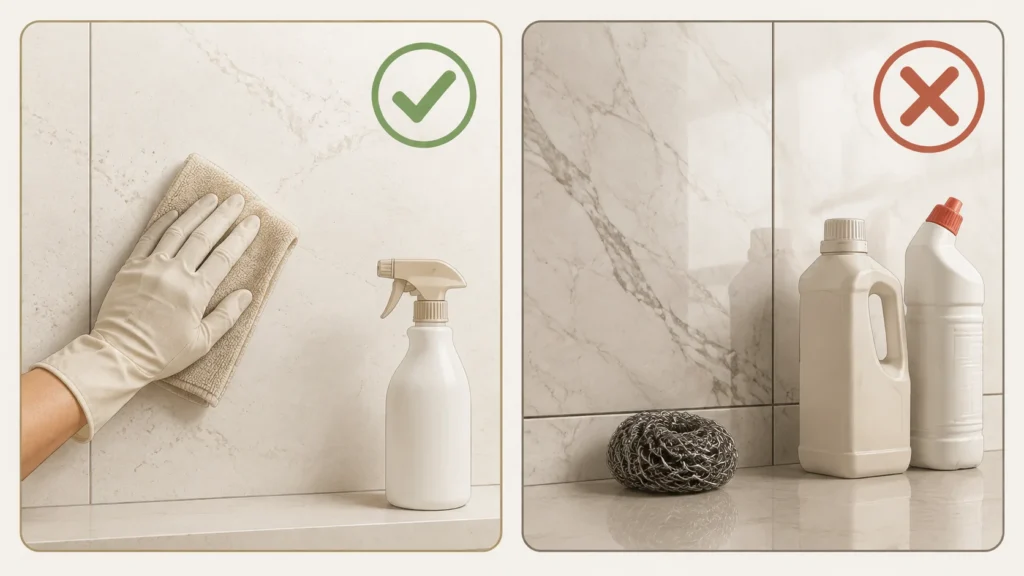
Wipe it with a damp cloth and a pH-neutral cleaner. That is genuinely the whole routine for sintered stone and porcelain slab, and it is the main reason both outperform paint and wallpaper over a decade.
Day to day:
- Wipe down with a damp cloth or a pH-neutral cleaning solution.
- Skip abrasive scrubbers on polished surfaces.
- On a kitchen backsplash, clean cooking oil promptly so it does not build up around the edges and joints.
In bathrooms:
- A quick squeegee or dry cloth after showering stops water spots forming on polished panels.
- If there are any grout lines, clean them regularly. Mould is the standing risk in our climate.
What to avoid:
- Harsh acidic or alkaline cleaners on polished stone.
- Pressure washing on interior cladding.
- Standing water pooling at the floor junction at the base of the wall.
Sintered stone’s zero porosity means it never needs sealing, which is a real advantage over natural marble or granite in Malaysian humidity.
FAQ
Is stone wall cladding the same as tiling? No. Tiling uses many small modular pieces separated by grout, while stone wall cladding uses a few large slabs joined with fine silicone lines. Tiles come from jubin shops and go up by a general tiler. Cladding slabs come from stone fabricators and need templating, workshop cutting, and a specialist crew.
Can stone wall cladding be installed over existing tiles? Often yes, provided the existing tiles are sound, well bonded, and reasonably flat. Any drummy or hollow-sounding tiles must come off first, because a large panel bonded over a loose tile inherits that weakness. Your fabricator should check the substrate before quoting rather than after.
How thick should stone wall cladding be? For wall applications, 6mm to 12mm is the usual range. Thinner panels are lighter and easier to lift into place, thicker panels carry more weight but tolerate minor irregularities better. Slabs made for flooring are heavier than a wall needs, and the extra load falls on the adhesive.
Does stone wall cladding work in a Malaysian bathroom? Yes, and it is one of the better applications for it. Sintered stone and porcelain slab are non-porous, so moisture has nowhere to penetrate, and removing most of the grout removes most of the mould problem in a poorly ventilated bathroom.
How long does a stone wall cladding job take? Expect roughly one to three weeks from templating to installation, depending on material availability and your fabricator’s schedule. The installation itself is usually a day or two per wall. The lead time sits in the fabrication, not the fitting.
Conclusion
Stone wall cladding has earned its spot in the Malaysian renovation toolkit, not as a show-home luxury but as a durable answer to walls that have to cope with humidity, hard afternoon sun, and years of wok cooking. The material choice follows the environment, the finish follows how you live, and the installation method decides whether the wall still looks right in year ten.
Get those three right and the wall stops asking anything of you. If you are weighing a feature wall, a backsplash, or a full-height bathroom, talk to a stone specialist who can assess your wall dimensions and substrate before quoting, so the number you get is one you can actually build to.