

Dekton is a sintered stone surface made in Spain by Cosentino, produced by firing a blend of mineral powders at over 1,200°C until the particles fuse into one solid, non-porous slab. It is the brand most Malaysian interior designers reach for when a project needs stone that works outdoors as well as it does indoors.
That last point is the whole reason Dekton exists in a market already full of sintered stone. Plenty of surfaces survive a wok. Very few survive a wok and a Malaysian afternoon on an open patio. This guide covers what Dekton actually is, how it performs, what Sinno charges for it in 2026, and where it stops making sense.
Key Takeaways
- Dekton is Cosentino’s sintered stone brand from Spain, fired above 1,200°C so it contains no resin and no pores.
- It is UV stable, which makes it one of the few countertop materials genuinely suited to Malaysian outdoor kitchens, patios and pool surrounds.
- Supply and install through Sinno runs from RM248/sqft (Group 0) to RM469/sqft (Group 4 and 5), against RM110 to RM150/sqft for Moca Compact.
- A typical 40sqft Malaysian kitchen in Group 2 Dekton comes to roughly RM14,040 fully installed.
- If your project is entirely indoors, a house-brand sintered stone delivers most of the same performance for less than half the price.
What Exactly Is Dekton?
Dekton is an ultra-compact sintered stone surface manufactured by Cosentino, a Spanish company that has been in the stone industry for over 40 years. It launched in 2013 and has since become the reference brand for sintered stone worldwide.
The difference between Dekton and quartz stone comes down to what holds the slab together. Quartz is roughly 90% natural quartz chips bound with polyester resin. Dekton has no resin at all. It is a blend of quartz, glass and porcelain raw materials compacted and fired until the minerals themselves fuse. Nothing in the slab can melt, yellow or soften, because there is no plastic in it to begin with.
If you want the full picture on the material category rather than the brand, our guide to sintered stone explained for Malaysian homes covers the features and drawbacks in detail.
How Is Dekton Made?
Dekton is produced using Cosentino’s Exclusive Particle Sintering process, which compresses and fires raw mineral powder in four stages:
- Raw material selection. Quartz particles, glass and porcelain powder are blended to a set ratio.
- High-pressure compaction. The dry mixture is pressed into a dense, uniform slab form.
- Sintering. The compacted slab is fired above 1,200°C, fusing the particles into a single solid mass.
- Finishing. Slabs are calibrated and finished matte, velvet or polished.
What this does in practice is compress a geological process into a few hours. The same heat and pressure that form natural stone over millions of years, applied in a factory in Almería. The result has effectively zero porosity, which is why Dekton never needs sealing.
Our article on the science behind sintered stone goes deeper into what happens inside the kiln.

What Makes Dekton Different from Other Sintered Stones?
All sintered stone is made the same broad way, so the differences between brands come down to slab size, finish range and certification. Here is where Dekton separates itself in the Malaysian market:
- Certified for outdoor use. This is the real differentiator. Dekton is tested and warranted for exterior application, so it will not fade, chalk or degrade in year-round tropical sun.
- Large slab formats. Standard Dekton slabs run around 3,200mm x 1,400mm, and several Group 3 and Group 4 designs go larger again at up to 3,360mm x 1,670mm. Fewer joints on a long island run.
- Polished finishes that hold up. Cosentino’s polished range gives you a genuinely reflective surface without the fragility that makes gloss porcelain slabs so awkward to fabricate.
- A design library with depth. Concrete, marble, stone, timber and abstract patterns spread across six pricing groups, so the look you want is not locked behind the top tier.
- Book-match and dark-match options. Group 5 designs such as Awake and Lucid come as matched pairs, so a large feature wall or island can be mirrored across the joint.
One honest note on thickness. Dekton is produced globally in several thicknesses, but what Sinno supplies in Malaysia is 12mm, with Moone also available in 20mm at RM272/sqft. If a supplier is quoting you 4mm Dekton for a countertop, ask what it is actually for, because that format belongs on a wall.
What Are Dekton’s Key Properties?
Heat Resistance
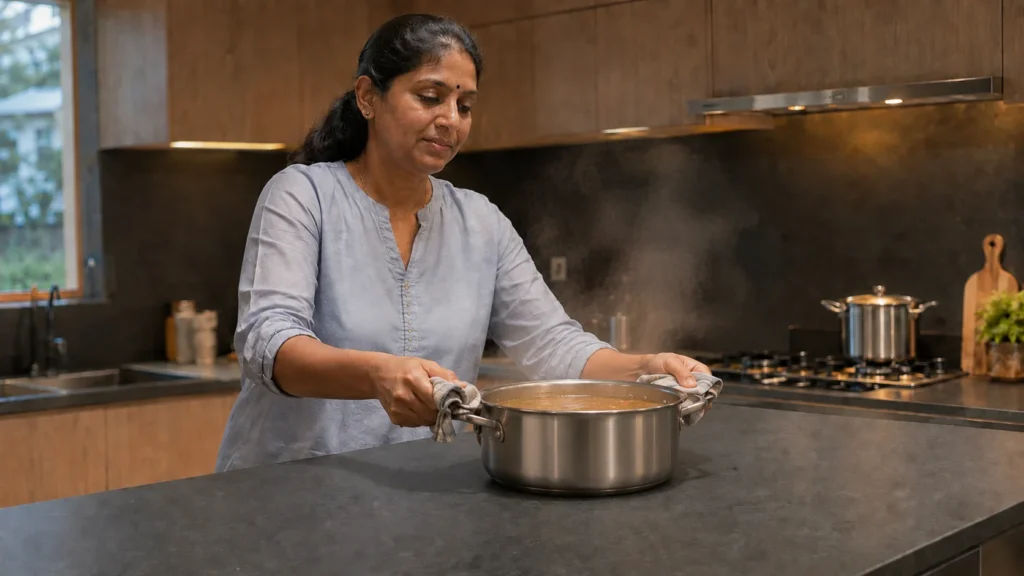
Dekton handles a wok straight off the flame. A wok pushed hard for char kuey teow runs at 250 to 300°C, and sintered stone sits comfortably above that because it was manufactured at more than four times the temperature. There is no resin in the slab to scorch or yellow, which is the exact failure mode that catches people out with quartz.
That does not make it indestructible, and thermal shock on a chilled slab is still worth avoiding. Our full breakdown on putting a hot pan on a sintered stone countertop covers where the real limits sit.
UV Stability
Malaysian sun is relentless, and most countertop materials were never designed for it. Quartz yellows under prolonged direct UV. Compressed marble fades. Dekton does not, because the pigment is fired into the mineral body rather than suspended in resin.
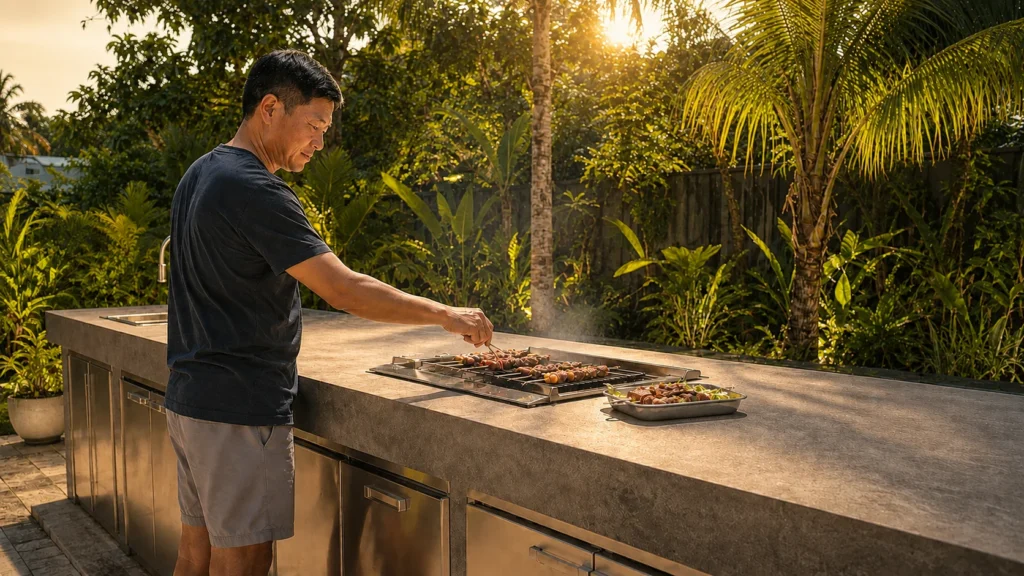
This is the single reason to specify Dekton over a cheaper sintered stone. If the surface will sit on a patio, in an alfresco kitchen, around a pool, or on a wall that catches direct afternoon sun through full-height glazing, UV stability stops being a nice-to-have.
Zero Porosity
Dekton absorbs nothing. No water, no oil, no pigment, no bacteria. In a Malaysian kitchen where turmeric, sambal and dark soy sauce are in daily rotation, that matters more than any specification on the datasheet. There is no sealing on installation, no annual re-sealing, and no impregnator to buy.
Scratch Resistance
Sintered stone sits at Mohs 8, harder than engineered quartz at 7 and well above granite at 6 to 7. Your knives will not mark it. You can technically cut directly on the surface, though we still recommend a chopping board, mostly because the countertop will win and your knife edge will lose.
Low Maintenance
Warm water and a mild dish soap. That is the entire care routine. No specialist stone cleaner, no sealer, no polish. For stubborn marks, a cream cleaner on a soft cloth clears them without any risk to the surface.
Where Can You Use Dekton in a Malaysian Home?
Dekton’s range of application is wider than quartz, which is restricted to interior use. Here is where it earns its place.
Kitchen Countertops
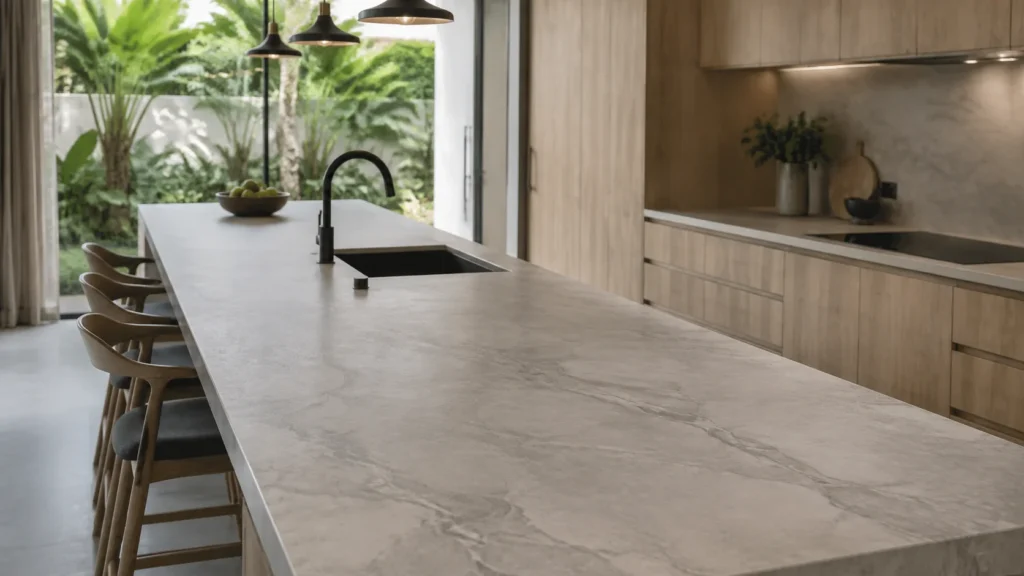
The most common use by far. Heat resistance, stain resistance and a hygienic non-porous surface line up neatly with how Malaysians actually cook, and the large slab format lets most island tops be fabricated with no visible seam at all.
Bathroom Vanity Tops
Complete water resistance and zero upkeep make Dekton an easy specification for vanity tops. The design range runs from soft whites and warm beiges through to heavily veined blacks, so it works in a minimalist bathroom and a more classical one equally well.
Outdoor Kitchens and Alfresco Areas
This is Dekton’s home ground. Outdoor kitchen counters, wet bars, garden dining tops and pool surrounds all sit in full sun and heavy rain, and very few surfaces handle that combination without visible change over a few years.
Wall Cladding
Large-format Dekton panels create feature walls and full-height backsplashes with one or two joints rather than dozens of grout lines. Our guide to stone wall cladding for Malaysian homes explains how the installation works and what the fabricator needs from the wall.
Flooring
Dekton is specified for flooring in high-traffic residential and commercial spaces where surface hardness matters. There are real installation requirements involved, which we cover in sintered stone flooring in Malaysia.
How Much Does Dekton Cost in Malaysia?
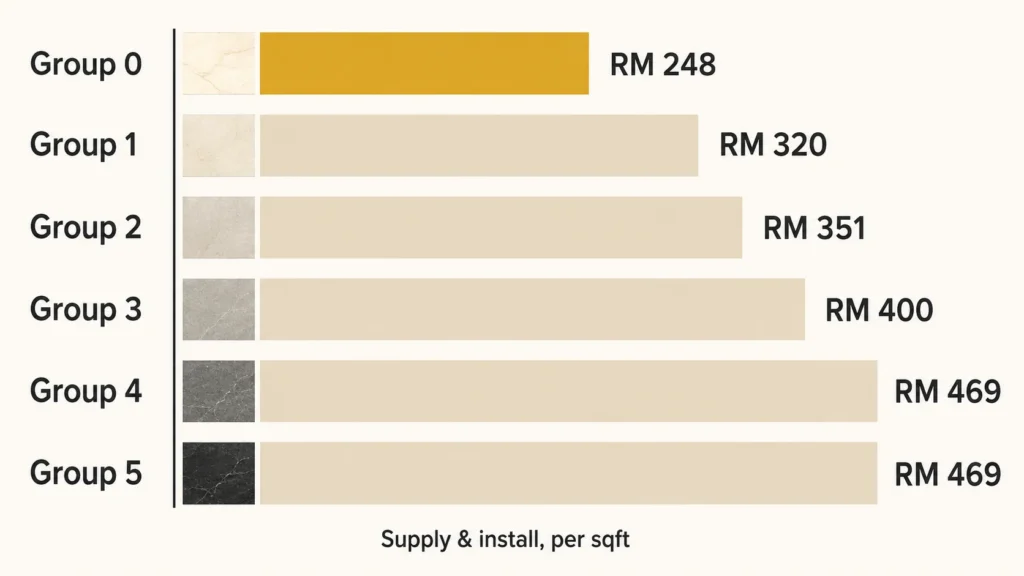
Dekton is priced in six groups, from Group 0 up to Group 5. These are Sinno’s 2026 supply and install rates per square foot, which cover the slab, templating, cutting, edge profiling and installation.
| Group | Supply & install (per sqft) | Finish | Example designs |
|---|---|---|---|
| Group 0 | RM 248 | Matte | Aeris, Danae, Eter, Moone |
| Group 1 | RM 320 | Matte | Kreta, Nacre, Sirius25 |
| Group 2 | RM 351 | Matte | Adia, Argentium, Aura22, Kelya, Marina, Trevi, Zenith |
| Group 3 | RM 400 | Matte, some polished | Entzo 22, Laurent, Morpheus, Nara, Neural, Somnia, Uyuni |
| Group 4 | RM 469 | Polished | Arga, Awake, Bergen, Helena22, Khalo, Lucid, Trance |
| Group 5 | RM 469 | Polished, book-match | Awake BM, Lucid BM, Trance DM |
Two things worth knowing about this table. Group 5 carries the same installed rate as Group 4 because the fabrication work is identical, but the slab itself costs more, since book-matched pairs have to be bought and cut together. And Moone in 20mm sits slightly above its Group 0 rate at RM272/sqft.
To make the numbers concrete, a typical Malaysian kitchen with around 40 square feet of countertop works out roughly as follows:
| Design | Group | 40sqft installed |
|---|---|---|
| Moone | Group 0 | RM 9,920 |
| Trevi | Group 2 | RM 14,040 |
| Bergen | Group 4 | RM 18,760 |
If you are buying slabs rather than a fabricated countertop, retail slab prices run from RM3,700 for a Group 0 slab of about 51sqft up to RM11,900 for a Group 5 book-matched slab.
For context against every other material on the market, our 2026 stone countertop price guide for Malaysia puts these figures beside quartz, granite and the house brands.
Dekton or Moca Compact: Is the Premium Worth It?
This is the comparison most homeowners actually face, so here it is plainly.
| Dekton | Moca Compact | |
|---|---|---|
| Origin | Spain (Cosentino) | China, supplied under Sinno’s house brand |
| Supply & install | RM 248 to RM 469/sqft | RM 110 to RM 150/sqft |
| Slab size | Up to 3,360 x 1,670mm | Up to 3,200 x 1,800mm |
| Certified for outdoor use | Yes | Indoor applications |
| Finishes | Matte, velvet, polished | Matte, gloss |
| Warranty | Manufacturer warranty | Supplier warranty |
Read that table honestly and the answer sorts itself. For an indoor kitchen countertop, Moca Compact gives you the same non-porous, heat-resistant, resin-free surface for roughly a third of the price, and in a wider gloss range. Dekton earns its premium when the surface goes outdoors, when you want a certified international brand behind a high-value project, or when you need a book-matched feature that only Cosentino’s library offers.
Still weighing sintered stone against quartz more broadly? Our honest guide to whether sintered stone is better than quartz works through that decision.

Is Dekton Right for Your Home?
Dekton makes sense if:
- You are building an outdoor kitchen, alfresco dining area or pool surround.
- You want a surface with zero maintenance, no sealing and no specialist cleaning, for the next 15 to 20 years.
- You cook hard, with high-heat wok work as a weekly habit rather than an occasional event.
- You want a long island or feature wall with no visible seam.
- You want an international manufacturer warranty on a premium renovation.
Dekton is the wrong call if:
- Budget is the deciding factor. At RM248/sqft minimum, Dekton starts above where most Malaysian kitchen countertop budgets land.
- The project is entirely indoors. You are paying for UV certification you will never use.
- You want a gloss finish on a tight budget, which the house brands cover far more cheaply.
Before committing to any sintered stone, it is worth reading the disadvantages of sintered stone so you go in with both sides of the picture. Impact chipping at edges and cutouts is real, and it applies to Dekton as much as to any other brand.

FAQ
How much is Dekton per square foot in Malaysia? Dekton runs from RM248/sqft to RM469/sqft supply and installed, depending on which of the six pricing groups the design sits in. Group 0 designs such as Aeris and Moone sit at RM248, Group 2 designs such as Trevi and Argentium at RM351, and the polished Group 4 and Group 5 designs at RM469.
Is Dekton better than quartz? For heat, UV and outdoor use, yes. Dekton contains no resin, so it will not scorch under a hot wok or yellow in direct sun, while quartz can do both. Quartz remains the better value for an indoor kitchen where neither of those conditions applies, and it is more forgiving to fabricate.
Can Dekton be used outdoors in Malaysia? Yes, and it is one of the very few countertop materials that can. Dekton is tested and certified for exterior application, so year-round tropical sun, humidity and heavy rain will not fade or degrade it. Quartz, compressed marble and most solid surfaces should stay indoors.
Does Dekton need sealing? No. Dekton has effectively zero porosity, so there is nothing for a sealer to penetrate. No sealing on installation, no annual re-sealing, no impregnator.
Can Dekton chip? Yes. Like all sintered stone, Dekton is hard but not impact-proof, and the vulnerable points are unsupported edges and the corners of sink and hob cutouts. A dropped pot landing on an edge can take a chip out. This is a fabrication and handling issue more than a material flaw, which is why the install matters as much as the slab.
What is the difference between Dekton and Moca Compact? Both are sintered stone, so the material science is the same. Dekton is Cosentino’s Spanish brand, certified for outdoor use, priced at RM248 to RM469/sqft installed. Moca Compact is Sinno’s house brand from China at RM110 to RM150/sqft, suited to indoor applications.
Conclusion
Dekton is a genuinely excellent surface, and for most Malaysian kitchens it is also more surface than the job needs. That is not a criticism of the product. It is what happens when a material engineered for exterior architectural use gets specified for an indoor countertop that will never see the sun.
Where Dekton has no real competitor is outdoors. An alfresco kitchen, a pool bar, a patio dining top, a west-facing feature wall behind full-height glazing. In those places the UV certification is doing actual work, and RM248 to RM469 per square foot buys something no cheaper slab can match.
If you are weighing Dekton against a house-brand sintered stone for your renovation, tell us where the surface is going and we will give you both quotes side by side, so you can see exactly what the premium is buying.