

Same stone, same stain resistance. Here’s how honed and polished quartz differ in a Malaysian kitchen.
Honed and polished quartz are the same material with the same stain resistance, so the choice comes down to three things: whether you would rather hide fingerprints or wipe spills with less effort, whether the colour you want is actually stocked in a honed finish in Malaysia, and which brand you are buying.
That last point is where the money sits. Homeowners are often told that honed quartz stains faster and needs sealing. Neither is true. Cost is the one claim with something behind it, and even then it depends on the brand: Silestone charges around 10% more for a honed finish, whilst Caesarstone prices honed and polished the same.
Key Takeaways
- Honed and polished quartz have identical stain resistance. Both are non-porous engineered stone, and neither one needs sealing.
- Honed hides fingerprints and water marks far better. Polished wipes clean with less scrubbing.
- The honed premium depends on the brand. Silestone honed costs about 10% more than polished in the same group; Caesarstone honed sits at RM427 per sqft, the same as polished stone in that collection.
- Roughly 95% of quartz slabs brought into Malaysia are polished, so honed means fewer colours and longer lead times. Moonstone Quartz is the exception, stocking honed and leather more deeply than polished.
- Use one finish across your wet and dry kitchens. Mixing them forces a second slab and adds cost for a difference guests will not notice.
What is the difference between honed and polished quartz?
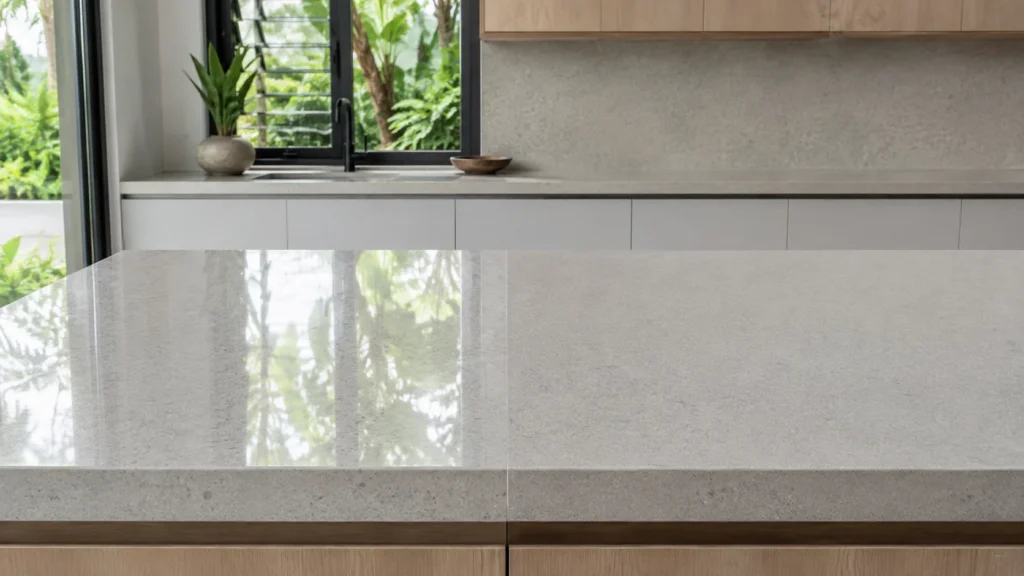
The difference is the last step of manufacturing, not the stone itself. Polished quartz is buffed to a high sheen; honed quartz stops short of that buffing and stays matte. Both slabs can come off the same production line, in the same colour, with the same quartz content and the same resin binder.
Think of it like satin versus gloss paint on the same wall. The paint is identical. Only the way light bounces off it changes.
Polished quartz
Polished quartz has a glossy, reflective surface. Colours read deeper, veining looks sharper, and the counter throws light back into the room instead of absorbing it. This is the default finish in Malaysian showrooms and the one most homeowners picture when they say “quartz”.
That reflectivity is the single reason homeowners give us most often for choosing polished: it makes the kitchen feel bigger. In a compact condominium kitchen or a narrow terrace house galley with one window, a reflective counter bounces light onto the ceiling and cabinet fronts, and the space reads more open than it measures. Whether that is worth the daily wiping is a personal call, but it is a real effect and it explains a lot about what sells here.
Honed quartz
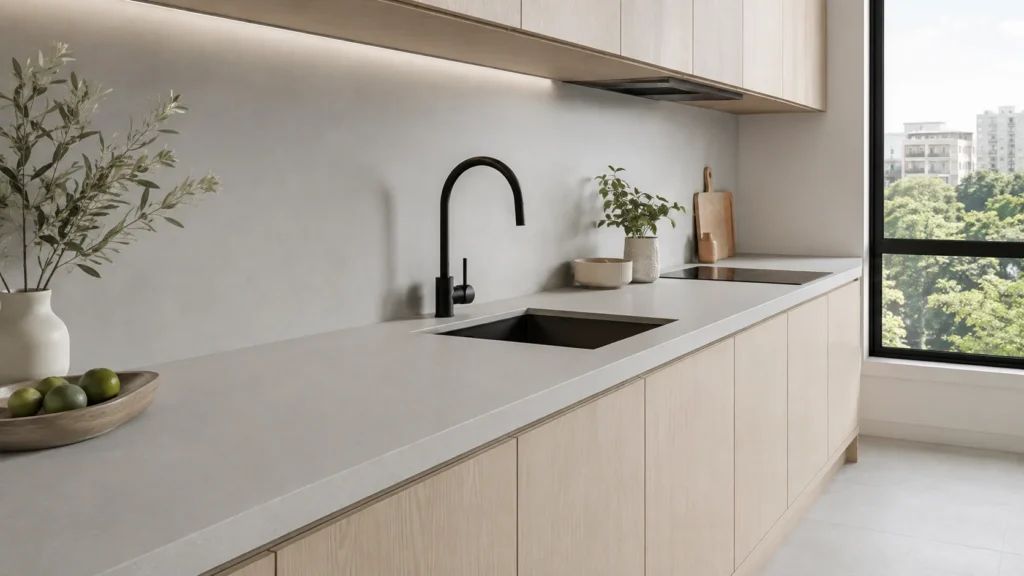
Honed quartz has a matte, non-reflective surface that still feels perfectly smooth under your palm. There is no texture and no grip, just less shine. Colours look softer and veining reads quieter, which is why honed suits minimalist, Scandinavian and Japandi kitchens that are trending in Malaysian condominium renovations.
Leather quartz
Leather finish sits outside this comparison but is worth knowing about. Diamond-tipped brushes open the surface slightly during manufacturing, leaving a gently pebbled texture you can feel. It hides marks better than either honed or polished, needs a soft cloth rather than a scourer, and is rare enough in Malaysia that you should confirm stock before designing around it. Our complete stone finish guide covers leather, gloss and textured surfaces across quartz, sintered stone and porcelain.
| Polished | Honed | Leather | |
|---|---|---|---|
| Look | Glossy, reflective | Matte, soft | Low sheen, tactile |
| Feel | Smooth | Smooth | Lightly textured |
| Hides fingerprints | Poorly | Well | Best |
| Cleaning effort | Lowest | Slightly more | Most |
| Availability in Malaysia | Wide | Limited | Rare, special order |
Does honed quartz stain more easily than polished?
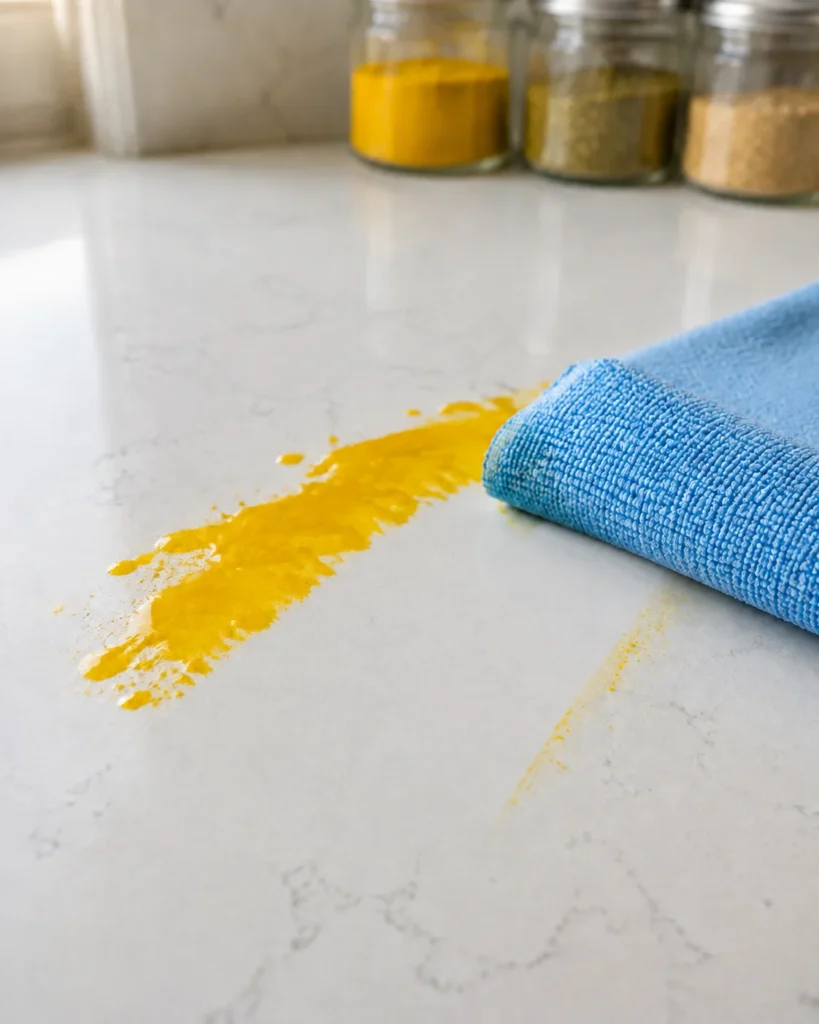
No. Honed and polished quartz have the same porosity, so turmeric, curry, kicap and belacan cannot soak into one faster than the other. This is the single most common misconception we hear in the showroom, and it costs homeowners the finish they actually wanted.
What differs is visibility and scrubbing effort. A dried sambal splash sits on top of both surfaces. On polished quartz, the smooth glossy surface releases it with one wipe. On honed quartz, the matte surface can hold onto pigment slightly longer, so you may need a second pass with a soft cloth or a paste of bicarbonate of soda and water.
The cleanup window is the same for both. You do not need to rush to a honed counter faster than a polished one. Clean spills within the day and neither finish will hold a mark. For the full method, including which products damage quartz, see our guide on how to clean a quartz countertop the right way.
Do either of them need sealing?
Neither finish needs sealing. Quartz is bound with resin, which makes it non-porous regardless of how the surface is finished. Any supplier recommending a sealer for quartz is selling you something you do not need. We explain the difference between sealers and impregnators, and where they genuinely apply, in this guide on impregnators.
Which finish handles a Malaysian kitchen better day to day?
Polished wins on cleaning effort. Honed wins on how the counter looks between cleans. Which matters more depends on how often you cook and how much you notice smudges.
Fingerprints and water marks. Honed is the clear winner. On polished quartz, especially in black or charcoal, every fingerprint and dried water droplet shows. In a humid Malaysian kitchen where surfaces stay damp longer and the counter gets touched constantly during cooking, that means wiping several times a day to keep it looking clean.
Oil and grease. Polished has the edge here. Wok cooking throws a fine film of oil across everything within a metre of the stove, and that film is more visible on a light honed surface than a light polished one. Dark honed colours handle it better than pale ones.
Grip when wet. Honed gives you more purchase for rolling dough or kneading. Polished quartz turns slippery once wet, which is a minor annoyance rather than a real problem.
Scratch resistance. Identical. The finish does not change quartz hardness. Scratches show more on polished surfaces because the gloss breaks visibly, whilst a matte surface disguises fine abrasions.
Heat resistance. Identical, and limited for both. Quartz resin scorches, so use a trivet for anything straight off the burner regardless of finish. Our guide on putting hot pans on a quartz kitchen top explains what actually causes the damage.
Does a honed finish cost more in Malaysia?
It depends on the brand. Silestone charges roughly 10% more for a honed finish than for polished in the same group. Caesarstone does not, pricing its honed colours the same as polished stone in the same collection. There is no single industry rule here, which is exactly why you should ask before assuming.
Starting with Silestone, where the premium applies. Silestone prices by group, so find your group’s polished rate and add about 10%:
| Silestone group | Polished per sqft | Honed per sqft (approx.) |
|---|---|---|
| Group 1 | RM 282 | RM 310 |
| Group 2 | RM 318 | RM 350 |
| Group 3 | RM 343 | RM 377 |
| Group 4 | RM 448 | RM 493 |
| Group 5 | RM 484 | RM 532 |
| Group 6 | RM 571 | RM 628 |
| Group 7 | RM 634 | RM 697 |
On a typical 30 sqft kitchen counter run in Group 2, that 10% works out to around RM960 extra. Worth knowing before you fall in love with a matte sample, though not usually enough on its own to change the decision.
Caesarstone works differently. Its honed colours carry no finish premium:
| Brand | Colour | Finish | Supply & install per sqft |
|---|---|---|---|
| Caesarstone | Dreamy Carrara | Honed | RM 427 |
| Caesarstone | Darcrest | Honed | RM 427 |
| Caesarstone | Piatra Grey | Polished | RM 427 |
| Moonstone | Cotton Cloud | Polished | RM 182 |
| Moonstone | Calacatta Breeze | Leather | RM 226 |
Moonstone looks like it charges a texture premium, with leather at RM226 against polished Cotton Cloud at RM182. It does not. Moonstone’s polished Perla Cloud is also RM226, so that RM44 gap is a collection difference rather than a finish premium.
Finish hits your budget a second way, indirectly. Honed options in Malaysia cluster in the premium brands, so if you are shopping Zenstone at RM110 to RM160 per sqft, you will be looking at polished only. For the full brand-by-brand breakdown, see our quartz stone price guide for Malaysia.
Can you actually buy honed quartz in Malaysia?
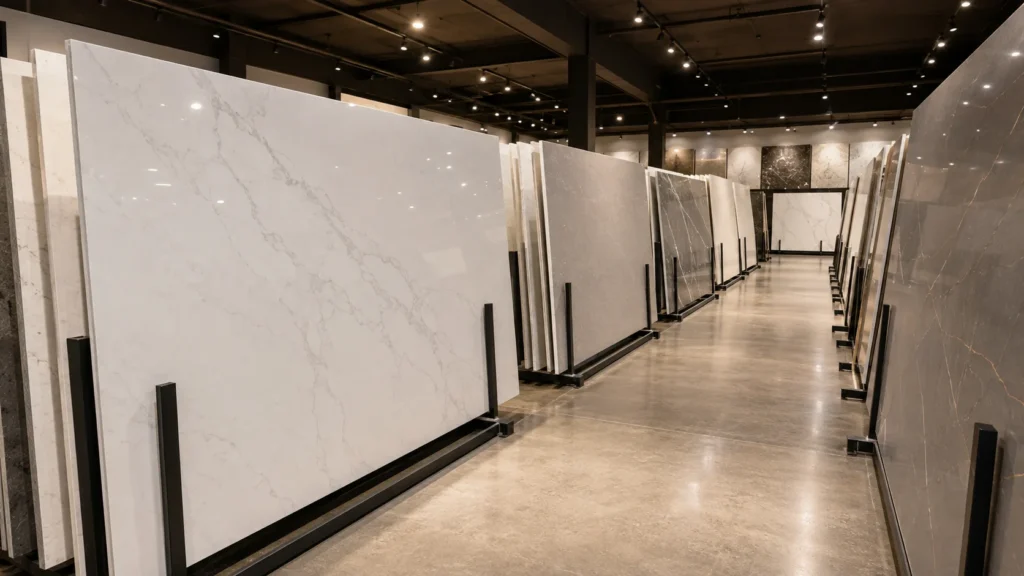
Yes, but your colour choice narrows sharply and you should confirm stock before your cabinets are built. Roughly 95% of quartz slabs brought into Malaysia by wholesalers are polished, and that is a commercial decision rather than an oversight.
Why polished took over the Malaysian market
Homeowners chose it. This is the part of the story that gets skipped: the shortage of honed quartz in Malaysia is not something suppliers imposed on the market, it is something the market asked for.
Wholesalers here have brought honed finishes in. The slabs sat. Buyers walked into showrooms, saw the matte samples next to the polished ones, and kept picking polished because the reflection made the display kitchen look larger and the colours look richer. After enough slow-moving stock, importers stopped restocking honed and narrowed their range back to what actually sells.
The inventory maths then reinforces it. Carrying 80 colours in three finishes means managing 240 slab variants, and the non-polished ones turn over slowly. Once demand is soft, no importer will carry that risk.
So when a supplier tells you honed is not available in the colour you want, they are usually being straight with you. The demand simply has not been there long enough to justify the shelf space.
China quartz is polished almost without exception. If you are shopping the affordable end of the market, honed is unlikely to be on the table.
Caesarstone and Silestone offer polished plus honed or matte across much of their Malaysian range, but honed variants are stocked in smaller quantities. Ask about lead times early.
Moonstone Quartz works the other way round, specialising in honed and leathered surfaces and holding deeper stock of them than of polished. If a matte finish is non-negotiable for you, start there.
The practical rule: confirm your finish is physically available before you finalise cabinet dimensions. Designing a kitchen around a slab that turns out to be a 10-week special order is an expensive way to learn this.
Which finish suits your kitchen design?
Match the finish to the look you are building, then check it survives your cooking habits.
- Modern and contemporary: either works. Honed for a softer, quieter surface; polished for depth and contrast.
- Scandinavian and minimalist: honed. Pale greys, whites and beiges in matte are what give these kitchens their calm.
- Traditional Malaysian kitchens: polished. Warmer tones and classic cabinetry read better with a bit of shine.
- Industrial: honed or leather. The matte surface suits raw, utilitarian cabinetry better than gloss.
One design note worth acting on: pair honed quartz with matte black taps and handle-less cabinets and the whole kitchen reads as deliberate rather than accidental. Gloss taps against a matte counter tend to look like a compromise.
Should your wet and dry kitchens use different finishes?
We usually advise against it, for one reason that has nothing to do with looks: it costs more. Most Malaysian homeowners with a wet and dry kitchen pick one finish for both, and that is the sensible default.
The reason sits in how slabs are cut. Your wet kitchen counter and dry kitchen counter are normally nested onto the same slab, so the offcuts from one become the pieces for the other. Choose two different finishes and that stops being possible. You now need a minimum of two slabs, you pay for the wastage on both, and you may end up buying a second full slab to produce a short dry kitchen run.
Depending on the brand and how much counter you are covering, that decision can add several thousand ringgit for a difference most guests will never notice. The same maths applies to choosing different colours for each counter, which we break down in why choosing different colours for each countertop is more expensive.
So pick the finish that suits your heavier-use space and run it throughout. For most Malaysian homes that means the wet kitchen leads the decision, since it takes the wok cooking, the oil and the volume. Our guide to the best countertop for a wet kitchen goes deeper on material choice for that space.
There is one case where mixing is worth the money: when the two counters are in different rooms and read as separate spaces, and you have already accepted the second slab for another reason, such as a contrasting island. Ask your fabricator to price both options before you decide. The gap is usually larger than homeowners expect.

How do you clean each finish?
Both finishes clean the same way, with one small difference in effort.
For daily upkeep on either surface:
- Wipe with a damp microfibre cloth
- Use mild dish soap for oil and grease
- Dry with a clean cloth to prevent water spots, which matters most on polished
For stubborn marks on honed quartz, a paste of bicarbonate of soda and water lifts pigment without scratching. Give it a few minutes before wiping.
Never use abrasive cleaners, bleach, or acidic products such as vinegar and lemon juice on either finish. These attack the resin binder, and the damage is permanent.
Which finish should you choose?
Choose polished if you want the least cleaning effort, the widest colour selection, or the option to shop the affordable end of the market. Choose it especially if your kitchen is small or short on natural light, since the reflection genuinely opens the space up. It is also the safer call for resale, because Malaysian buyers still read polished as the default.
Choose honed if fingerprints and water marks genuinely bother you, you are building a minimalist or Scandinavian kitchen, and you are willing to check stock early and accept a shorter colour list. You are not giving up any stain resistance. Budget around 10% more if you are buying Silestone, or nothing extra if you are buying Caesarstone.
Choose leather if you want a tactile, natural surface and you have time to source it. Expect a special order.
If you are still weighing materials rather than finishes, quartz versus sintered stone is the decision to settle first.
FAQ
Does polished quartz make a small kitchen look bigger? It does help, and this is the reason Malaysian homeowners give us most often for choosing polished. The reflective surface bounces light onto the ceiling and cabinet fronts, so a compact condominium kitchen or a narrow galley reads more open than it measures. Honed absorbs that light instead.
Does honed quartz stain from turmeric and curry? No more than polished quartz does. Porosity is the same across both finishes, so pigment sits on the surface rather than soaking in. Clean it within the day and neither finish will hold a mark.
Is honed quartz more expensive than polished in Malaysia? It depends on the brand. Silestone honed costs about 10% more than polished in the same group, so a Group 2 colour moves from RM318 to roughly RM350 per square foot. Caesarstone charges no premium, pricing honed colours like Dreamy Carrara at RM427, the same as polished stone in that collection.
Which finish shows fingerprints less? Honed, by a wide margin. The matte surface scatters light instead of reflecting it, so fingerprints, water marks and smudges are far less visible, which is especially useful in dark colours and humid kitchens.
Can I get honed quartz in any colour? No. Around 95% of quartz slabs imported into Malaysia are polished, so honed options are concentrated in premium brands and in Moonstone Quartz. Confirm availability before finalising your kitchen design.
Can I use a different finish in my wet and dry kitchen? You can, but it usually costs more and we rarely recommend it. Both counters are normally cut from the same slab, so choosing two finishes forces a minimum of two slabs and you pay the wastage on both. Most Malaysian homeowners run one finish throughout and put the savings elsewhere.
Conclusion
There is no better finish here, only a better fit. Polished asks less of you at the sink and gives you every colour on the market. Honed asks for a little more scrubbing on stubborn marks and gives you a counter that looks clean even when you have not touched it since breakfast.
What should not factor into your decision is stain resistance, because it does not differ. What should factor in is availability and, if you are buying Silestone, the 10% honed premium. Both are things you can only confirm by asking.
Before you commit, go and touch both finishes in the same colour, under the same light, and look at a full slab rather than a palm-sized sample. Colour and finish both read differently at scale, which is exactly why we suggest never choosing a countertop from a sample alone.