

Quartz or sintered stone for your Malaysian kitchen? Compare heat, UV resistance, pricing and durability to decide.
Quartz and sintered stone are the two most popular countertop materials in Malaysia, and the right choice comes down to one question first: does your countertop get direct sunlight? Get that answer, then weigh cooking habits, budget, and the look you want, and the rest of the decision falls into place.
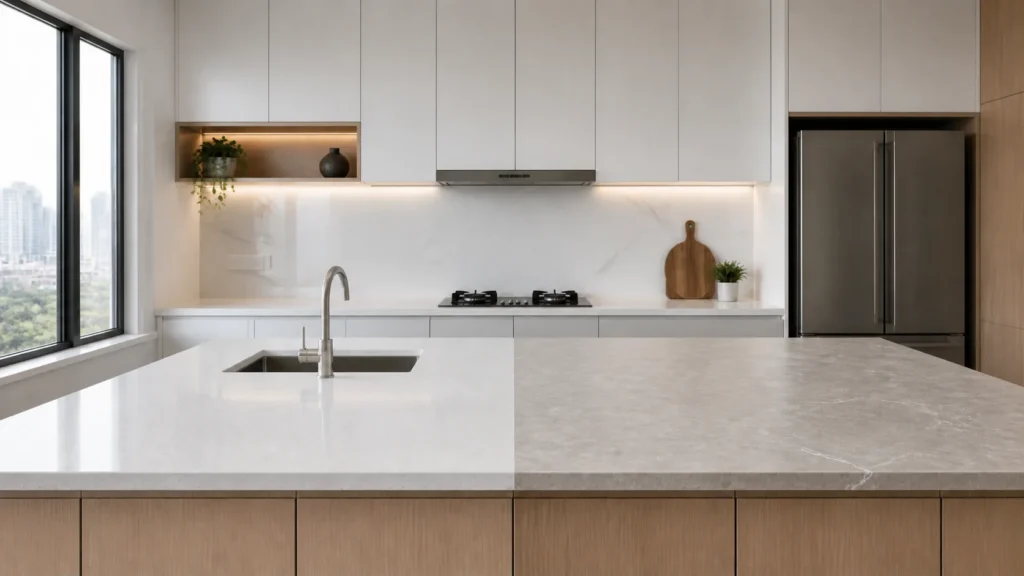
Key Takeaways
- Sunlight is the biggest decider: sintered stone is UV-stable and won’t yellow, while quartz’s resin can discolour under prolonged direct sun.
- Quartz handles daily knocks better; sintered stone handles high heat and scratches better.
- Quartz runs from RM 110 to RM 689 per sqft supply and install, depending on brand and design; sintered stone runs from RM 110 to RM 469 per sqft.
- Both are non-porous and resist stains from turmeric, curry, and coffee without sealing.
- Sintered stone edges need a chamfer to reduce chip risk; quartz edges can take more creative profiles.
What Are Quartz and Sintered Stone Made Of?
Quartz is engineered from roughly 90–95% crushed natural quartz crystals bound with polymer resin and pigment, which is what gives it a hard, consistent, non-porous surface. That resin also adds a bit of flex, which is why quartz shrugs off the everyday bumps of a working kitchen.
Sintered stone is different: natural minerals are compressed and fired at around 1,200°C with no resin at all. The result is an ultra-dense slab that leads on heat tolerance, scratch resistance, and UV stability, but without resin’s flex, it’s more prone to chipping at a sharp point impact.
That resin-versus-no-resin split explains almost every difference on this page, starting with the one that should decide your choice first.
Does Sunlight Change Which Stone You Should Pick?
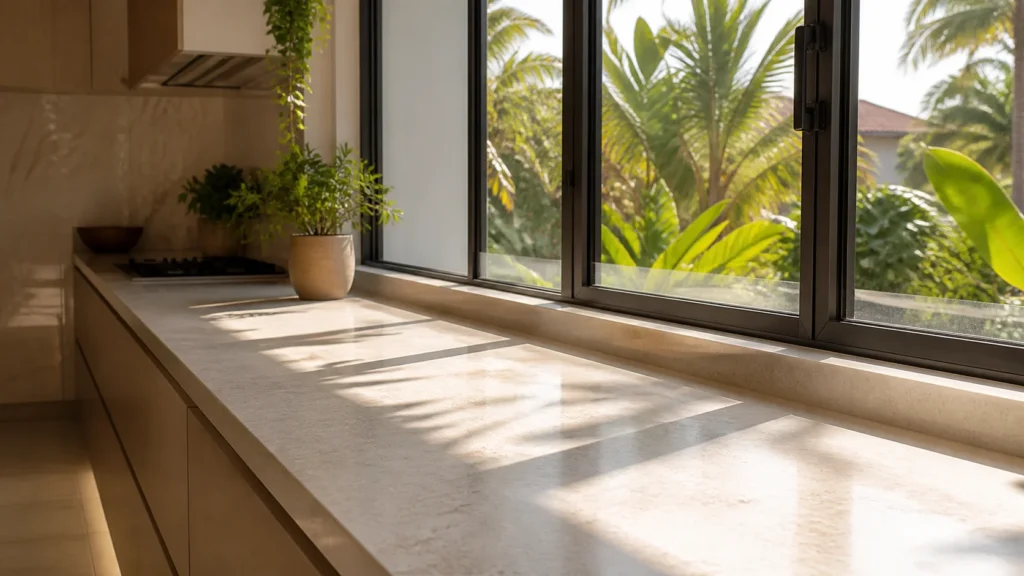
Yes. If your countertop sits under direct sun, sintered stone is the safer pick, because its resin-free composition won’t yellow or fade the way quartz can.
Malaysian kitchens with east- or west-facing windows, skylights, or an open-air wet kitchen put a countertop through hours of direct UV exposure every day. Quartz’s polymer resin is not UV-stable, so colour can shift over time in that kind of exposure; it’s designed for indoor use. Sintered stone has no resin to break down, so its colour holds under prolonged sun, which is why it’s the standard choice for outdoor and semi-outdoor wet kitchens.
If your kitchen is fully indoor with no direct sun hitting the countertop, this factor drops out and the decision moves to how you cook and what you want to look at every day.
How Do Quartz and Sintered Stone Compare Side by Side?
Quartz wins on impact tolerance and edge flexibility; sintered stone wins on heat and UV. Here’s the full breakdown:
| Category | Quartz | Sintered Stone |
|---|---|---|
| Heat Resistance | Up to ~150°C; use a trivet for hot wok or pan contact | Up to ~300°C; far more tolerant of direct heat (still use trivets for safety) |
| UV Resistance | Not UV-stable; indoor use only | UV-stable; suitable for bright, sunlit, or outdoor settings |
| Stain Resistance | Non-porous, high | Non-porous, high |
| Scratch Resistance | Very good | Excellent (ultra-dense) |
| Impact Resistance | Better (resin adds toughness and flex) | More brittle; a hard point impact at a weak spot can chip or crack |
| Design/Finish | Widest range of consistent colours; true polished finish | Convincing stone, metal, and wood looks; many designs use surface-printed veining |
| Edges | Homogeneous, no vein break; supports creative profiles | 3mm chamfer recommended to reduce chip risk (can reveal a two-tone edge) |
For a deeper look at why scratch resistance differs so much between materials, see our guide to the Mohs hardness scale and what it actually means for countertop selection.
What Will You Actually Notice Living With Each Stone?
You’ll notice quartz shrugging off bumps and stains, and sintered stone shrugging off hot pans and sun.
Quartz: The Everyday Workhorse
Quartz is the tough daily driver. It resists dents and chips from normal bumps, and if it does take a hard hit, it’s more likely to mark or dent than to crack outright. It’s non-porous and highly stain-resistant, which matters in a kitchen that sees kunyit, curry, and kopi spills on a regular basis. The polished finish stays polished too, because there’s no separate glaze layer to wear off over time, unlike some sintered stone gloss finishes. Edge profiles like ogee, pencil, and mitre are also easier to achieve, thanks to the material’s flexibility and full-body homogeneity.
The trade-off: quartz isn’t UV-safe, and sudden extreme heat can damage the resin, so a trivet is non-negotiable. If you like to know whether a hot pan straight off the stove is safe on quartz, we’ve covered that in detail.
Sintered Stone: The High-Heat, UV-Proof Powerhouse
Sintered stone is the heat champion: it shrugs off hot pans far better than quartz, though safe placement habits still matter. It’s ultra-dense and UV-stable, which makes it the go-to for sun-drenched or outdoor kitchens, and it offers dramatic marble and stone effects across gloss, matt, and leather finishes.
The trade-offs are worth knowing before you commit. Many Malaysian-market sintered slabs have printed surface veins around 1mm deep, so edges and post-polishing can show a vein break. Glossy glaze finishes can pick up fine micro-scratches with friction over time in heavy-use zones. And corners or edges can chip if struck hard enough, so a 3mm chamfer helps reduce that risk, at the cost of a slightly visible two-tone edge. Even top-tier sintered stones show impact limitations in independent testing, so normal home use is fine, but avoid dropping heavy items directly on edges. We go into this in more depth in our honest guide to sintered stone’s disadvantages.
How Do You Choose Between Quartz and Sintered Stone?
Work through these three questions in order, and the answer usually becomes obvious by the second one.
- Does your countertop get direct sunlight? If yes, go with sintered stone, since its UV stability settles the decision on its own. If no, move to question two.
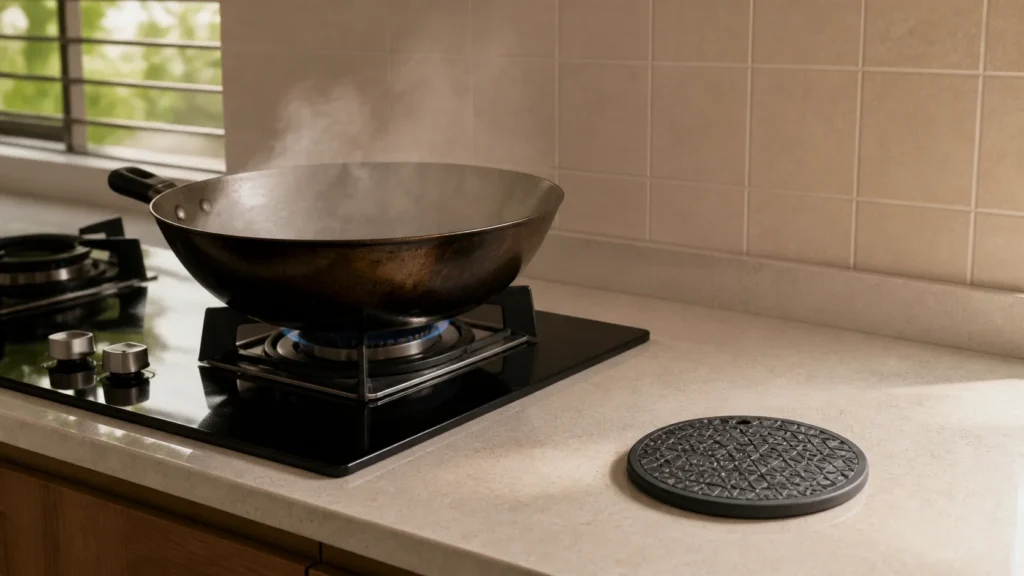
- Do you cook heavily and want worry-free heat? If yes, sintered stone has the clear heat advantage. If cooking is light to moderate, either material works, so move to question three.
- Do you prioritise impact tolerance, edge profile flexibility, and a polished look that never wears? If yes, quartz is the better fit: it’s tougher against knocks, its edges stay homogeneous, and there’s no glaze layer to wear down. If not, pick based on the finish and design you’re drawn to.
What Do Quartz and Sintered Stone Cost in Malaysia?
Quartz and sintered stone overlap in price at the entry level, but quartz’s premium brands run noticeably higher than sintered stone’s. All prices below are supply-and-install per square foot, current for 2026.
| Brand | Material | Tier | Price Range (per sqft) |
|---|---|---|---|
| Zenstone | Quartz | Sinno Signature | RM 110 – RM 160 |
| Moonstone | Quartz | Sinno Signature (textured) | RM 182 – RM 226 |
| Silestone | Quartz | Global Premium | RM 282 – RM 634 |
| Caesarstone | Quartz | Global Premium | RM 332 – RM 689 |
| Moca Compact | Sintered Stone | Value | RM 110 – RM 150 |
| Dekton | Sintered Stone | Global Premium | RM 248 – RM 469 |
At the entry level, house-brand quartz (Zenstone) and value sintered stone (Moca Compact) land in the same RM 110–150 range, so budget alone won’t decide much there. The gap widens as you move up: premium quartz brands like Caesarstone can run well past what Dekton charges for its top collections, mostly because of design-led colours like Calacatta-style veining. For a full breakdown of quartz pricing by brand and collection, see our 2026 quartz stone price guide, or our general stone countertop price guide if you’re comparing across all materials.

What Fabrication Details Matter for Sintered Stone Edges and Finish?
The details that matter most are edge treatment, gloss versus true polish, and vein continuity. Get these wrong and you’ll notice them every day.
Edge treatment: for sintered stone, specify a ~3mm chamfer on exposed edges. It reduces chip-off risk but does mean accepting a two-tone visual where the body and adhesive layer show through.
Gloss vs polished: many sintered stones use a glaze gloss rather than a true polish. Friction over time, from pots sliding, cutting boards, and daily wiping, can create fine lines in that glaze. For heavy cooking zones, a matt or smooth-matt finish holds up better. Quartz’s polished surface, by contrast, stays stable because there’s no glaze to wear. If you’re still deciding between finishes, our complete stone finish guide compares polished, honed, leather, and gloss side by side.
Vein continuity: because many sintered stone designs aren’t full-body, expect a vein break where the slab is cut or edged. Quartz patterns run more consistently through cuts and edges since colour and pattern go all the way through the slab.

How Do You Care for Quartz and Sintered Stone Countertops?
Both materials are low-maintenance, but a few habits protect them long-term. Use a trivet for very hot cookware, especially on quartz, where sudden heat is the main risk. Wipe up spills such as curry, turmeric, and coffee while they’re fresh, even though both surfaces are non-porous and won’t stain if left a little while. For sintered stone, pay extra attention to edges and corners, and keep in mind that a glossy glaze finish may pick up micro-scratches over time in heavy-use zones.
If you want the full routine, including which cleaning products to avoid, see our guide on how to clean a quartz countertop the right way.
FAQ
Is quartz or sintered stone better for a Malaysian kitchen? Neither is universally better; it depends on whether your countertop gets direct sunlight. Sintered stone is the better pick under UV exposure or for outdoor/wet kitchens; quartz is the better everyday performer for a fully indoor kitchen with heavy daily use.
Does quartz turn yellow in Malaysian sunlight? Quartz’s polymer resin isn’t UV-stable, so prolonged direct sun exposure can cause yellowing or fading over time. If your countertop sits under a skylight or a west-facing window, sintered stone avoids this problem entirely.
Is sintered stone more expensive than quartz in Malaysia? Not necessarily. Entry-level sintered stone (Moca Compact) and entry-level quartz (Zenstone) both start around RM 110 per sqft supply and install. Premium quartz brands like Caesarstone can cost more than premium sintered stone like Dekton, largely due to design-led colour collections.
Can I put a hot pan directly on quartz or sintered stone? Sintered stone tolerates much higher heat (up to ~300°C) than quartz (up to ~150°C), but a trivet is recommended for both, since sudden thermal shock can still cause localised damage even on sintered stone.
Does sintered stone chip more easily than quartz? At a sharp point impact, yes: sintered stone’s lack of resin makes it more brittle than quartz, which is why a chamfered edge is recommended. For general daily use, both materials hold up well.
Conclusion
If your kitchen sits under direct sun or opens onto an outdoor wet kitchen, sintered stone’s UV stability makes the decision for you. If you’re working with a fully indoor kitchen and want a tough daily surface with the widest choice of consistent colours, quartz is hard to beat. Either way, the material matters less than getting the fabrication right. Talk to us about your layout, sunlight exposure, and cooking habits, and we’ll help you land on the stone that still looks right in fifteen years.