

One is quarried from the earth, the other engineered in a factory. Here’s what that means in your kitchen.
Granite is a natural stone cut straight from a quarry, while quartz is an engineered stone made by binding crushed natural quartz with resin and pigment in a factory. That single difference in how they are made drives everything else you will notice day to day: granite takes a hot wok without flinching but is porous, and quartz never absorbs a thing but wants a trivet under the wok.

Key Takeaways
- Granite is 100% natural stone, quarried and cut. Quartz is engineered from roughly 90% crushed quartz bound with polymer resin.
- Granite wins on heat. You can set a hot wok straight down on it. Quartz resin can scorch or discolour with prolonged contact above roughly 150°C.
- Quartz wins on stains. It is non-porous out of the factory, so turmeric, curry oil and soy sauce sit on the surface instead of soaking in.
- Standard granite is porous and needs sealing every one to three years. Sensa Granite by Cosentino skips that entirely: its SenGuard treatment is applied at the factory and carries a 15-year written warranty against oil, coffee and acid stains.
- Quartz gives you colour and pattern consistency across every slab. Granite gives you a slab nobody else has, but matching a second piece later is close to impossible.
- Branded quartz in Malaysia runs from RM110 per square foot (Zenstone) up to RM689 (Caesarstone Statuario Maximus), supply and install. Sensa Granite runs RM349 to RM780. Unbranded granite is quoted per slab.
- Neither material is better outright. The right answer depends on how hard you cook and how much upkeep you are willing to do.
What is the difference between quartz and granite kitchen tops?
The core difference is origin: granite is quarried as a solid natural stone, and quartz is manufactured by compressing crushed quartz crystals with resin and pigment under vacuum and pressure. Everything homeowners argue about, heat, stains, sealing, price, traces back to that.
Here is the short version before we go into detail:
| Quartz Stone | Granite | |
|---|---|---|
| What it is | Engineered: around 90% crushed quartz plus polymer resin and pigment | 100% natural stone, quarried and slabbed |
| Porosity | Non-porous | Porous |
| Sealing | Never | Every 1 to 3 years, or never with Sensa SenGuard |
| Direct hot cookware | Use a trivet | Handles it |
| Stain resistance | High, straight out of the box | Good when sealed; Sensa carries a 15-year stain warranty |
| Pattern consistency | Consistent across slabs and batches | Every slab is different |
| Choosing your slab | Pick from a collection by name | Hand-pick the actual slab |
| Malaysian pricing | RM110 to RM689 per sqft, supply and install | RM349 to RM780 for Sensa; unbranded quoted per slab |
| Best suited to | Heavy spice and sauce cooking, matched runs, low upkeep | Heavy wok cooking, one-of-a-kind character |

What is quartz stone actually made of?
Quartz stone is an engineered surface made from roughly 90% crushed natural quartz crystals, bound with polymer resin and coloured with pigment, then cured into a slab. The quartz is the hard part that resists scratching. The resin is what fills every gap between the crystals, and that is why a quartz top does not absorb anything.
Because the recipe is controlled in a factory, so is the look. If you order the same collection in six months for a laundry top, it will match. Manufacturers can produce a flat white, a fine grey, or a convincing Calacatta vein, and hold it consistent across the whole run.
The resin is also quartz’s one real weakness. It is a plastic, and plastics do not enjoy high heat. That is the trade-off you are accepting when you choose quartz, and it is worth understanding properly rather than discovering it with a wok. We covered the details in what are the disadvantages of quartz stone countertops.
Brands available in Malaysia include Zenstone and Moonstone locally, plus imported Caesarstone and Silestone. If you are weighing the two imported names against each other, Caesarstone vs Silestone breaks down where each one earns its price.
What is granite, and where does it come from?
Granite is an igneous rock formed from magma that cooled slowly deep underground, then quarried, cut into slabs, and polished. No factory involved, and no two slabs alike.
That geological history is exactly why granite shrugs off heat. It formed at temperatures far beyond anything a domestic stove produces, so a wok fresh off a high flame does not bother it.
The same natural origin creates the porosity. Granite has microscopic gaps between its mineral crystals, and liquid can work its way in. Sealing fills those gaps. Skip the sealing and a splash of curry oil or turmeric water has somewhere to go.
This is where branded granite pulls away from the unbranded slab yards. Sensa Granite by Cosentino arrives with SenGuard applied at the factory, a stain-resistant treatment that lasts 15 years and comes with a 15-year warranty in writing against oil, coffee and acid stains. No annual re-sealing, and no relying on a verbal assurance from whoever installed it. It is worth being precise about what that means though: SenGuard is a treatment applied to a stone that is still naturally porous, rather than a material that is non-porous the whole way through like quartz.
Two things worth knowing before you shop for granite in Malaysia. First, quality varies a lot between quarries and grades, so density and finish matter more than the colour name. Second, some suppliers label granite as “quartzite” because it sounds more premium, which is a genuine problem when you are comparing quotes. We unpacked that in why some suppliers call granite “quartzite”.

Which one handles a hot wok better?
Granite, comfortably. You can lift a wok off the flame and set it directly on granite with no trivet and no consequence. Quartz cannot make that claim, because the resin binding it starts to suffer with prolonged contact above roughly 150°C, and the damage shows up as a dulled patch or a faint yellow-brown mark that does not polish out.
For a lot of Malaysian kitchens this is the deciding factor, not a footnote. If your dry kitchen is where the wok actually lands, or you are moving a claypot straight from the stove to the counter during a Chinese New Year reunion dinner, granite removes a whole category of worry.
The practical middle ground: most homeowners who choose quartz simply keep a trivet or a folded cloth beside the hob, and never have a problem in fifteen years. It is a habit, not a hardship. But it has to be a habit that actually holds, including when a helper or a visiting relative is cooking. We go deeper into what quartz can and cannot take in can you put hot pans directly on a quartz stone kitchen top.
If your heavy cooking happens in a separate wet kitchen, this factor loses most of its weight, and you can choose on looks and upkeep instead. What is the best countertop for a wet kitchen in Malaysia covers that split properly.

Which one stains more easily in a Malaysian kitchen?
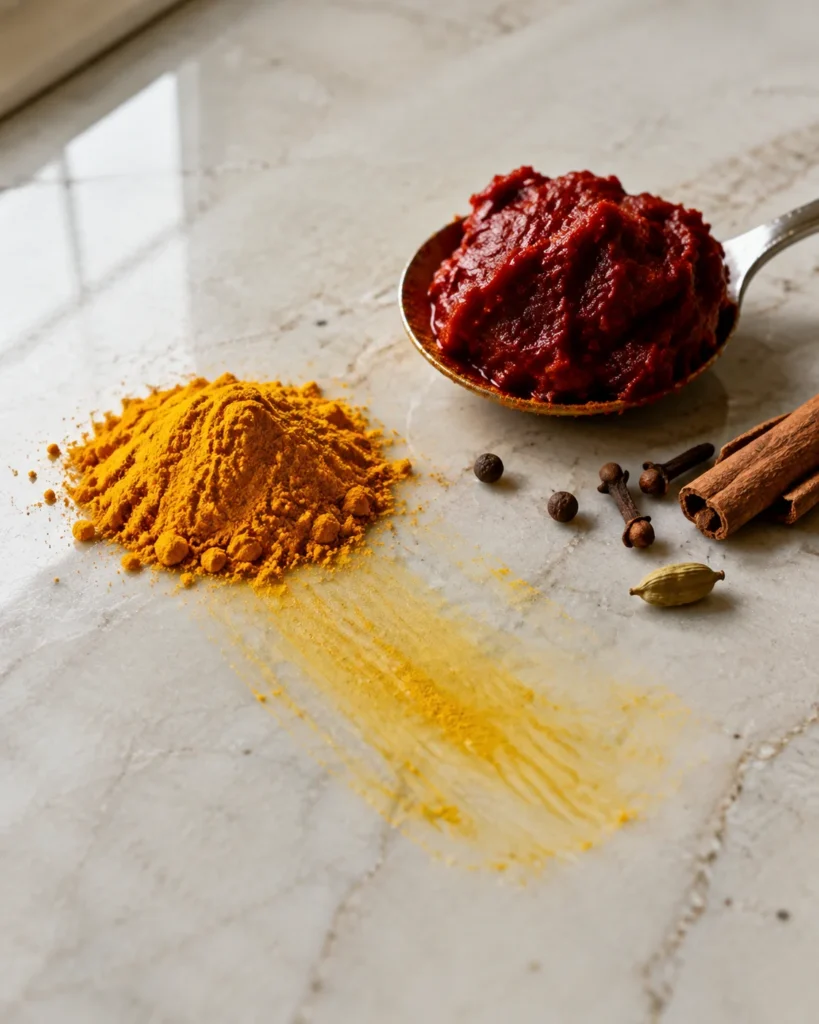
Granite, and it is not close, unless the granite is properly sealed and the sealing is kept up. Quartz is non-porous from day one, so turmeric, kunyit-marinated chicken, dark soy, curry oil and red wine sit on the surface until you wipe them off.
Think of it like the difference between a raincoat and a cotton shirt. Both keep you dry in a drizzle. Only one of them is still dry after a proper downpour.
Malaysian cooking is a proper downpour. Turmeric in particular is the ingredient that catches people out, because it stains fast and it stains yellow, which is visible on almost every stone colour. On sealed granite you have a window of minutes to wipe it. On unsealed or lapsed-seal granite, the window can be shorter than the time it takes to finish plating.
Quartz’s non-porous structure also means there is nowhere for bacteria to settle, which is why premium quartz collections carry NSF-51 food-contact certification. If you bake or prep directly on the counter rather than on a board, that matters more than it sounds. See why NSF-51 certified quartz is non-negotiable for what the certification actually covers.
Does granite really need sealing, and how often?
Standard granite does, usually on installation and then re-applied every one to three years depending on the sealer and how hard the counter works. Sensa Granite by Cosentino does not, because SenGuard is already on it when it leaves the factory and is warranted for 15 years.
Malaysia’s climate does not help the unsealed case. Humidity sits around 70 to 90% year-round, and a counter that is damp more often than not gives sealant a harder life than the same stone would face in a dry climate. Re-sealing is not a difficult job, and it is not expensive, but it is a recurring one that many homeowners simply forget about until a stain reminds them.
The SenGuard warranty is the part worth paying attention to, because it is written rather than implied. It covers oil, coffee and acid stains for 15 years, which happens to describe most of what actually lands on a Malaysian kitchen counter. A slab yard telling you their granite is “already treated” is making a claim. A 15-year warranty document is a commitment you can hold someone to.
Quartz asks for none of this either. Soap, water, a soft cloth, done. No sealer, no reminder in your calendar, no window of vulnerability while you procrastinate.
So be honest with yourself about which kind of homeowner you are. If a periodic maintenance task is something you will genuinely do, standard granite’s porosity is a manageable detail. If it is something you will mean to do, either quartz or Sensa removes the question entirely.
How much do quartz and granite cost in Malaysia?
Quartz is sold from published brand price lists, so you can check a number before you walk in. These are current 2026 supply-and-install rates per square foot:
| Brand | Origin | Supply & install per sqft |
|---|---|---|
| Zenstone | Local | RM110 to RM160 |
| Moonstone | Local | RM182 to RM226 |
| Silestone | Spain | RM282 to RM634 |
| Caesarstone | Israel/USA | RM332 to RM689 |
Granite splits into two cases. Branded granite is priced like quartz, by name and by collection. Sensa by Cosentino runs from RM349 per square foot for Siberia up to RM780 for Orinoco, supply and install, with SenGuard and its 15-year stain warranty included at every price point:
| Sensa Granite (Cosentino) | Supply & install per sqft |
|---|---|
| Siberia | RM349 |
| Moak Black | RM518 |
| Glacial Blue | RM622 |
| Sant Angelo | RM655 |
| Orinoco | RM780 |
Unbranded granite is the other case, and it is not sold from a fixed list because you are buying a specific slab rather than a repeatable product. Price moves with the quarry of origin, the colour, the rarity of the pattern and how the slab was finished, which is why that quote should always name the material and give you a per-square-foot figure you can compare. Ask for it in writing before you commit, the same way you would with quartz.
Two costs people forget when comparing. Unbranded granite carries the ongoing cost of re-sealing across the life of the counter, which Sensa and quartz both avoid. And a premium imported quartz collection can cost more upfront than plenty of granite you will be shown. Run the numbers over fifteen years, not over the invoice.
For a fuller breakdown of where Sensa sits against the newer materials, see sintered stone vs granite for Malaysian kitchens.
For the full brand-by-brand breakdown on quartz, including which collections sit at which tier, see our quartz stone price guide for Malaysia.
Which one gives you more control over the look?
Quartz, by a wide margin. You choose a collection by name, and every slab in that collection looks like the sample. Granite gives you something quartz cannot fake, a pattern that exists on exactly one slab in the world, but you have to accept it on its own terms.
This matters most in three situations. If your kitchen needs more than one slab, quartz will match seamlessly and granite may show a visible shift where two pieces meet. If you want the countertop, island and backsplash to read as one surface, quartz makes that straightforward. And if you might extend the counter later, a quartz collection can usually be reordered, while a granite slab from a particular block is gone once it is gone.
The flip side is that granite offers depth. Light moves through the mineral flecks in a polished granite slab in a way that a printed or pigmented pattern does not quite replicate. Homeowners who love granite tend to love it precisely because it looks like stone rather than like a very good drawing of stone.
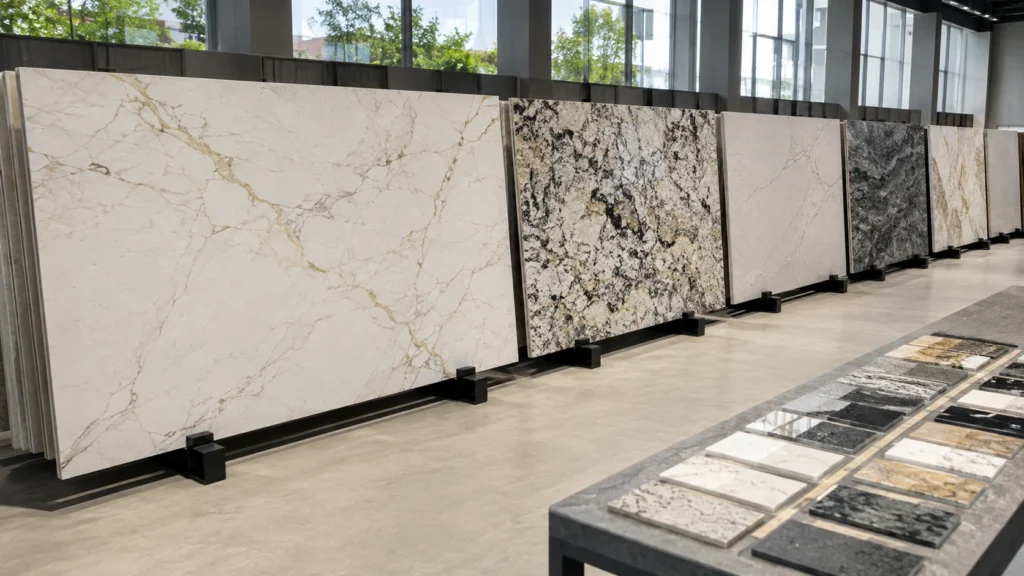
If you lean granite, go and hand-pick your actual slab rather than choosing from a sample chip. A 10cm sample tells you almost nothing about what a 3-metre slab will look like on your island.
Which should you choose for your kitchen?
Choose based on how you cook and how much upkeep you will genuinely keep up with, not on which material sounds more premium.
Choose quartz if you:
- Cook with turmeric, curry, soy and other staining ingredients regularly
- Want zero maintenance, with no sealing schedule to remember
- Need multiple pieces to match, or want counter, island and backsplash to read as one
- Have a specific colour or pattern in mind and want it exactly
- Are happy to keep a trivet beside the hob
Choose granite if you:
- Do heavy wok cooking on the same counter and want to skip the trivet entirely
- Want a surface with genuine natural character that nobody else has
- Are willing to re-seal every one to three years, or would rather pay for Sensa and get a 15-year stain warranty instead of a maintenance schedule
- Prefer classic, warm-toned natural stone over engineered uniformity
- Can visit a yard and hand-pick a slab you actually like
Still torn on the granite side specifically? Is granite still the best countertop choice for Malaysian kitchens goes deeper on where granite still leads and where it has been overtaken.
FAQ
Is quartz better than granite? Neither is better outright. Quartz is better for stain resistance and low upkeep, granite is better for direct heat, and the right choice depends on whether your kitchen sees more hot woks or more turmeric.
Can I put a hot pot on quartz? Not directly. Quartz contains polymer resin that can dull, discolour or mark with prolonged contact above roughly 150°C, so use a trivet or a heat pad for anything straight off the flame.
Does quartz need sealing? No. Quartz is non-porous by construction, so there is nothing for a sealer to fill. Any supplier telling you to seal quartz annually is either mistaken or selling you something you do not need.
Which is cheaper in Malaysia, quartz or granite? It depends on which of each. Local quartz from RM110 per square foot undercuts Sensa Granite, which starts at RM349, while premium Caesarstone and Silestone collections cost more than most Sensa colours. Get both quoted per square foot on the same scope before comparing.
Will granite stain if I forget to seal it? Standard granite can. Unsealed or lapsed-seal granite absorbs oils and pigments, and turmeric, curry oil and dark sauces are the usual culprits in a Malaysian kitchen. Sensa Granite avoids the issue, since SenGuard is factory-applied and warranted against oil, coffee and acid stains for 15 years.
Is there a granite that does not need sealing? Yes. Sensa Granite by Cosentino comes with SenGuard applied at the factory, which lasts 15 years and carries a 15-year written stain warranty, so there is no periodic re-sealing to keep up with. You still clean it normally and avoid harsh abrasives, which can degrade the treatment over time.
Can quartz and granite be used together in one kitchen? Yes, and it can work well. Some homeowners run granite on the wet kitchen counter where the wok lands and quartz on the dry kitchen island, which puts each material where its strength counts.
Conclusion
Quartz and granite are not competing for the same job, even though they end up on the same shortlist. Granite is the natural stone that takes heat without complaint, and asks for a sealing habit in return unless you go with Sensa and its 15-year written stain warranty. Quartz is the engineered surface that never stains and never needs sealing, and asks only that you keep a trivet handy. Look honestly at your own kitchen, at what actually gets cooked there and by whom, and the answer usually picks itself.
If you would like to see both in person before deciding, come by our showroom and put your hand on the real slabs. We will quote both materials per square foot on the same scope so you are comparing like with like.