

Granite is still an excellent countertop, but it is no longer automatically the best one for a Malaysian kitchen. It remains the material that takes a wok straight off the flame without a trivet, and no engineered surface has matched that. What has changed is that quartz and sintered stone now beat it on staining, matching and upkeep, which are the three things Malaysian homeowners actually complain about after five years.

Key Takeaways
- Granite handles direct heat better than quartz. A hot wok goes straight down on it, no trivet required.
- Standard granite is porous and needs re-sealing every one to three years. Miss the cycle and turmeric, curry oil and kopi leave marks that do not wipe off.
- Sensa Granite by Cosentino avoids that entirely. SenGuard is applied at the factory and carries a 15-year written warranty against oil, coffee and acid stains.
- No two granite slabs match. If your kitchen needs more than one slab, expect a visible shift where they meet, and accept that a matching piece later is close to impossible.
- 2026 supply-and-install pricing: Sensa Granite runs RM349 to RM780 per sqft, quartz runs RM110 to RM689 depending on brand, and sintered stone runs RM110 to RM469. Unbranded granite is quoted per slab.
- Granite is the right call if you cook hot and hard and want real natural stone. Quartz or sintered stone is the right call if you want to stop thinking about the counter after installation.
Why did granite dominate Malaysian kitchens for so long?
Granite earned its reputation on three things that still hold up: it shrugs off heat, every slab is genuinely one of a kind, and it lasts for decades. Walk into a showroom in the early 2000s and granite filled every display, because at the time nothing else offered that combination at a sensible price.
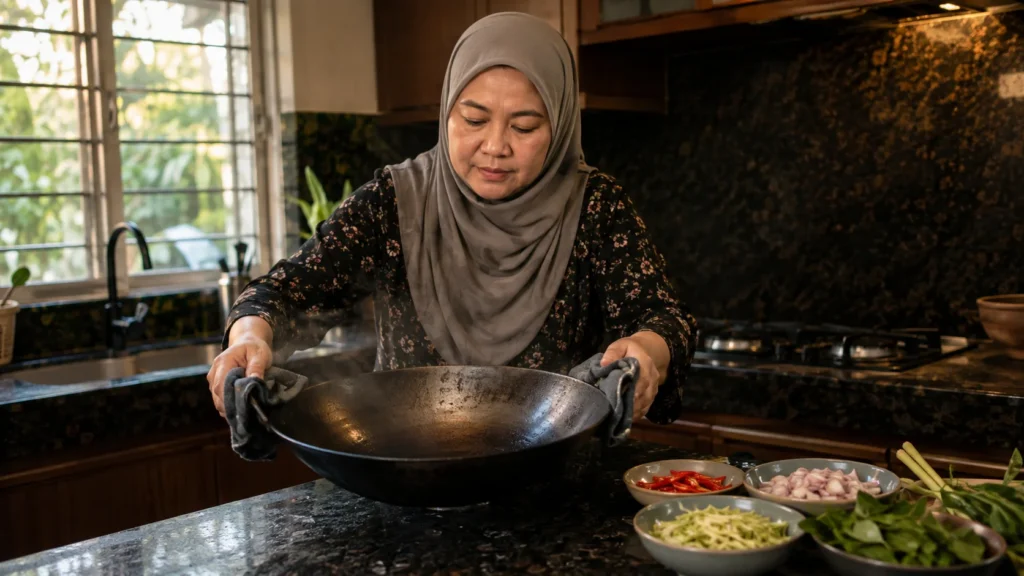
Can granite really take a hot wok straight off the flame?
Yes, and this is granite’s clearest advantage over engineered quartz. Granite formed from magma that cooled deep underground at temperatures far beyond anything a domestic hob produces, so a wok fresh off high flame does not bother it. No scorch mark, no discolouration, no dulled patch.
Quartz cannot make the same claim. The polymer resin binding the crushed quartz starts to suffer with prolonged contact above roughly 150°C, and the damage shows as a faint yellow-brown mark that does not polish out. For a household that fries daily, prepares rendang over hours, or moves a claypot from stove to counter during a reunion dinner, that difference is practical rather than theoretical.
If your heavy cooking happens in a separate wet kitchen, the calculation shifts. What is the best countertop for a wet kitchen in Malaysia covers how to split materials between the two.
What makes granite look different from engineered stone?
Depth. The crystalline patterns and mineral flecks in granite formed over millions of years, and light moves through a polished granite surface in a way that a pigmented or printed pattern does not quite replicate. Homeowners who love granite tend to love it precisely because it looks like stone rather than like a very good drawing of stone.
Every slab is also unique. If you want a kitchen that nobody else has, granite delivers that in a way no factory product can.
How long does granite actually last?
Granite countertops fitted in Malaysian homes 20 and 30 years ago are still in service. That is a track record rather than a durability claim. The stone sits at 6 to 7 on the Mohs hardness scale, which means everyday knives and kitchen tools will not scratch it. Kept sealed and properly supported, granite genuinely outlasts the cabinets underneath it.
Where does granite fall short in a Malaysian kitchen?
Granite’s weak points are porosity, slab matching and colour range. None of them are dealbreakers on their own, but all three matter more in a Malaysian kitchen than they would in a European one.
Does granite need sealing, and what happens if you skip it?
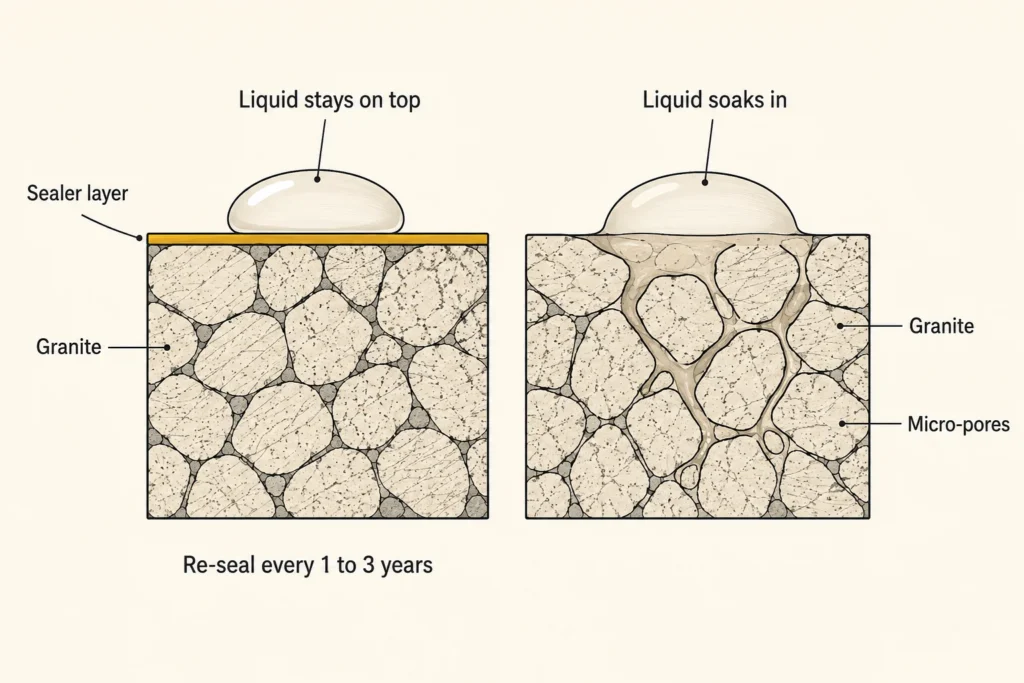
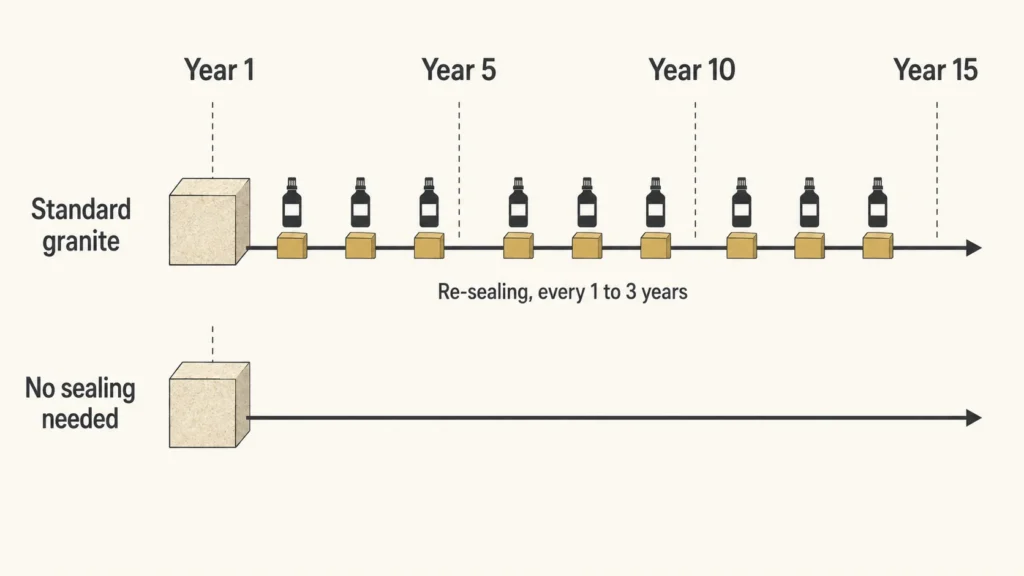
Standard granite needs sealing on installation and re-sealing every one to three years. Skip it and the stone starts absorbing whatever sits on it.
Granite has microscopic gaps between its mineral crystals, and liquid works its way in. Now think about what lands on a Malaysian counter in a normal week: turmeric, curry paste, kicap manis, santan, cooking oil, strong kopi. Turmeric is the one that catches people out, because it stains fast and it stains yellow, which shows on almost every granite colour. On properly sealed granite you have minutes to wipe it. On lapsed-seal granite the window can be shorter than the time it takes to plate the dish.
Malaysia’s climate makes this harder, not easier. Humidity sits around 70 to 90% year-round, and a counter that is damp more often than not gives sealant a shorter working life than the same stone would get in a dry climate.
There is a proper solution to this. Sensa Granite by Cosentino arrives with SenGuard already applied at the factory, a stain-resistant treatment that lasts 15 years and comes with a 15-year written warranty against oil, coffee and acid stains. No re-sealing schedule, and no relying on a verbal assurance from whoever installed it.
Be precise about what that means though. SenGuard is a treatment applied to a stone that remains naturally porous underneath, not a material that is non-porous the whole way through like quartz or sintered stone. It closes the gap considerably. It does not erase it.
Why is it so hard to match granite slabs?
Because no two slabs are the same, and that cuts both ways. If your kitchen needs more than one slab for an L-shaped run or a large island, the colour and pattern will shift visibly where the pieces meet.
This means hand-picking your slabs at the yard, ideally from the same block, and agreeing with the fabricator where the join will sit before anything is cut. It also means that if you extend the counter or need a repair two years later, finding a match is close to impossible. A 10cm sample chip tells you almost nothing about what a three-metre slab will look like on your island, which is exactly the trap covered in why you shouldn’t choose your countertop from a sample only.
Is granite’s colour range limited?
Yes, to whatever the quarries produce. The variety is wide, from deep blacks to warm golds to dramatic blues, but if you have a specific colour in mind you may simply not find it in natural stone.
Engineered materials give you the opposite problem. Quartz manufacturers can produce a flat white, a fine grey or a convincing Calacatta vein and hold it consistent across every slab in the collection, which is why quartz wins whenever a design has to be matched exactly across counter, island and backsplash.
One more thing worth knowing before you shop. Some suppliers label granite as “quartzite” because it sounds more premium, which makes quotes genuinely hard to compare. We unpacked that in why some suppliers call granite “quartzite”.
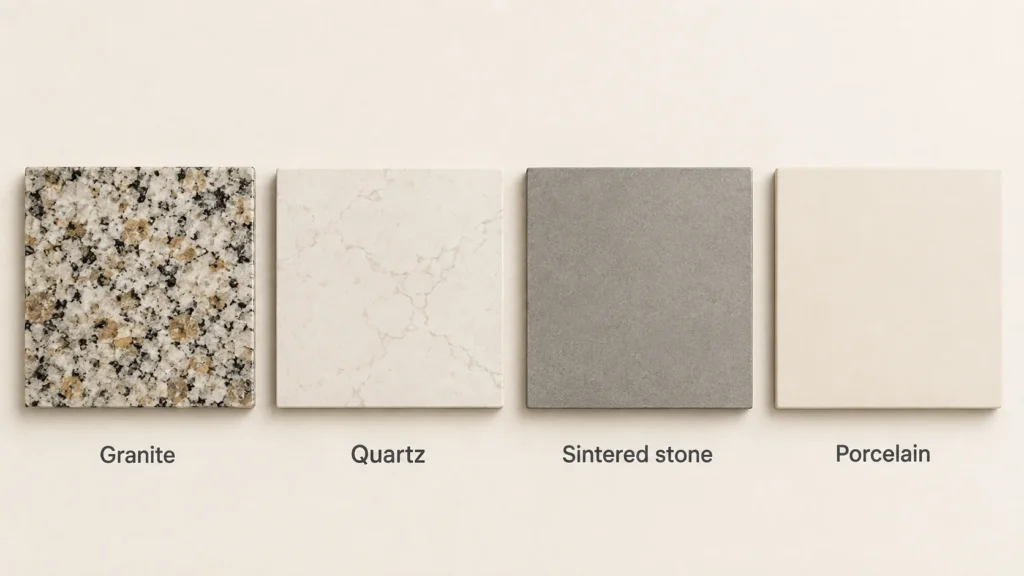
How does granite compare to quartz, sintered stone and porcelain?
Granite wins on heat and natural character. It loses on stain resistance, matching and long-term upkeep to every engineered material on this list. Here is the short version before the detail:
| Granite | Quartz Stone | Sintered Stone | Porcelain Slab | |
|---|---|---|---|---|
| What it is | 100% natural stone | Around 90% crushed quartz plus resin | Minerals fired above 1,200°C | Fired clay-based large-format slab |
| Porosity | Porous | Non-porous | Non-porous | Non-porous |
| Sealing | Every 1 to 3 years, or never with Sensa | Never | Never | Never |
| Direct hot cookware | Handles it | Use a trivet | Handles it | Good, but watch thermal shock |
| Slab matching | Every slab differs | Consistent | Consistent | Consistent |
| UV / outdoor use | Good | Not suitable | Suitable | Suitable |
| 2026 supply and install | RM349 to RM780 (Sensa); unbranded per slab | RM110 to RM689 | RM110 to RM469 | Quoted per project |
Granite vs quartz: which suits a Malaysian kitchen better?
It comes down to whether your kitchen sees more hot woks or more turmeric. Granite takes the heat, quartz takes the stains, and both claims are true at the same time.
Where granite wins: direct heat, genuine natural character, and a slab nobody else has.
Where quartz wins: non-porous from day one with no sealing ever, colour consistency across slabs, a far wider design range, and no recurring maintenance cost.
For most Malaysian households the honest answer is that the staining advantage matters more often than the heat advantage, because turmeric appears on the counter more frequently than a wok does. But if the wok lands on your dry kitchen counter rather than in a separate wet kitchen, granite removes a whole category of worry. What is the difference between quartz and granite kitchen tops goes through this trade-off in full.
2026 quartz pricing, supply and install per square foot:
| Brand | Origin | Price per sqft |
|---|---|---|
| Zenstone | Local | RM110 to RM160 |
| Moonstone | Local | RM182 to RM226 |
| Silestone | Spain | RM282 to RM634 |
| Caesarstone | Israel/USA | RM332 to RM689 |
Local quartz undercuts branded granite comfortably. Premium imported quartz costs more than most Sensa colours. Granite and quartz do not sit in tidy budget tiers, so get both quoted per square foot on the same scope before comparing.
Granite vs sintered stone: does sintered stone beat granite outright?
On performance, largely yes. Sintered stone matches granite’s heat resistance and adds the stain resistance granite lacks, without any sealing at all.
Sintered stone is made by firing natural minerals above 1,200°C with no resin in the mix, which leaves it non-porous, scratch-resistant and UV-stable. That last point matters if you are running a counter into a wet kitchen with an open window or building an outdoor bar.
Where granite wins: natural character, and a proven multi-decade track record in Malaysian homes.
Where sintered stone wins: zero porosity, no sealing, better edge durability, UV stability, and a much lower entry price than branded granite.
2026 sintered stone pricing, supply and install per square foot:
- Moca Compact Regular: from RM110
- Moca Compact Leather and Premium: from RM130
- Moca Compact Homogeneous: from RM150
- Dekton Group 0: from RM248
- Dekton Group 4: up to RM469
Sensa Granite with SenGuard is the version of granite that competes properly here, and sintered stone vs granite for Malaysian kitchens runs that comparison category by category.
Granite vs porcelain slab: what is the real difference?
Porcelain slabs are non-porous, lighter and available in very large formats, while granite handles thermal shock better and offers more edge profile options.
Porcelain is worth considering for wall cladding and flooring more than for a heavy-use kitchen counter, and not every porcelain slab on the market is thick enough or dense enough for countertop work. Pricing varies too much between suppliers and thicknesses to quote a useful range here, so ask for a per-square-foot figure in writing on your actual scope. Our 2026 stone countertop price guide sets out what a fair quote looks like across every material.
What does the Malaysian kitchen do to a granite countertop?
Three local factors change how granite performs here: constant humidity, high-heat cooking, and the ingredients we cook with. Countertop performance is never universal, and a material that suits a London kitchen may not suit one in Kajang.
How does tropical humidity affect granite?
Humidity shortens the working life of sealant. At 70 to 90% year-round, a granite counter is rarely fully dry, and sealant that might last three years in a dry climate can need attention sooner here. That is not an argument against granite. It is an argument for either committing to the sealing schedule honestly or paying for SenGuard-protected granite so the schedule disappears.
Quartz, sintered stone and porcelain are unaffected by humidity, which is a quiet practical edge in Malaysian conditions.
Does your cooking style change which material you should buy?
It should be the main thing driving the decision, ahead of colour and ahead of brand.
Daily wok cooking on the same counter: granite excels. Sintered stone matches it. Quartz asks for a trivet, which is a habit rather than a hardship, but it has to be a habit that holds even when a helper or a visiting relative is cooking.
Heavy turmeric, curry paste and acidic ingredients: the non-porous materials win clearly. Standard granite demands immediate cleanup and a kept sealing schedule to stay unmarked.
Moderate cooking, mixed methods: most materials perform fine, so choose on design and budget instead.
Is granite actually cheaper over 15 years?
Not always, and this is where upfront pricing misleads people. Standard granite carries a recurring re-sealing cost across the life of the counter, plus the risk of a stain that needs professional restoration if a cycle gets missed. Sensa Granite with SenGuard and every non-porous engineered surface both avoid that entirely.
Run the numbers over fifteen years rather than over the invoice. A slab that costs RM40 less per square foot but wants attention every second year is not the bargain it looks like on quotation day.
Which myths about granite need correcting?
Four keep coming up in showrooms, and two of them push homeowners in the wrong direction.
Myth: granite is maintenance-free
Standard granite is not. This is the most damaging misconception of the four, because homeowners who install granite expecting nothing to do end up frustrated the first time a stain will not lift. Sensa Granite with SenGuard is the closest thing to a maintenance-free granite, and even that wants normal cleaning and no harsh abrasives. Our guide to stone countertop myths covers the equivalent misconceptions across other materials.
Myth: granite is outdated
Granite is a natural material with timeless appeal. What changed is that it is no longer the only premium option on the floor. More choice for homeowners is a good outcome, and it does not make granite a worse stone than it was in 2005.
Myth: all granite is the same
Quality varies enormously between quarries and grades. Origin, mineral composition, density and finish all affect how the slab performs. A dense, well-finished granite from a reputable supplier will outlast a cheap slab noticeably, so ask about origin and density rather than choosing on colour name alone.
Myth: granite always cracks
Granite does not crack under normal kitchen use. Cracking almost always traces back to improper installation, inadequate cabinet support, or a sharp impact from below. Properly templated, fabricated and supported, a granite counter is structurally sound for decades. The failure is in the workmanship, not the stone.

So, is granite still the best countertop for Malaysian kitchens?
Granite is still an excellent countertop, but it is no longer the default best choice for every kitchen. It leads on heat and natural character, and it trails on stain resistance, matching and upkeep.
Choose granite if you:
- Cook with high heat regularly and want to set hot cookware straight down
- Want a surface with genuine natural character that nobody else has
- Will either keep to a re-sealing schedule or pay for Sensa and get a 15-year stain warranty instead
- Prefer warm-toned natural stone to engineered uniformity
- Can visit a yard and hand-pick the actual slab
Choose quartz or sintered stone if you:
- Want a surface that needs nothing from you after installation
- Cook heavily with turmeric, curry and acidic ingredients
- Need slabs to match across counter, island and backsplash
- Have a specific colour or pattern in mind and want it exactly
- Would rather not think about the countertop again for fifteen years
Still weighing more than these few materials? Our complete guide to kitchen countertop materials in Malaysia compares 14 options side by side.
FAQ
Is granite still a good countertop choice in Malaysia? Yes, particularly for kitchens with heavy wok cooking, though it is no longer the automatic best choice. Quartz and sintered stone now beat granite on stain resistance and upkeep, so granite makes most sense when direct heat and natural character matter more to you than a zero-maintenance surface.
How often does granite need sealing in Malaysia? Standard granite needs sealing on installation and re-sealing every one to three years, and Malaysia’s 70 to 90% humidity tends to push that towards the shorter end. Sensa Granite by Cosentino needs none of it, because SenGuard is factory-applied and warranted for 15 years.
Can you put a hot wok directly on granite? Yes. Granite formed at temperatures far beyond anything a domestic hob produces, so direct contact with hot cookware causes no scorching or discolouration. This is the one area where granite clearly outperforms engineered quartz.
Does granite stain from turmeric and curry? Standard granite can, if the sealing has lapsed. Turmeric is the worst offender in a Malaysian kitchen because it stains quickly and leaves a yellow mark visible on most granite colours. Properly sealed granite gives you a few minutes to wipe it up.
How much does granite cost in Malaysia in 2026? Sensa Granite by Cosentino runs from RM349 per square foot for Siberia up to RM780 for Orinoco, supply and install, with SenGuard included at every price point. Unbranded granite is quoted per slab rather than from a fixed list, because you are buying one specific piece of stone rather than a repeatable product.
Is granite or quartz better for a Malaysian kitchen? Granite is better if your wok lands on the counter, quartz is better if turmeric does. Most Malaysian households find the staining question comes up more often than the heat question, which is why quartz has taken so much of granite’s former ground.
Conclusion
Granite has earned its place in Malaysian kitchens across decades of real service, and nothing about the newer materials changes that. What changed is the competition. Quartz and sintered stone removed the two things homeowners actually got tired of, the sealing schedule and the stains, and granite answered with SenGuard rather than with a new kind of stone.
So be honest about how you cook and how much upkeep you will genuinely keep up with, not how you imagine you will cook. The countertop that matches your real kitchen is the right one.
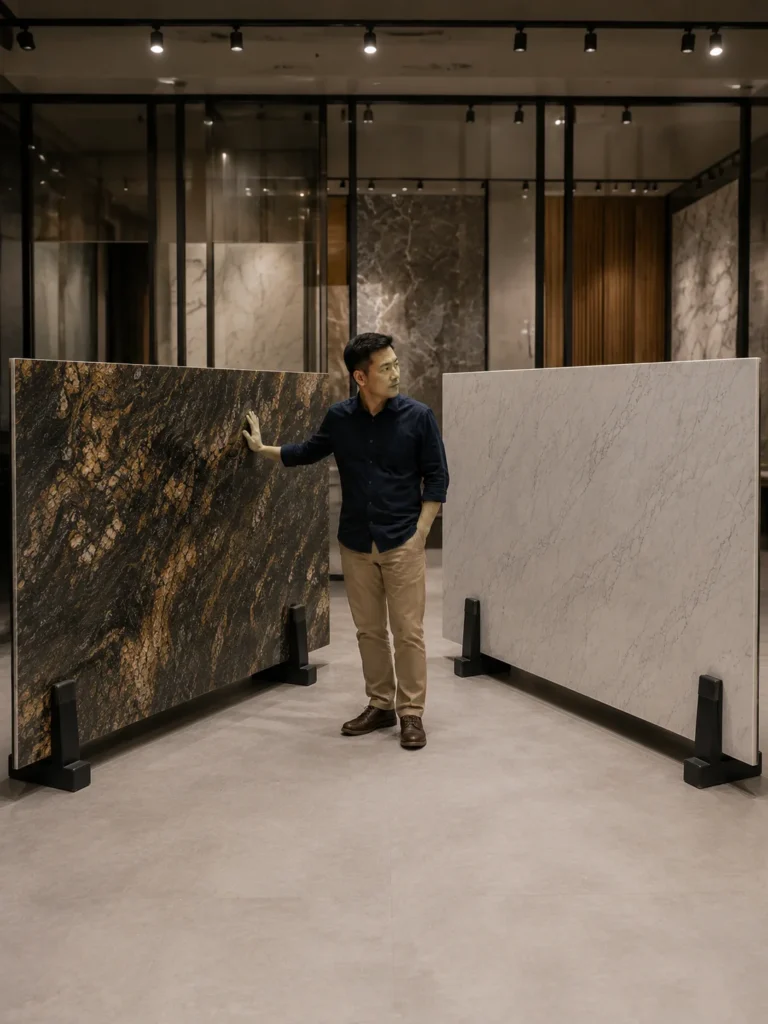
If you would like to see granite alongside quartz and sintered stone before deciding, come by our showroom and put your hand on the actual slabs. We will quote all three per square foot on the same scope, so you are comparing like with like.