

Calacatta Gold is a design, not a material grade. The same name sits on a RM160 per square foot slab and on a RM571 Silestone slab, and nothing in the name tells you which one you’re being quoted. What separates them is veining depth, quartz content, traceability and warranty.
That white base with sweeping golden veins has become one of the most requested countertop looks in Malaysian homes, from Mont Kiara condominiums to new semi-Ds in Setia Alam. It’s also one of the most copied, which is why two quotations for “Calacatta Gold quartz” can differ by four times and both be technically accurate.
Here’s an honest breakdown from a fabricator’s side of the workshop, with real 2026 numbers you can hold us to.

Key Takeaways
- Calacatta Gold is a pattern name, not a quality standard. Anyone can print it, so judge the slab and the supplier, not the label.
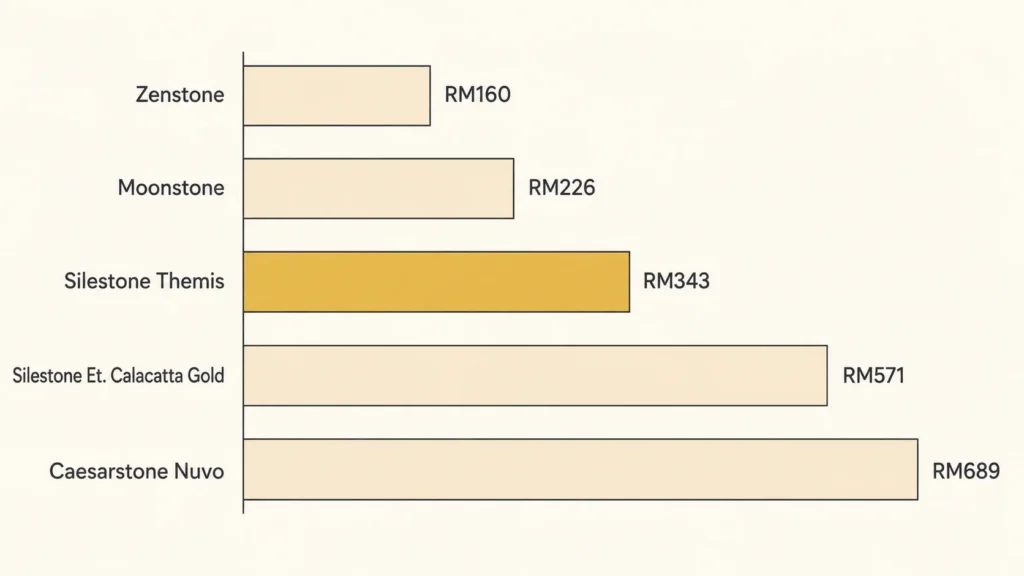
- Sinno’s Calacatta-look quartz runs from RM160/sqft (Zenstone) to RM689/sqft (Caesarstone Calacatta Nuvo), supply and install. It’s a five-rung ladder, not a two-way choice.
- Silestone Et. Calacatta Gold costs RM571/sqft. Silestone’s own Calacatta Themis and Calacatta Tova cost RM343/sqft, which is the most overlooked option in this comparison.
- Genuine quartz below roughly RM110/sqft is uncommon in Malaysia. A “Calacatta Gold” quoted well under that is usually compressed marble, not quartz.
- Budget and premium quartz share the same heat limit of roughly 150°C. Neither takes a wok straight off the flame.
What Is Calacatta Gold Quartz Stone?
Calacatta Gold quartz is an engineered stone made to replicate the look of Calacatta marble. It is not marble, and that distinction trips up more first-time buyers than any other point in this article.
Real Calacatta marble is quarried in Tuscany, is genuinely rare, costs a fortune, and needs sealing and careful handling around anything acidic. Quartz manufacturers saw the obvious opening: reproduce that white-and-gold drama without the upkeep.
The result is made from roughly 90–93% crushed natural quartz crystals bound with polymer resins and pigments, with the golden veining engineered in during manufacturing. You get a non-porous surface that resists turmeric and curry, needs no sealing, and comfortably lasts 15 to 20 years with normal care.
What varies enormously is the quality of that engineering. How convincing the veining looks, how much actual quartz is in the slab, and how the colour holds up over a decade all depend on who made it.
What Actually Separates a Budget Calacatta Gold from Silestone?
Four things: quality control, veining depth, quartz content, and whether anyone stands behind the slab in five years. Price follows those, not the other way round.
Manufacturing Origin and Quality Control
Unbranded China-imported Calacatta Gold comes from a large network of factories across Guangdong, Fujian and elsewhere. China is the world’s largest producer of engineered quartz, and the scale cuts both ways. Some Chinese factories produce genuinely excellent quartz that matches European brands. Others cut quartz content, use cheaper resins, or run inconsistent pigmentation.
The problem for Malaysian buyers isn’t that the material is Chinese. It’s that most unbranded imports arrive through trading companies rather than branded channels, so you cannot trace the factory, verify the composition, or chase anyone when something goes wrong. A slab with no name on the back is a slab with no accountability behind it.
Branded quartz solves that regardless of where it’s made. Zenstone is Sinno Stone’s own house quartz brand at roughly 93% natural quartz, which means a named product, a consistent specification, and a supplier you can come back to. Silestone Et. Calacatta Gold is made by Cosentino in Spain under standardised production, so every slab meets the same protocol and matches the sample you approved.
Veining Design and Visual Realism
Premium Calacatta Gold has veining with depth; budget Calacatta Gold has veining that sits flat on the surface. This is the difference you’ll notice every day, and it’s the one photographs hide best.
Budget-tier Calacatta Gold typically follows more uniform, repetitive vein patterns. On weaker slabs the veining looks printed on rather than integrated, and the transition between white base and gold vein is abrupt instead of gradual. The aesthetic has improved a lot in recent years and some premium-tier Chinese slabs are convincing, but the only way to know is to inspect the full slab rather than a 100mm sample.
Silestone Et. Calacatta Gold uses Cosentino’s digital veining technology, and the veins carry layers of translucent and opaque tone that read as three-dimensional. Gold and grey interplay with softer transitions. The pattern looks grown rather than printed.
If you chose Calacatta Gold specifically because you love the marble look, this is where your money actually goes.

Material Composition and Durability
Reputable Calacatta Gold quartz contains 90–93% natural quartz with polymer resin. Budget-tier slabs can drop as low as 80% quartz with more resin to cut cost, and higher resin content means more heat sensitivity, more yellowing risk under UV, and weaker scratch and stain performance.
The real hazard sits below that tier. Some ultra-cheap “Calacatta Gold quartz” priced well under RM110/sqft isn’t quartz at all. It’s compressed marble sold as quartz, which stains, scratches and deteriorates quickly in a Malaysian kitchen.
Silestone Et. Calacatta Gold uses Cosentino’s HybriQ+® formulation, a hybrid mineral composition that cuts crystalline silica below 40% and as low as 10% on some colours, with a minimum 20% recycled content including glass. The lower silica matters most to the people cutting and polishing the slab, which connects to wider concerns about silica exposure in fabrication. Silestone also adds N-Boost, a molecular surface treatment that makes liquids bead rather than spread.
Silestone carries a 25-year manufacturer warranty. Unbranded imports typically carry none.
Certifications and Traceability
Unbranded Calacatta Gold usually arrives without internationally recognised certification. That doesn’t automatically make it unsafe, but it means you’re trusting a supplier’s word instead of independent verification, with no Greenguard emissions testing and no traceable route for a warranty claim.
Silestone carries Greenguard certification for low chemical emissions, which is worth something in an enclosed Malaysian kitchen without strong ventilation, and every slab is traceable by batch number.
What Does Calacatta Gold Cost in Malaysia in 2026?
Calacatta-look quartz through Sinno runs from RM160 to RM689 per square foot, supply and install. Five rungs, not two, and the gap between them is smaller than most homeowners expect.
| Brand and colour | RM/sqft | Total for 26 sqft |
|---|---|---|
| Zenstone Calacatta Gold | RM160 | RM4,160 |
| Moonstone Calacatta Breeze | RM226 | RM5,876 |
| Silestone Calacatta Themis / Calacatta Tova | RM343 | RM8,918 |
| Silestone Et. Calacatta Gold | RM571 | RM14,846 |
| Caesarstone Calacatta Nuvo | RM689 | RM17,914 |
The 26 square foot figure is a standard L-shaped countertop for a three-bedroom Malaysian condo. Zenstone’s other Calacatta designs (Calacatta Paris, Calacatta Storm, Calacatta White) sit at RM155–160.
The Option Most Buyers Miss
If you want Silestone but RM571 is beyond the budget, look at Calacatta Themis and Calacatta Tova at RM343. Same brand, same HybriQ+® formulation, same N-Boost surface, same 25-year Cosentino warranty, at 60% of the price of Et. Calacatta Gold. The veining is different, not worse.
This is a better answer than reaching for Caesarstone’s Calacatta Nuvo as a compromise. Nuvo is a superb slab, but at RM689 it’s the most expensive quartz in the range and costs more than the Silestone it’s meant to undercut. If you want the full brand comparison, see Caesarstone versus Silestone across their ranges.
What These Prices Don’t Include
Supply and install covers the countertop at standard installation. Charged on top: cutouts beyond a single sink opening, upgraded edge profiles, backsplashes, and waterfall returns priced as additional square footage. These vary by fabricator, so read our breakdown of what every line item in a quote means before comparing two quotations.
Our 2026 quartz price guide covers every brand and collection, and the full stone countertop price guide covers other materials.
How Does Calacatta Gold Hold Up in a Malaysian Kitchen?
Well on stains and humidity, poorly on direct heat, and the white base is the part most at risk from sun. Origin changes less here than most people assume.
Heat Resistance
Both budget and premium Calacatta Gold share the same weakness, because both are bound with polymer resin. Resin begins to soften above roughly 150°C, and a wok off a gas flame runs at 250–300°C.
No Calacatta Gold quartz takes a wok straight off the burner, Silestone included. N-Boost doesn’t change heat tolerance. Keep a trivet within arm’s reach of the hob and make it part of the cooking routine rather than an afterthought.
Stain Resistance
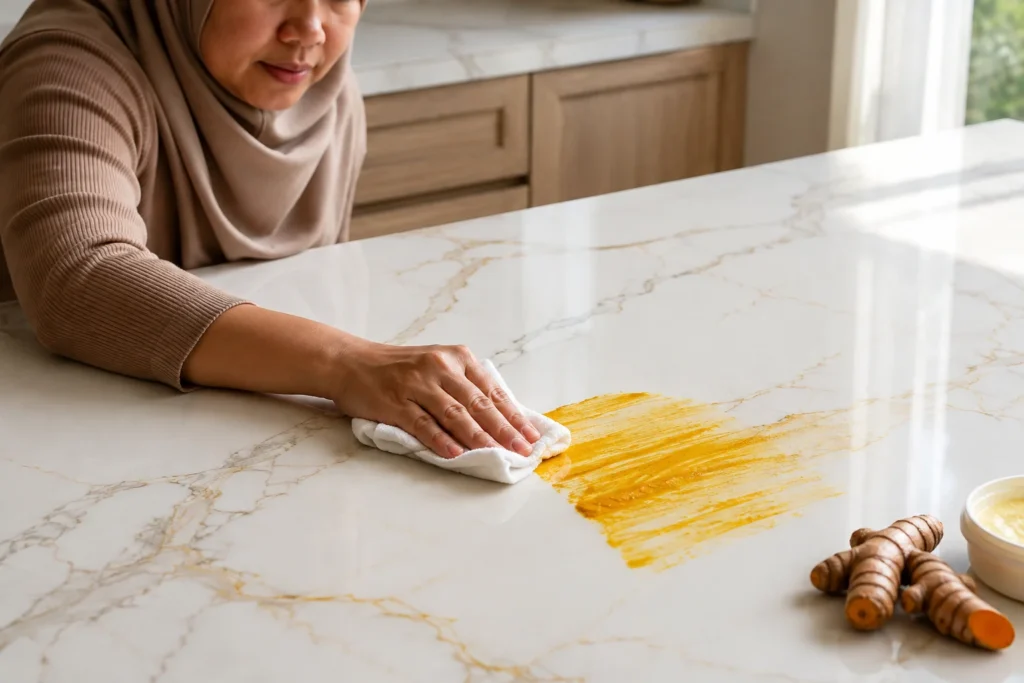
Genuine quartz at 90%+ quartz content handles Malaysian cooking stains well regardless of origin. Turmeric wipes clean off authentic quartz with a cream cleanser like CIF, which surprises most homeowners who’ve heard otherwise.
Lower-grade slabs with reduced quartz and higher resin absorb stains more readily as they age. Silestone’s N-Boost adds liquid repellency so spills bead instead of spreading, which buys you time rather than making the surface stain-proof.
Humidity and Tropical Climate
Malaysia’s year-round humidity around 80% is hard on porous materials, and neither option is porous. No mould or mildew takes hold on the surface itself, which is a real advantage over natural marble.
UV Resistance and Yellowing
This is the one that catches Calacatta Gold specifically. The whole appeal is a bright white base, and white is what shows yellowing first.
If your kitchen takes direct afternoon sun through a west-facing window, common in Malaysian apartments, UV exposure is a genuine concern. Silestone’s HybriQ+® formulation offers better UV stability than traditional quartz compositions. For unbranded imports, UV performance varies by manufacturer and cannot be verified without long-term testing. Sun damage is a warranty exclusion across essentially every quartz brand, so this one sits with you either way.
How Do You Spot Fake Calacatta Gold?
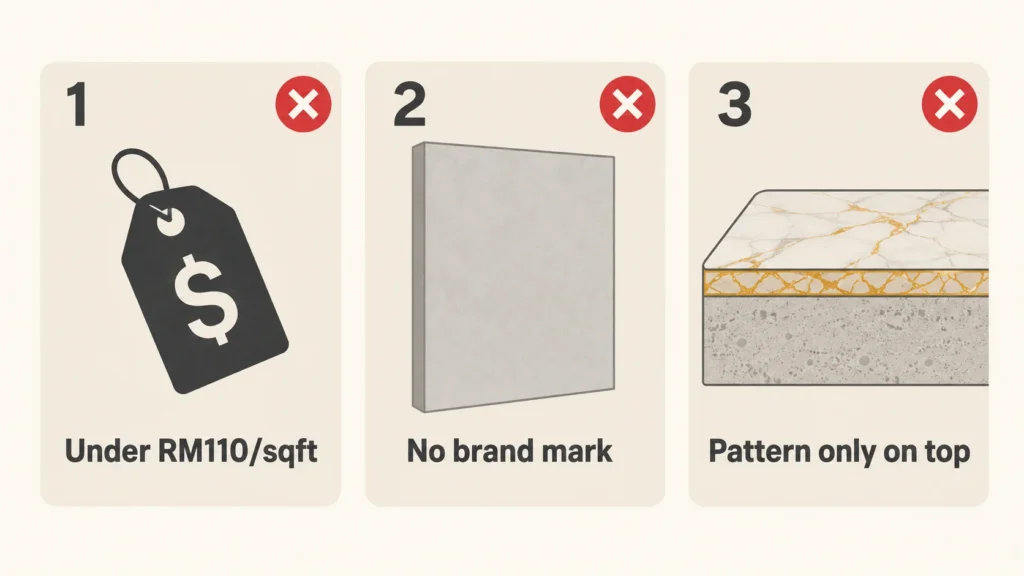
Three checks catch nearly all of it: the price, the mark on the back, and whether the pattern goes deeper than the surface.
Red Flags
Suspiciously low pricing is the strongest signal. Genuine quartz below roughly RM110/sqft is uncommon in the Malaysian market. A “Calacatta Gold quartz” quoted well under that is very likely compressed marble wearing a quartz finish.
No brand identification on the slab. Reputable manufacturers mark the back with a brand name and batch number. A completely unmarked slab with no traceable origin is a risk you’re absorbing personally.
Veining that looks too perfect, or stops at the surface. Genuine quartz carries pigment through the material’s depth. Surface-only imitations reveal a different colour underneath once the edge is profiled, which you discover after fabrication rather than before.
Our guide on how to spot fake quartz covers four at-home tests, including the glass scratch and lemon juice checks.
How to Protect Your Investment
Before paying a deposit, ask your supplier the right questions: where was the slab manufactured, what’s the factory name, what warranty applies, and how is a claim actually processed.
For Silestone, confirm your supplier is an authorised Cosentino dealer, check the brand name and batch number on the back of the slab, and match that batch number against your invoice.
Whichever tier you pick, view the full slab rather than approving a sample. A 100mm chip cannot show you vein placement across three metres, which is exactly why choosing on a sample alone goes wrong.

Which Calacatta Gold Should You Choose?
Match the tier to how long you’ll live with it and how much sun the counter takes. Three honest profiles.
Choose Zenstone or Moonstone Calacatta If
- Budget is the deciding factor and you want to keep the countertop under RM6,000
- You’re fitting out a rental or investment unit where ultra-premium finish won’t change the return
- The kitchen is indoors without heavy afternoon sun
- You accept the trade-offs: flatter veining and a shorter practical lifespan than premium tiers
- You’ve inspected the full slab in person
Choose Silestone Calacatta Themis or Tova If
- You want branded quality, traceability and the 25-year Cosentino warranty without paying RM571/sqft
- You like the Calacatta look but aren’t committed to the exact Et. Calacatta Gold vein pattern
- This is the value pick of the five, and the one most buyers never get shown
Choose Silestone Et. Calacatta Gold If
- This is your long-term home and you want it to still look right in year 15
- The veining itself is the reason you chose Calacatta Gold, and you want the closest quartz approximation to real marble
- Your kitchen takes direct sun and UV stability matters
- You want warranty security you can actually claim against
How Long Does Installation Take?
In-stock material installs within about 7 working days. Special-order material from Spain takes 21 to 28 days.
Most Zenstone and Moonstone colours sit in Malaysian warehouses, so templating to installation runs roughly a week. Silestone Et. Calacatta Gold is generally a special order, and the 21 to 28 days covers overseas shipping, customs clearance, fabrication and fitting. Installation itself is usually a single day for a standard kitchen.
Plan this into your renovation sequence rather than discovering it late. Our guide on how long countertop installation takes in Malaysia sets out the full timeline.
Quartz needs CNC cutting and precision edge profiling, so this is not a DIY material. For Silestone, using an authorised fabricator is what keeps the 25-year warranty valid.

FAQ
How much does Calacatta Gold quartz cost in Malaysia? Calacatta-look quartz runs RM160 to RM689 per square foot supply and install, depending on brand. Zenstone Calacatta Gold sits at RM160, Moonstone Calacatta Breeze at RM226, Silestone Calacatta Themis and Tova at RM343, Silestone Et. Calacatta Gold at RM571, and Caesarstone Calacatta Nuvo at RM689.
Is Silestone Calacatta Gold worth the extra money over a budget slab? It depends on how long you’re staying and how much sun the counter gets. Over a 15-year stay in a sun-facing kitchen, the better UV stability, deeper veining and 25-year warranty justify it. For a rental unit or a short-term hold, they don’t.
Is Calacatta Gold quartz the same as Calacatta marble? No. Calacatta Gold quartz is engineered stone made from roughly 90–93% crushed quartz and resin, designed to look like Calacatta marble. Real Calacatta marble is a porous natural stone quarried in Italy that needs sealing and careful handling around acidic food.
Will a white Calacatta Gold countertop yellow over time? It can, if it takes prolonged direct sunlight. The resin in quartz is what yellows, so a west-facing kitchen window is the main risk. Silestone’s HybriQ+® formulation resists it better than standard quartz, but sun damage is excluded from essentially every quartz warranty.
Can I put a hot wok on Calacatta Gold quartz? No, on any brand. Quartz resin softens above roughly 150°C and a wok off a gas flame reaches 250–300°C. Use a trivet regardless of what you paid per square foot.
Conclusion
The honest verdict is that “China versus Silestone” is the wrong frame. The real question is whether the slab is traceable and whether the tier suits how long you’ll live with it.
Budget-tier Calacatta Gold from a named brand delivers a genuinely good-looking kitchen at RM160 to RM226 per square foot. It won’t match Silestone’s veining depth or warranty, and it isn’t meant to. Silestone Et. Calacatta Gold at RM571 earns its price through visual depth, UV stability and 25 years of manufacturer backing, and Calacatta Themis at RM343 splits the difference better than anything else on the list.
The bad outcome isn’t picking the wrong tier. It’s buying an unmarked slab from a supplier who cannot tell you which factory made it or what’s actually in it. Whether you spend RM4,000 or RM18,000, make sure you’re getting genuine quartz stone from someone accountable.
Come and see the full slabs before you decide. Bring your cabinet door sample, stand the slabs up in daylight, and choose with your eyes rather than a screen. That’s how a kitchen transformation starts properly.