

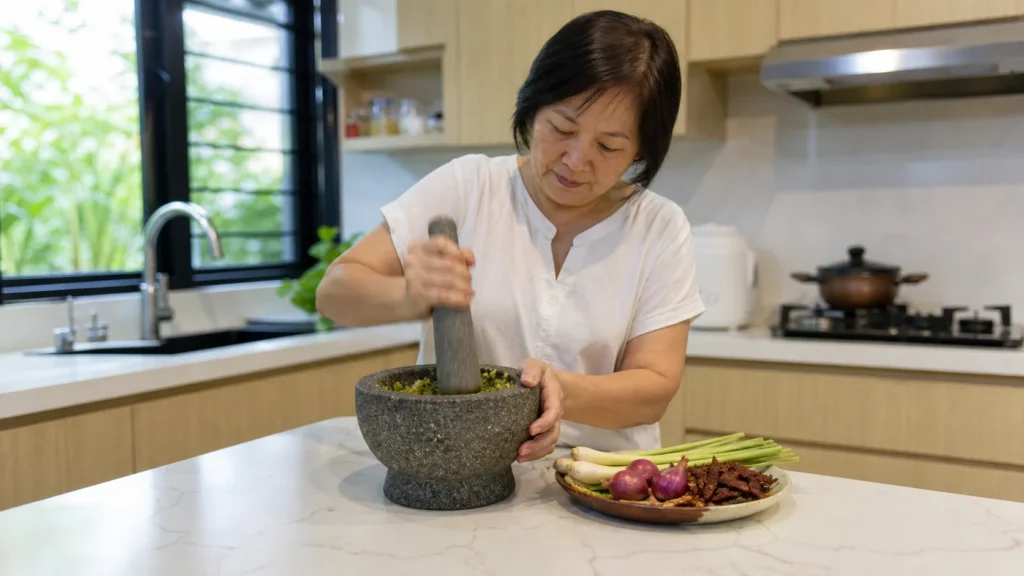
You can, but you shouldn’t do it directly on either surface. Quartz stone and sintered stone both shrug off heat, stains and scratches in a Malaysian kitchen, but neither material is built for the repeated percussive impact of a granite batu lesung landing on the same spot fifty times in a row.
That doesn’t mean giving up your sambal. It means putting something between the mortar and the slab, which takes about two seconds and costs almost nothing.
Key Takeaways
- Never pound directly on quartz or sintered stone. A thick hardwood board or a rubber mat under the mortar removes the risk entirely.
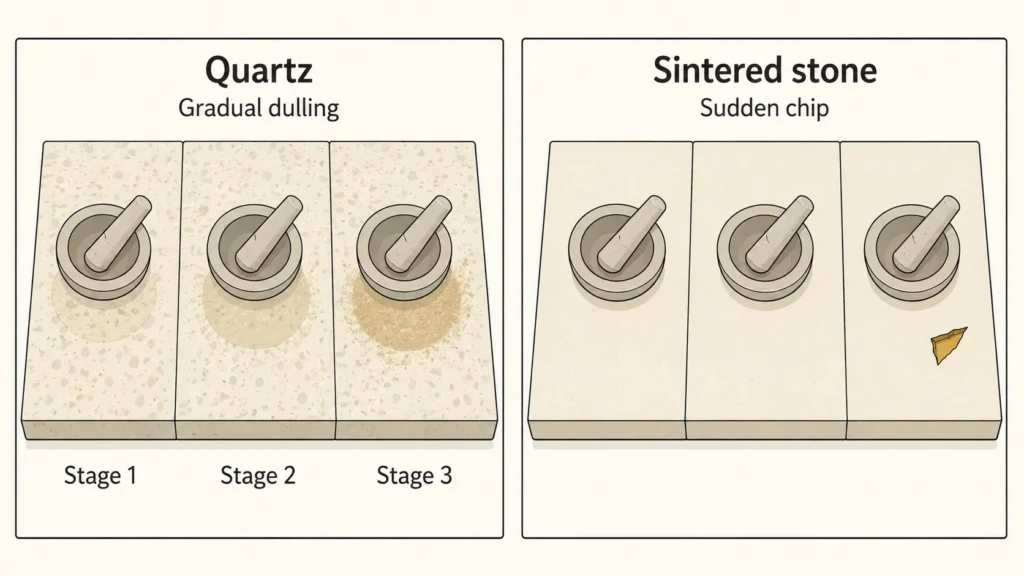
- Quartz fails gradually. The resin absorbs part of each blow, so damage shows up as a dull patch or micro-fractures that trap stains months later.
- Sintered stone fails suddenly. It is harder on the surface but more brittle, so heavy pounding is likelier to chip it than to dull it.
- A chip in sintered stone is the harder problem to live with, because the decorative layer is thin and polishing the damage out exposes the body colour underneath.
- Edges, sink cutouts and seam joints are the worst places to pound on either material. Keep the mortar well inside the slab and over a cabinet, not over an unsupported span.
Why Does Pounding Stress a Countertop Differently From Chopping?
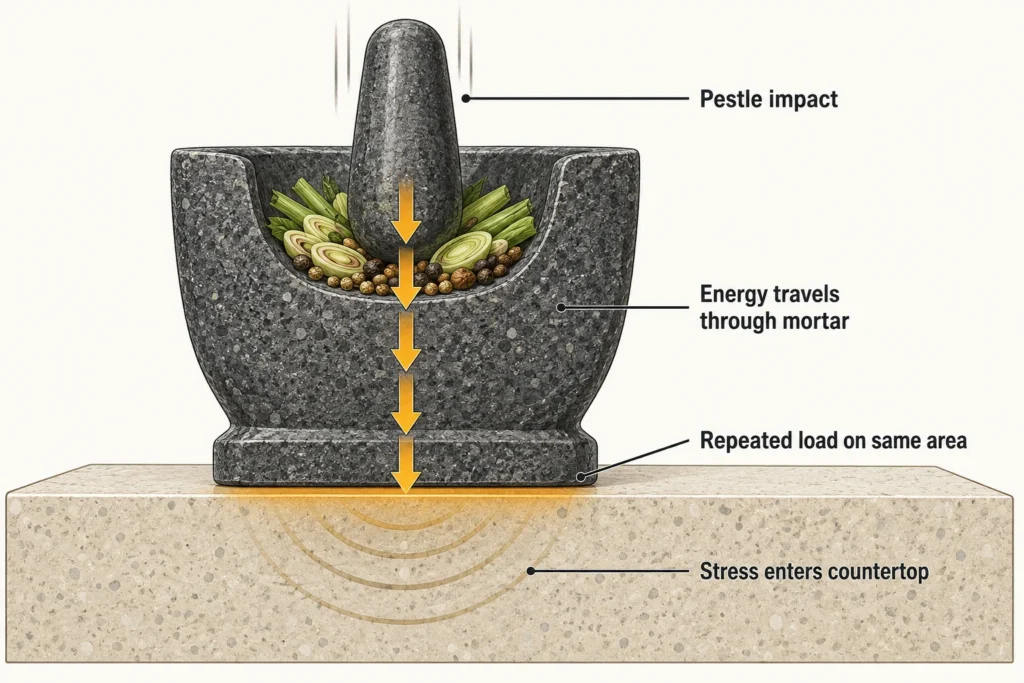
Pounding is percussive, and that makes it a different kind of load altogether. A knife spreads its force along the length of a blade. A hot pot puts static weight on a wide flat base. A batu lesung concentrates the full weight of the mortar plus your arm into the small ring where its base meets the stone, then repeats that shock every half second.
A traditional granite mortar weighs roughly 3kg to 8kg. Each strike sends that mass, accelerated by your arm, straight down through a contact patch smaller than your palm.
This is also why hardness ratings don’t answer the question on their own. The Mohs hardness scale tells you how well a surface resists scratching. It says nothing about how a slab handles a sharp blow, which is a separate property called toughness. A material can be extremely hard and still crack under impact, and that distinction sits at the centre of everything below.
Can You Pound Lemongrass on a Quartz Countertop?
Light pounding on quartz rarely causes visible damage straight away, but repeated heavy pounding will wear the surface down over time. Quartz countertops are made from roughly 90% to 95% natural quartz crystals bound with polymer resin, which puts them around 7 on the Mohs scale, harder than a steel knife blade.
Why the Resin Works in Your Favour
The resin content is what saves quartz here. Unlike a purely mineral surface, quartz has a small degree of flex. When force lands on it, part of that energy goes into deforming the resin matrix rather than travelling rigidly through the slab. It is the same property that makes quartz more forgiving when a heavy pot slips out of your hand.
For gentle work, bruising a few lemongrass stalks or crushing three cloves of garlic, quartz will take it without complaint.
Where the Risk Builds Up
Heavy, sustained pounding is a different matter. A proper sambal belacan session, hammering dried chillies and shallots until they break down, creates concentrated stress in one small area over and over.
Three things can follow. First, the surface can develop micro-fractures too fine to see, which quietly break the non-porous seal that makes quartz stain-resistant. Cooking oil and turmeric then have somewhere to go, and the discolouration that appears weeks later will not clean off. Second, the patch under the mortar can turn dull and matte as the polish wears away, which shows up badly on dark colours. Third, if the mortar shifts mid-swing and lands on its rim rather than flat, you can chip the surface in a single blow.
There is a commercial angle too. Most quartz manufacturers exclude impact damage from their warranty, so a chip from mortar work is your cost, not theirs.
The Verdict on Quartz
Quartz tolerates light mortar use and degrades slowly under heavy use. It is forgiving rather than immune, and the cumulative wear is the part homeowners underestimate.

Can You Pound Lemongrass on a Sintered Stone Countertop?
Sintered stone resists the surface marking better than quartz, but it carries a higher risk of chipping outright. The material is made by pressing natural minerals under extreme pressure and firing them above 1,200°C with no resin at all, which produces a dense surface rating 7 to 8 on the Mohs scale.
A Harder Surface With No Resin
Sintered stone is essentially ultra-compressed mineral, closer in nature to the granite batu lesung itself. Two hard mineral surfaces meeting each other scuff far less than a mineral mortar grinding against a resin-bound one. Dragging a heavy mortar across sintered stone is unlikely to leave the dull patch that quartz would show.
The Brittleness Problem
The same hardness that keeps the surface pristine is what makes it brittle, and this is one of the well-documented disadvantages of sintered stone that homeowners find out about too late.
With no resin to absorb and spread the energy, a blow travels rigidly through the slab. A sharp concentrated impact, which is exactly what mortar work produces, can chip or crack it. The risk climbs sharply near edges, around sink cutouts and along seam joints, where the slab has less material around the impact point to carry the load.
Repair is the part that stings. A minor chip in quartz can be filled with colour-matched resin that bonds into the material. Sintered stone can’t be repaired the same way, because the decorative layer sits only about a millimetre deep. Polish the damage out and you go straight through the pattern to the lighter body colour beneath. Serious damage usually means replacing the piece.
The Verdict on Sintered Stone
Sintered stone stays looking newer under light use and fails harder under heavy use. Less gradual wear, more risk of one bad afternoon.

Which Handles Mortar Pounding Better, Quartz or Sintered Stone?
Neither is designed for it, but they fail in opposite ways, and that difference matters more than picking a winner.
| Quartz stone | Sintered stone | |
|---|---|---|
| Surface hardness | Around 7 on Mohs | 7 to 8 on Mohs |
| Resin content | Roughly 5% to 10% polymer resin | None |
| Behaviour under impact | Flexes slightly, absorbs part of the energy | Rigid, transmits the force through the slab |
| Typical failure | Dull patch, micro-fractures, staining later | Sudden chip or crack |
| Light pounding, such as bruising lemongrass | Usually unmarked, still not advised | Surface stays unmarked, still not advised |
| Heavy pounding, such as sambal belacan | Wear accumulates over months | Real chip risk, especially near edges |
| Repair options | Colour-matched resin fill often works | Difficult, thin decorative layer, often needs replacement |
Read that table as two personalities rather than a scoreboard. Quartz gives you warning: the patch dulls, you notice, you change habits. Sintered stone gives you no warning at all, then hands you a chip that is expensive to put right. If you want the fuller picture beyond impact alone, our guide to how quartz and sintered stone compare overall covers heat, scratches, UV and cost side by side.
How Do You Protect Your Countertop and Keep Using Your Batu Lesung?
Put something absorbent between the mortar and the stone. That single habit closes the entire issue, and you have four practical options.
Use a Thick Wooden Chopping Board
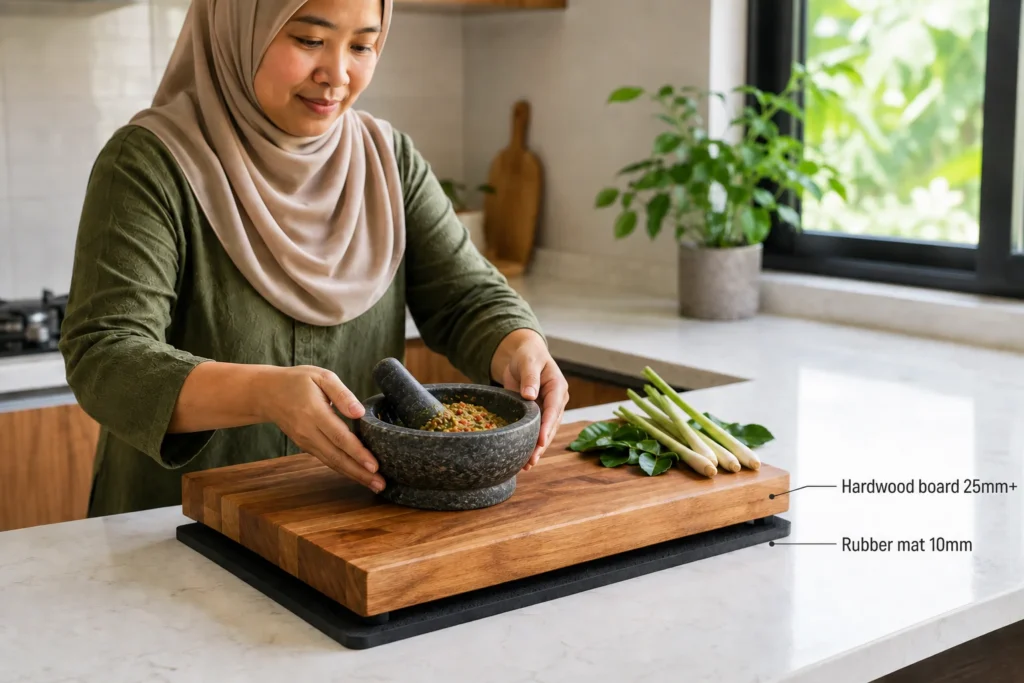
This is the simplest fix and the most effective. Place a hardwood board at least 25mm thick under the mortar before you start. The wood takes the shock and passes almost nothing to the slab. Rubber wood and acacia boards do the job and are easy to find at MR.DIY, IKEA Malaysia or your local kitchenware shop.
Make sure the board is wider than the mortar base by a decent margin. If the mortar creeps towards the edge during a long pounding session, you want it still landing on wood.
Add a Rubber Mat Underneath
A food-grade silicone or rubber mat around 10mm thick absorbs shock well and, just as usefully, grips both the countertop and the mortar base so nothing slides. Board plus mat together is the belt-and-braces version, and it also cuts the noise, which your neighbours in a condominium will appreciate.
Set Up a Dedicated Pounding Station
Many Malaysian homes separate the dry kitchen from the wet kitchen, and heavy pounding belongs firmly in the wet kitchen. If you have the space, give it a spot of its own: a sturdy kitchen trolley, a standalone wooden table, or a granite offcut laid on a low counter. A granite offcut is the local favourite, since it takes unlimited punishment and costs little if a fabricator has one spare.
Match the Mortar to the Job
Not every mortar hits equally hard. A heavy granite batu lesung built for pounding rempah delivers far more force than a small ceramic mortar meant for herbs. If most of your work is lemongrass, ginger and garlic, a lighter mortar reduces the load on whatever sits beneath it.
What About Other Traditional Malaysian Kitchen Tasks?
Some are completely safe on stone, and two carry the same impact risk as mortar work.
Rolling dough for roti canai or kuih is fine on both materials. A smooth non-porous surface is an excellent pastry bench, flour wipes straight off, and there is no impact involved. Just keep the rolling pin from knocking against the countertop edge.
Tenderising meat with a mallet carries the same risk profile as pounding. Use a thick board underneath every time.
Chopping bones with a cleaver is the highest-risk task of the lot, and it can chip either material in one strike. Never bring a cleaver down on a stone countertop directly, no matter which stone it is.
The logic is the same one you already apply when you avoid putting hot pans straight onto quartz. Small habit, large saving.

How Do You Check Your Countertop After Mortar Use?
Look at the area under your board every month or so, in raking light rather than straight on. Stand to one side of the counter and let light skim across the surface, which makes a dull patch or a fine crack visible when a head-on look would miss it.
On quartz, you are watching for a change in sheen. If the patch under the mortar reflects light differently from the stone around it, the polish is wearing and your protection needs upgrading before staining follows. Keep the area clean while you are at it, and stick to the methods in our guide on cleaning your quartz countertop the right way, because abrasive scouring will dull a surface just as effectively as a mortar will.
On sintered stone, run a fingernail along the nearby edges and around any cutout. Small chips catch the nail before your eye picks them up, and a chip found early is far cheaper to address than one that has spread.
FAQ
Can I pound lemongrass directly on quartz if I only do it occasionally? Occasional light pounding is unlikely to leave a visible mark on quartz, because the resin absorbs part of each blow. It is still worth putting a board down, since “occasionally” has a way of becoming twice a week, and the wear is cumulative rather than obvious.
Will a wooden chopping board really absorb enough impact? Yes, provided it is solid hardwood at least 25mm thick and wider than the mortar base. Wood compresses slightly under each strike and dissipates the energy before it reaches the stone, which is why butchers have used thick wooden blocks for centuries.
Does a chip caused by a mortar count as a warranty claim? Almost certainly not. Quartz and sintered stone warranties cover manufacturing defects, and nearly all of them exclude impact damage explicitly, so a chip from mortar work will be treated as misuse rather than a fault in the material.
Is granite a better choice if I use a batu lesung every day? Granite handles impact well and is the traditional pounding surface for good reason, but it is porous and needs periodic sealing, which is its own maintenance trade-off. A better answer for most kitchens is to keep the countertop you want and give the mortar a granite offcut or a thick board to land on.
I already have a dull patch where I’ve been pounding. Can it be fixed? On quartz, a fabricator can sometimes re-polish a dulled area, though matching the original sheen across a large top is difficult and the result may still be visible in raking light. On sintered stone, re-polishing risks cutting through the decorative layer, so ask your fabricator to assess it before anyone touches the surface.
Conclusion
Can you pound lemongrass on your quartz or sintered stone countertop? Not directly, on either one. Quartz will forgive light work and wear down under heavy work. Sintered stone will keep looking flawless until the day it chips.
The fix is almost insultingly simple. Slide a thick wooden board or a rubber mat under the mortar and pound as hard as your rendang requires. Your sambal belacan, your laksa paste, your rempah: none of them need to cost you a countertop.
Your batu lesung has earned its place in the kitchen. Your countertop has earned a board between them. If you are still choosing a material and want to know how each one behaves in a kitchen that actually cooks, our team is happy to talk you through it before you commit.