

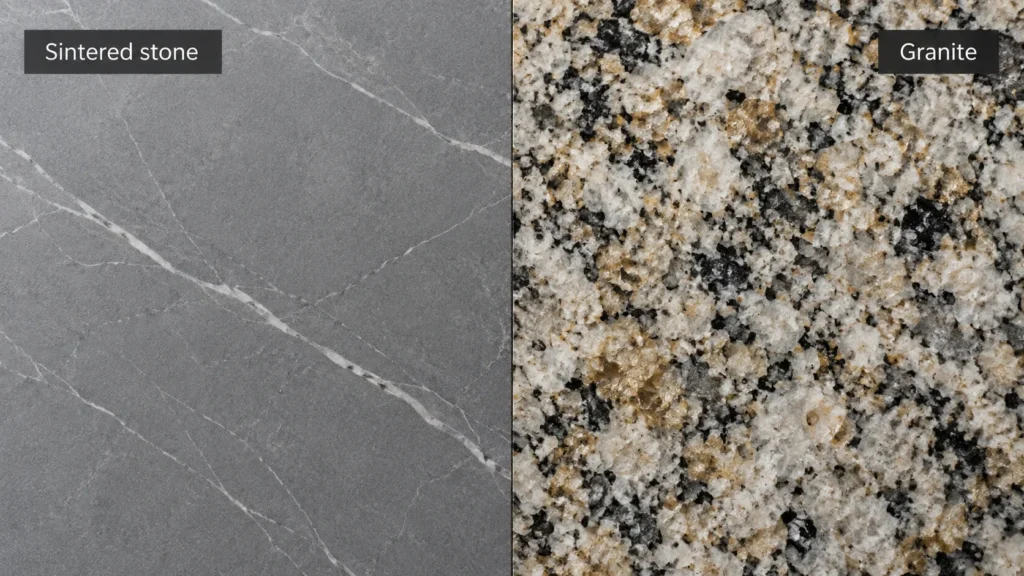
For most Malaysian kitchens, sintered stone is the better countertop, because it matches granite on heat and beats it on stains, sealing and slab matching. Granite still holds two advantages that matter to some households: it is genuine natural stone, and every slab is one of a kind. The gap between them is not about which stone is tougher. It is about how much upkeep you are willing to keep doing in year five, year ten and year fifteen.
Key Takeaways
- Both materials take a hot wok. Sintered stone is fired above 1,200°C and withstands sustained heat to around 300°C, and granite formed from cooling magma, so neither one scorches.
- Sintered stone is non-porous from the inside out. Standard granite is porous and needs re-sealing every one to three years, which is the single biggest practical difference in a Malaysian kitchen.
- Sensa Granite by Cosentino closes most of that gap. SenGuard is applied at the factory and carries a 15-year written warranty against oil, coffee and acid stains, with no re-sealing schedule.
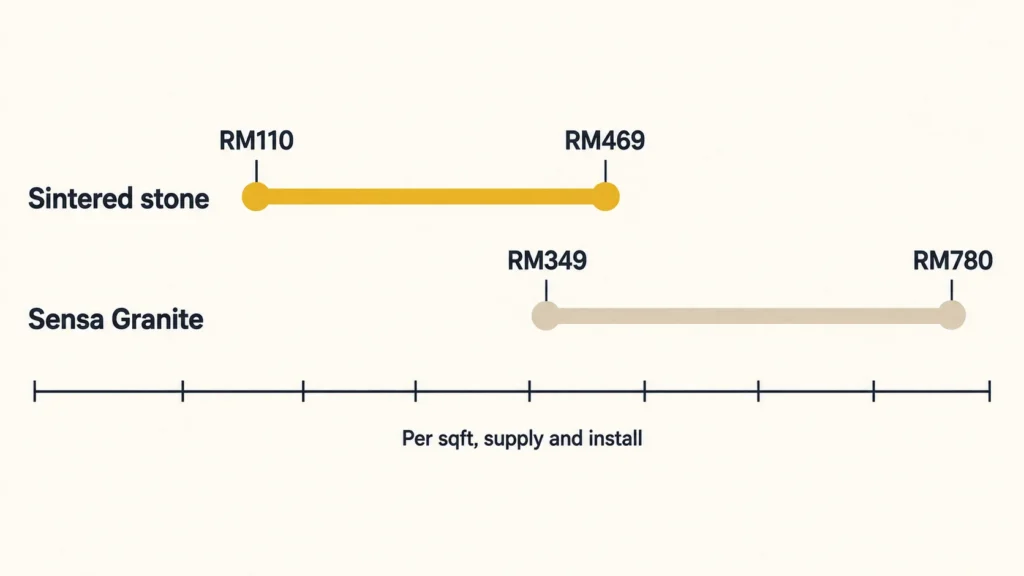
- 2026 supply-and-install pricing: sintered stone runs RM110 to RM469 per sqft, Sensa Granite runs RM349 to RM780 per sqft. Unbranded granite is quoted per slab.
- Sintered stone slabs match across a large kitchen. Granite slabs never do, so plan the join before anything is cut.
What is sintered stone, and what is granite?
One is manufactured to be consistent, the other is quarried and is different every time. That single difference drives almost everything else in this comparison.
What is sintered stone?
Sintered stone is an engineered surface made by compressing natural minerals such as silica, clay, feldspar and mineral pigments under roughly 25,000 tonnes of pressure, then firing the slab at around 1,200°C. The particles fuse permanently with no resin binder, which leaves a dense slab with close to zero porosity and consistent colour through its full thickness.
In Malaysia the two names you will meet most often are Dekton by Cosentino from Spain and Moca Compact, which is locally supplied. If you want the full manufacturing picture rather than the comparison, our guide to sintered stone explained for Malaysian homes covers the features and the drawbacks in detail.
What is granite?
Granite is 100% natural igneous rock, formed as magma cooled slowly deep underground over millions of years. The speckles, veins and tonal shifts you see in a slab are the actual mineral crystals that formed during that cooling, which is why no two slabs are identical.
Granite has been the default countertop in Malaysian homes for decades. Walk into an older landed house in Petaling Jaya or a terrace house in Penang and the kitchen top is very likely granite, still in service. Premium branded granite here means Sensa by Cosentino, which arrives with SenGuard already applied at the factory, a stain-resistant treatment carrying a 15-year warranty against oil, coffee and acid stains. Our granite buying guide for Malaysian kitchens goes deeper into where granite still wins.
One warning before you shop. Some suppliers label granite as “quartzite” because the name sounds more premium, which makes quotes hard to compare like for like. We unpacked that in why some suppliers call granite “quartzite”.
Which one handles wok heat better?
Both handle it, with sintered stone holding a small edge over the long run. This is the one category where granite genuinely competes with the newer material rather than trailing it.
Sintered stone was fired above 1,200°C during manufacturing and withstands sustained heat of around 300°C in service. A wok straight off a high gas flame does nothing to it, and sintered stone’s heat resistance is the clearest advantage it holds over resin-bound quartz.
Granite also takes direct heat without scorching, for the same reason it exists at all. What granite is less comfortable with is thermal shock, meaning a sharp temperature change across a small area. A slab with existing micro-cracks, or one that takes a screaming hot wok on the same spot several times a week for years, can develop hairline fractures or a dulled patch where the sealed finish has degraded.
For a household that fries daily, cooks rendang over hours, or moves a claypot from stove to counter during a reunion dinner, both materials cope. If that cooking happens in a separate wet kitchen, read what is the best countertop for a wet kitchen in Malaysia before you split the budget between the two rooms.
Winner: Sintered stone, narrowly

Which resists scratches and chips better?
Sintered stone, mostly at the edges. On the flat surface, the difference between the two is academic.
On the Mohs hardness scale, sintered stone sits at 7 to 8 and granite at 6 to 7. Both sit above the hardness of a kitchen knife, so neither surface scratches from ordinary chopping, sliding pots or dragging a ceramic bowl. You would have to work at it to leave a visible mark on either.
The real difference shows at corners and edges. Granite is a natural material with its own internal inconsistencies, and those weak points concentrate at a cut edge, so granite chips more readily when a heavy pot is knocked against a corner or during fabrication. Sintered stone is uniform all the way through, so its edges hold up better to knocks, although a hard strike from underneath can still crack it.
Neither material forgives a slab that is poorly supported. Both crack from bad installation far more often than from anything you do while cooking.
Winner: Sintered stone, on edge durability
Which one survives turmeric, curry oil and kopi?
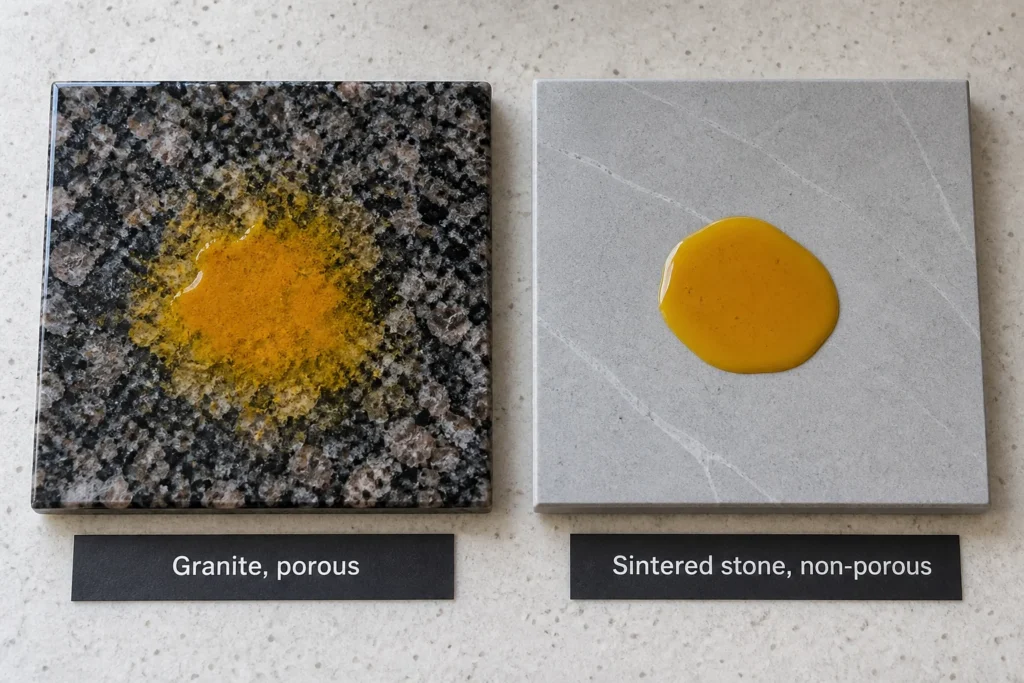
Sintered stone, without any contest. This is where the gap opens widest, and it is the category that matters most in a Malaysian kitchen.
Think about what actually lands on a Malaysian counter in a normal week: turmeric, curry paste, kicap manis, santan, cooking oil and strong kopi. Turmeric is the one that catches people out, because it stains fast and it stains yellow, which shows on almost every granite colour.
Standard granite is porous. Microscopic gaps between the mineral crystals let liquid work its way in, and once a stain has penetrated below the surface it is very difficult to lift. That is why standard granite is sealed on installation and re-sealed every one to three years. Malaysia’s humidity, sitting at 70 to 90% year-round, gives sealant a shorter working life here than it would get in a dry climate. Miss a cycle and a spilled mug of kopi has minutes rather than an afternoon before it leaves a mark.
Sensa Granite with SenGuard changes the maths considerably. A factory-applied treatment with a 15-year warranty against exactly the three things that ruin Malaysian granite counters, oil, coffee and acid, removes the re-sealing schedule entirely. Be precise about what that means though: SenGuard protects a stone that is still porous underneath. It closes the gap. It does not erase it.
Sintered stone has nothing to seal. It does not absorb liquid because there is nowhere for liquid to go, so stain resistance is a property of the material rather than a coating applied to it. That also means no micro-pores for bacteria to sit in, which matters on a food preparation surface in a hot, humid climate.
Winner: Sintered stone, with Sensa Granite a much closer second than standard granite
How much upkeep does each one actually need?
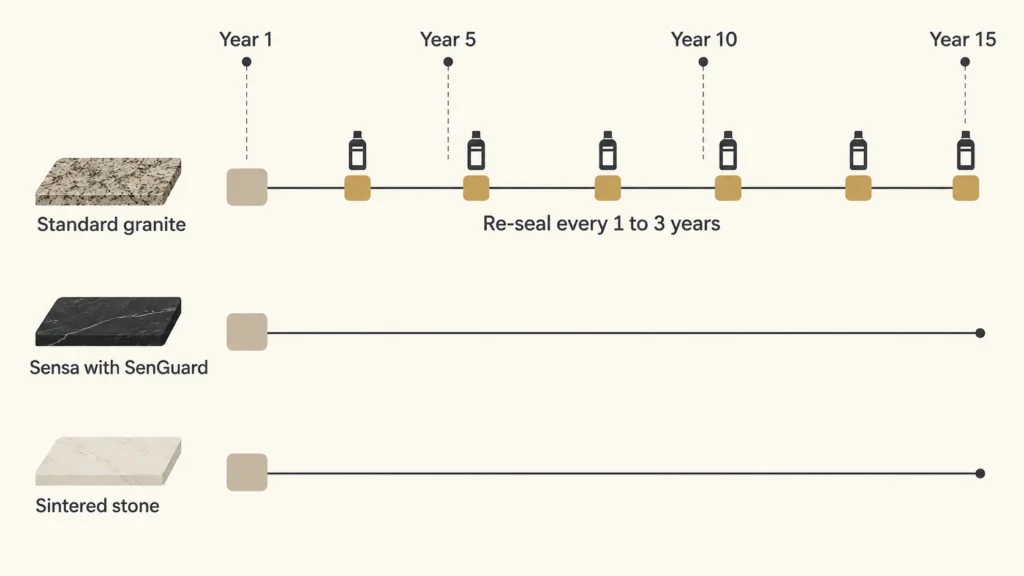
Sintered stone needs the least, standard granite needs the most, and Sensa Granite sits close to sintered stone.
Standard granite asks for a sealing appointment every one to three years, careful use of stone-safe cleaners, and quick cleanup of anything oily or acidic. None of that is difficult. The problem is that most homeowners overestimate how reliably they will do it. A counter that looks superb on handover day but wants attention every second year tends to become a grievance by year six.
Sensa Granite removes the sealing schedule, which is the biggest single chore. You still clean it properly and keep abrasive scouring products away from the treated surface, but the recurring cost and the diary reminder both disappear.
Sintered stone asks for a damp cloth. No sealing, no specialist stone cleaner, no annual schedule. Stubborn marks come off with a mild household cleaner. Over fifteen years that difference adds up in money as well as effort, which is worth running before you compare the two quotations line by line.
Winner: Sintered stone, with Sensa Granite close behind
Which one looks better in a Malaysian home?
Neither. This one is genuinely personal preference, and it is the category where granite still wins hearts.
Granite gives you depth that no engineered slab fully copies. The crystalline patterns formed underground over millions of years, and polished granite catches light in a way a pigmented or printed pattern does not quite match. If you want a kitchen nobody else has, granite delivers that by definition.
Sintered stone gives you the opposite advantage: predictability. Marble-look veining, concrete textures, solid matte colours and wood-effect patterns, all consistent from slab to slab. That consistency is what lets you run one design across counter, island and backsplash without a visible shift where the pieces meet.
That shift is a real planning issue with granite. If your kitchen needs more than one slab for an L-shaped run or a large island, the colour and pattern will change at the join. Hand-pick your slabs at the yard, ideally from the same block, and agree with your fabricator where the seam sits before anything is cut. It also means a matching repair or extension two years later is close to impossible.
Either way, do not choose from a 10cm chip. A sample tells you almost nothing about what a three-metre slab will look like on your island, which is the trap covered in why you shouldn’t choose your countertop from a sample only.
Winner: Personal preference

What do sintered stone and granite cost in Malaysia in 2026?
Sintered stone starts far lower and stretches across a wider range. Branded granite starts where mid-range sintered stone ends.
Sintered stone, supply and install per square foot:
| Range | Price per sqft |
|---|---|
| Moca Compact Regular | From RM110 |
| Moca Compact Leather and Premium | From RM130 |
| Moca Compact Homogeneous | From RM150 |
| Dekton Group 0 | RM248 |
| Dekton Group 1 | RM320 |
| Dekton Group 2 | RM351 |
| Dekton Group 3 | RM400 |
| Dekton Group 4 | RM469 |
Sensa Granite by Cosentino, supply and install per square foot:
| Colour | Price per sqft |
|---|---|
| Siberia | RM349 |
| Moak Black | RM518 |
| Glacial Blue | RM622 |
| Sant Angelo | RM655 |
| Orinoco | RM780 |
Two things are worth reading out of those tables. First, sintered stone gives you far more room to step up gradually, from RM110 all the way to RM469, so the budget conversation has more than two answers in it. Second, SenGuard is included at every Sensa price point, so you are not paying separately for the stain protection.
Unbranded granite from hardware suppliers and smaller stone merchants sits below Sensa, and it is quoted per slab rather than per square foot, because you are buying one specific piece of stone rather than a repeatable product. What you give up is consistency of quality, a guaranteed sealing treatment, and someone accountable if the fabrication goes wrong. For the wider picture across every material, see our 2026 stone countertop price guide.
Winner: Sintered stone, on budget flexibility
Does either one need special fabrication?
Both need a proper stone fabricator, and neither is a job for a tiler or a general renovation contractor.
Granite is heavy, and its natural inconsistencies mean every slab has to be templated and handled carefully to avoid cracking during cutting and transport. Sintered stone at 12mm needs fabricators with the right diamond tooling and real experience in the material, because a chipped edge on a fired slab is far harder to make good than on natural stone.
The failure mode people underestimate is buying the slab from one party and asking someone else to fit it. Nobody carries the warranty in that arrangement, and the fabricator who did not supply the stone has no reason to accept a cracked slab as their problem. Here is why that almost always goes wrong.
Winner: Draw, both need a proper fabricator
So which is better for Malaysian kitchens?
Sintered stone, for most households. It matches granite where granite is strongest and beats it everywhere granite is weakest, and it starts at a lower price.
| Factor | Sintered stone | Granite |
|---|---|---|
| Heat resistance | Excellent, to around 300°C | Excellent, watch thermal shock |
| Scratch resistance | Excellent, Mohs 7 to 8 | Very good, Mohs 6 to 7 |
| Edge and chip resistance | Better | Chips more readily |
| Stain resistance | Non-porous, nothing to seal | Porous. Sensa with SenGuard: 15-year warranty |
| Sealing | Never | Every 1 to 3 years, or never with Sensa |
| Slab matching | Consistent across slabs | Every slab differs |
| Natural character | Engineered | 100% natural, unique |
| 2026 supply and install | RM110 to RM469 per sqft | RM349 to RM780 per sqft (Sensa) |
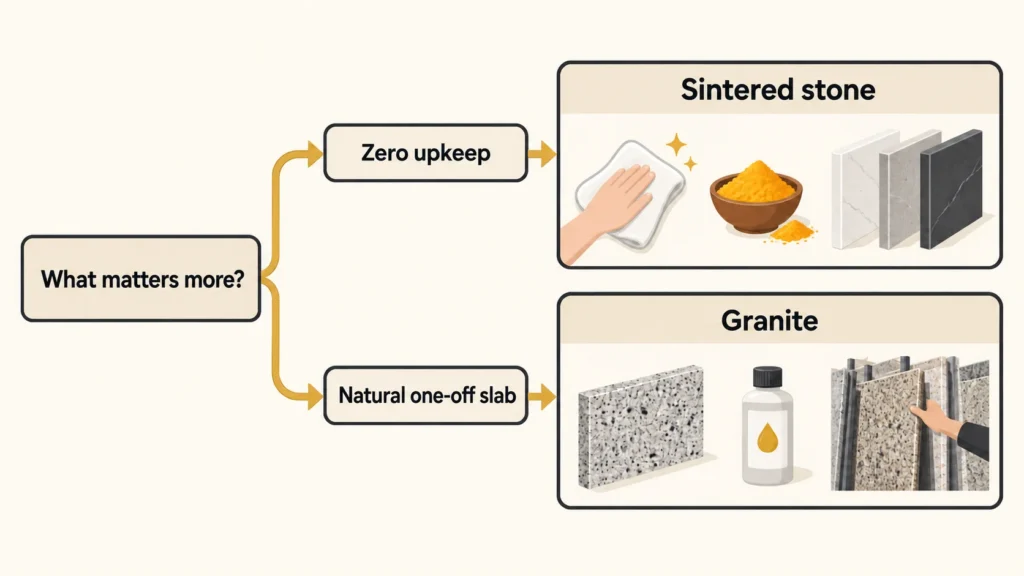
Choose sintered stone if you:
- Cook heavily with turmeric, curry paste and acidic ingredients
- Want a counter that asks nothing of you after handover
- Need slabs to match across counter, island and backsplash
- Want to start at RM110 per sqft and step up as the budget allows
- Are running the surface outdoors or into a wet kitchen with an open window
Choose granite if you:
- Want real natural stone with a slab nobody else has
- Prefer warm-toned crystalline stone over engineered uniformity
- Will either keep to a sealing schedule honestly or pay for Sensa and get the 15-year warranty instead
- Can visit a yard and hand-pick the actual slab before it is cut
Granite is not a poor choice, and Sensa Granite in particular answers the strongest practical objection to granite in this climate. But if you are choosing on how the kitchen will behave in year ten rather than on how it photographs in month one, sintered stone is the safer bet for a Malaysian household.
FAQ
Is sintered stone better than granite for Malaysian kitchens? For most kitchens, yes. Sintered stone matches granite on heat resistance and beats it on stain resistance, sealing, edge durability and slab matching, while starting at a lower price. Granite keeps the advantage on natural character and on being a genuine one-off slab.
Can you put a hot wok directly on sintered stone and granite? Yes, on both. Sintered stone is fired above 1,200°C and withstands sustained heat of around 300°C, and granite formed from cooling magma, so neither scorches from direct contact with hot cookware. Granite is the one more affected by repeated thermal shock in the same spot over many years.
Does granite stain from turmeric in a Malaysian kitchen? Standard granite can, if its sealing has lapsed. Turmeric stains fast and stains yellow, which shows on most granite colours. Properly sealed granite gives you minutes to wipe it up, and Sensa Granite with SenGuard carries a 15-year warranty against oil, coffee and acid stains without any re-sealing.
How much does sintered stone cost compared to granite in Malaysia? Sintered stone runs RM110 to RM469 per square foot supply and install in 2026, while Sensa Granite runs RM349 to RM780. Entry-level sintered stone costs roughly a third of the cheapest branded granite, and premium Dekton still sits below most Sensa colours.
Does sintered stone need sealing like granite? No. Sintered stone is non-porous the whole way through, so there is nothing for a sealer to do. Standard granite needs sealing on installation and re-sealing every one to three years, which Malaysia’s 70 to 90% humidity tends to push towards the shorter end.
Can my renovation contractor install a sintered stone or granite countertop? Not properly. Both materials need a stone fabricator with templating equipment and the right diamond tooling, and a countertop supplied by one party and fitted by another usually ends up with nobody carrying the warranty when something cracks.
Conclusion
Granite earned its place in Malaysian kitchens over decades of real service, and nothing about sintered stone changes that record. What changed is that a newer material now matches granite on heat while removing the sealing schedule, the staining risk and the slab-matching headache, and it does it from RM110 per square foot.
So the honest question is not which stone is better on paper. It is how you cook, how much upkeep you will genuinely keep up with, and whether a unique natural slab is worth the maintenance that comes attached to it. Still weighing more than these two? Our complete guide to kitchen countertop materials in Malaysia compares 14 options side by side.
If you would rather decide with your hands than with a table, come by the showroom and see both materials as full slabs. We will quote sintered stone and granite per square foot on the same scope, so you are comparing like with like.